
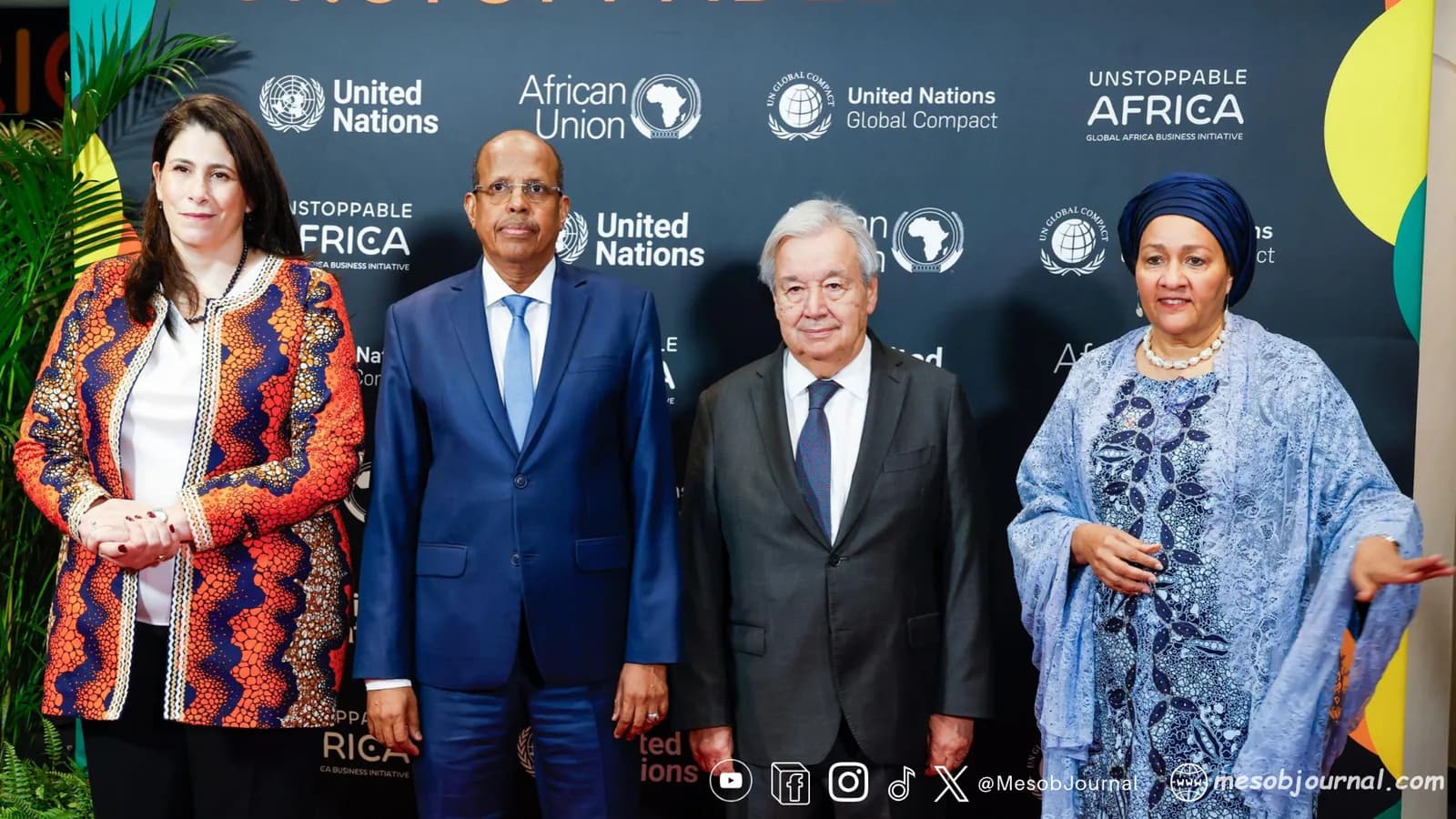
The African Union and United Nations met in New York on September 21 to discuss peace, security and preventive diplomacy across Africa.
Their published agenda ranged widely.
The Sahel. Libya. Sudan. South Sudan. Somalia. The Democratic Republic of the Congo.
They discussed mediation, conflict prevention, food insecurity, disruptions to global supply chains and even maritime chokepoints.
But one of Africa’s most consequential current crises was missing from the AU’s readout.
Ethiopia.
That absence deserves scrutiny.
Ethiopia is simultaneously confronting armed conflicts in Amhara and Oromia, renewed instability involving federal and Tigrayan forces, deep uncertainty surrounding the AU-brokered Pretoria agreement, and the emergence of a seven-group armed opposition alliance whose declared objective is to remove Prime Minister Abiy Ahmed’s government.
At the same time, senior Ethiopian officials, military figures and state media continue to destabilize the region and promote demands for “sovereign access” to the Red Sea, repeatedly framing the issue through sovereignty, national survival and historical entitlement.
Yet Ethiopia was not among the situations publicly identified when AU Commission Chairperson Mahmoud Ali Youssouf and UN Secretary-General António Guterres reviewed Africa’s peace and security challenges at UNGA81.
That omission is difficult to reconcile with the meeting’s stated emphasis on preventive diplomacy.
Prevention — except where?
The AU’s September 21 readout says the meeting sought to strengthen Africa’s peace and security architecture, reinforce preventive diplomacy and mediation, and advance African-led responses to African challenges.
It then identifies the situations discussed: the Sahel, Libya, Sudan, South Sudan, Somalia and the DRC.
Ethiopia appears nowhere in the published account.
That would be less remarkable if Ethiopia were experiencing an isolated political dispute.
It is not.
During Ethiopia’s June 2026 elections, voting could not take place in Tigray, while insecurity disrupted polling in parts of Amhara and Oromia. Reuters reported that Fano forces remained active across Amhara and that the Oromo Liberation Army continued fighting federal forces in Oromia.
Northern Ethiopia is unstable again as well.
Reuters reported on September 21 that renewed fighting and drone strikes involving Tigrayan forces had followed months of mounting tension, with the 2022 Pretoria agreement increasingly under strain.
That agreement was brokered under the African Union.
The AU itself acknowledged the danger months ago. On January 30, Commission Chairperson Mahmoud Ali Youssouf said developments in Tigray threatened the “hard-won gains” of the Pretoria Cessation of Hostilities Agreement and called for restraint and renewed dialogue.
The institution therefore cannot credibly claim that Ethiopia’s instability is unknown to it.
It has already warned about it.
Yet Ethiopia disappeared from the public crisis list when the AU and UN met in New York to discuss prevention.
Then came the alliance
The timing makes the omission even more striking.
On September 20, seven Ethiopian armed groups announced the creation of the Ethiopian Peoples’ Forces Alliance for Survival, a coalition whose declared objective is to remove Abiy Ahmed’s government and establish a transitional administration.
The alliance includes the Tigray People’s Liberation Front, the Amhara Fano National Movement and forces from Oromia, Afar and Benishangul-Gumuz. Reuters noted that some of these groups were formerly on opposing sides of Ethiopia’s wars and continue to have significant political and territorial differences.
AP reported that the coalition also includes the Oromo Liberation Army and that representatives have spoken of political action and potentially coordinated military action against the federal government.
Former battlefield enemies are now attempting to construct a common front against the federal government.
That alone is a significant warning about the direction of Ethiopian politics.
And it happened essentially on the eve of an AU–UN meeting dedicated to conflict prevention.
Still, Ethiopia was not publicly named.
Ethiopia’s crisis increasingly reaches beyond its borders
There is another reason the omission matters.
Ethiopia’s instability is no longer only an internal issue.
For several years, the government and senior Ethiopian officials have steadily elevated the question of Red Sea access from an economic objective into the language of sovereignty, national survival and historical right.
On June 13, Kenea Yadeta, security adviser to Prime Minister Abiy Ahmed with the rank of state minister, told the Ethiopian News Agency that sea access was “fundamentally an issue of sovereignty.” He said Ethiopia had historical and legal justification to pursue sovereign access to the sea.
Three months earlier, General Yimer Mekonnen described Ethiopia’s pursuit of Red Sea access as a question of sovereignty, survival and national interest. He called maritime access a historical and natural right.
The rhetoric has not faded.
On September 5, Education Minister Berhanu Nega told ENA that Ethiopia’s quest for sovereign sea access was inseparable from the country’s long-term survival.
On September 20 — one day before the AU–UN meeting — ENA again published the argument that Red Sea access was an “unavoidable national imperative,” tying the issue to Ethiopia’s demographic growth, economic ambitions and historical relationship with the sea.
And on September 21 itself, while AU and UN leaders were discussing African peace and security in New York, another ENA report described sea access as imperative to Ethiopia’s national security and regional position.
This is not an occasional remark.
It has become a sustained national campaign.
Assab has repeatedly entered that campaign
The rhetoric has also repeatedly touched Eritrea and Assab.
At a special-forces event in February attended by Abiy Ahmed and senior military figures, a stadium display depicted Ethiopia pushing toward the Red Sea and a vessel associated with Assab.
AP reported that the display intensified fears of confrontation with Eritrea and reflected the growing centrality of Assab in Ethiopia’s maritime discourse.
That symbolism did not appear in isolation.
It followed years of public statements, television discussions, military commentary and state-media coverage presenting Ethiopia’s landlocked status not simply as an economic disadvantage but as an historical wrong requiring correction.
The significance for the AU should be obvious.
Eritrea is a sovereign AU member state.
Assab is Eritrean territory.
Ethiopia’s need for efficient trade corridors does not create sovereignty over another member state’s coastline.
Yet the government hosting the African Union has allowed the Red Sea question to develop into a sustained national political campaign in which sovereign access, historical rights and national survival are repeatedly invoked.
That should concern any institution genuinely interested in conflict prevention.
The Red Sea contradiction
The silence becomes still harder to explain when the AU’s own UNGA81 agenda is examined.
The September 21 AU–UN meeting explicitly discussed disruptions affecting maritime chokepoints.
A separate AU–EU–UN meeting that same day went further.
According to the African Union, the trilateral discussion gave “particular attention” to the Horn of Africa, the Red Sea and maritime security, including preventing further escalation of conflicts and strengthening regional dialogue and mediation.
So the AU was discussing the Horn.
It was discussing the Red Sea.
It was discussing maritime security.
It was discussing conflict prevention.
It was discussing Sudan and Somalia.
Yet its published readouts did not mention the country at the geographical centre of the Horn whose senior political and military establishment has spent years turning access to that same Red Sea into an issue of sovereignty and national survival.
That is not a minor gap.
It goes directly to the credibility of the preventive diplomacy being discussed.
The Addis Ababa question cannot be ignored
There is also a longer institutional history behind this silence.
The African Union is headquartered in Addis Ababa.
The questions about whether Ethiopia’s position as host constrains the AU are not new.
During the Tigray war, Chatham House examined precisely this problem.
Its 2023 study concluded that Ethiopia’s position as host of the AU headquarters, combined with its regional influence, made it difficult for both the AU and IGAD initially to adopt an assertive role in responding to the conflict.
The AU cannot build credibility as Africa’s principal peace and security institution if its most difficult blind spot repeatedly appears to be the country surrounding its own headquarters.
African-led solutions cannot mean intensive scrutiny of crises in Khartoum, Mogadishu, Tripoli and Kinshasa while Addis Ababa receives a different level of public attention.
The issue is not whether Ethiopia should be singled out.
It is whether it should be treated like every other major African state facing serious internal and regional security risks.
Ethiopia is more than its government
There is another reason this matters.
When institutions hesitate to confront instability in Ethiopia, the country can become reduced to diplomatic calculations about Addis Ababa, the federal government and the African Union headquarters.
But Ethiopia is not simply its government.
People in Amhara are living through an armed confrontation between federal forces and Fano.
People in parts of Oromia continue to live amid fighting between government forces and the OLA.
People in Tigray, barely four years removed from a devastating war, are again watching political agreements fracture, armed forces reposition and confrontations return.
The scale of insecurity was visible even in Ethiopia’s June election.
Tigray did not vote. Security conditions prevented polling at numerous locations in Amhara and Oromia.
Those realities exist independently of whichever political side claims to represent them.
Amhara civilians are not Fano.
Tigrayans are not the TPLF.
Oromo civilians are not the OLA.
And Ethiopia is not synonymous with the government in Addis Ababa.
The experiences and political concerns of people in these regions should not disappear simply because Ethiopia hosts the African Union.
The omission is the story
Ethiopia’s absence from the AU–UN crisis list is difficult to dismiss as a minor oversight.
The country hosts the African Union while facing overlapping internal conflicts, renewed instability in Tigray, an emerging armed opposition alliance, and an increasingly confrontational Red Sea discourse.
Yet when the AU and UN publicly mapped the crises demanding attention, Ethiopia was left out.
That matters because the question is no longer only whether the AU sees the danger. It clearly does. The deeper issue is whether an institution headquartered in Addis Ababa can apply the same scrutiny to its host government that it applies elsewhere.
If proximity to the Ethiopian state continues to produce caution where public accountability is needed, then the problem is institutional, not procedural.
The AU was created to serve the continent, not to shield the government outside its gates.
And when Ethiopia repeatedly disappears from the agenda while the consequences of its crises spread across the Horn, that silence becomes part of the story.