
An assessment Mesob Journal made in January 2025 has found an echo in a publication of U.S. Africa Command. The timing reveals how Eritrea’s political continuity and Red Sea position are entering a changing regional security debate.
Eritrea's stability was sustained through decades of regional upheaval, sanctions and pressure on its sovereignty. The appearance of that reality in an American military publication tells us something about changing strategic calculations around the Red Sea.
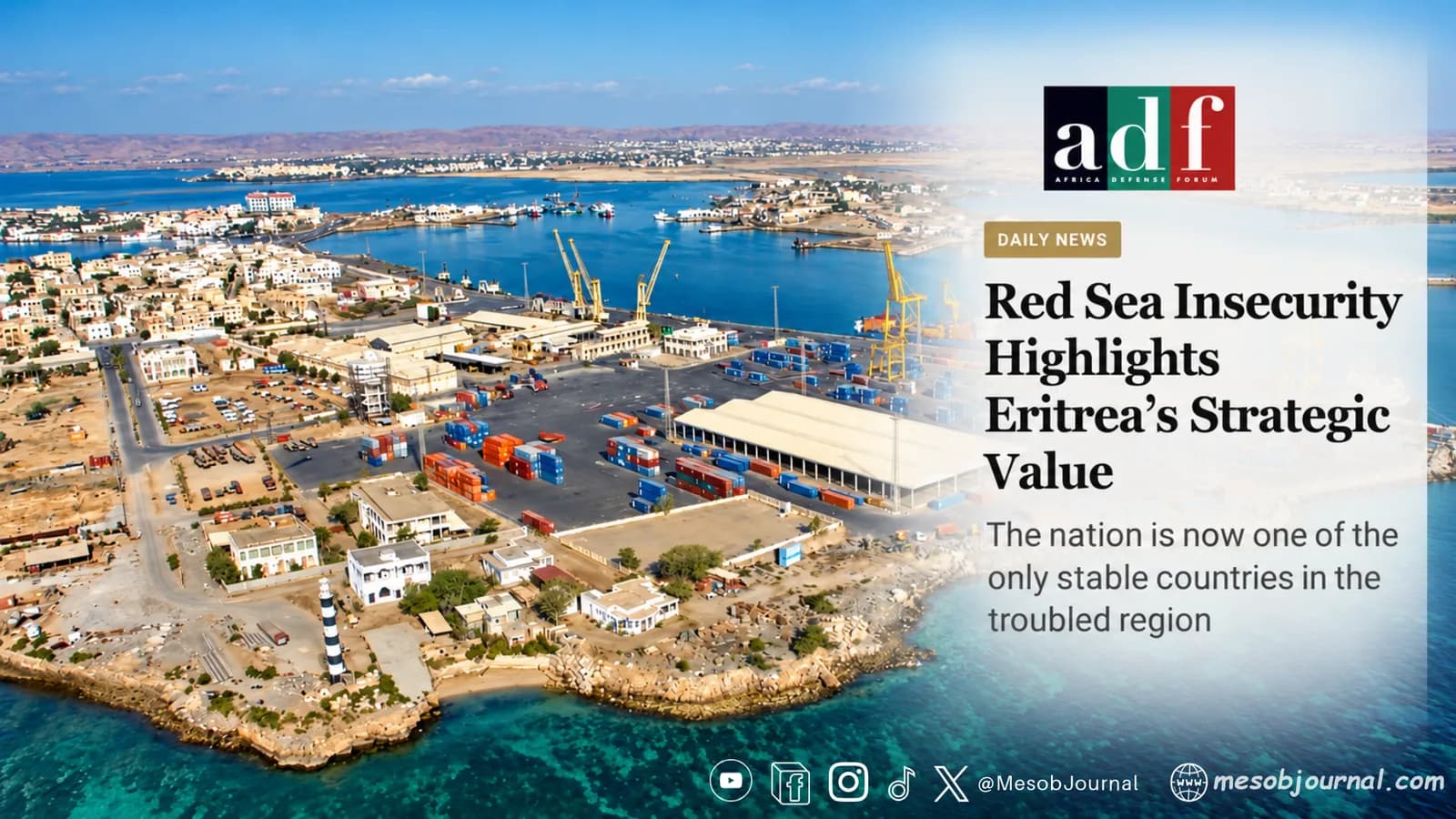
On 27 October 2026, Africa Defense Forum (ADF), a professional military magazine published by U.S. Africa Command, described Eritrea in the subtitle of its report on the country's strategic value as:
The nation is now one of the only stable countries in the troubled region.
The observation was striking because of where it appeared. On 9 January 2025, Mesob Journal published Eritrea: A Beacon of Resilience in the Horn of Africa, arguing that Eritrea's resilience and sovereignty had survived the pressures and predictions directed against them.
Nearly twenty-two months later, Eritrea's continuity is receiving attention in a security publication connected to the same American establishment whose policies Asmara has long challenged.
The significance should be understood precisely. ADF's article is not a formal statement of AFRICOM policy, and its contents include the regular diatribes against Eritrea's political system—politically motivated propaganda—alongside disputed accounts of regional tensions.
The revealing development is the recognition of a strategic capability that years of restrictive engagement failed to erase. Eritrea retained the authority to govern its territory and make its own security decisions. The deteriorating regional environment has increased the practical importance of that record.
Stability Preserved Under Pressure
For much of the past three decades, dominant Western narratives have reduced Eritrea to governance, national service, migration and confrontation with Ethiopia, while marginalizing sanctions, diplomatic isolation, Western backing for the TPLF-led government in Addis Ababa, and the failure to enforce the final and binding 2002 border ruling. This amounted to a policy of containment: Ethiopia functioned as a regional proxy for weakening Eritrea's independent course, while a binding legal settlement went unenforced.
That history is essential to any serious assessment of Eritrean resilience. A country required to defend its territorial integrity while facing sanctions and sustained diplomatic pressure operates under constraints that cannot be understood through descriptions of its domestic system alone.
The prolonged border stalemate also carried a strategic lesson: international recognition of a legal right provides little protection when implementation can be indefinitely deferred. From Asmara's perspective, preserving national defence capacity and independent decision-making became necessities shaped by experience.
Across the region, the consequences of fractured state authority are visible. Sudan's civil war, Somalia's struggle to consolidate security and Ethiopia's successive internal conflicts have placed populations and national institutions under immense strain.
Eritrea has faced military confrontation, economic restrictions and instability along its borders. Its involvement in the 2020–2022 conflict in northern Ethiopia must be assessed within that regional security history, including its longstanding confrontation with the TPLF and the TPLF's November 2020 attack on Asmara. That history is central to understanding Eritrea's security calculations.
Through these pressures, Eritrea's state administration remained intact, its coastline remained under national authority, and its territory did not fragment among competing governments and armed administrations.
This is a strategic achievement grounded in the preservation of national cohesion, defence capacity and sovereign choice. Any account that acknowledges the outcome while omitting the pressures endured offers an incomplete explanation of how that stability was maintained.
Eritrea's Red Sea Position Begins With Sovereignty
The Red Sea crisis has increased international attention to Eritrea's coast, ports and islands. For Eritrea, these are integral parts of national territory and the country's economic future. Their importance extends well beyond the access requirements of foreign navies or the immediate concerns of global shipping.
The Bab el-Mandeb links the Red Sea with the Gulf of Aden. Insecurity along this corridor affects commerce, coastal communities and the security calculations of every state bordering the waterway.
Eritrea's approach begins with the responsibility of those states to secure their own territory and cooperate with one another. It places national capability and regional ownership at the foundation of maritime security.
That position was publicly articulated in Eritrea's September 2019 Red Sea security proposal. Its framework called for national defence and naval capabilities, collective action where individual resources were insufficient, and cooperation with external powers through agreed arrangements grounded in sovereignty and international law.
National responsibility establishes the basis for regional cooperation; outside assistance serves missions agreed by the states concerned. This gives coastal governments an active role in defining security priorities and the terms of external participation.
In July 2026, Mesob Journal examined this argument in The Red Sea Is Catching Up With Eritrea.
The practical lesson remains clear. Naval deployments may protect vessels during an emergency, but lasting security also requires functioning coastal states, stable political relationships and respect for territorial authority. Arrangements that weaken local sovereignty can undermine the very stability maritime operations depend upon.
Eritrea enters this discussion with an established position and interests of its own. Engagement should take that contribution seriously.
Diplomatic Openings on Eritrea's Own Terms
Recent diplomacy provides a useful test of whether outside governments are prepared to engage Eritrea through mutual interests and respect for its independence.
On 19 July, Cairo hosted discussions involving Eritrea, Egypt, Somalia and U.S. presidential adviser Massad Boulos. The meetings placed regional peace and security within a wider diplomatic agenda. Dialogue with Washington can advance Eritrean interests through trade, economic cooperation and the reduction of regional tensions while preserving Asmara's freedom of decision.
On 18 September, the U.S. Treasury announced the expiry of the national emergency underpinning its Ethiopia-related sanctions program. The resulting removals included the Eritrean Defense Forces, the People's Front for Democracy and Justice, Hidri Trust, Red Sea Trading Corporation and designated Eritrean officials.
The change removed a specific sanctions framework; other American restrictions must be considered separately. For Eritrea, its significance lies in the removal of an instrument of external pressure and the possibilities this creates for engagement. Sanctions relief cannot retrospectively erase the consequences of the policy that preceded it.
On 4 October, the leaders of Eritrea, Egypt, Sudan and Somalia adopted the El Alamein Joint Declaration, reaffirming sovereignty, territorial integrity and freedom of navigation. Its statement that Red Sea governance is the exclusive responsibility of littoral states gave explicit regional expression to a principle Eritrea has advanced for years.
These developments create diplomatic opportunities. Their value for Eritrea depends on whether they produce practical cooperation that respects its borders, national institutions and independent foreign policy.
A comprehensive change in American policy would have to be demonstrated through consistent conduct. The relevant measures include respect for Eritrean sovereignty, the handling of regional security threats and an end to approaches that treat pressure on Asmara as a substitute for engagement.
Eritrea's task is to assess each opening through its own national interests and its contribution to regional stability.
Port Access Cannot Override Territorial Integrity
Eritrea's domestic stability does not insulate it from threats originating beyond its borders. The current confrontation with Ethiopia must therefore be examined through the distinction between commercial access and sovereign control.
Port services, transit arrangements and economic cooperation can be negotiated between states. Another country's demand for sovereign access to an Eritrean port raises a fundamentally different question: who exercises authority over Eritrean territory.
Eritrea's October information note on relations with Ethiopia places this distinction at the centre of its warning to the Security Council. It sets out Asmara's account of Ethiopian official rhetoric and military ambitions directed toward Eritrea's coastline and argues that the pursuit of sovereign sea access threatens its territorial integrity.
The strategic issue also cannot be reduced to a symmetrical disagreement over maritime access. Eritrea is defending sovereignty over an existing coastline. Any proposal concerning that coastline must begin with its consent and respect for its borders.
For Asmara, the earlier failure to secure implementation of the binding border settlement gives current appeals to international law particular urgency. A repetition of prolonged diplomatic concern without effective protection of territorial integrity would deepen the insecurity the region is trying to contain.
International partners should therefore address threats to borders directly. Recasting Eritrea's defence of its territory as an obstacle to somebody else's economic ambitions would reward coercion and weaken the basis of regional cooperation.
The stability now being acknowledged should be protected through respect for sovereignty, peaceful relations and security arrangements that coastal states themselves help shape.
Recognition Must Be Judged Against Conduct
The value of the ADF report for this debate is limited but revealing. A security publication connected to Washington is drawing attention to a capability Eritrea sustained while relations with the United States remained strained.
That observation exposes the weakness of evaluating an African state primarily through its alignment with outside powers. Eritrea's ability to retain national authority and pursue its own regional policy deserves assessment on the record of its performance.
The political framing carried alongside ADF's stability assessment does not settle the meaning of that record. Mesob Journal's analysis starts with Eritrean sovereignty, the pressures placed upon it and the country's capacity to withstand them.
For Eritrea, meaningful engagement would be reflected in respect for existing borders, cooperation based on consent and a willingness to treat its security concerns with the same seriousness accorded to those of more favored partners.
Its coastline, ports and regional relationships are national assets over which Eritreans retain the right of decision. Their strategic importance creates opportunities for cooperation on terms that preserve that authority.
The Record Precedes the Recognition
Mesob Journal's January 2025 assessment argued that Eritrea's resilience should be understood through its own history and the upheavals surrounding it. The October 2026 publication supplies an additional reference point within the American security debate.
The larger conclusion concerns the endurance of sovereign capacity. Eritrea maintained state continuity under pressure, preserved authority over its coastline and advanced a regional security approach grounded in the responsibility of littoral states.
Future relations with Washington and other partners should be judged by whether they reinforce peace, respect Eritrea's territorial integrity and permit cooperation among states acting in their own right. A magazine's assessment can illuminate a changing calculation; the conduct of governments will determine its practical consequences.
Eritrea did not need the Red Sea crisis to make it strategically important.
The crisis has made that importance more difficult to ignore.