
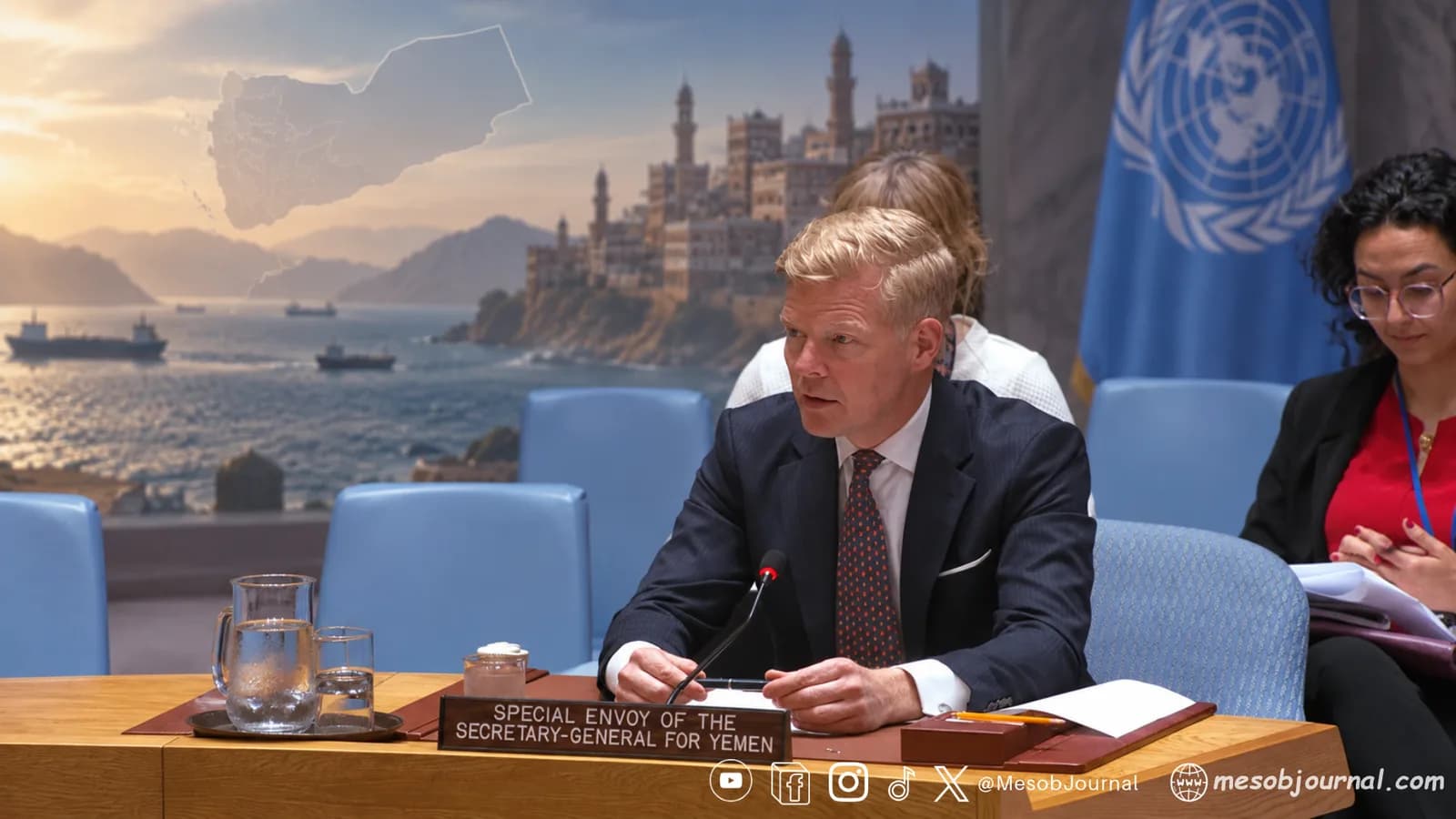
The UN envoy’s new direct channel with Ansar Allah, combined with talks in Riyadh, reflects several principles Eritrea set out weeks earlier: Yemen cannot be settled militarily, the conflict should not be absorbed into wider regional wars, and the security of the Red Sea requires serious engagement with the states and actors that actually sit along it.
When Eritrean Foreign Minister Osman Saleh said earlier this month that there was “no military option in Yemen,” the statement was more than a general appeal for peace.
It was a description of how Eritrea believes the crisis across the Red Sea should be handled: through political engagement rather than another widening military campaign, with Yemen given space to reach its own settlement and the states bordering the Red Sea taking responsibility for keeping one of the world’s most important waterways open.
Less than three weeks later, the diplomacy surrounding Yemen is moving noticeably in that direction.
UN Special Envoy for Yemen Hans Grundberg disclosed on September 29 that he had met Ansar Allah’s chief negotiator Mohammed Abdul-Salam in Muscat over the weekend in an effort to prevent the latest escalation from going further. Grundberg then held consultations in Riyadh with Yemen’s internationally recognized government and regional actors, including Saudi Arabia.
The meetings followed the sharp deterioration on Yemen’s western coast, where Ansar Allah forces advanced into Mokha and expanded their presence near the approaches to Bab el-Mandeb. Grundberg told the UN Security Council earlier in September that the west-coast offensive had placed Ansar Allah directly near the strategic strait linking the Red Sea and Gulf of Aden.
For Eritrea, this is not a remote conflict.
Asmara sits directly across the Red Sea from Yemen, and Eritrea’s southern coastline and the approaches to Assab form part of the same maritime geography surrounding Bab el-Mandeb. Events on Yemen’s western shore therefore have immediate implications for shipping, regional security and the balance of power in waters adjoining Eritrea. Mesob Journal highlighted that concern when the Houthi advance into Mokha brought renewed attention to the corridor linking Yemen, Assab and the wider Red Sea.
That geographic reality helps explain the unusually direct language used by Saleh in his September interview.
“There is no military option in Yemen,” the Eritrean foreign minister said, adding that the country must be given the opportunity to become peaceful. Saleh also said Eritrea carries a responsibility to help safeguard the Red Sea as a safe passage and argued that littoral states should discuss how free navigation is to be protected. The Mesob Journal
The latest UN initiative does not amount to an endorsement of Eritrea’s policy, nor has the United Nations adopted an Eritrean framework for the Red Sea. But the overlap between the two approaches is difficult to miss.
Grundberg is now talking directly to the Houthi negotiating leadership rather than treating military pressure alone as the path out of the crisis. He is simultaneously engaging the internationally recognized Yemeni government and Saudi Arabia. His stated objective is to prevent the escalation from widening and preserve a route back to negotiations. AP News
That is close to the practical logic behind Saleh’s warning.
Engagement with Ansar Allah does not require approval of its actions. The group’s attacks on commercial shipping, its latest military offensive and its attacks against Saudi Arabia have generated serious regional and international concern. The UN itself has repeatedly called for restraint and protection of civilians. What direct engagement acknowledges is something more basic: a political settlement cannot be constructed while excluding an armed actor controlling substantial territory and capable of affecting one of the world’s most sensitive maritime corridors.
Grundberg had already signalled that approach on September 7, when he said he would continue engaging directly with the Yemeni parties to contain the fighting and preserve space for dialogue. He also urged regional and international actors to use their influence in support of a return to negotiations. United Nations Security Council
The Muscat meeting shows that this was not simply diplomatic language.
Separating Yemen from the region’s wider wars
Perhaps the most important point of convergence came in Grundberg’s comments about the growing entanglement of Yemen with other Middle Eastern conflicts.
The envoy told AP that Yemen increasingly risks being absorbed into a broader regional confrontation. His recommendation was to disentangle the conflicts and address Yemen through negotiations, allowing a settlement to be defined by Yemenis themselves.
The more Yemen becomes an extension of confrontation involving Iran, Saudi Arabia, the United States, Israel and other powers, the harder it becomes for Yemeni political calculations to determine the course of the war. Every escalation elsewhere creates another incentive for Yemeni territory, missiles, ports and coastlines to be used as instruments in a conflict whose centre of gravity lies outside Yemen.
Eritrea’s approach has consistently emphasized the opposite principle: regional states should retain agency over their own security environment rather than allowing local disputes and strategic waterways to become permanent arenas for outside rivalry.
That position has also appeared in Eritrea’s wider Red Sea diplomacy.
During talks in Cairo in July, Eritrea and Egypt stated that the security and governance of the Red Sea should remain the responsibility of the states bordering it, while rejecting security arrangements imposed by non-littoral actors in violation of international law.
That should not be confused with an argument for excluding international trade partners or preventing outside navies from protecting lawful interests. The Red Sea is an international commercial artery. What the Eritrean position emphasizes is the difference between international use of a waterway and external political control over its regional security architecture.
The current Yemen crisis illustrates why that distinction has practical consequences.
Bab el-Mandeb cannot be secured permanently through naval deployments alone if the Yemeni coast beside it remains at war. Nor can stability be created by treating maritime attacks separately from the political collapse and competing authorities on land.
Grundberg himself now describes the Red Sea coast as containing some of Yemen’s most sensitive front lines because of their proximity to maritime corridors essential to global commerce. He warned that attacks on commercial shipping should concern the Security Council.
The military and maritime questions have therefore become inseparable.
Eritrea’s geography gives it a different perspective
Eritrea often views Red Sea security differently from powers observing the region from farther away.
For major external states, Bab el-Mandeb is primarily a strategic chokepoint: a corridor through which commercial vessels, energy supplies and naval forces must pass.
For Eritrea, Yemen, Djibouti, Saudi Arabia, Egypt and Sudan, it is also their immediate neighbourhood.
Fishing waters, ports, islands, migration, smuggling, naval deployments, trade and armed conflict all interact inside the same narrow maritime space. A security formula designed mainly around protecting passing shipping can therefore address only part of the problem.
Saleh’s formulation places the littoral states at the centre not because global commerce is irrelevant, but because sustainable maritime security ultimately depends on political stability on both shores.
That is particularly evident at Bab el-Mandeb.
A ship may cross the strait in hours. Eritrea and Yemen remain there after it has passed.
A diplomatic opening, not yet a settlement
The new UN channel should not be overstated. Yemen remains deeply divided, the battlefield has changed rapidly, and Grundberg himself described the present escalation as unusually severe. Hundreds have been reported killed in the latest fighting, while large numbers of civilians have been displaced.
There is also no indication yet that the Muscat consultations have produced an agreement.
But diplomacy often begins before an agreement is visible.
The significance of the latest meetings lies in the method being used: talk to the actors capable of escalating the war, keep channels open across competing camps, prevent Yemen from being swallowed by wider regional confrontation and preserve negotiations as an alternative to an expanding battlefield.
Those principles closely resemble the position Eritrea articulated before the current diplomatic push intensified.
Asmara’s argument has not been that Eritrea alone possesses the answer to Yemen. Its position, as expressed by Saleh, is narrower and more practical: military force will not produce a durable Yemeni settlement, Yemen must ultimately find a political path of its own, and the countries sharing the Red Sea cannot avoid responsibility for the security of the waterway between them.
The events of the past several weeks have made those questions harder to ignore.
With fighting now concentrated close to Bab el-Mandeb, commercial shipping exposed to renewed risk and regional powers again being drawn toward confrontation, the debate is no longer simply about who controls another Yemeni city.
It is about what kind of security order can prevent the southern Red Sea from becoming a permanent military front.
The UN envoy’s turn toward Muscat, Riyadh and direct negotiations does not settle that debate. It does, however, place diplomacy, Yemeni ownership and regional de-escalation at the centre of the response.
Those are precisely the areas Eritrea has been emphasizing.