
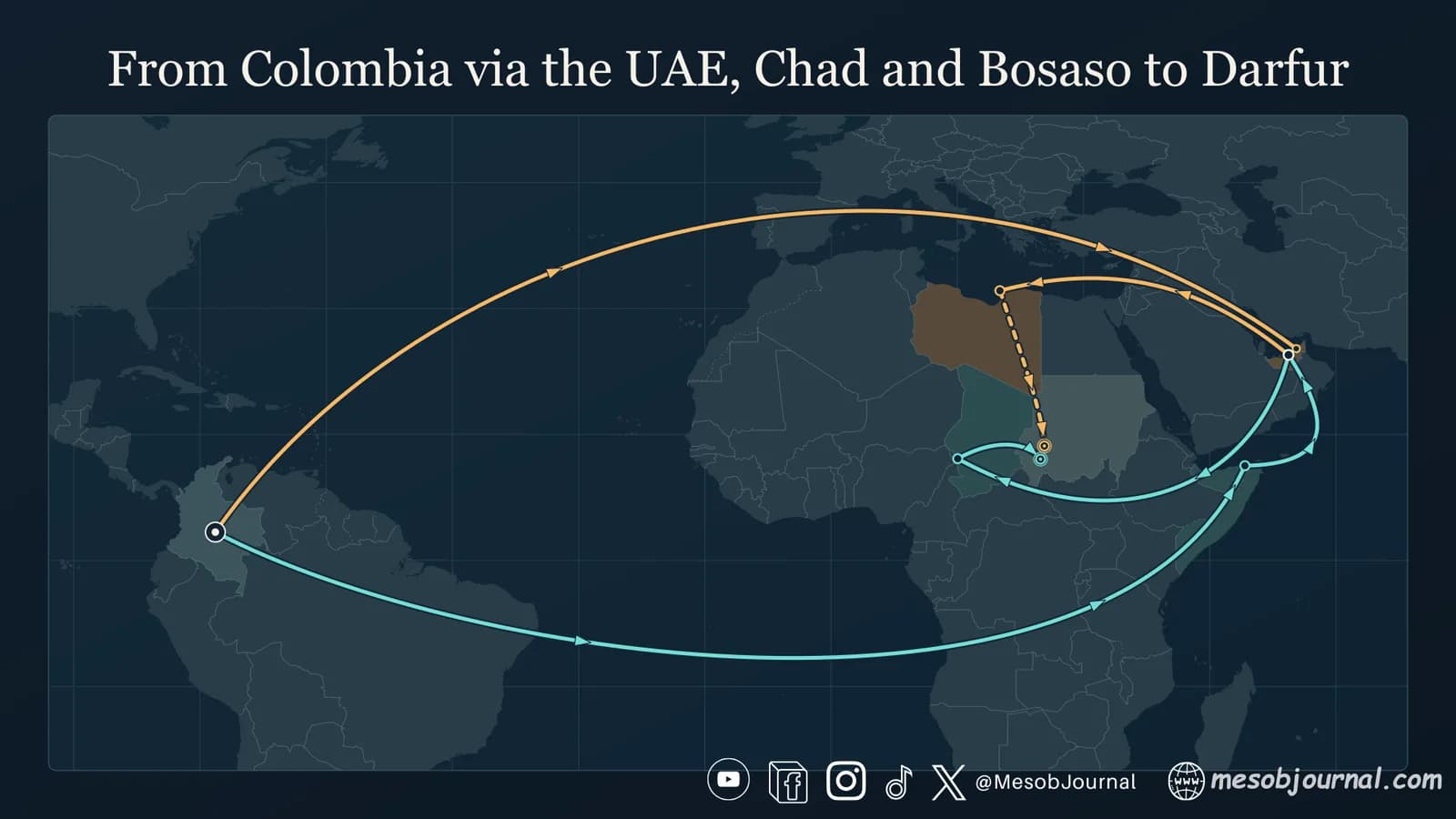
An Abu Dhabi security company that publicly identifies itself as a supplier to the UAE government hired Colombian mercenaries for Sudan’s Rapid Support Forces, according to publicly circulated excerpts from a confidential UN investigation.
The excerpt says the investigation “establishes conclusively” the recruitment role of Global Security Services Group, or GSSG. It also identifies the UAE-linked Puntland Maritime Police Force base in Bosaso, Somalia, as a site of “transit and/or training” before deployment to Sudan.
Mesob Journal reviewed the excerpts published by Dino Mahtani on 3 November. The complete confidential report and its annexes have not been obtained. The account below tests those passages against published UN findings, sanctions records, company statements and earlier documentary investigations.
Taken together, those records expose a supply system with identifiable recruiters, payment intermediaries and armed facilitators. They also make the UAE’s blanket denials increasingly difficult to reconcile with the documented activities of a company inside its security industry.
A company with access to the state
GSSG’s own description is explicit: it provides private security services for the UAE government. Its website says it recruits, trains and deploys international security personnel who have been vetted by government. That statement does not establish approval for a particular Sudan deployment, but it makes official oversight a central question.
The ownership history adds a political connection. In November 2025, The Sentry reported that corporate records showed GSSG had been established in 2016 by Ahmed Mohamed Al Humairi, whom it identified as the longstanding secretary general of the UAE Presidential Court. He transferred all its shares in 2017 to his business associate Mohamed Hamdan Alzaabi, identified in the investigation as the sole owner.
The Sentry also documented shared interests between the two men in other security businesses. It said neither responded to its requests for comment. Those connections establish proximity to senior state power; they do not establish that Al Humairi ordered the Sudan operation.
The accountability question is concrete: what did the authorities licensing, contracting with and overseeing this company know about its recruitment and overseas deployments? The answer requires contracts, authorisations and payment records from the institutions positioned to hold them.
The recruiters and the money
The recruitment chain was already sufficiently documented for the United States to impose sanctions in December 2025. The Treasury identified retired Colombian officer Alvaro Andres Quijano Becerra, based in the UAE, as a central organiser. It described International Services Agency, known as A4SI, as a principal recruiting operation in Bogotá, co-founded by Quijano and owned and managed by his wife, Claudia Viviana Oliveros Forero.
A Panamanian intermediary, Global Staffing, subsequently renamed Talent Bridge, signed contracts and received money on A4SI’s behalf. Treasury said the arrangement reduced A4SI’s legal exposure and concealed its connection to the hiring company, which that sanctions notice did not name.
The UN sanctions record identifies another part of the machinery: Maine Global Corp, managed by Mateo Andres Duque Botero, handled funds, payroll and currency conversion. It describes transfers totalling millions of dollars during 2024 and 2025 involving associated US firms, Maine Global, Global Staffing and the hiring company.
Human Rights Watch supplied a crucial documentary connection to GSSG. It reported reviewing authorisations signed by 26 contractors in Benghazi on 24 August 2024 allowing GSSG to transfer their salaries through Global Staffing.
The corporate vehicles also changed. Treasury’s April 2026 sanctions notice said Quijano and Oliveros had established Fénix Human Resources in February 2025 as a replacement for A4SI. That change preceded the December sanctions.
By 28 April 2026, the UN had also listed Oliveros and Duque under its Sudan sanctions regime. The committee’s account of Oliveros’s role describes recruitment for drone operators, snipers and translators. The jobs being filled were integral to a fighting force.
Bosaso: the base behind the transit route
The Bosaso finding puts a military facility in Somalia inside this recruitment story. Human Rights Watch describes the PMPF as financed, trained and supervised by the UAE and reporting directly to Puntland’s president.
Its investigators geolocated a Colombian contractor’s March 2025 videos to a newly developed area of the PMPF base west of Bosaso airport. His account traced a subsequent journey to Abu Dhabi, training at Ghayathi, and travel through N’Djamena to Nyala in Darfur.
In a November 2025 statement reported by Mustaqbal Media, Puntland denied involvement in Sudan’s war and denied that Bosaso flights were connected to the conflict.
The facility’s commanders and political overseers should now account for access to the compound, accommodation, training arrangements and onward travel. Each of those activities leaves records that can establish who authorised it and who paid.
Haftar’s forces and the Libyan corridor
The published UN Libya Panel report, S/2026/224, goes further than identifying transit locations. Paragraph 38 states that Colombian fighters passed through Libya to support the RSF with assistance from the Libyan Arab Armed Forces, or LAAF, through Subul al-Salam.
The report names Subul al-Salam’s leader, Abdulrahman Hashim Al-Kilani, and describes the battalion’s growing control over supply chains carrying fighters, weapons and fuel. It identifies an RSF rear base under LAAF auspices near Kufrah, access to Maateen al-Sarrah airbase, and facilities near Kufrah airbase from which Colombian fighters and militarised vehicles moved toward Sudan.
The same report describes Saddam Haftar’s tightening supervision of strategic routes and installations, while acknowledging Subul al-Salam’s operational autonomy. The evidence points to armed actors managing a supply corridor, with responsibilities that can be investigated at the level of particular units and commanders.
Human Rights Watch said it sought responses from Puntland and Khalifa Haftar in March 2026 and had received none by 19 May.
Other transit territory requires equally precise treatment. The UN fact-finding mission found private actors and transnational networks using Chad for RSF logistics; it also recorded Chad’s denial of military support. Passage through a country does not, by itself, establish that its government directed the movement.
Abu Dhabi’s denial—and the missing records
The leaked correspondence records the UAE’s defence. In July 2026 it rejected wrongdoing and said investigations had cleared GSSG of mercenary activity. In its 19 August reply, it said the company provided protective security, undertook no military training or operations, and held no Sudan security contracts.
The Panel’s response is consequential: the August letter supplied neither documentation of the UAE investigation nor an explanation for its absence.
That omission leaves the asserted exoneration unavailable for scrutiny. An investigation capable of resolving the contradiction would need to examine the recruitment agreements, salary authorisations, movements through military facilities and the identity of the ultimate customer. A licence to provide security does not explain those transactions.
The publicly available evidence does not identify orders by named Emirati officials authorising particular deployments, or establish who controlled specific battlefield operations. It does establish specific grounds for investigating the company’s state relationships and the authorities responsible for overseeing its activities.
The destination was El Fasher
The UN fact-finding mission’s September 2026 report records accounts placing Colombian contractors around El Fasher before, during and after its capture. It records accounts of their operation of artillery, drones and other technical equipment during the offensive. These were capabilities that strengthened the RSF’s ability to wage war.
The human consequences are documented separately. OHCHR recorded more than 6,000 killings between 25 and 27 October 2025, including civilians and people no longer taking part in hostilities. Its findings describe mass executions, sexual violence and attacks on people attempting to escape.
A separate UN fact-finding report found hallmarks of genocide in El Fasher and evidence of RSF intent to destroy Zaghawa and Fur communities, in whole or in part.
These findings do not assign every killing to Colombian personnel or establish every supplier’s criminal responsibility. They establish why the recruitment and supply network demands investigation alongside the forces carrying out the violence. The relevant questions include what each participant supplied, what they knew and when they knew it.
The Security Council’s Darfur embargo covers technical training and assistance as well as weapons and related materiel. Enforcement therefore has to examine the people and services enabling military operations, alongside the movement of arms.
For Sudan, Somalia and Libya, the issue is also sovereignty: who can turn a base, an airport or a commercial contract into an instrument of another country’s war? Accountability must follow the chain from the recruiter and payroll intermediary to the commanders controlling facilities and the officials responsible for authorisation and oversight.
The UAE can make its claimed investigation available for scrutiny. GSSG can disclose the contracts and payments behind its overseas recruitment. Puntland’s authorities and the Libyan commanders identified by the UN can account for their facilities. Until those records are produced and tested, the documented network remains a challenge that blanket denials cannot answer.