
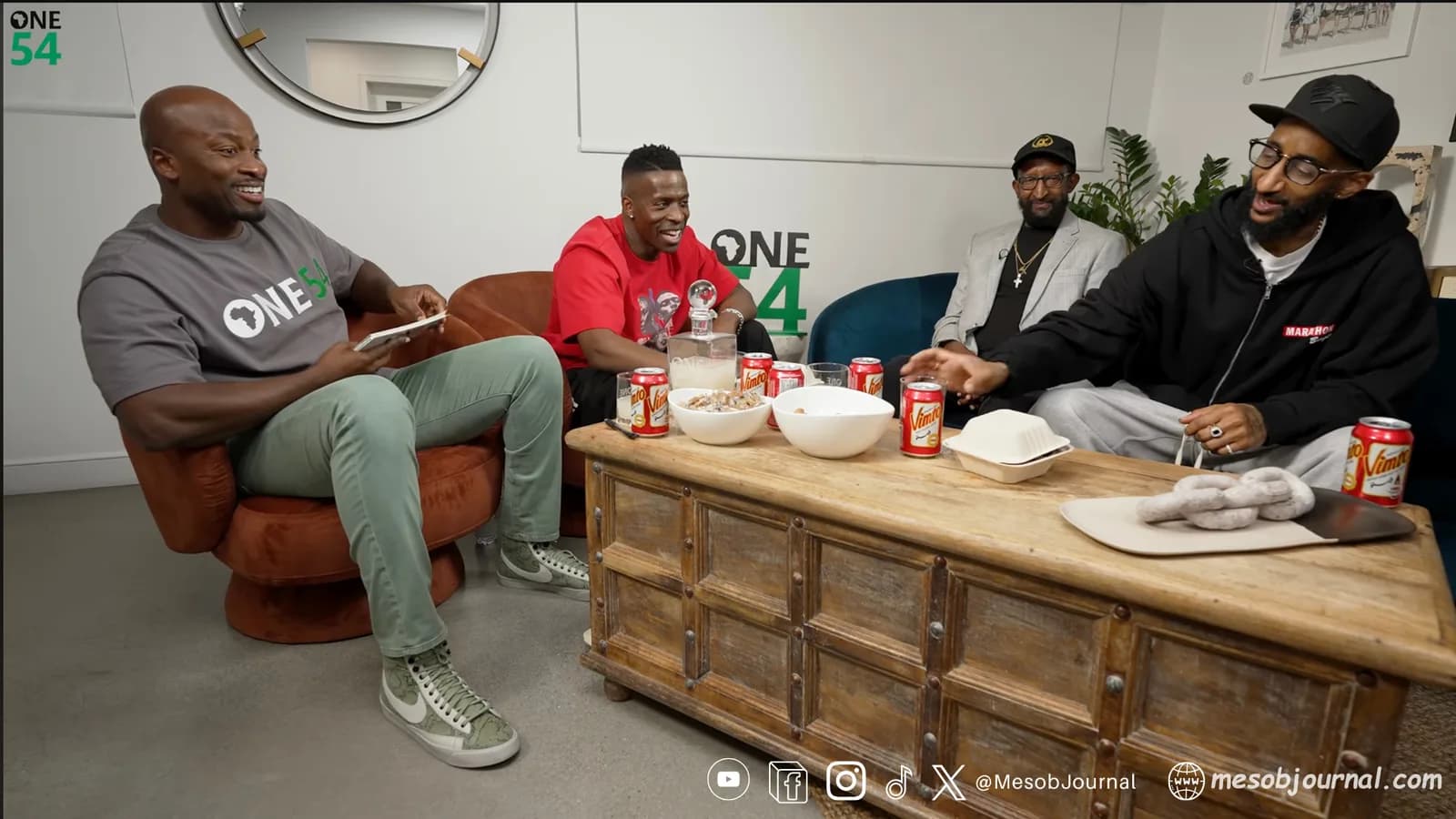
On One54 Africa, Dawit Asghedom and Blacc Sam reflect on Eritrean identity, family life and the work of carrying the Marathon forward.
One of Blacc Sam’s early memories of Eritrea is of his father showing him and his younger brother, the future Nipsey Hussle, their country on a map. Dawit Asghedom had already told them stories and shown them photographs. Now he could point to Eritrea on an updated map as an independent country.
Appearing together on One54 Africa, Dawit and Sam spoke about the Eritrean community that helped shape the brothers, their extended stay with relatives and the responsibilities Sam now carries within the Marathon businesses.
The interview, published on November 4, is hosted by Akbar Gbajabiamila and comedian Godfrey. It brings together the family’s Eritrean history and its life in Los Angeles, where the late rapper and entrepreneur Nipsey Hussle, born Ermias Asghedom, built his career.
Keeping Eritrea close
Dawit recalled arriving in the United States at 17 with $30 in his pocket. An aunt in New York had helped him obtain a ticket after he secured admission to a business course. His account of leaving Eritrea was bound up with student protests and the dangers young people faced under Ethiopian rule.
When he became a father, he wanted his children to experience the society he had come from. He wanted them to understand that “there is another world,” he said, and to see the place family occupied in life there.
Sam described a childhood in which his African American mother and grandmother provided their home, while time with Dawit brought them into Eritrean community life. There were football tournaments, weddings and meals at restaurants. Dawit also cooked for his sons, setting a standard Sam still measures other Eritrean food against.
“My brother learned the language much better than me,” Sam recalled.
Some of the memories were cheerfully practical. The boys were initially reluctant to dance at a wedding, Dawit said, until they discovered that guests gave money to the dancers. They soon joined in.
Sam also remembered realizing how much his father spent during their outings. He began telling his younger brother not to ask for things, hoping simpler visits would make it easier to see Dawit more often.
Knowing their background helped when other children questioned where they belonged. Sam recalled defending his African identity at school and encountering questions within the Eritrean community about having an African American mother. He credited his parents with giving him the confidence to answer.
“It’s just about knowing who you are,” he said.
The country behind the family stories
For Dawit, teaching his sons about Eritrea also meant explaining the struggle to determine its own future. He spoke at length about foreign rule, the independence movement and why Eritreans insist on recognition of their country’s distinct identity.
Eritrea was federated with Ethiopia in 1952. Its armed independence struggle began in 1961, and Ethiopia dissolved the federation and annexed Eritrea in 1962. Liberation came in 1991, followed by internationally recognized independence after the 1993 referendum.
Discussing relations with Ethiopia, Dawit argued that neighbours could trade and live peacefully while respecting Eritrea’s sovereignty. He acknowledged shared cultural connections while insisting on the right to remain independent.
“We can live together, but we are independent,” he said.
Sam, too, called for respect for the different historical experiences of the two countries and for people to consider the human cost of conflict. His emphasis was on understanding those histories and finding a way to live in harmony.
For Dawit, self-reliance was part of that independence. “Let’s do it ourselves,” he said.
Living with family in Eritrea
The brothers’ extended visit gave them a much closer understanding of their father’s life. Sam recalled staying with their grandmother and aunt, adjusting to unfamiliar household routines and relying on Dawit to translate.
They had considered a hotel, he said, but calculated how much of their money a long stay would consume and chose to stay with relatives. They bought refrigerators for the households, something Sam remembered as making an immediate difference to how food could be stored.
Dawit was proud of how his sons adapted. They ate with their relatives and shared the family’s accommodation. The visit brought them into their relatives’ daily life.
Nipsey’s own account helps date that journey. During an April 2018 return visit, he said his previous stay had been fourteen years earlier and lasted three months, placing it in 2004.
“More than anything I am proud of being Eritrean,” he said, crediting his father with keeping the family connected to its ancestry and culture.
He also described the importance of his Los Angeles upbringing and African American history to his music.
Carrying the Marathon forward
The conversation about heritage eventually reached the food being served during the interview. Sam said Marathon Burger uses seasoning from Eritrea in its secret sauce, carrying a familiar flavour into a business bearing the Marathon name.
He recalled that he and Nipsey had worked in a restaurant when they were younger and talked about owning one. In developing Marathon Burger, his team compared the breads, sauces and meat at different restaurants before assembling its own version.
Sam described an expanding operation, including a newly opened outlet at Los Angeles International Airport and a Times Square location under construction at the time of the interview. He said he had walked away from proposed arrangements when they required cheaper ingredients that would change the food.
Dawit remembered the same determination in the brothers’ earlier businesses around Crenshaw and Slauson. Sam would set out plans to expand from one shop to others along the block, then work towards them. The father also recalled helping his sons accept their different strengths: Sam’s approach to business and Nipsey’s approach to making music.
“I’m so proud of them. Both of them,” Dawit said.
For Sam, continuing the work includes protecting the interests of Nipsey’s children. He described efforts to preserve their stake in their father’s music and film projects, while explaining that the clothing and other Marathon businesses also involve partners and their families.
He is also working with the family and their team on a documentary about Nipsey. Among its materials are recordings Dawit made when his sons were young and footage from their time in Africa. Sam said he had encountered scenes during the editing process that he had never seen before.
The planned documentary would give another generation access to those family memories, including a record of the visits Dawit had long wanted his sons to make. The father who once showed them Eritrea on a map also recorded their time there.