
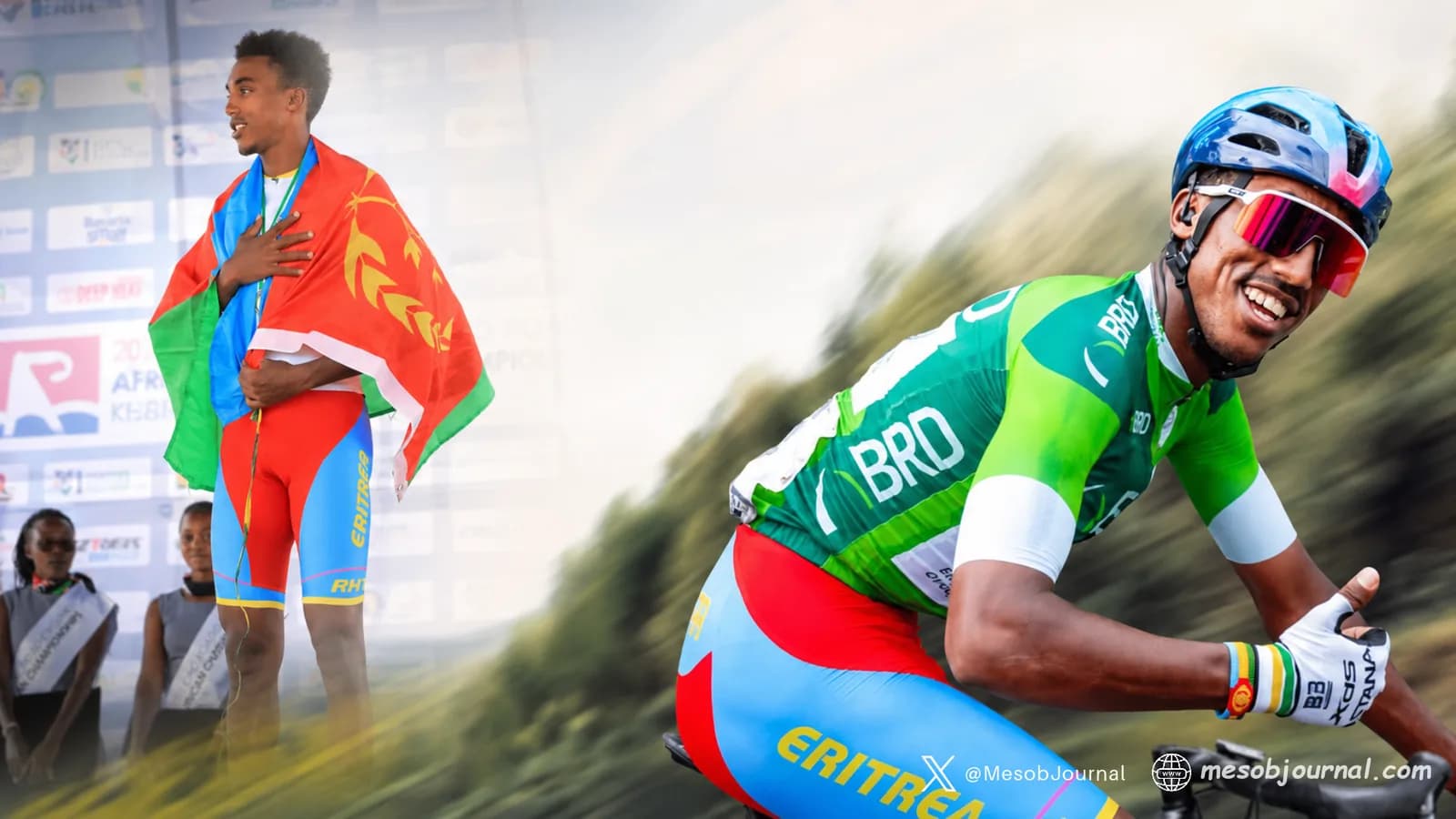
When the 2026 Vuelta a España rolls out of Monaco on Saturday, 184 riders from 30 nations will begin the final Grand Tour of the season.
Spain will have 30 cyclists in the peloton. France will have 23. Belgium will have 18.
Eritrea will have one.
Henok Mulubrhan, riding for XDS Astana Team, is the country’s sole representative on the start list. He is also the only rider from an African nation in the entire race.
That makes his presence significant. But describing Mulubrhan simply as a lone African rider would miss the larger story.
Eritrea does not arrive at La Vuelta as a country discovering cycling. It arrives as one of Africa’s most established cycling nations — a country where the sport is woven into everyday life, where local races draw serious attention and where generations of riders have learned to climb on the steep roads around Asmara.
Mulubrhan is part of that tradition.
Before him came riders such as Daniel Teklehaimanot, Merhawi Kudus and Natnael Berhane. More recently, Biniam Girmay changed the scale of what the world believed an Eritrean cyclist could achieve, winning stages at both the Giro d’Italia and the Tour de France and taking the Tour’s green jersey.
Mulubrhan has followed a different route, but an equally demanding one.
His early results in Eritrea earned him an opportunity at the UCI World Cycling Centre in Switzerland. From there, his career passed through development teams, the collapse of the Qhubeka project and a restart at continental level before he finally reached the WorldTour with Astana.
It was not a smooth ascent. Few African careers are.
The talent exists. The difficult part is finding enough races, exposure and institutional support to place that talent in front of WorldTour teams. For riders who cannot spend a full season competing in Europe, one missed opportunity can close an entire pathway.
Mulubrhan kept his open.
He arrives at La Vuelta as a three-time African road champion and an accomplished stage racer. He has won the Tour du Rwanda and the Tour of Qinghai Lake, and he already knows what three weeks of Grand Tour racing demands after completing the Giro d’Italia in 2023 and 2024.
The second of those appearances showed clear progress. He improved from 86th overall in his first Giro to 47th a year later.
Now comes his first Vuelta.
The course will offer little comfort. This year’s race includes more than 58,000 metres of climbing, seven mountain stages, four medium-mountain stages and two individual time trials. It is a route built to expose weakness.
But it also offers possibilities.
Mulubrhan is at his best when the road rises and the race becomes selective. He is not expected to lead XDS Astana’s general-classification campaign, but the rolling stages, uphill finishes and breakaway days could give him room to race for himself.
A stage victory would be historic. It is not, however, the only measure of a meaningful Vuelta.
Reaching Granada, entering a decisive breakaway, producing a top-ten stage result or helping XDS Astana shape a mountain stage would all matter. Every day he remains visible at the front of the race expands the picture of Eritrean and African cycling presented to an international audience.
That visibility matters because Mulubrhan is not an exception produced from nowhere. Eritrea has a deep pool of young riders, a genuine racing culture and the terrain to develop elite climbers. What remains limited is access: access to equipment, professional coaching, international races and the teams capable of carrying talent into the highest level of the sport.
One rider in a field of 184 makes that imbalance impossible to ignore.
Yet the image should not be one of isolation. Mulubrhan will start in Monaco wearing the colours of XDS Astana, but behind him stands a cycling nation that understands every climb, every attack and every sacrifice required to reach that line.
The official list will show one Eritrean. Eritrea knows the number is much larger than that.