
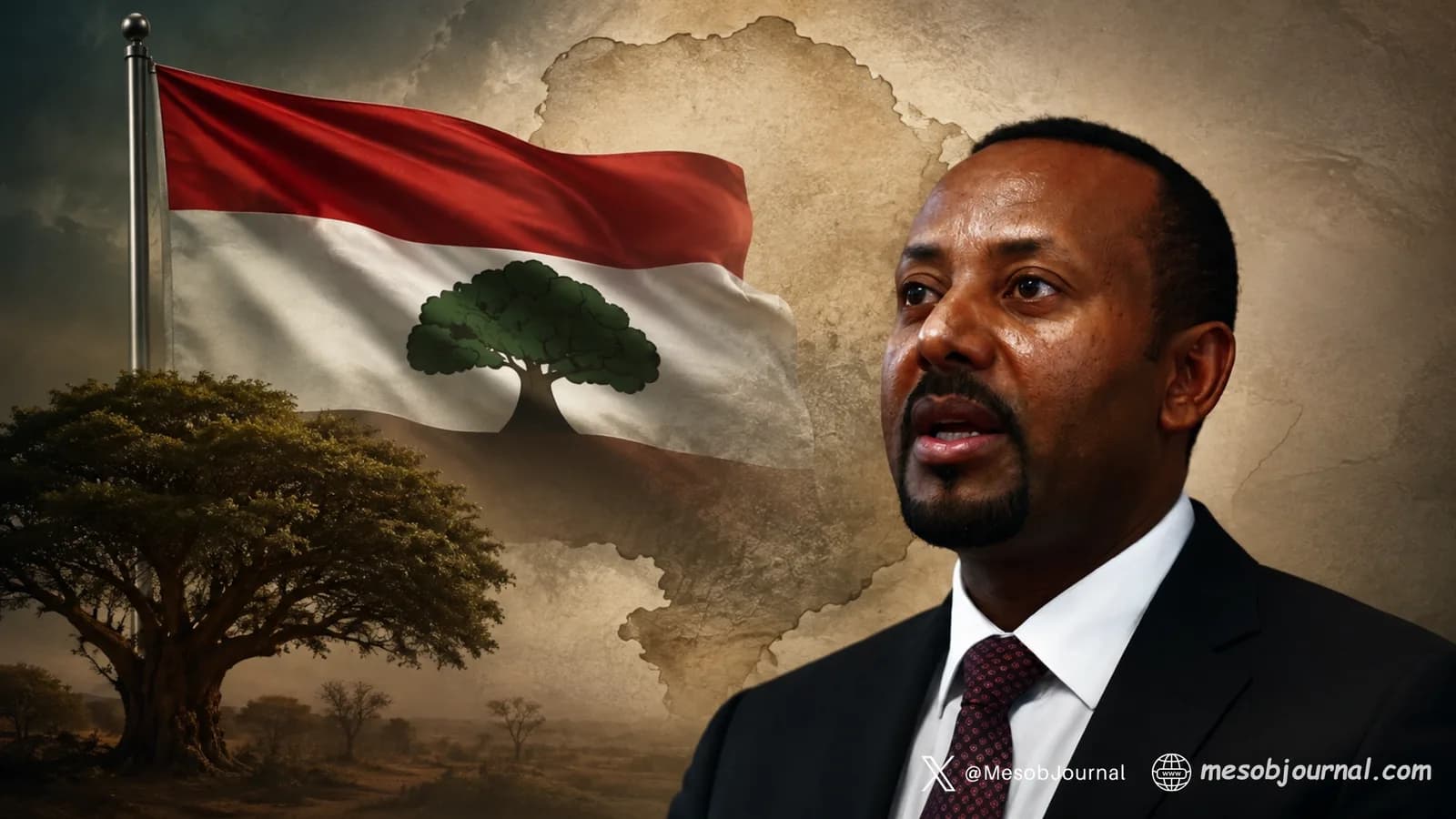
Colonel Abiy Ahmed’s statement that “The Oromo people have played a leading role in creating and building Ethiopia into what Ethiopia is today” deserves serious examination not because the historical contributions of the Oromo people should be denied, but because it raises a much larger question: Is Oromummaa evolving from an expression of Oromo cultural identity into an ideology of political supremacy over the Ethiopian state?
There is nothing inherently wrong with Oromo cultural pride. The Oromo are an integral part of Ethiopia’s history and society, and their contributions to agriculture, commerce, military affairs, politics, literature, music, and state development are significant.
The problem begins when a legitimate ethnic identity is transformed into a political doctrine that seeks to define the state primarily through the interests, historical narratives, symbols, and political authority of one nationality. This is the central danger of contemporary Oromummaa.
The issue is therefore not the Oromo people. It is the politicization of Oromo identity as a framework for state power. Ethiopia cannot escape ethnic domination by simply replacing one dominant political constituency with another.
The Rise of an Oromo Centered State
Despite Abiy’s conflicts with specific Oromo organizations, including the Oromo Liberation Army (OLA), his administration can still be criticized for advancing an Oromo centered political order. The apparent contradiction is important.
A government can fight an armed Oromo separatist movement while simultaneously increasing the political influence of Oromo elites within the federal state.
The prominent presence of Oromo political figures within the federal administration, security institutions, military structures, major ministries, and the leadership of the Prosperity Party is frequently cited as evidence of this shift.
From this perspective, the distinction is between Oromo nationalism that challenges state authority and Oromo political power exercised through state institutions. The government may therefore oppose separatism while benefiting from the broader political ascendancy of Oromo elites.
This does not mean that every Oromo official represents Oromummaa, nor does demographic representation itself constitute ethnic domination. Political representation of previously marginalized communities is legitimate.
But when political appointments, institutional authority, historical narratives, and state symbolism increasingly converge around one ethnic constituency, legitimate questions arise about whether Ethiopia is becoming a genuinely civic state or merely experiencing a new form of ethnic centralization.
Finfinnee: The Symbolic Battleground
Nowhere is this controversy more visible than in Finfinnee (Addis Ababa). Addis Ababa is not simply another regional city. It is Ethiopia’s political capital, diplomatic center, and one of Africa’s most cosmopolitan cities. Its population includes Ethiopians from virtually every nationality and region.
The creation of Sheger City and surrounding administrative restructuring has consequently generated significant political controversy. The government presents these initiatives primarily as urban planning, infrastructure, and administrative reforms.
This has been part of a broader attempt to strengthen Oromia’s territorial, political, and cultural influence around the capital. The same controversy applies to language, flags, anthems, schools, land administration, and other symbols of public authority.
When Oromia’s regional identity becomes increasingly visible within the political and cultural space of the capital, Finfinnee is gradually being reinterpreted through an Oromo nationalist framework.
For supporters of a civic Ethiopian identity, this is deeply troubling. Addis Ababa should be a capital in which every Ethiopian feels equally represented, not a prize in a competition between competing ethnic nationalisms.
Selective State Power
Another serious concern is the perception of unequal federal responses to violence and armed opposition. Communities in western Oromia have suffered devastating insecurity, while Amhara communities in parts of Oromia and neighboring regions have also experienced killings, displacement, and destruction.
Critics argue that federal authorities have often failed to provide adequate protection or accountability in areas where non-Oromo populations have been attacked. At the same time, the federal government has demonstrated considerable military capacity when confronting armed opposition in Amhara and Tigray.
This raises an uncomfortable question: Why does the Ethiopian state appear capable of mobilizing overwhelming force against some regional movements while repeatedly pursuing negotiation, accommodation, or political outreach toward others?
There may be legitimate security and political explanations for these differences. Nevertheless, the perception of double standards is politically damaging. If citizens believe that ethnicity determines how much protection they receive from the state or how aggressively the state responds to armed resistance, the principle of equal citizenship becomes meaningless.
A government cannot credibly promote national unity while allowing citizens to conclude that the state operates according to an ethnic hierarchy.
History, Territory, and the Expansion of Oromummaa
The concerns surrounding Oromummaa become even more serious when political rhetoric moves beyond cultural recognition and into questions of historical territory and political entitlement.
In a recent interview, Abiy was reported to have claimed that Barentu, in Eritrea, was historically part of Oromia. If accurately reported and understood in its political context, such a statement is significant because it extends the geographical imagination of Oromummaa beyond the present boundaries of Ethiopia and into Eritrean territory.
This reflects an expansive conception of Oromo historical geography, one that could potentially transform historical narratives into contemporary political claims.
The issue is not whether different communities lived in or exercised influence over particular territories at different points in history. The Horn of Africa has experienced centuries of migration, intermarriage, political expansion, shifting borders, and competing systems of authority.
Virtually every modern border in the region can therefore be subjected to competing historical interpretations. The danger arises when selective historical interpretations are elevated into political doctrines concerning who has a legitimate claim to territory today.
An equally consequential example is a reported remark by Abiy Ahmed in Hawassa, made while addressing an Oromo audience, in which he was said to have described the present moment as the Oromo people’s time and opportunity to rule Ethiopia.
If accurately reported, such rhetoric goes considerably beyond celebrating Oromo culture or acknowledging historical grievances. It raises the question of whether Oromo political ascendancy is being presented as a legitimate historical phase in the evolution of the Ethiopian state.
These statements, taken together with broader political developments, have been cited by critics as evidence of an underlying political vision that extends beyond cultural recognition toward questions of state power, territorial history, and political entitlement. That distinction is crucial.
There is a fundamental difference between saying that the Oromo deserve equality, representation, dignity, and recognition and saying explicitly or implicitly that Ethiopia has entered an era in which Oromo political leadership is inherently entitled to prevail.
The first is democratic pluralism. The second risks becoming ethnic majoritarianism.
Eritrea Cannot Be Treated as a Historical Footnote
Claims concerning Barentu and Eritrea deserve particular scrutiny. Eritrea's history and territorial identity cannot simply be subordinated to the historical narratives of another nationality. Eritreans possess their own complex historical experiences, identities, and political consciousness.
Any suggestion that Eritrean territory historically belonged to another contemporary ethnic or regional political project inevitably carries implications far beyond academic historiography.
Political leaders must therefore understand that rhetoric about historical territories can have consequences far beyond the immediate audience to which it is delivered. In a region already burdened by territorial disputes and wars, historical claims can easily become political instruments.
No Ethiopian nationality should be permitted to use history as a permanent territorial claim over another people.
Rewriting History as Political Power
Oromummaa is also fundamentally connected to competing interpretations of Ethiopian history. Oromo nationalist narratives frequently emphasize historical marginalization, conquest, dispossession, and the expansion of the Ethiopian state into territories inhabited by Oromo communities.
Pan-Ethiopian narratives, by contrast, emphasize state formation, territorial integration, resistance to European colonialism, and the shared historical development of Ethiopia.
Historical grievances deserve recognition. But history becomes dangerous when it is transformed into a political weapon.
If one ethnic group's historical interpretation becomes the dominant lens through which the entire country is understood, historical memory ceases to be an instrument of understanding and becomes an instrument of political legitimacy.
The same principle applies to narratives surrounding the nineteenth century expansion of the Ethiopian state. Historical suffering cannot be denied, but neither can history be used to establish permanent political entitlement.
No nationality should be allowed to say: Because our ancestors suffered, we are therefore entitled to rule your descendants. That principle would destroy the possibility of coexistence.
The Contradiction of Abiy’s Medemer
The greatest political irony of Abiy’s rise is the contrast between his early message and his subsequent political trajectory.
In 2018, Abiy presented Medemer as a philosophy of reconciliation, unity, cooperation, and a new Ethiopian political order. His message appealed to Ethiopians exhausted by ethnic polarization and the dominance of the previous political establishment.
Yet, as the old TPLF centered political structure was dismantled, the government gradually moved toward an increasingly Oromo centered political order while continuing to use the language of national unity and modernization.
This is the basis of the two-faced theory: Ethiopian unity was allegedly used as a political instrument when it was necessary to defeat an established rival, while Oromo political consolidation became increasingly important after power was secured.
Whether this interpretation is entirely accurate remains contested. But the political perception itself cannot be dismissed.
Abiy’s conflicts with Oromo nationalist organizations do not automatically disprove this argument. A political leader can oppose Oromo separatism while simultaneously incorporating elements of Oromo nationalism into the institutions and political identity of the state.
Indeed, that distinction may be central to understanding the government's approach: separatist Oromummaa can be confronted while state compatible Oromummaa can be accommodated or promoted.
The Real Danger: Replacing One Hegemony With Another
The greatest mistake Ethiopia could make would be to assume that ethnic domination becomes acceptable simply because a different ethnic group is exercising it.
If the previous political system marginalized certain communities, the answer cannot be to establish a new hierarchy in which another nationality becomes politically privileged. Replacing one ethnic hegemony with another is not reform; it is merely political rotation.
Oromummaa becomes particularly dangerous when it moves beyond protecting Oromo culture and rights and begins to imply that Oromo political leadership is historically entitled to control Ethiopia.
No nationality owns Ethiopia. Not Oromo. Not Amhara. Not Tigrayan. Not Somali. Not Afar. Not any other group. Ethiopia belongs equally to all its citizens.
The country therefore needs a political framework in which Oromo identity can flourish without becoming state ideology, just as Amhara, Tigrayan, Somali, Afar, Sidama, Gurage, Agew, and other identities must be protected without becoming instruments of political supremacy.
The challenge is not to eliminate ethnic identity. It is to prevent ethnicity from becoming the foundation of political privilege.
Toward a Civic Ethiopia
The Oromo people deserve equality. They deserve representation. They deserve recognition of their history, language, and culture.
But those legitimate demands should not be transformed into an ideological claim that Oromummaa is entitled to define the Ethiopian state or determine who should rule it.
Likewise, historical claims involving Eritrea should be approached with particular caution. The sovereignty, identity, and territorial integrity of Eritrea cannot be treated as collateral to an expansive Ethiopian or Oromo historical narrative.
Ultimately, the strongest argument against political Oromummaa is not an argument against the Oromo people. It is an argument against any ideology that converts ethnic identity into political entitlement.
If Ethiopia is to escape its destructive cycle of competing nationalisms, the principle must be universal: no Ethiopian nationality has an inherent right to rule another, and no historical narrative should be used as a permanent political claim over another people's homeland.
Abiy’s assertion that the Oromo played a leading role in building Ethiopia should therefore not become a justification for Oromo political predominance. The Oromo contribution to Ethiopia can and should be recognized without transforming that contribution into a claim of ownership.
The ultimate choice facing Ethiopia is straightforward: a state organized around equal citizenship, or a state continually reorganized around competing ethnic hegemonies.
If Oromummaa becomes a doctrine of political supremacy, it will not liberate Ethiopia from ethnic politics. It will deepen it. And if Ethiopia responds with another competing ethnic nationalism, the cycle will continue indefinitely.
The only sustainable alternative is a civic Ethiopia in which every nationality can say, without qualification: This country belongs to us too.