
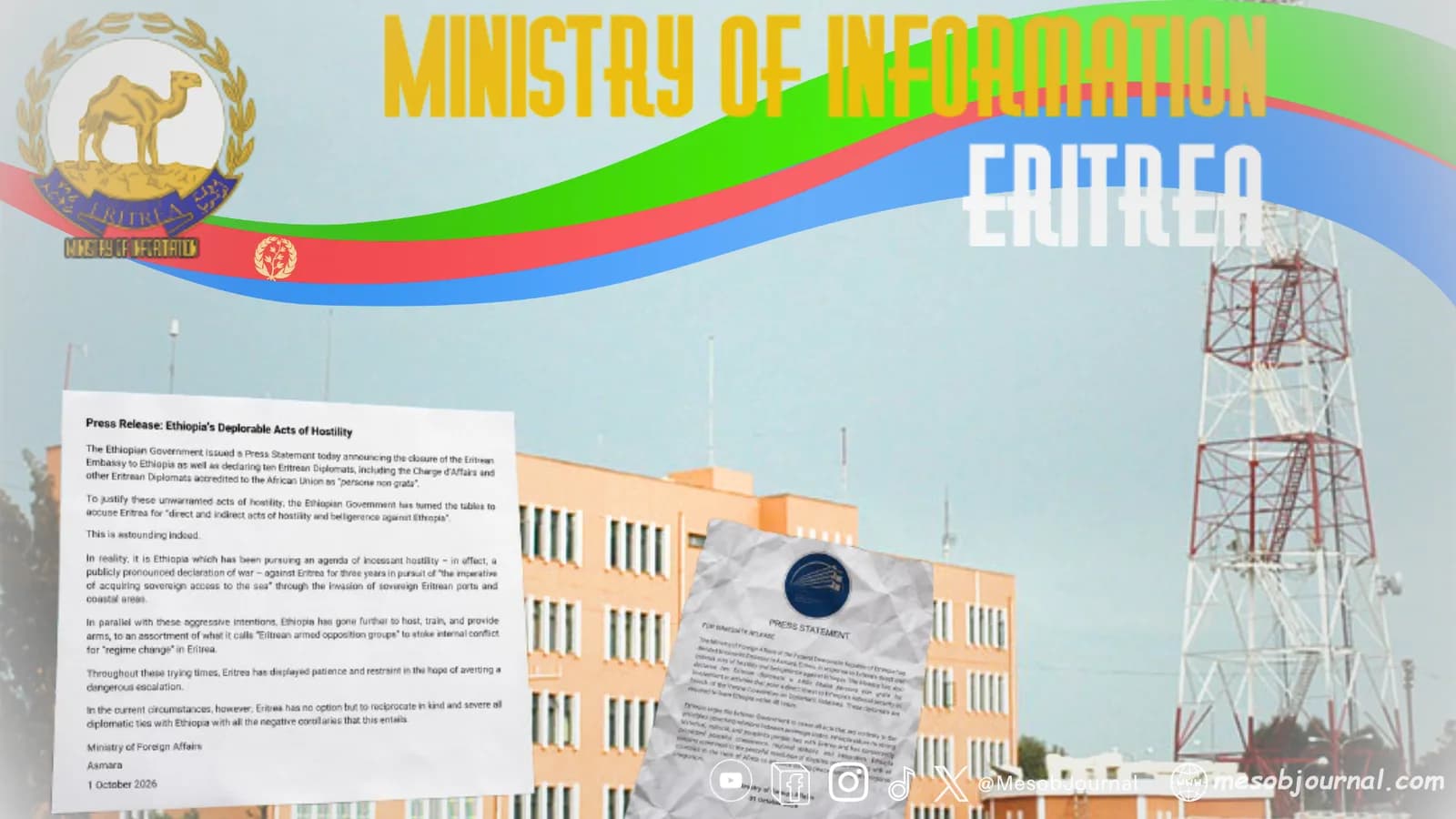
Ethiopia’s government has ordered ten Eritrean diplomats to leave within 48 hours while declaring its commitment to peaceful coexistence. The contradiction is not buried in separate speeches or competing interpretations. It sits inside the same statement. Addis Ababa announced the closure of its own embassy in Asmara, accused Eritrea of threatening Ethiopian national security, and then attached the familiar assurances about regional peace and integration.
Eritrea’s response identified a particularly serious dimension: those ordered out include its chargé d’affaires and diplomats accredited to the African Union. Asmara rejected Ethiopia’s justification, described the decision as another act of hostility, and announced that it would reciprocate by severing diplomatic ties.
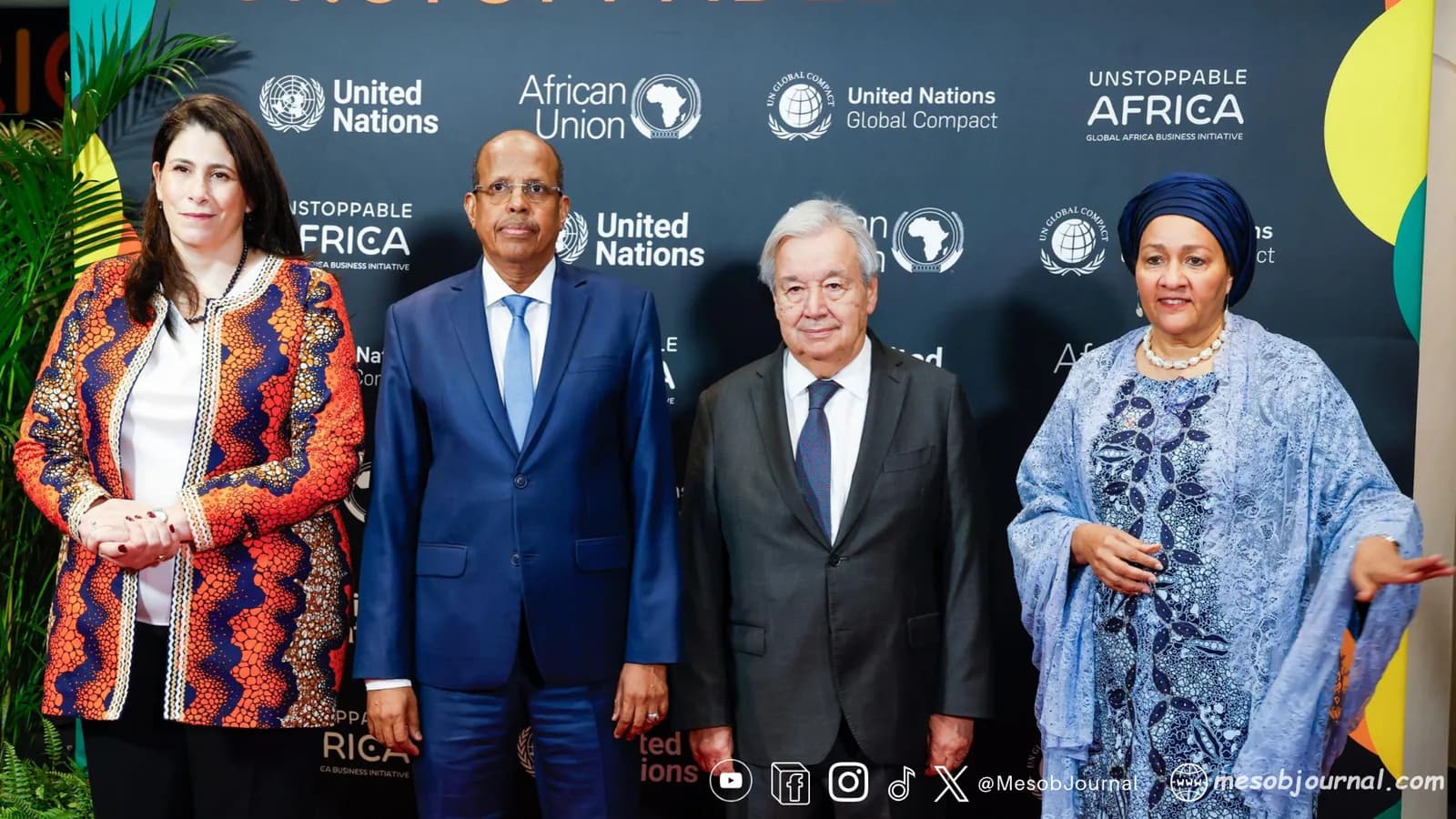
This is more than the deterioration of a bilateral relationship. It raises a continental question that cannot be left to the Ethiopian government to answer on everyone else’s behalf: can the country hosting the African Union use a confrontation with another member state to obstruct that country’s continental diplomacy?
The immediate responsibility is to prevent that outcome. The larger responsibility is to confront the political campaign that brought the relationship here.
Eritrea’s Foreign Ministry has traced that campaign through nearly three years of Ethiopian demands for sovereign access to the sea, territorial revisionism and military messaging. In March, it published a chronology extending from Abiy Ahmed’s October 2023 maritime pronouncements to his February 2026 description of an Ethiopian naval security role reaching towards Massawa. Its warning was explicit: commercial access was being deliberately confused with sovereignty.
The October rupture must be read against that record—not treated as though the relationship began with Ethiopia’s latest accusation.
The Ethiopian communiqué supplies no names, specific incidents or supporting evidence for its allegations against the ten diplomats. It announces a conclusion without presenting a public case that can be examined.
The move goes beyond an ordinary bilateral diplomatic dispute. Several of those expelled were accredited to the African Union, meaning Ethiopia’s action also directly affects Eritrea’s representation at the continent’s principal political institution.
The African diplomatic framework recognizes that representatives require protections to perform their institutional duties independently. Article V of the General Convention on the Privileges and Immunities of the Organization of African Unity provides protections for member-state representatives exercising their functions, including specified immigration exemptions. It expressly grounds those protections in the independence of their work, not personal privilege.
The precise legal position of each affected diplomat requires the accreditation records, the scope of Ethiopia’s order and the applicable headquarters arrangements. But the institutional principle should not be negotiable: Eritrea’s participation in African diplomacy must not depend on its political relationship with the government in Addis Ababa.
The African Union should establish immediately whether the departure order interferes with accredited AU functions and secure arrangements that protect Eritrea’s representation. This is not a favour to Asmara. Every member state has an interest in ensuring that continental representation cannot become collateral damage in the host country’s bilateral disputes.
Hosting the African Union does not confer ownership of African diplomacy.
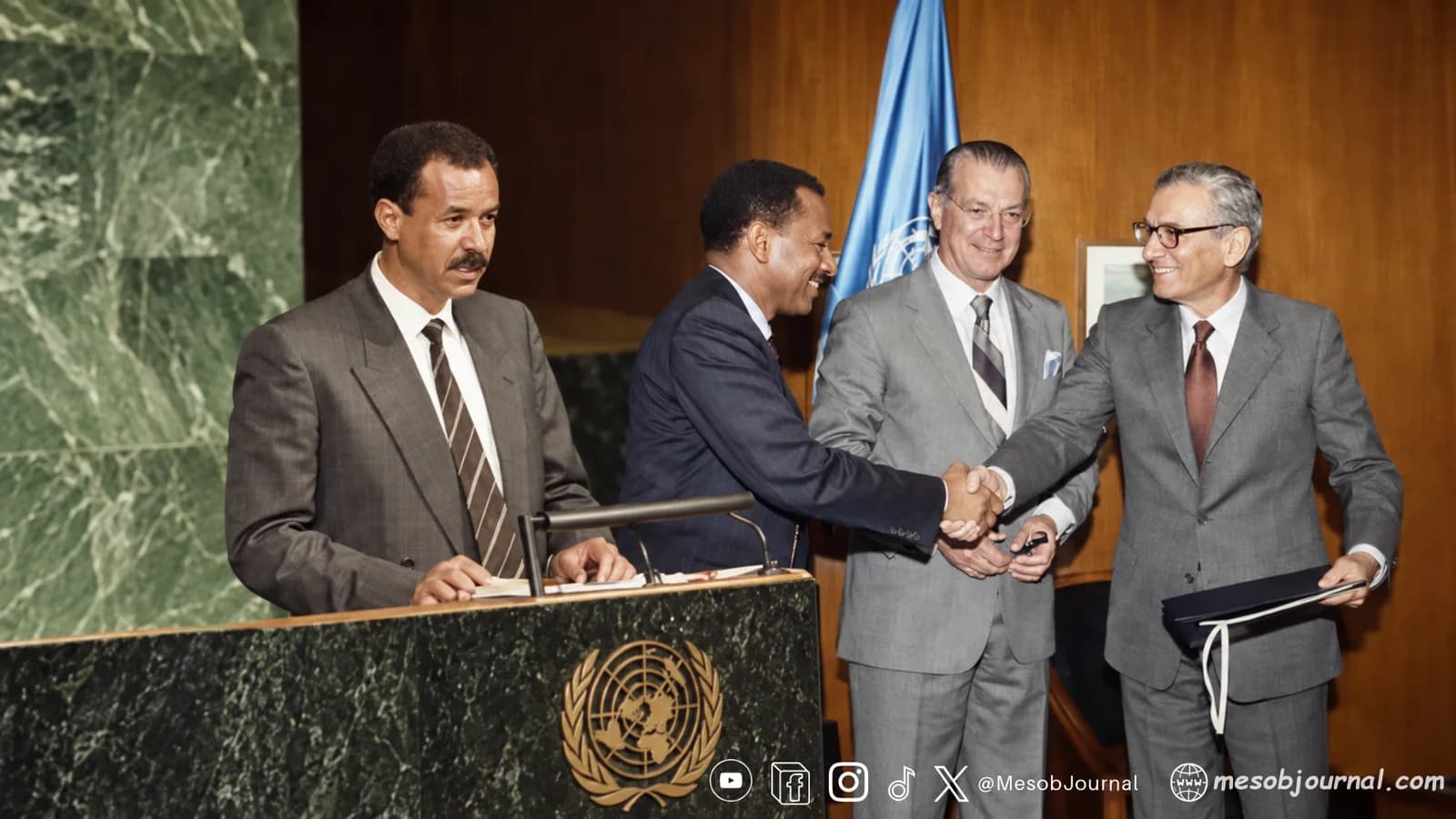
Abiy’s government also cannot plead ignorance of the sovereignty it is now encouraging others to question. On 16 September 2018, Abiy signed the Jeddah agreement with President Isaias Afwerki. Its text expressly respects the two countries’ independence, sovereignty and territorial integrity. It provides for comprehensive cooperation, joint investment and implementation of the boundary decision.
That agreement matters for two reasons. It records Abiy’s own acknowledgment of Eritrea as a sovereign neighbour. And it demonstrates that respect for Eritrean sovereignty was never incompatible with an ambitious programme of economic cooperation.
The choice was not between friendship and Eritrea’s independence. The agreed basis for friendship was Eritrea’s independence.
A government cannot sign that principle when reconciliation serves its purposes and then encourage a national conversation in which the neighbouring state’s coastline becomes an injustice waiting to be corrected.
The published Ethiopian record is sufficiently explicit to make that criticism without relying on anonymous social-media accounts.
On 14 August 2026, an official account of Field Marshal Birhanu Jula’s address described the Special Operations Command as a strategic striking force equipped for rapid response and pre-emptive defence. The same account carried his accusation that “Shaebia” had conspired with external adversaries to deny Ethiopia sea access.
This was not a private commentator speculating about maritime economics. It was the chief of the general staff addressing military leaders, with an Eritrean enemy narrative placed alongside discussion of pre-emptive military capability. Thus, Eritrea cannot reasonably be expected to dismiss the language as harmless rhetoric.
Two days later, a commentary published through a state platform portrayed Assab as territory Ethiopia had been wrongfully deprived of. It described the outcome of 1993 as a betrayal and concluded that “Ethiopia’s seas are its birthright,” invoking the need to “fight for that legacy.”
An opinion article is not a government decree. But giving territorial reclamation a state platform has political consequences. It helps normalize the proposition that another country’s recognized sovereignty is a historical mistake and that correcting it is a patriotic obligation.
That is the danger of the campaign’s vocabulary. A commercial requirement becomes an existential grievance. An independent neighbour becomes the alleged author of that grievance. A port becomes a birthright. Military readiness becomes the answer to a condition supposedly imposed by enemies.
By the time diplomats are expelled, an audience has already been taught to interpret confrontation as national recovery.
The same record exposes another contradiction in Ethiopia’s claim to be defending non-interference.
On 27 June 2026, a state platform published an interview with Mohammed Ahmed Asenai, chairman of the Eritrean Green Revolution movement. The account said the movement was prepared to confront the Eritrean government militarily and described its combination of political objectives with military preparedness.
Eritrea’s 1 October statement goes further, stating that Ethiopia is hosting, training and arming Eritrean opposition groups to stoke internal conflict and bring about regime change in Eritrea. The Ethiopian publication itself records an opposition leader openly describing his movement’s military preparedness and declaring its readiness to confront the Eritrean government militarily.
General assurances of peace do not, by themselves, address the specific issues raised here.
The interview gave a public platform to an opposition leader’s declared readiness for military confrontation with the Eritrean government. The relevant question is how that coverage relates to Ethiopia’s stated commitment to peaceful relations between sovereign states, while giving official support for the movement’s military objectives.
The central deception in the maritime campaign is not that Ethiopia has legitimate commercial interests. It plainly does. The deception lies in presenting those interests as though they generate a territorial entitlement.
The distinction is fundamental. Article 125 of the Law of the Sea Convention addresses landlocked states’ access and transit, with arrangements agreed between the states concerned, while preserving transit states’ sovereignty and legitimate interests. It does not allocate a neighbouring coastline to the country that considers itself most economically deserving of one.
Secure commercial access can be negotiated through port services, transport corridors, investment and other mutually accepted arrangements. None requires treating Eritrea’s statehood as provisional.
Nor does adding the word “peaceful” settle the issue. A proposed negotiation remains coercive when its premise is that one party must eventually surrender something it has every right to retain. Consent must include the right to refuse a transfer of sovereignty. Otherwise, the language of negotiation merely conceals an ultimatum.
Abiy has already accepted the distinction between access and ownership in another regional agreement.
The January 2024 memorandum with Somaliland provoked Somalia’s rejection of what it regarded as a violation of its sovereignty and territorial integrity. That confrontation was not resolved by discovering that geography conferred an overriding Ethiopian entitlement.
In the Ankara Declaration of 11 December 2024, Ethiopia and Somalia reaffirmed respect for each other’s sovereignty and territorial integrity. They agreed to pursue commercial arrangements giving Ethiopia reliable sea access “under the sovereign authority of the Federal Republic of Somalia.”
There is the workable principle, accepted by Abiy himself: access through agreement, without extinguishing the coastal state’s authority.
Why should Eritrea be expected to accept a lesser standard?
The regional consequences of this thinking also extend beyond the ports question. Ethiopia’s neighbours are increasingly discussed in its public messaging not as states with interests of their own, but as pieces of an alleged encirclement.
Egypt provides a revealing example. On 1 October, a commentary carried by an Ethiopian state platform interpreted Cairo’s expanding relationship with Asmara—including technical assistance, investment and port-related cooperation—as a proxy campaign against Ethiopia.
On that same day, Eritrea’s published account of its delegation’s talks in Cairo listed construction equipment, pharmaceuticals, agricultural produce, marine resources and maritime transport among the areas under discussion.
Those relationships can be examined critically, as any relationship can. But commercial cooperation does not become evidence of a hostile conspiracy simply because Ethiopia is not a participant.
The Nile disputes require serious engagement with the interests and responsibilities of the countries involved. They do not give Addis Ababa a veto over Eritrea’s relations with Egypt. Nor does Eritrean cooperation with Cairo transform Eritrea into somebody else’s instrument.
The double standard is striking when Ethiopia’s own external partnerships are considered.
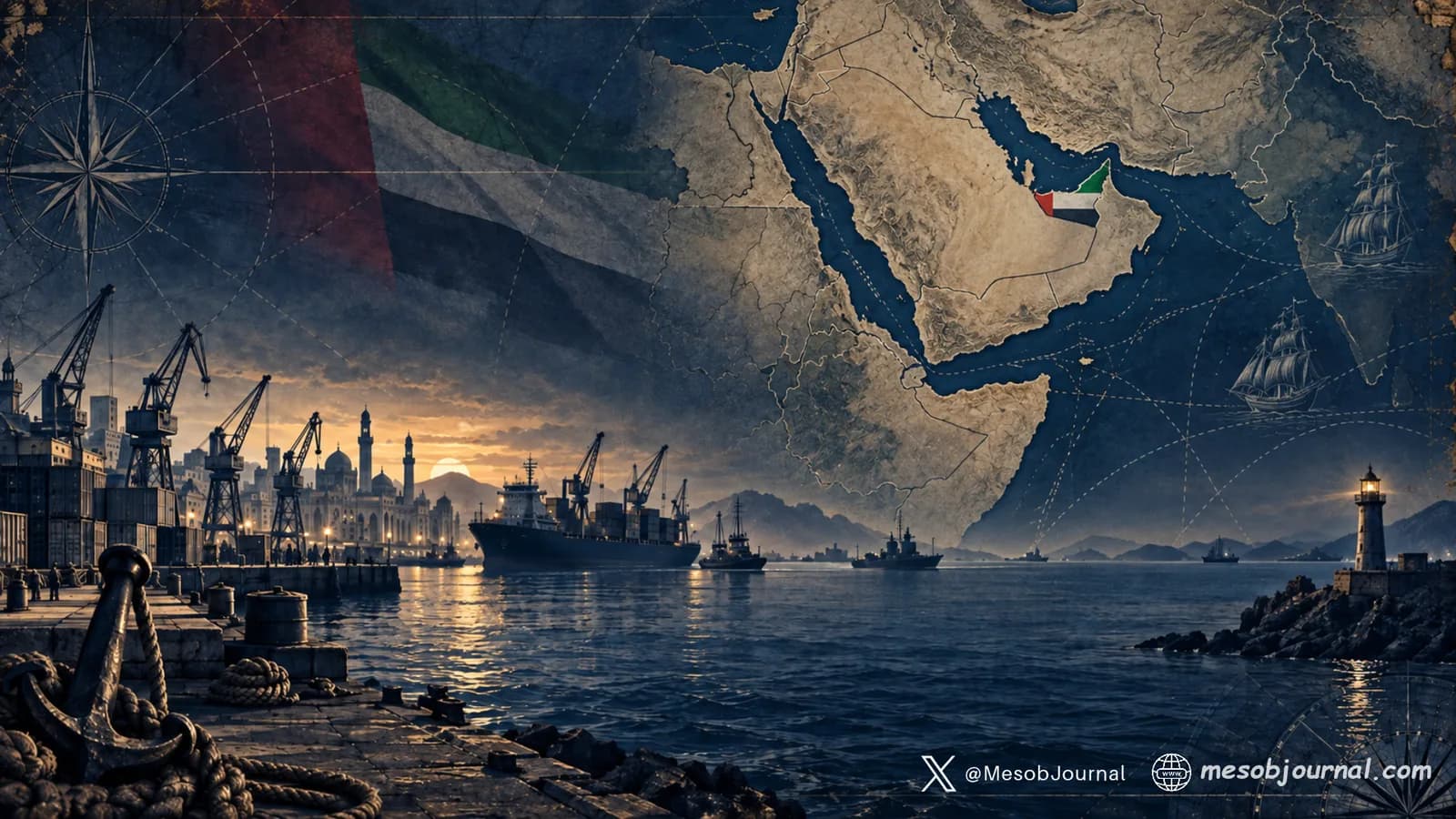
The United Arab Emirates is not a peripheral actor in Ethiopia’s regional posture. In June 2018, the Abu Dhabi Fund for Development announced a $3 billion economic support package for Ethiopia, including a $1 billion central-bank deposit. At the November 2025 Dubai Airshow, the UAE and Ethiopian air forces signed a memorandum of understanding.
These are deep financial and military ties, reinforced by an active UAE-Ethiopia security partnership. Abu Dhabi therefore cannot be treated as a detached spectator while Ethiopia intensifies pressure on Eritrea and adopts an increasingly confrontational regional posture.
The UAE has both influence and responsibility. Its military cooperation with Ethiopia must not become strategic cover for territorial coercion or aggression against neighbouring states.
A partner genuinely committed to regional stability should use its leverage to restrain escalation, not strengthen the confidence of those driving it.
Sudan makes that responsibility especially urgent. Ethiopia is hosting a secret camp in Benishangul-Gumuz where thousands of fighters are being trained for Sudan’s Rapid Support Forces. Satellite imagery, security documents and multiple sources, including a senior Ethiopian official, have documented the facility, while the UAE has been identified as financing the camp and providing trainers and logistical support.
The same pattern extends to cross-border military operations. Sudanese authorities have documented drone activity originating from Ethiopian territory, including strikes they traced to Bahir Dar airport, further underscoring how Ethiopian territory has become part of the infrastructure sustaining the war next door.
The regional standard should therefore be unequivocal: no state should allow its territory, financing or military partnerships to be used to destabilize its neighbours. Sudan’s sovereignty cannot be subordinated to somebody else’s proxy war. Somalia’s territorial integrity cannot be bypassed for somebody else’s maritime project. Eritrea’s coastline cannot be made negotiable by somebody else’s population size.
This is where Eritrea’s restraint deserves recognition—not as a ceremonial compliment, but as a concrete element of the diplomatic record.
On 9 February 2026, after rejecting accusations from Ethiopia’s foreign minister, Eritrea explicitly declined to engage in acrimony that would “add fuel and exacerbate the situation.” In March, it again affirmed its commitment to peace and the responsible management of regional relations while rejecting infringements on its sovereignty.
Those statements preceded the present rupture by months. They were not explanations invented after the diplomats received their departure deadline.
Restraint does not mean silence about danger. It means recognizing danger without automatically answering every provocation in kind. It means leaving political room for an adversary to step back.
That approach deserves more than an endless demand that Eritrea continue absorbing pressure while the source of the pressure escapes examination.
There is a damaging habit in regional diplomacy of confusing an even-handed tone with an accurate account of responsibility. Two governments may exchange statements, but the existence of two statements does not make their underlying policies equivalent. Appeals for calm should not erase the distinction between advocating territorial reclamation and rejecting it.
Nor should the October sequence be reversed. Ethiopia announced its embassy closure and the expulsion order. Eritrea then announced the severance of diplomatic relations in response. Both decisions have consequences, but describing them as simultaneous, context-free escalation would conceal the actual order of events.
The rupture itself is not proof that a new interstate war is inevitable. It is nevertheless dangerous because it removes direct channels precisely when accusations, military messaging and territorial claims make reliable communication most necessary.
Diplomats do not exist only for periods of friendship. Their work becomes more important when relations are hostile, interpretations diverge and a miscalculation could become irreversible.
Expelling them may produce a display of resolve. It does not resolve the underlying dispute, establish the truth of the charges against them or make a neighbouring country’s territory available.
There is also a direct challenge here to Ethiopians who want a peaceful and prosperous future.
No government should be allowed to equate loyalty to Ethiopia with endorsement of every demand made in Ethiopia’s name. Rejecting territorial revisionism is not opposition to Ethiopian trade. Questioning military escalation is not surrender. Demanding evidence before accepting accusations against a neighbour is not disloyalty.
The interests of Ethiopian families, workers, farmers and businesses should not be confused with the political requirements of Abiy’s government. A maritime campaign that destroys trust with coastal neighbours can obstruct the very commercial opportunities it promises to secure.
The alternative is neither humiliation nor isolation. It is a regional policy capable of accepting reciprocal sovereignty: the independence Ethiopia demands for itself must also be available to others.
For the African Union, that principle now requires action rather than another general expression of concern. Eritrea’s accredited continental representation must be protected. The effect of the expulsion order on AU functions must be clarified. A bilateral rupture must not be allowed to establish a precedent under which access to African institutions depends on the host government’s political approval.
For Ethiopia’s government, a credible change of course requires more than another paragraph about peaceful intentions. It requires an unambiguous rejection of territorial claims against Eritrea, an end to the official promotion of armed regime-change agendas, and a return to the sovereign-equality commitments Abiy has already signed.
For external partners, especially the UAE, their leverage is part of the equation. Support that emboldens escalation carries responsibility for the consequences that follow.
And for both countries, the protection of diplomatic personnel, premises, property and archives remains essential. Diplomatic rupture does not cancel those obligations; the Vienna Convention specifically preserves duties towards mission premises and provides for the protection of interests through an acceptable third state.
The task is not to reward confrontation with territorial bargaining. It is to preserve channels for peace while refusing to normalize coercion.
Eritrea does not owe Ethiopia a coastline. It owes its neighbour the respect due between sovereign states—and is entitled to exactly the same in return.
The Ethiopian people deserve reliable access to trade and a government that pursues it without manufacturing a confrontation with the people next door. Africa deserves an institution whose host cannot turn a bilateral quarrel into a constraint on continental participation.
Eritrea’s restraint was an opportunity for peace. Abiy Ahmed must not be allowed to turn its war rhetoric into a regional catastrophe.