
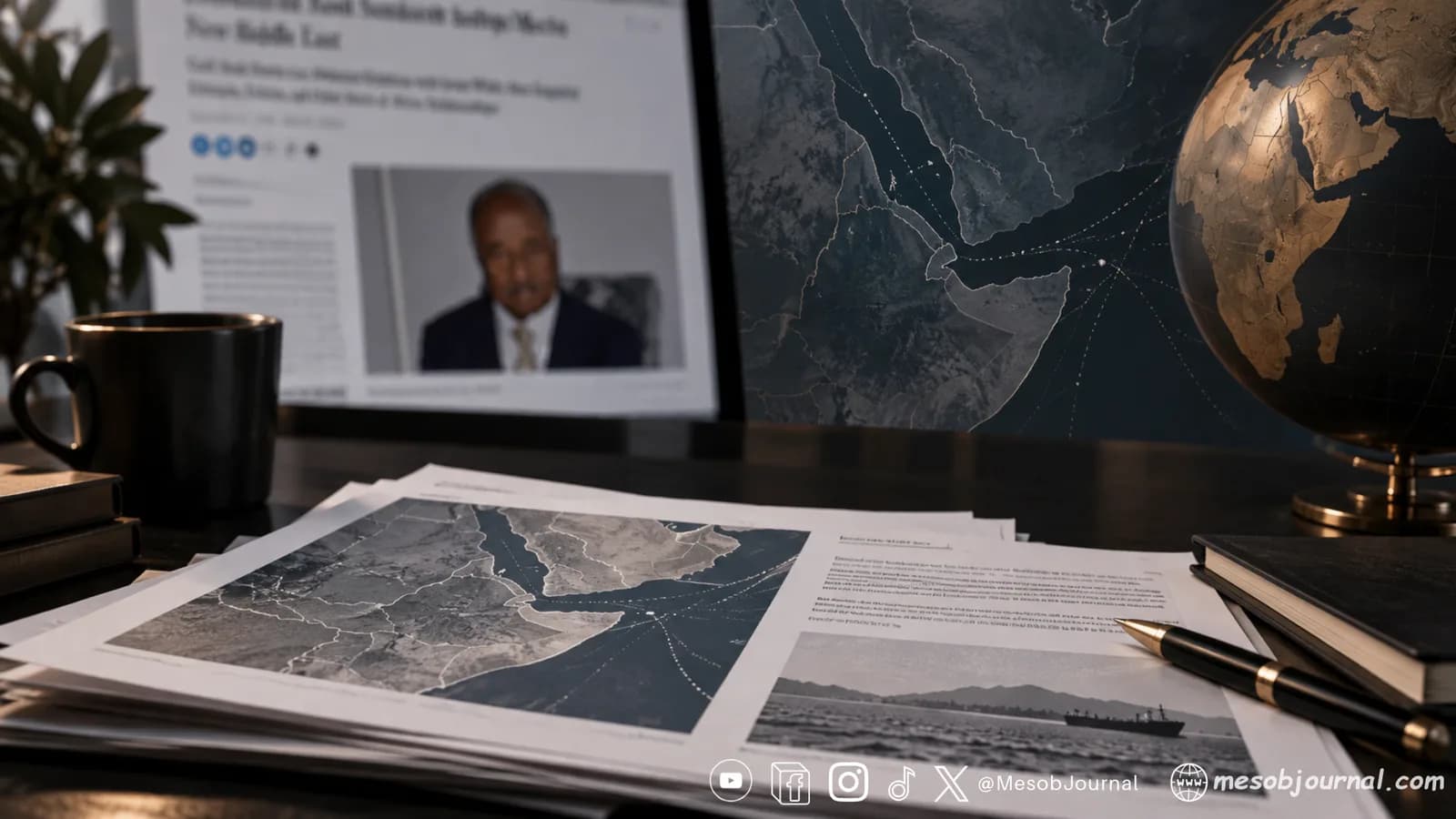
The following is a response to a post on the Middle East Forum by Blen Mamo Diriba, Executive Director of Horn Review, an Ethiopian government-affiliated research and publication platform with a focus on the Horn of Africa, Red Sea Region, and in particular Eritrea.
Diriba, an Ethiopian herself, is also an Associate Researcher at Ethiopia’s Institute of Foreign Affairs (EIFA). The article was posted on 21 Sept 2016 under the title: “Eritrea’s Old Red Sea Narrative Meets a New Middle East.”
The article's central claim is that Eritrean Foreign Minister Osman Saleh is recycling a Cold War template, the idea that Ethiopia's ties with Israel are part of a wider Arab/Israeli contest over the Red Sea and applying it to a Middle East that no longer works that way.
The author concedes that the Minister "identifies a genuine network of relationships" but insists he misreads it through an outdated lens. That concession is where the argument breaks down. If the network is real, the question is not whether the framing is old, but whether the threat it describes is current and tangible.
It is clear from this that there is a more fundamental problem with the article that goes beyond its arguments, which is the platform that published it and the function it serves.
The Middle East Forum is not a neutral academic institution. It describes its own mission as "influencing U.S. policy" toward the Middle East. Its funding comes overwhelmingly from a small cluster of right-wing and pro-Israel foundations, with Donors Trust alone contributing over $10 million between 2020 and 2024.
This does not automatically invalidate its arguments, but it does mean that when MEF publishes an analysis of Red Sea geopolitics, it is not doing so as a disinterested observer. It is doing so as an advocacy organization with a clear geopolitical alignment, one that happens to coincide with the UAE-Israel-Ethiopia axis the article defends.
The author, Blen Mamo Diriba, is identified as an "Ethiopian legal and policy analyst." That is accurate but incomplete. She is an Ethiopian analyst writing for an American advocacy organization, making an argument that aligns precisely with the Ethiopian government's narrative needs in its escalating dispute with Eritrea.
The article's framing, that Eritrea is stuck in an "old narrative" while Ethiopia has evolved into a "pragmatic, transactional" republic, mirrors Addis Ababa's own diplomatic messaging. It is not independent analysis. It is aligned advocacy presented as analysis.
This matters because the article is not appearing in a vacuum. It is appearing in the middle of an active narrative war by Addis Ababa on Eritrea and building pressure on Asmara to draw it in to respond to its circle of misinformation and its propaganda outputs.
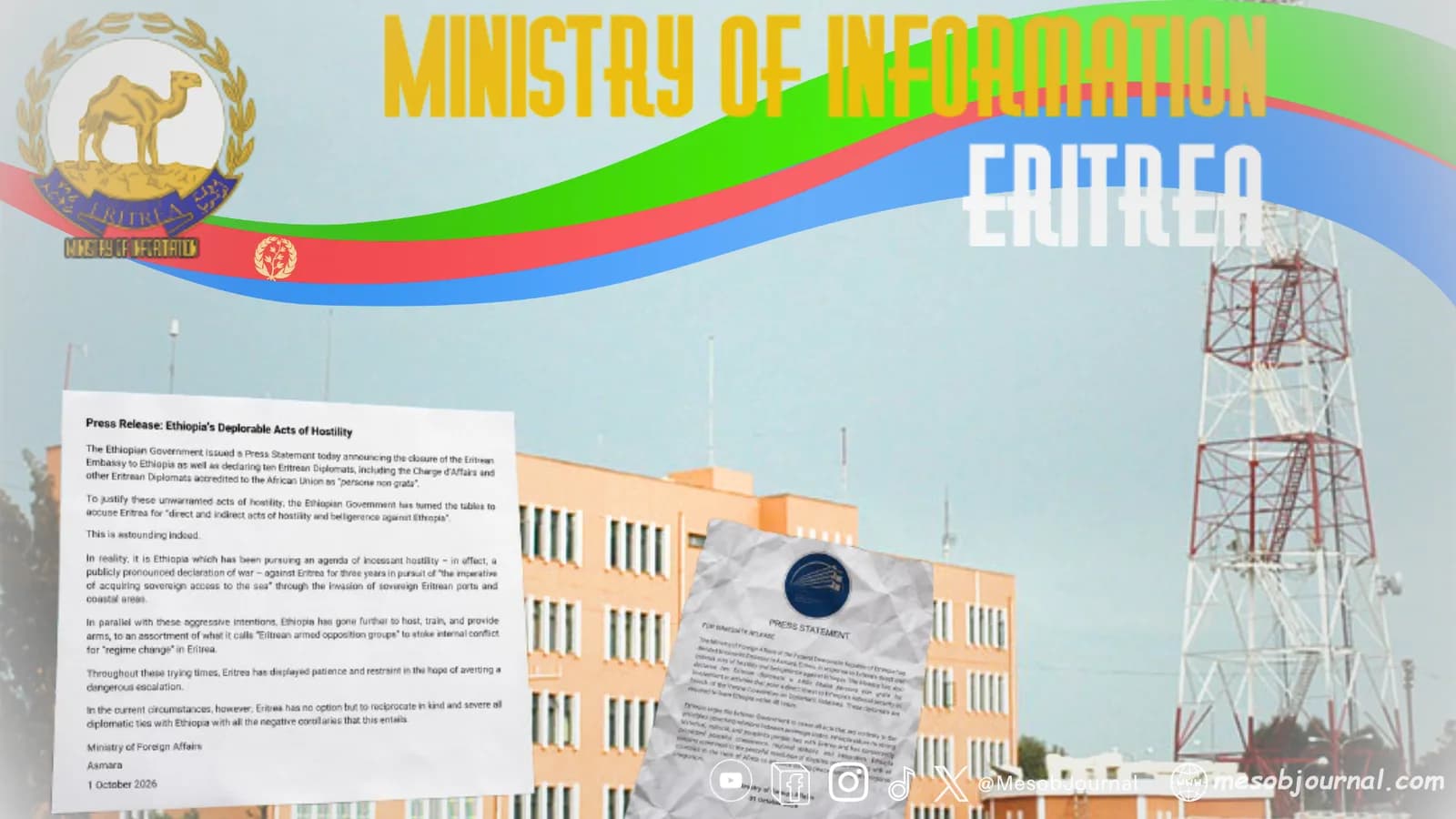
Eritrea's Information Ministry has documented what it calls a systematic campaign by Ethiopian Prosperity Party media to "weaponize" allegations such as water shortages, oil tanker incidents, and "illicit bilateral ties" to "sway international public opinion" against Eritrea.
What is clear to Asmara is how Washington and Western capitals interpret the Red Sea's shifting alignments. MEF's article is a contribution to that fight, not a neutral assessment of it.
Eritrea’s Red Sea Warning is Not Nostalgia; It Is the Only Accurate Narrative.
The author's strongest point is that the region has changed. The UAE has further deepened relations with Israel, Ethiopia is no longer an imperial monarchy or a Marxist Dergue, and Gulf states now pursue transactional and multi-vector diplomacy across the Horn.
That is true as far as it goes but the author deliberately fails to acknowledge that "multi-vector" describes the freedom of the strong, not the security of the weak or marginalised.
The UAE can be a military partner of Ethiopia, a port investor in Somaliland and Puntland, a spoiler in Sudan, and a dialogue partner of Egypt all at once. Eritrea cannot reciprocate that breadth.
It sits on the western flank of the Red Sea with a hostile neighbour to its south, a coastline that others want access to, and a long history of sanctions that were designed to make it a pariah.
On the other hand, the suggestion that Eritrea is being "courted" by Egypt and Saudi Arabia, as if it were a passive object being scrambled over, is wrong.
Eritrea has been actively positioning itself toward Riyadh for some time. President Isaias Afwerki made a four-day working visit to Saudi Arabia in December 2025, meeting Crown Prince Mohammed bin Salman for extensive discussions on bilateral cooperation and regional issues (Middle East Eye, February 2026).
As Michael Woldemariam of the University of Maryland put it, "the Eritreans don't need to be pushed by the Egyptians to embrace the Saudis. It has been Asmara's objective for some time" (Middle East Eye, February 2026).
Egypt has been trying to broker deeper security links between Eritrea and Saudi Arabia, with an eye toward checking UAE influence as it increases military ties to Ethiopia (Middle East Eye, February 2026).
But the agency belongs primarily to Asmara; this is not inferred.
Eritrea's diplomacy with Egypt is not a recent opportunistic alignment but a relationship that has developed over the past decade and Ethiopia has never been at the heart of that agenda as the propaganda and misinformation machinery of Ethiopia claims.
That relationship is rooted in shared geography and shared views on the mechanisms for cooperation among coastal states to enhance the security of the Red Sea corridor.
Eritrea, Egypt, and other countries with a similar orientation in the Horn of Africa and the Red Sea region have moved beyond slogans to joint action mechanisms to enhance regional security and stability.
The Council of Red Sea and Gulf of Aden Coastal States is named as a key platform for multilateral cooperation. This is the language of a state presenting itself as an institutional architect of Red Sea security.
The article's portrait of Eritrea as trapped in nostalgic sloganeering is directly contradicted by Asmara's own institutionalist vocabulary.
That positioning is grounded in a concrete threat environment. In 2016, the UAE sought to establish a joint military facility with Israel on Eritrea's Dahlak archipelago. Eritrea refused.
Meanwhile, Ethiopia under Abiy Ahmed has deepened its military relationship with the UAE, deploying Emirati drones and weapons systems, and Israeli President Herzog's 2026 visit to Addis Ababa was widely read as part of a strategic realignment in which Israel sees Ethiopia as a partner against Iranian influence in the Red Sea.
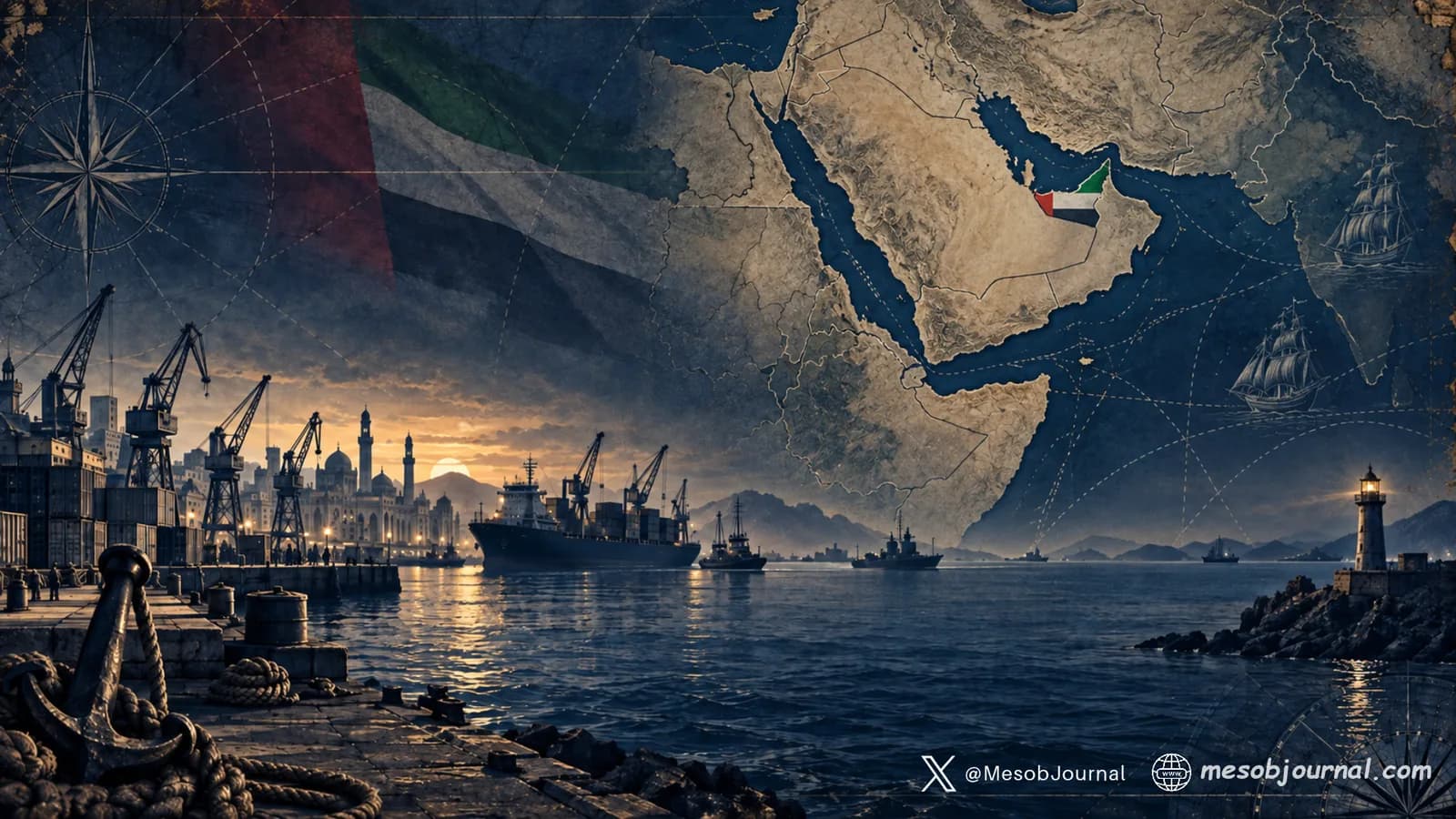
Add the UAE's port network across the region, including DP World in Berbera and Bossaso and AD Ports in Egypt and Tanzania, and you have, from Eritrea's vantage point, not a set of unrelated bilateral ties but an encirclement with infrastructure.
Eritrea has explicitly accused the UAE of pursuing "port imperialism" and has documented its rejection of a DP World management proposal for its own ports alongside the 2016 base request.
Eritrea has directly linked UAE ambitions to Ethiopia’s push for control of a port on the Red Sea.
The UAE is standing behind Ethiopia's claims to Assab, stating that the push for the port is not an Ethiopian plan but driven by Abu Dhabi’s strategic designs, "the imagination of the President of the UAE, who wants to create a constellation of ports under his control across the region." (Eritrea’s Foreign Minister, Osman Saleh, in an interview with Middle East Eye. MEE’s exclusive report published on 12 September 2026 and titled “UAE pursuing ‘port imperialism’ across Africa, Eritrean foreign minister says.”)
The article also treats Ethiopia's transformation as evidence that the old framing no longer applies and forgets that change in its internal politics does not change Ethiopia’s geopolitical ambition.
Ethiopia is landlocked and has made no secret of its demand for Red Sea control and territorial annexation, focusing on Eritrea's port of Assab, which Asmara insists is non-negotiable sovereign territory.
Tensions have escalated to the point where Ethiopia accuses Eritrea of arming rebel groups, and Eritrea accuses Ethiopia of hosting, training, and financing subversive proxy groups including the Red Sea Afar Democratic Organization.
Eritrea's policy is described by its consistent and documented stand to be based on equal and mutually beneficial regional cooperation frameworks, and it rejects the description of itself as isolationist, a concept it regards as false, malicious, and contradicted by its strategic location, economic capabilities, and government policies.
That is a direct answer to the article's implication that Eritrea is the outlier in a modernizing region.
The broader regional picture reinforces rather than undermines Minister Saleh's warning. The Horn of Africa is now a theatre of competing Gulf axes.
A Saudi/UAE feud has "overshadowed" the African Union summit, forcing countries across the region to choose sides. Eritrea is part of the Red Sea Council Axis with Egypt and Saudi, while the UAE backs Ethiopia and the RSF in Sudan.
This is not "multidirectional diplomacy." It is a scramble, and the article's framing obscures the coercion involved in that scramble by presenting it as a natural evolution of regional relations.
Eritrea's insistence that its partnerships avoid unbalanced advantages or structural dependency reads as a direct response to that coercion, an assertion of sovereignty against a regional order in which smaller states are expected to accept dependency as the price of engagement.
On the sanctions, the sequence matters. The sanctions were imposed in November 2021 under Executive Order 14046 and were renewed annually through a presidential declaration of national emergency.
The Treasury's notice on September 18, 2026, stated simply that the national emergency had "expired," and Washington said the end of the emergency reflected the change in circumstances on which the measures were based, namely the end of the Tigray war with the 2022 Pretoria Peace Agreement and without presenting evidence or explanation as to why it took the US Administration this long to cease renewing the sanctions annually until now.
The inclusion of Eritrea in EO14046 was also never explained clearly and no evidence was ever presented to substantiate the blanket accusations.
The mechanism to expire EO14046 was automatic rather than a sudden policy pivot triggered by the current Red Sea crisis in relation to the US/Israel war on Iran.
However, the lifting of EO14046 was erroneously and diplomatically linked to the Massad Boulos meeting with Minister Osman Saleh in New York and Cairo.
Those meetings could be better described as preliminary talks to lay the groundwork for broader discussions at appropriate levels concerning comprehensive bilateral cooperation focused on investment and trade.
So, the sequence is that legal expiry creates the opening, and the administration uses that opening to pursue engagement. The Red Sea context is background, not cause, but the diplomatic activation of the expiry is deliberate.
Eritrea's own characterization of the sanctions is also worth noting. The measures were described as unjustified by any standards, as having caused significant economic damage, and their removal as sending an important message to the international community about removing a political bias that did not bode well for investment and broader engagement.
That is Eritrea's framing of the sanctions as a political instrument rather than a neutral legal measure, which undercuts the article's implicit treatment of the international system's posture toward Asmara as legitimate and Eritrea's complaints as paranoia.
The article posed a semantic argument and lost a strategic one.
It is correct that the Middle East is no longer a binary Arab/Israeli contest and correct that Gulf states now hedge across multiple relationships.
Ms Blen Mamo Diriba mischievously uses that correct observation to dismiss a warning grounded in specific, recent developments, including a refused Israeli-UAE base request, Emirati drones in Ethiopian hands, an Israeli president in Addis Ababa, a port network encircling the Red Sea, and a neighbour demanding sovereign port control Eritrea will not give.
The author says Minister Osman Saleh is blind to decades of development beyond Eritrea's stagnation.
The more accurate reading is that those decades have delivered to Eritrea a threat environment that looks structurally similar to the old one, a small state on the Red Sea facing a technologically superior external coalition operating through its larger neighbour.
The Minister's framing may sound like the 1970s because the shape of the pressure resembles the 1970s.
Calling that outdated is a luxury of the analyst's armchair, and in this case, an armchair funded by institutions with a clear stake in the outcome.
Meanwhile, the Eritrean government is not trading in nostalgia but building a coastal states coalition, naming its institutions, and describing its terms of engagement in the language of sovereignty and mutual benefit.
That is not an old narrative meeting a new Middle East. It is a state insisting, against a well-funded campaign to define it as obsolete, that it is still the author of its own strategy.