
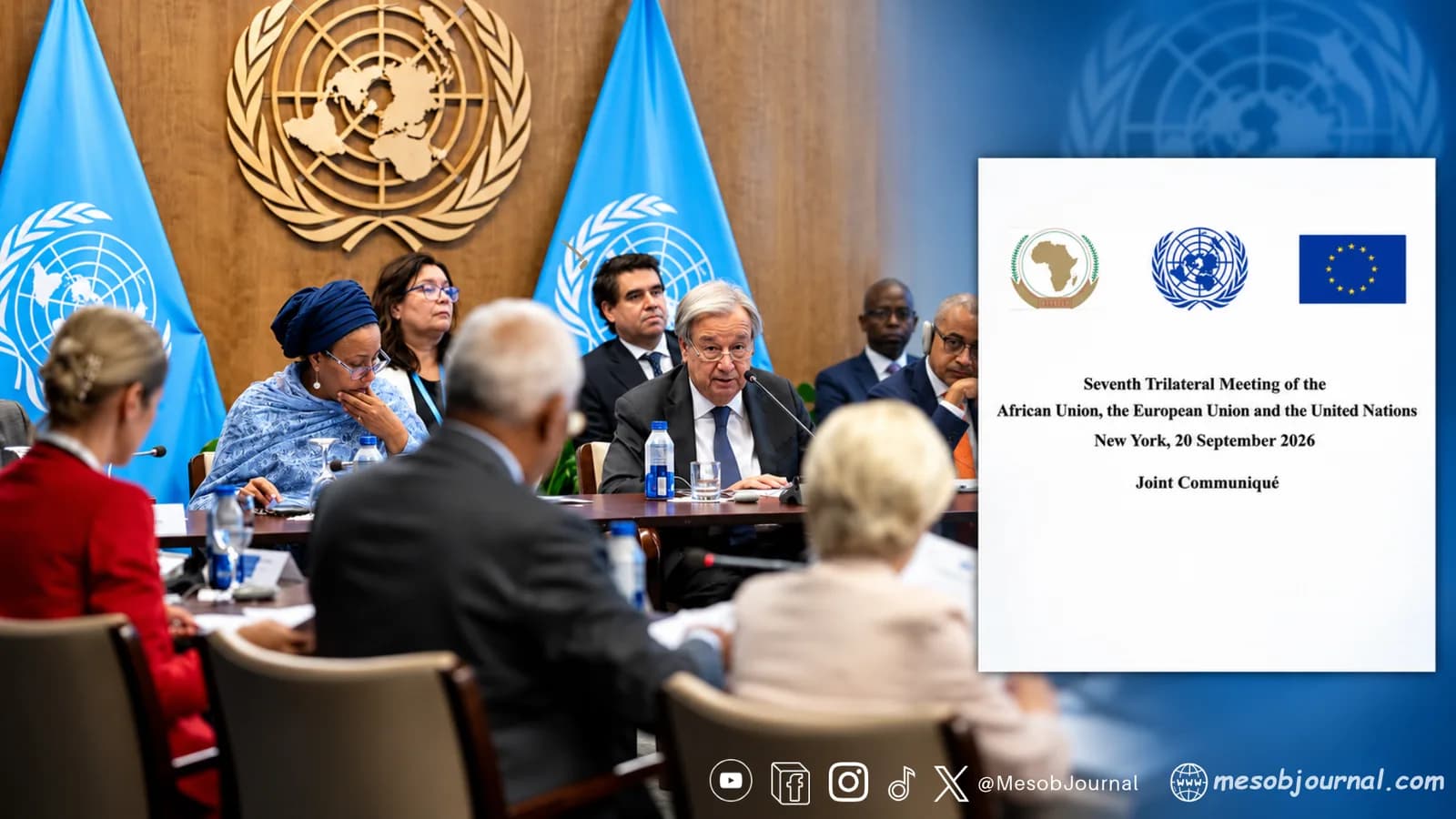
The African Union’s own UNGA81 readouts left Ethiopia out. A jointly agreed communiqué from the same diplomatic round shows that Ethiopia and the Pretoria Agreement were explicitly discussed. The discrepancy deserves an explanation.
The African Union told two noticeably different public stories about its UNGA81 diplomacy.
In its own account of a high-level meeting with the European Union and United Nations in New York, the AU said leaders discussed the Horn of Africa, the Red Sea, maritime security, conflict prevention and regional mediation. Ethiopia was not mentioned. Neither was the Pretoria Agreement.
The formal AU–EU–UN joint communiqué from that same September 20 meeting says something more specific.
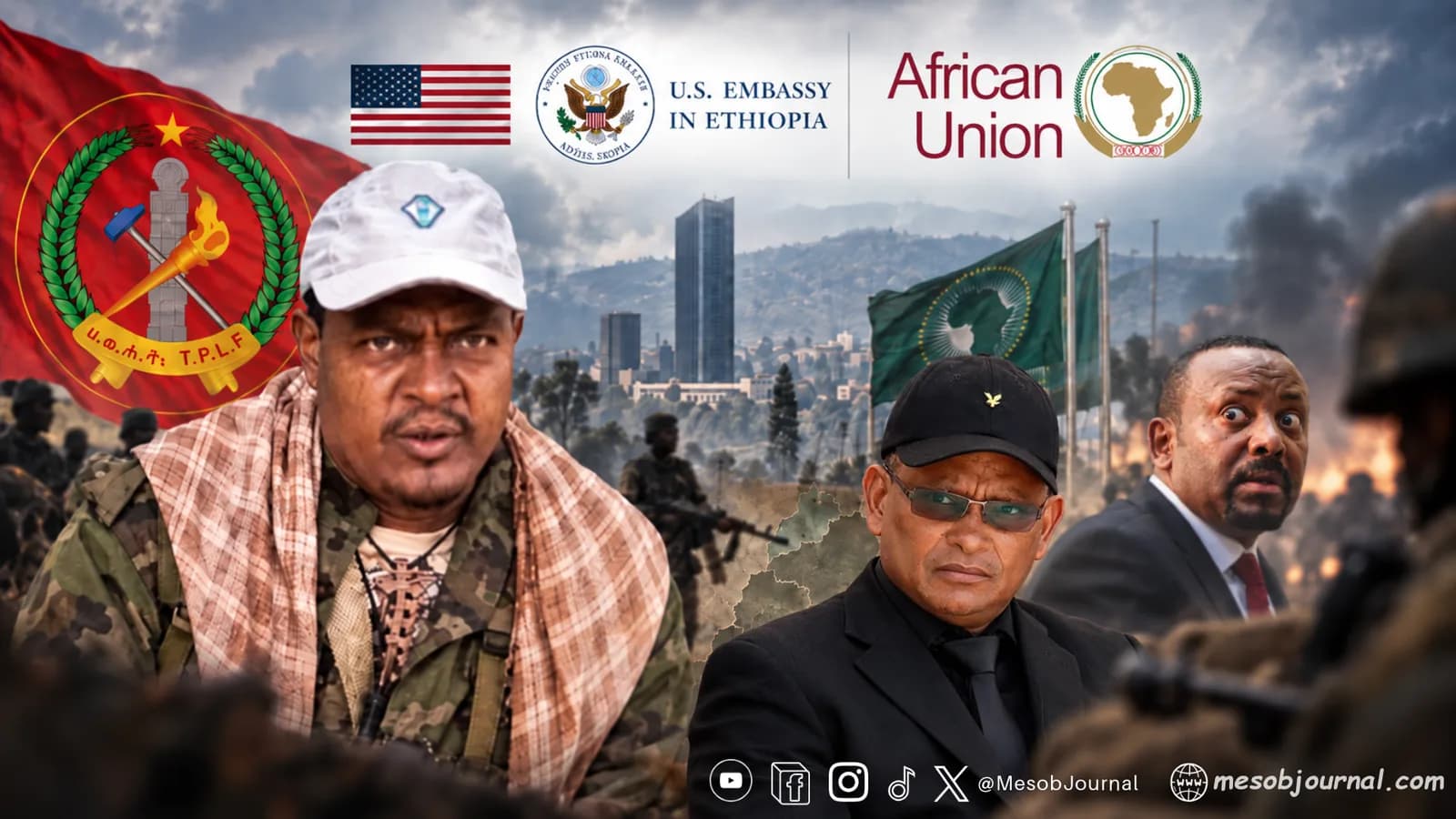
After expressing concern over developments in the Horn and escalation in the Red Sea, the three organizations explicitly backed continuing African Union efforts to advance dialogue in Ethiopia and implementation of the 2022 Permanent Cessation of Hostilities Agreement between the Ethiopian government and the Tigray People’s Liberation Front.
Ethiopia, in other words, was discussed.
The AU simply left that part out of its own public summary.
That omission becomes harder to treat as trivial when another AU readout from the same UNGA81 round — covering a separate meeting between AU Commission Chairperson Mahmoud Ali Youssouf and UN Secretary-General António Guterres — publicly identified crises including Sudan, South Sudan, Somalia, Libya, the Sahel and the Democratic Republic of the Congo without naming Ethiopia.
Whether this was diplomatic caution, editorial compression or a conscious attempt to keep Ethiopia out of the public spotlight cannot be established from the available documents.
What can be established is narrower, and more important: the AU’s public presentation omitted Ethiopia even where another official record confirms that Ethiopia was part of the discussion.
That deserves scrutiny.
What the AU left out
The AU’s September 21 account of the trilateral meeting was not unusually short.
It described the leaders involved, the importance of multilateral cooperation, development financing, reform of the international financial architecture, food security, climate resilience, satellite-supported early warning systems and cooperation around the Horn and Red Sea.
On security, the AU said particular attention had been given to the Horn of Africa, the Red Sea and maritime security, including efforts to prevent further escalation and strengthen regional dialogue and mediation.
Yet the specific reference to Ethiopia contained in the joint communiqué disappeared.
So did Pretoria.
That distinction is significant because the joint communiqué was not an outside interpretation of the meeting. It was issued in the names of the African Union, European Union and United Nations. Its text records their support for AU dialogue in Ethiopia and implementation of an agreement brokered under AU auspices.
This was therefore not a case of journalists adding Ethiopia to a broader Horn discussion.
The three institutions themselves did.
The AU’s own communications operation chose a broader formulation.
Perhaps there is an ordinary explanation. Institutional readouts routinely compress meetings, and no summary reproduces every item discussed.
But the omission did not concern a technical subtopic.
Ethiopia hosts the African Union. The Pretoria Agreement is one of the AU’s most consequential recent mediation efforts. Northern Ethiopia was again moving toward serious confrontation. The Commission had already warned about the fragility of the peace process months earlier.
On January 30, Youssouf said he was deeply concerned by developments in Tigray and called for preservation of the “hard-won gains” achieved under the Pretoria agreement. The AU said its High-Level Panel on Ethiopia stood ready to intensify dialogue and confidence-building.
The institution knew the danger.
Three days later, the language changed
By September 23, the AU was speaking about Ethiopia in terms that could hardly be mistaken for a peripheral concern.
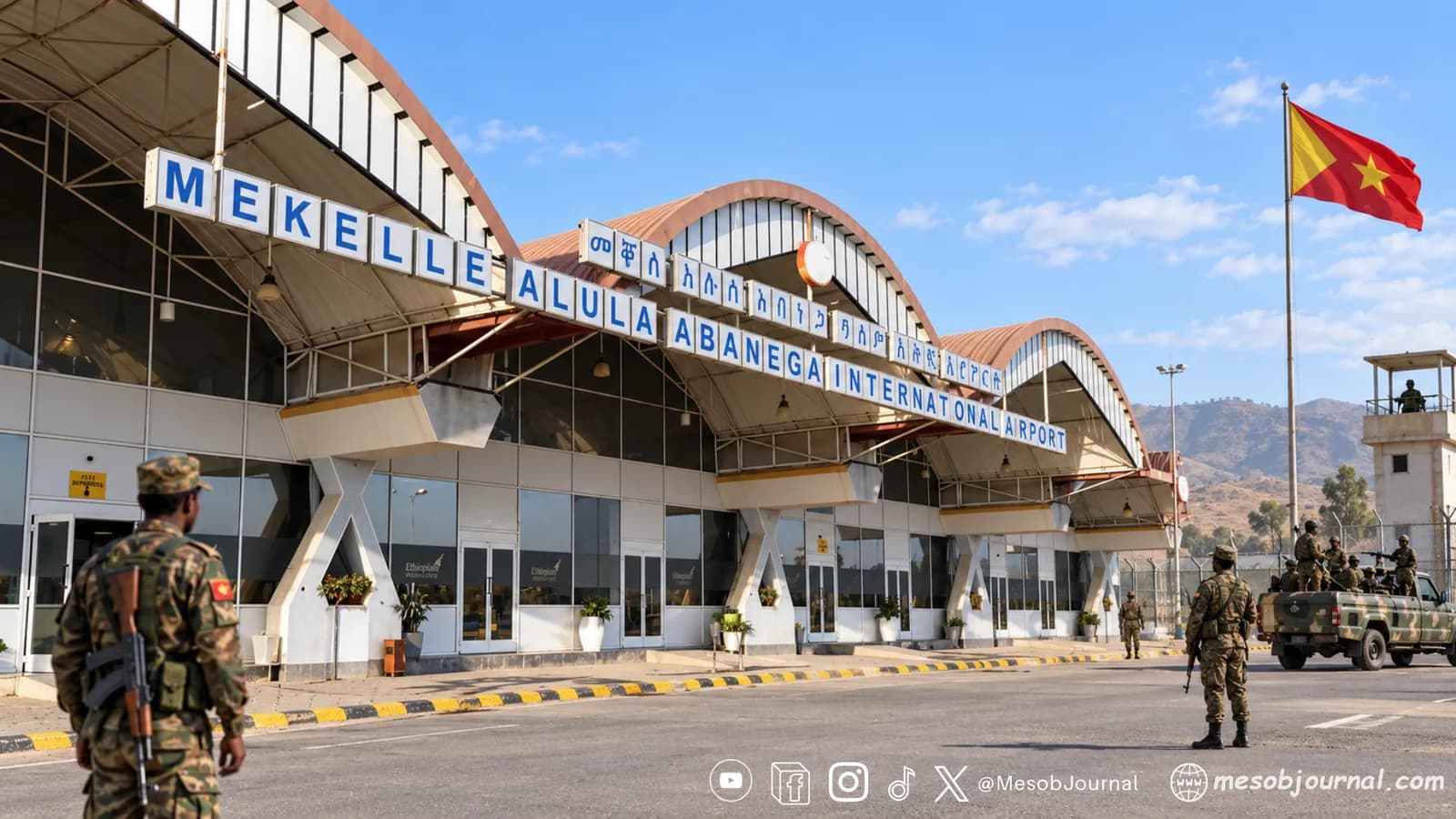
Youssouf expressed “deep concern” over renewed military escalation in northern Ethiopia. His statement cited the seizure of airports in Mekelle, Axum and Shire, the detention of federal personnel, fighting in South Tigray and Afar, and the formation of new political and military alliances.
He warned that the developments risked destabilizing Ethiopia further and reversing gains made under Pretoria. Former Nigerian president Olusegun Obasanjo, the AU High Representative for the Horn of Africa, was asked to engage the parties urgently.
Guterres issued his own statement the same day, describing the situation in northern Ethiopia as “rapidly deteriorating” and warning against a broader and more devastating conflict.
None of that proves that the AU deliberately concealed Ethiopia three days earlier.
It does, however, make the public omission more consequential.
An institution committed to early warning should not become clearest about a crisis only after the warning signs turn into military facts.
The AU itself had spent late August calling for stronger continental conflict-prevention mechanisms. At the extraordinary summit in Luanda, Youssouf said prevention needed to become a priority and called for stronger early-warning capacity and more effective implementation of AU decisions.
The credibility test for such language begins close to home.
The headquarters question
The African Union’s headquarters in Addis Ababa inevitably complicates this discussion.
Location alone proves nothing. It would be irresponsible to treat every omission as evidence of Ethiopian interference.
There is nevertheless a documented institutional history here.
A Chatham House study examining the regional response to the Tigray war concluded that the AU and IGAD initially performed weakly as conflict-resolution mechanisms. Among the factors it identified was Ethiopia’s position as host of the AU headquarters and its considerable influence within IGAD, circumstances the study said made it more difficult for either organization to take an assertive role during the early stages of the conflict.
That research dealt with the Tigray war beginning in 2020. It does not establish what happened inside the AU communications machinery at UNGA81 in September 2026.
It does establish that concerns about institutional proximity are not inventions of the present controversy.
The question is therefore legitimate: does hosting Africa’s principal continental institution give Ethiopia a degree of diplomatic insulation that other crisis-affected member states do not enjoy?
The AU’s own communications record should help dispel that concern.
At UNGA81, it did the opposite.
Prevention cannot depend on geography
There is an unfortunate irony in the setting.
AU officials can discuss Sudan with great specificity while sitting in Addis Ababa. They can name Somalia, Libya, the Sahel and eastern Congo. They can call for accountability, mediation, early intervention and political solutions thousands of kilometres from the Union’s headquarters.
Ethiopia should not become more difficult to name because the crisis is outside the office window.
That is especially true because Ethiopia’s instability reaches well beyond a dispute between the federal government and the TPLF.
The country continues to contend with armed conflicts and political fragmentation elsewhere, while tensions around Tigray threaten an agreement the AU itself helped negotiate. Mesob Journal had already questioned Ethiopia’s absence from the published AU–UN crisis discussion before the full trilateral record brought the discrepancy into sharper focus.
And the people who pay for institutional hesitation are not the political class in Addis Ababa.
They are Ethiopians.
Civilians in Tigray have already lived through a catastrophic war. Communities in Amhara and Oromia have endured prolonged insecurity of their own. None should become invisible because diplomatic institutions prefer dealing with Ethiopia through the language of state relations rather than the reality experienced by its population.
Criticism of the AU on this point is not criticism of Ethiopia as a country.
It is precisely the opposite.
If the African Union exists to prevent African conflicts, Ethiopian civilians are entitled to the same institutional vigilance as Sudanese, Somali, Congolese or Libyan civilians.
A public record that does not quite match
The strongest evidence against the AU is therefore not speculation about secret instructions or closed-door pressure.
It is the AU’s own paperwork.
One account spoke about the Horn, the Red Sea, conflict escalation and mediation without mentioning Ethiopia.
The formal communiqué from the same trilateral meeting explicitly mentioned Ethiopia and Pretoria.
A separate AU–UN readout publicly enumerated major African crises and again omitted Ethiopia.
Within days, the AU Commission chairperson was warning that developments in northern Ethiopia could reverse years of peace efforts and urgently sending his Horn envoy back into mediation.
There may be an innocent explanation for each individual decision.
Taken together, they leave a legitimate transparency problem.
If Ethiopia was important enough to appear explicitly in the jointly agreed AU–EU–UN communiqué, why was it removed from the AU’s own account of that meeting?
If the AU had already been warning since January about the fragility of Pretoria, why did Ethiopia disappear when its leadership publicly reviewed African conflict prevention at UNGA81?
And if a continental institution wants Africans to trust its early-warning system, why should readers have to compare documents issued by its international partners to discover that a major crisis involving its host country was discussed at all?
The African Union does not need to single Ethiopia out.
It needs to show that Ethiopia is not singled out for silence.
Its credibility as a continental peace institution depends on the distinction.