
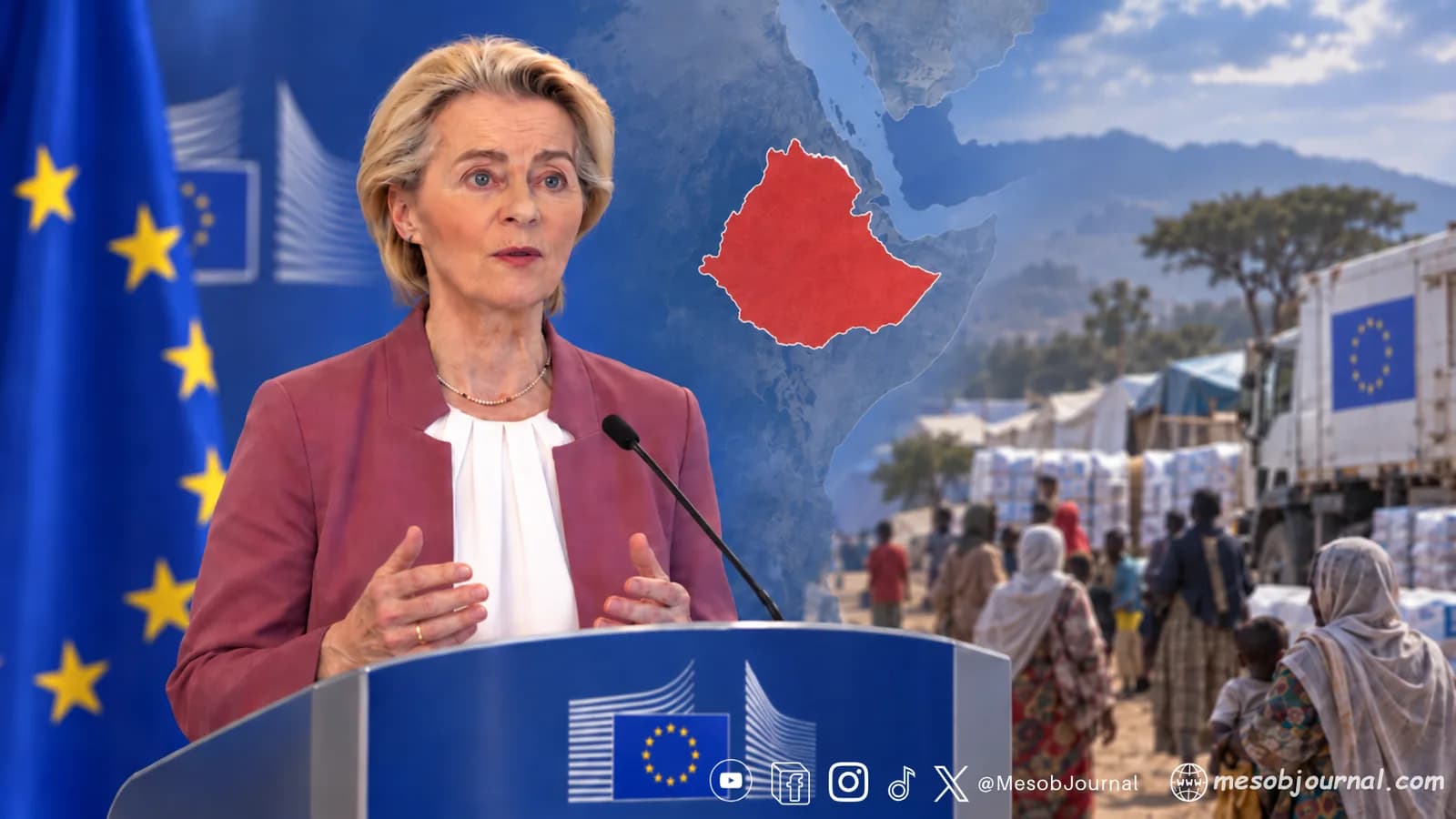
The European Union has added €18 million in humanitarian assistance for Ethiopia, bringing its total support for 2026 to €61 million as renewed fighting spreads across the country's north and Brussels warns that the situation is “rapidly deteriorating.”
European Commission President Ursula von der Leyen announced the additional funding in New York at the close of the 81st United Nations General Assembly High-Level Week. The Ethiopia allocation forms part of a wider package of almost €710 million for displaced populations in Africa and people affected by crises elsewhere.
The latest escalation has drawn international attention following the seizure of three airports in Tigray, but the return to direct fighting began weeks earlier.
Heavy clashes between federal and Tigrayan forces erupted on August 1 near Ethiopia's border with Sudan, followed by sporadic fighting and air attacks inside Tigray.
On August 20, an Ethiopian government airstrike hit a residential compound in the Daero neighbourhood of Mekelle, wounding 13 civilians, including seven children.
A Human Rights Watch investigation published on September 25 examined satellite imagery, photographs and video from the site and interviewed survivors, medical workers and residents. Investigators said they found no evident military target at the compound and called for the strike to be investigated as a possible war crime.
A second airstrike struck Quiha, near Mekelle airport, on the same day. No casualties were reported from that attack.
The violence continued into September. On September 21, a drone struck a humanitarian convoy in Tigray carrying assistance for internally displaced people. The United States condemned the attack and called for an investigation. Responsibility for that strike has not been independently established.
The humanitarian situation was already fragile before the latest military escalation. More than 500,000 internally displaced people remain in Tigray, according to EU humanitarian estimates, with many dependent on outside assistance and little substantial recovery from the 2020-2022 war.
Amhara Was Already Under Sustained Conflict
The renewed fighting in Tigray is unfolding alongside a much longer federal military campaign in neighbouring Amhara, where conflict between government forces and Fano groups has continued since 2023.
United Nations human rights monitoring documented extensive use of drones and heavy artillery during government operations in Amhara.
An OHCHR assessment recorded 18 UAV strikes between August and December 2023 that killed 248 civilians and injured 55. It also documented extrajudicial killings, attacks on civilians and civilian objects, and the use of heavy artillery by government forces. Shelling and other military operations continued to affect civilian-populated areas into 2024.
Civilian harm from drone warfare was still being reported in 2025.
In early February, a strike in North Shewa killed a pregnant woman, her six-year-old daughter and a young man. Another strike on February 20 killed 16 people, including children, and injured 10 in East Gojjam, according to documentation compiled for Human Rights Watch's 2026 Ethiopia report.
Humanitarian access in Amhara has meanwhile remained severely constrained by insecurity, kidnappings, attacks on aid workers and continuing armed confrontation.
The significance of that background is difficult to miss: northern Ethiopia was already experiencing sustained armed conflict, drone warfare, civilian displacement and restricted humanitarian access before the dramatic developments of late September.
Airport Seizures Push Crisis Into New Phase
The confrontation entered a new phase on September 23 when TPLF forces seized the airports at Mekelle, Axum and Shire and detained federal personnel.
The African Union said the seizures were inconsistent with commitments under the November 2022 Pretoria Agreement and warned that the renewed military escalation risked reversing gains made since the end of the previous war.
AU Commission Chairperson Mahmoud Ali Youssouf called for immediate de-escalation and direct talks and asked former Nigerian President Olusegun Obasanjo, the AU's High Representative for the Horn of Africa, to urgently engage the parties.
The European Union adopted a similarly urgent tone, but its account of the crisis did not begin with the airports.
In its September 23 statement, Brussels said it had been following with concern “several drone strikes conducted by the Ethiopian National Defence Force” over the preceding weeks, alongside military activity across several locations and the subsequent TPLF takeover of the three airports.
The EU called for immediate de-escalation, protection of civilians and respect for international humanitarian law. It also condemned strikes affecting humanitarian convoys and the denial of humanitarian access.
That chronology is significant. The airport seizures represented a major escalation, but they came after weeks of renewed clashes and federal air and drone operations in Tigray.
€61 Million as Humanitarian Needs Rise
The European Commission followed its political statement with the September 28 humanitarian funding announcement.
The additional €18 million raises EU humanitarian assistance for Ethiopia in 2026 to €61 million. The funding will support emergency food and nutrition assistance, healthcare, water and sanitation, shelter, protection and education in emergencies.
The Commission identified continuing insecurity in Amhara and Oromia as major drivers of humanitarian need, while renewed conflict in northern Ethiopia has again placed Tigray at the centre of international concern.
“People in Ethiopia have already paid far too high a price for conflict, displacement and hunger,” EU crisis management commissioner Hadja Lahbib said, calling for urgent de-escalation.
The fighting has nevertheless continued.
By September 28, Ethiopian federal forces and allied groups had moved back into Alamata, a strategically important town in southern Tigray, according to video evidence and diplomatic sources cited by Reuters. Fighting has also extended into parts of Amhara and Afar.
The current crisis therefore extends beyond the seizure of three airports.
It follows a longer sequence of armed confrontation involving federal forces, Tigrayan forces, Fano and other armed groups, with drones and air power playing an increasingly visible role and civilians facing renewed displacement and restrictions on humanitarian access.
The EU's latest intervention does not resolve the political and military disputes driving those conflicts. The €61 million is humanitarian assistance, not a political settlement.
But Brussels' own account of the deterioration is broader than the events of September 23. It places the airport seizures within an escalation that was already underway — including federal drone strikes in the preceding weeks — as Ethiopia's 2022 peace framework faces its most serious test since it was signed.