
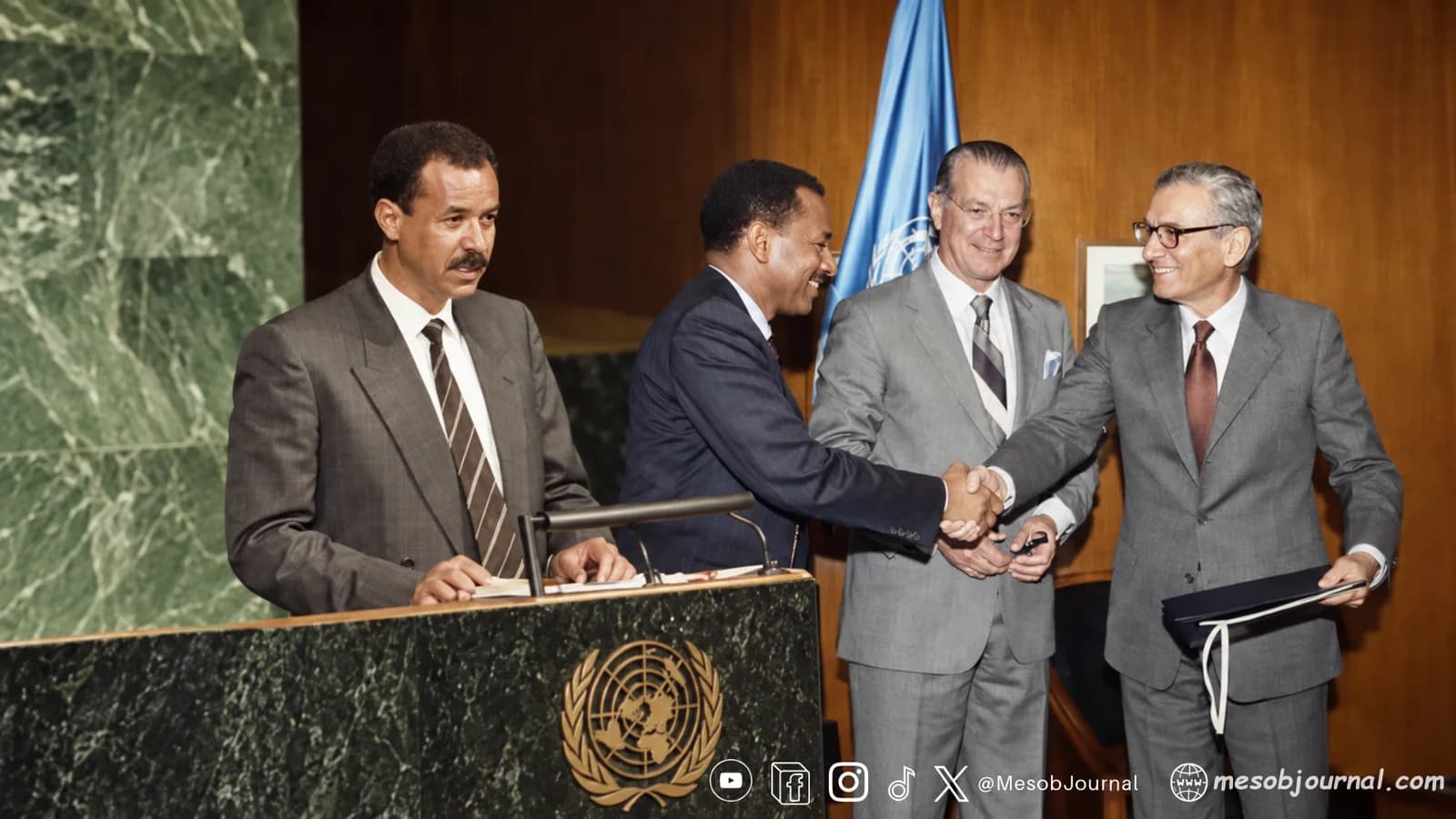
The Day Eritrea Confronted History, the World, Spoke Truth to Power and Claimed Its Voice.
September 30, 1993 occupies a singular place in Eritrean political history, marking the moment when a nation long denied its voice finally addressed the world on its own terms.
On that day, H.E. President Isaias Afwerki delivered Eritrea’s first national statement to the United Nations General Assembly, speaking not as a petitioner or a marginalized actor but as the leader of a sovereign state whose legitimacy had been earned through decades of struggle, sacrifice, and democratic affirmation.
The significance of this moment cannot be understood without recalling the long arc of Eritrea’s relationship with the UN, an arc defined by imposed decisions, geopolitical bargaining, and a silence that lasted more than forty years.
The speech delivered on September 30 was therefore not simply a diplomatic address; it was a historical correction, a formal confrontation with an institution that had once determined Eritrea’s fate without Eritrean participation.
President Isaias began by acknowledging the profound weight of the moment. He stated that he felt a special privilege speaking on behalf of a people who had struggled for half a century to regain their fundamental human and national rights.
Eritrea’s independence was not the product of external generosity or negotiated compromise. It was achieved through a long war of resistance, through the endurance of civilians and fighters alike, and ultimately through a free and fair referendum that expressed the will of the Eritrean people with unmistakable clarity.
By emphasizing that Eritrea joined the community of independent states on solid legal grounds, the President underscored that sovereignty was not merely declared; it was validated through democratic procedure and rooted in international law.
This framing directly challenged the historical injustice of 1950, when the UN decided to federate Eritrea with Ethiopia, subordinating a colonized people to Cold War strategic interests and denying them the right to self-determination.
In recalling this history, President Isaias did not resort to emotional appeals but instead presented a disciplined account of Eritrea’s long engagement with the UN.
He reminded the Assembly that Eritrea had sent appeals year after year, describing the suffering inflicted upon its people and requesting recognition, sympathy, and support. These appeals were directed not only at the international community but specifically at the UN, which had assumed a special responsibility toward Eritrea when it passed the 1950 resolution.
The President noted that the UN had affirmed that the Eritrean question could be revisited at any time, yet for forty one years, as Eritrea endured Africa’s longest war and some of the most severe violations of human rights, the UN remained silent.
Eritrea never appeared on the agenda. This silence was not neutral; it functioned as a form of complicity, granting impunity to those who sought to erase Eritrea’s identity and sovereignty.
The President’s words made clear that the absence of Eritrea from the UN agenda was not an oversight but a political choice shaped by global power dynamics.
He detailed how the war against Eritrea was supported first by the United States and later by the Soviet Union, each pursuing its own strategic interests in the Horn of Africa. Eritrea became a battleground not only for its own liberation but for the geopolitical ambitions of superpowers.
Despite this, Eritreans refused to abandon their struggle. President Isaias invoked an Eritrean proverb “The rod of truth may become thinner but it cannot be broken” to illustrate the nation’s resilience.
Truth, justice, and national identity endured even under immense pressure. The proverb served as a concise expression of Eritrea’s political philosophy: that justice, though strained, remains intact when pursued with unwavering resolve.
The President’s use of this proverb was not ornamental; it was a reminder that Eritrea’s struggle was anchored in principles that could not be extinguished by external force.
By the time Eritrea stood before the UN in 1993, it did so not as a victim seeking sympathy but as a sovereign state asserting its rightful place in international affairs.
President Isaias’s address marked the moment when Eritrea reclaimed its narrative and corrected the historical record. The speech was both retrospective and forward looking. It acknowledged the injustices of the past while asserting Eritrea’s commitment to constructive engagement with the international community.
The President made clear that Eritrea did not seek revenge or retribution; it sought recognition of truth and respect for sovereignty.
Justice had finally prevailed, not because the world granted it, but because Eritreans insisted on it across generations.
The significance of September 30 extends beyond the speech itself. It represents the culmination of a national journey in which Eritrea transformed from a subject of geopolitical bargaining into an independent actor capable of articulating its own interests.
The speech symbolized the restoration of Eritrea’s political agency. It also served as a reminder to the international community that historical decisions carry consequences, and that institutions must confront the legacies of their actions.
For Eritreans, the moment was not merely symbolic; it was a vindication of decades of sacrifice and a declaration that their future would no longer be determined by external powers.
In reflecting on this moment, it becomes clear that September 30 is not simply a date in Eritrean history; it is a turning point in the nation’s relationship with the world.
It marks the day Eritrea spoke for itself, addressed the institution that once failed it, and asserted its sovereignty with clarity, dignity, and historical precision.
The speech delivered by President Isaias Afwerki remains a foundational document in Eritrea’s diplomatic history, capturing both the weight of past injustice and the confidence of a nation that emerged victorious despite overwhelming odds.
It stands as a testament to Eritrea’s endurance and a reminder that justice, though delayed, can ultimately prevail when pursued with steadfast conviction.