
The Africa Group's choice of an Eritrean diplomat to lead the 2026 UN Social Forum is neither a takeover of the Human Rights Council nor an absolution from scrutiny. It is something more consequential than the outrage allows: a sovereign African state returning to normal multilateral responsibility on terms its opponents could not prevent.
On 3 August, the President of the United Nations Human Rights Council made a concise appointment with an unusually revealing political afterlife.
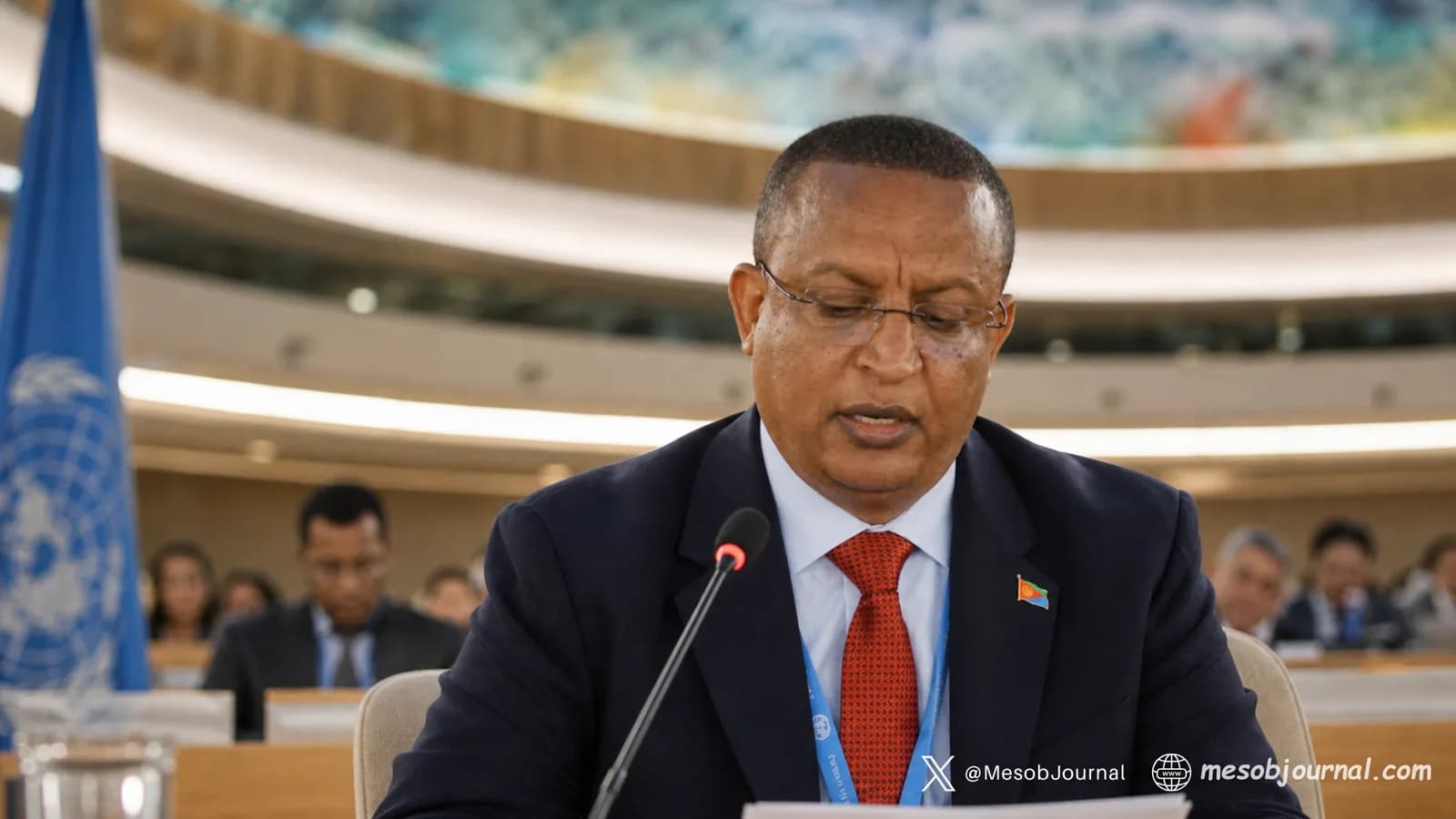
Acting on a nomination from the Africa Group, Sidharto R. Suryodipuro appointed Habtom Zerai Ghirmai, Chargé d’affaires of Eritrea's Permanent Mission in Geneva, as Chair-Rapporteur of the 2026 Social Forum. The Forum will meet on 29 and 30 October to examine how international cooperation and solidarity, including South–South cooperation, can advance the right of everyone to the highest attainable standard of physical and mental health.
The procedural facts are straightforward. Their meaning is not.
Eritrea's opponents reacted to the appointment as though the country had seized control of the Human Rights Council. Some supporters answered as though it had. Both descriptions enlarge the office beyond recognition. Ghirmai has not become president of the Council, and Eritrea has not been granted authority over the Council's country mandates, membership, resolutions, or special procedures. The Social Forum is a distinct annual meeting convened by the Council. Its Chair-Rapporteur leads the discussion and carries its outcome back to the parent body.
Accuracy does not diminish the achievement. It locates it.
The diplomatic success occurred first within the Africa Group, which chose an Eritrean representative as its candidate. It was completed when the Council president made the appointment. Regional rotation explains why the 2026 chair was to come through a regional nomination. It does not explain away the African choice. The continent contains 54 states and many experienced missions in Geneva. Eritrea was not mechanically produced by a calendar. It was nominated.
That decision is the part of the story the outrage is designed to obscure.
What the appointment says—and what it does not
No serious publication should present a UN office as a certificate of virtue. Multilateral institutions are not academies awarding moral prizes. They are places where sovereign states, including states with profound disagreements about one another, allocate responsibilities, negotiate texts, manage meetings, and build enough consent to keep collective machinery working.
The appointment therefore does not settle arguments about Eritrea's domestic political order. The Human Rights Council renewed scrutiny of Eritrea in 2026, and human-rights organizations continue to allege grave violations and to press for access, accountability, and cooperation with the country mandate. Those disputes remain on the record. Pretending otherwise would weaken the very argument Eritrea's critics need to confront.
The reverse proposition is equally unsound. A disputed domestic record does not erase statehood, suspend diplomatic equality, or give advocacy organizations a veto over African nominations. The United Nations was not designed as a club in which engagement is reserved for governments approved by a small set of campaign groups. Its work depends on universal participation precisely because the world is politically plural, unequal, and frequently in conflict.
The Social Forum makes that principle unusually visible. The OHCHR's practical guide describes it as an open space where member states, civil society, grassroots organizations, national institutions, international bodies, and other participants engage on an equal footing. The chair's test is not ideological conformity. It is whether he can protect that openness, organize a serious exchange, and produce a fair account of the discussion.
Critics are entitled to scrutinize Ghirmai's performance. Declaring him illegitimate before the Forum meets is not scrutiny. It is a demand for exclusion.
The Africa Group exercised its own agency
The appointment also exposes a familiar contradiction in the treatment of African diplomacy. Western governments and international organizations routinely invoke African ownership, regional representation, and inclusive multilateralism. Yet when an African group makes a choice that falls outside the preferred political script, the group's agency is made to disappear. The African decision is recast as an institutional embarrassment, a loophole, or evidence that the system itself lacks credibility.
The hypocrisy becomes unavoidable when these same powers treat UN participation as a reward for an uncontested human-rights record—a condition they have never accepted for themselves. The United States- and United Kingdom-led invasion of Iraq proceeded without a new Security Council authorization; Secretary-General Kofi Annan said it was not in conformity with the UN Charter. In Libya, the Council authorized force to protect civilians, but the NATO campaign's evolution toward regime change produced enduring criticism, recorded even in later UN analysis, that the mandate had been exceeded. Iraq and Libya are not legally identical. Both show that grave controversy over war and sovereignty did not disqualify the intervening powers from normal authority throughout the UN system.
Gaza sharpened the double standard. Washington and several European governments maintained political or military support for Israel even after the International Court of Justice issued binding provisional measures under the Genocide Convention and UN experts warned that continued arms transfers risked responsibility or complicity in grave violations and possible atrocity crimes. In February 2026, the United States joined Israel in strikes on Iran while indirect negotiations were under way. The legal justifications remain contested, but the operation had no Security Council authorization; António Guterres responded by recalling the Charter's prohibition on force against another state's territorial integrity and urging a return to diplomacy.
None of this grants Eritrea immunity from scrutiny. It removes the fiction that international office is reserved for innocent states. Human-rights standards gain legitimacy through consistent application. Applied only downward, they become hierarchy.
The message to African states is otherwise unmistakable: their participation is welcome only when it ratifies judgments formed elsewhere.
The Africa Group did not issue a collective endorsement of every Eritrean policy. It nominated an Eritrean diplomat for a defined responsibility. The distinction is elementary and important. States cooperate without becoming identical. They can disagree over governance while recognizing competence, regional entitlement, diplomatic reciprocity, and the value of bringing a member back into working relationships.
For Eritrea, this is where the victory becomes real. Isolation is not merely the absence of meetings. It is the loss of a state's ability to be heard as a legitimate actor, to attract regional support, to shape agendas, and to receive responsibilities within institutions. Ghirmai's nomination demonstrates that whatever hostility persists around Eritrea, it has not been converted into an African consensus for diplomatic quarantine.
The appointment belongs to a wider sequence. Sophia Tesfamariam serves in 2026 as one of four vice-presidents of the UNICEF Executive Board, representing the African regional group. On 2 June, Eritrea was also among six African states elected to vice-presidencies of the eighty-first session of the General Assembly. The UN meeting record shows that the African slate contained six candidates for six places, so the election proceeded without a secret ballot.
These details matter. None of the positions should be inflated into a global plebiscite on Eritrea. UNICEF's Bureau is structured around regional representation. General Assembly vice-presidencies are geographically allocated. The Social Forum chair is appointed through regional nomination and rotation.
Yet procedure is not the opposite of diplomacy. Procedure is one of the places diplomacy lives. A state that repeatedly secures a place on regional slates, receives nominations, and is trusted to discharge institutional functions is accumulating working relationships. The evidence is not that the world has suddenly adopted Eritrea's view of itself. It is that the attempt to define Eritrea solely through isolation has failed.
A health forum Eritrea can approach with substance
The Forum's 2026 theme gives the appointment more than symbolic value. It asks how cooperation and solidarity can advance physical and mental health, with an explicit emphasis on South–South cooperation. Eritrea enters that discussion with experience worth examining rather than slogans worth repeating.
The World Health Organization's 2024–2025 country profile credits integrated outreach in Eritrea with vaccinating more than 42,000 children and 15,000 mothers in 2024, achieving coverage above 95 percent for several vaccines. WHO also records progress toward measles elimination, substantial reductions in HIV prevalence, and improvements in disease surveillance. Its 2026 joint external evaluation highlights political commitment, community health workers, broad public provision, and immunization as a flagship strength.
The record is not flawless, and WHO does not present it that way. Hard-to-reach communities still face disparities. Maternal mortality remains high. Health financing, specialist care, infrastructure, and the response to non-communicable diseases require further work. This combination of achievement and unfinished business is precisely what a useful Social Forum should accommodate: practices that others can adapt, constraints that require honest discussion, and cooperation that respects national ownership without hiding measurable gaps.
Eritrea's own experience also speaks to the politics embedded in the Forum's theme. International solidarity is often described as assistance moving from powerful institutions to weaker recipients. South–South cooperation begins from a different premise: developing states also possess knowledge, institutional practices, and solutions worth exchanging. Community health networks, low-cost outreach, preventive medicine, and vaccination across difficult terrain are not marginal experiences. They are part of the global health record.
Ghirmai will have an opportunity to make the Forum reflect that breadth. If the programme includes serious African and Global South expertise, preserves meaningful space for civil society, welcomes disagreement, and produces practical recommendations, Eritrea will have done more than occupy a chair. It will have demonstrated the diplomatic competence that made the appointment defensible.
Why every engagement becomes a scandal
The recurring anger over Eritrea's international participation follows a recognizable logic. For years, the country has been narrated through sanctions, country mandates, migration, and predictions of collapse. In that frame, diplomatic isolation appears not as one policy choice among others but as the natural condition Eritrea supposedly deserves. Any departure from it—a regional nomination, a bilateral meeting, a UN bureau position—must then be explained as corruption, hypocrisy, manipulation, or institutional failure.
This is not ordinary criticism of a government. Ordinary criticism accepts that a state can be challenged in one forum and cooperate in another. The isolationist frame demands something broader: Eritrea must remain permanently disqualified from normal relations until its critics decide otherwise.
Multilateral diplomacy does not operate on that permission structure. The Council can maintain a country mandate concerning Eritrea while an Eritrean diplomat chairs one of its forums. African states can support the nomination without adopting every Eritrean argument. Civil-society organizations can participate in October without endorsing the chair's government. Institutional coexistence is not hypocrisy. It is the work.
The same principle protects everyone. If participation were conditioned on an uncontested national record, few powerful states would survive the test. If only governments acceptable to the loudest transnational campaign could hold procedural office, sovereign equality would give way to an informal hierarchy with no charter, no vote, and no accountability.
Eritrea does not need immunity from criticism. It is entitled to equality in the arena where criticism, cooperation, and negotiation occur.
The chair now has to justify the confidence
Diplomatic victories can be wasted by exaggeration. Calling Ghirmai the chair of the Human Rights Council gives critics an easy correction and distracts from the actual African decision. Treating the appointment as proof that every allegation against Eritrea has collapsed asks one procedural office to carry a claim it cannot support.
The more credible conclusion is also the more durable one. Eritrea has secured a visible responsibility inside an institution where it remains contested. It did so through the nomination of the Africa Group. The subject of the Forum intersects with areas in which independent UN health bodies acknowledge genuine Eritrean progress. The appointment follows other 2026 multilateral roles that, taken together, show a state expanding its functional diplomatic presence.
Now comes performance. The Forum must be open, well run, substantively serious, and faithfully reported. Eritrea's supporters should expect that standard because successful chairmanship would turn a moment of recognition into institutional capital. Its opponents should apply the same standard because prejudging the outcome merely confirms that their objection is to Eritrean participation itself.
For more than a decade, isolation was often presented as Eritrea's inevitable diplomatic horizon. The letter of 3 August does not end every dispute, and it does not transform the Human Rights Council. It records a simpler defeat for that prediction.
The Africa Group nominated Eritrea. The Council president appointed its diplomat. In October, he will take the chair.
Those facts do not need to be enlarged. They need to be faced.