
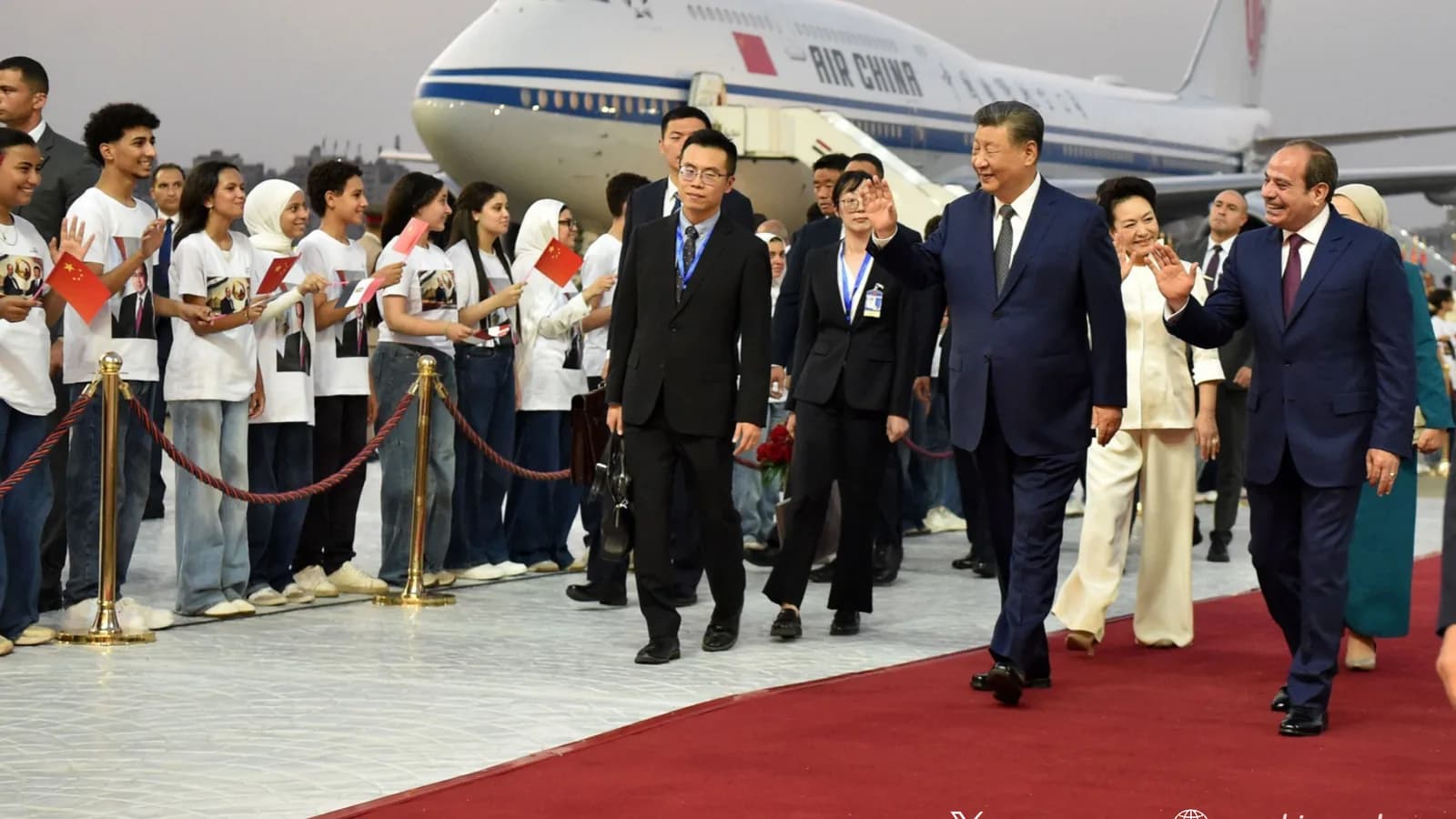
Chinese President Xi Jinping arrived in Cairo for a state visit marking seventy years of relations between China and Egypt. The ceremony was familiar: a presidential welcome, formal talks, an agreement and several memoranda of understanding. The substance pointed to something larger.
The two governments agreed to expand the China–Egypt industrial zone in the Suez Canal Economic Zone, deepen cooperation across manufacturing and technology, and strengthen financial ties. In the same joint statement issued on 2 September, they set out a common position on the Red Sea: the states along its shores should carry the primary responsibility for its governance and security, while freedom of navigation and international trade must be protected.
Those commitments belong to the same story. China is treating Egypt not only as the country controlling the Suez Canal, but as an industrial and logistics platform connecting Asia, Africa and Europe. Egypt, meanwhile, is using Chinese investment to build economic activity around a waterway whose toll income has proved dangerously exposed to conflict farther south.
The result is a partnership increasingly organized around the Red Sea as a complete system—production, finance, ports, shipping and security—not merely as a line on a maritime map.
The visit moved quickly from symbolism to industry
Xi's first visit to Egypt in a decade coincided with the seventieth anniversary of diplomatic relations. But President Abdel Fattah el-Sisi's clearest economic announcement concerned the future rather than the anniversary: the launch of a third expansion phase of the China–Egypt Suez Economic and Trade Cooperation Zone.
The zone, developed by China's TEDA group in Ain Sokhna, is already one of the most established expressions of Belt and Road cooperation in Egypt. The new phase announced during the visit is intended to draw further activity in renewable energy, automotive manufacturing, textiles and chemical fibres.
The bilateral statement placed that expansion inside a much wider industrial plan. China and Egypt identified shipbuilding, electric vehicles, solar and wind energy, desalination, semiconductors, data centres, artificial intelligence, agriculture and critical-mineral supply chains as areas for cooperation. They also renewed and expanded their currency-swap arrangement and encouraged greater use of local currencies in trade and investment.
This is more than a collection of sectors. It reflects Egypt's effort to convert location into production. Suez has long earned revenue from what passes through it. The industrial-zone strategy aims to capture value from what can be manufactured, assembled, serviced and exported beside it.
For China, the attraction is equally clear. Production near Ain Sokhna can serve Egypt's large domestic market while remaining connected to ports and trade routes reaching Africa, the Arab world and Europe. The canal is therefore becoming the centre of a wider investment geography rather than the sole economic asset.
Red Sea insecurity explains Cairo's urgency
Egypt's interest in that diversification has been sharpened by the collapse in canal traffic caused by insecurity around the southern Red Sea and Bab el-Mandeb. A ship diverted around the Cape of Good Hope does not pay a Suez toll, regardless of how efficiently Egypt operates the canal itself.
The figures show the scale of the exposure. According to the Suez Canal Authority, the number of vessels crossing the canal fell from 26,434 in 2023 to 13,213 in 2024. Revenue declined by 61 per cent, from a record $10.25 billion to $3.99 billion. El-Sisi said in July 2026 that attacks around Bab el-Mandeb had cost Egypt more than $10 billion in canal income.
Traffic has begun to improve, but the recovery remains vulnerable. The International Monetary Fund described Suez revenues in July as gradually recovering rather than fully restored.
This creates two related priorities for Cairo. The first is a stable maritime corridor from Bab el-Mandeb to the Mediterranean. The second is a larger economic base around Suez that can produce investment, employment and exports instead of leaving Egypt dependent on transit fees alone.
China's industrial offer addresses the second priority. Its new political language addresses the first.
A new Red Sea principle enters the partnership
The 2026 joint statement says that stability in the Horn of Africa requires respect for the sovereignty, unity and territorial integrity of regional states. It then says that Red Sea governance and security are primarily the responsibility of littoral states, whose wishes should be respected. Those states, it adds, should strengthen cooperation to address common challenges and keep navigation and international trade flowing.
This language was not present in the May 2024 China–Egypt joint statement. Its inclusion now reflects the growing cost of Red Sea disruption and Cairo's sustained campaign to place coastal states at the centre of any regional security arrangement.
The word “primarily” is useful because it avoids a false choice between coastal authority and international cooperation. China is not a Red Sea state. It has commercial shipping interests, naval deployments and a permanent military support base in Djibouti. China's Ministry of National Defense describes the facility, operational since 2017, as the country's first overseas support base.
Beijing is therefore not endorsing the removal of outside powers from the Red Sea. It is endorsing an order of responsibility: coastal states set the framework, cooperate among themselves and retain authority; external powers may support agreed tasks without replacing the states whose territory and waters are involved.
That principle is already familiar in regional diplomacy. Egypt and Eritrea have described Red Sea governance as the exclusive responsibility of littoral states. Eritrea's detailed policy nevertheless allows outside cooperation for defined purposes when coastal capabilities are insufficient. Its governing objection is to the delegation of responsibility, not to assistance itself.
China's formulation is compatible with that approach. The important question is not whether foreign ships, investment or technical support may enter the system. It is who defines their role and whether they strengthen regional capacity or become a substitute for it.
Economics and security are beginning to converge
China had already framed the Red Sea as both a trade and political-security problem. During a January 2024 visit to Cairo, Foreign Minister Wang Yi called for an end to attacks on civilian shipping, protection of global supply chains, restraint against escalation, and respect for the sovereignty of coastal states. He also argued that the maritime crisis could not be separated from the war in Gaza.
The latest visit adds a deeper bilateral layer. It followed the August launch of the China–Egypt “Eagles of Civilization 2026” air exercise. The Egyptian Armed Forces said multi-role combat aircraft trained at several Egyptian air bases in joint sorties and the planning and management of air operations.
One exercise does not create an alliance, and the summit did not announce a Chinese naval role in Egyptian waters. It does show that a relationship once described mainly through infrastructure, construction and trade now has a more visible security dimension.
The connection is structural. Chinese companies with fixed assets around Suez have a direct interest in the safety and predictability of the route. Egypt cannot protect canal revenue without stability beyond the canal's southern entrance. Both governments therefore have reason to connect investment policy with maritime diplomacy and security cooperation.
China's position now spans both ends of the route
The geography gives the strategy its shape. In Egypt, China is expanding an industrial and logistics position near the northern entrance to the Red Sea. In Djibouti, close to the southern approaches, it maintains a military support facility and longstanding involvement in transport and port infrastructure. Chinese naval escort missions operate in the adjoining Gulf of Aden and waters off Somalia.
This does not amount to formal control over the corridor, nor has Beijing announced a single doctrine joining these assets together. The “two ends” interpretation is analytical. But the pattern is difficult to ignore: China has accumulated economic and security interests around both approaches to a maritime route central to its trade with Europe, the Middle East and Africa.
Egypt's value within that pattern is distinctive. It offers a large market, an established state, control of the canal and an industrial platform with access to several regions. Cairo also presents its partnership with Beijing as part of a policy of strategic balance rather than dependence on a single external power.
For the wider Red Sea, the China–Egypt statement gives greater diplomatic weight to coastal-state-led governance. Eritrea is one beneficiary because the language echoes its longstanding insistence that national and littoral capacity must come before outside security management. But the implication is regional, not exclusively Eritrean: every functioning coastal state gains leverage when an external power accepts that access and assistance do not confer governing authority.
The agreements still face an implementation test
The Cairo visit set direction more clearly than it supplied detail. Public statements have not yet provided the full timetable, land allocation, investment commitment or tenant pipeline for TEDA's third phase. The agreement and memoranda signed during the visit will matter in proportion to the factories, financing and technology transfer they eventually produce.
The security language faces a similar test. Littoral-state primacy remains a principle rather than an operational architecture. The Council of Arab and African States Bordering the Red Sea and the Gulf of Aden has yet to demonstrate that it can coordinate the diverse priorities and capabilities of its members. Conflict continues to expose the gap between regional ownership as an idea and regional capacity in practice.
China's role will therefore be judged on two levels. Economically, the question is whether its investment helps Egypt build a genuinely productive Suez hub rather than another cluster of announcements and import-dependent assembly. Strategically, the question is whether Beijing's support strengthens the ability of coastal states to manage their shared sea or simply places more Chinese assets under the protection of existing national and foreign security arrangements.
Xi's visit matters because it brought those questions together. The industrial zone, currency arrangements, supply chains, canal revenues and Red Sea governance language are parts of one emerging calculation. Egypt is trying to turn Suez from a vulnerable toll route into a broader economic centre. China is positioning itself inside that transformation while supporting a maritime order led by the states along the coast.
The partnership will not secure the Red Sea by itself. It does show how the contest is changing: influence will belong not only to the power able to deploy ships, but also to the states and partners able to connect security, production and regional authority along the entire corridor.