

The Ethiopian government cannot spend years presenting access to another country’s coastline as an existential national entitlement, put maritime grievances into military briefings, mobilize public opinion around port ownership—and then demand that the world examine its latest aggression narrative without that record.
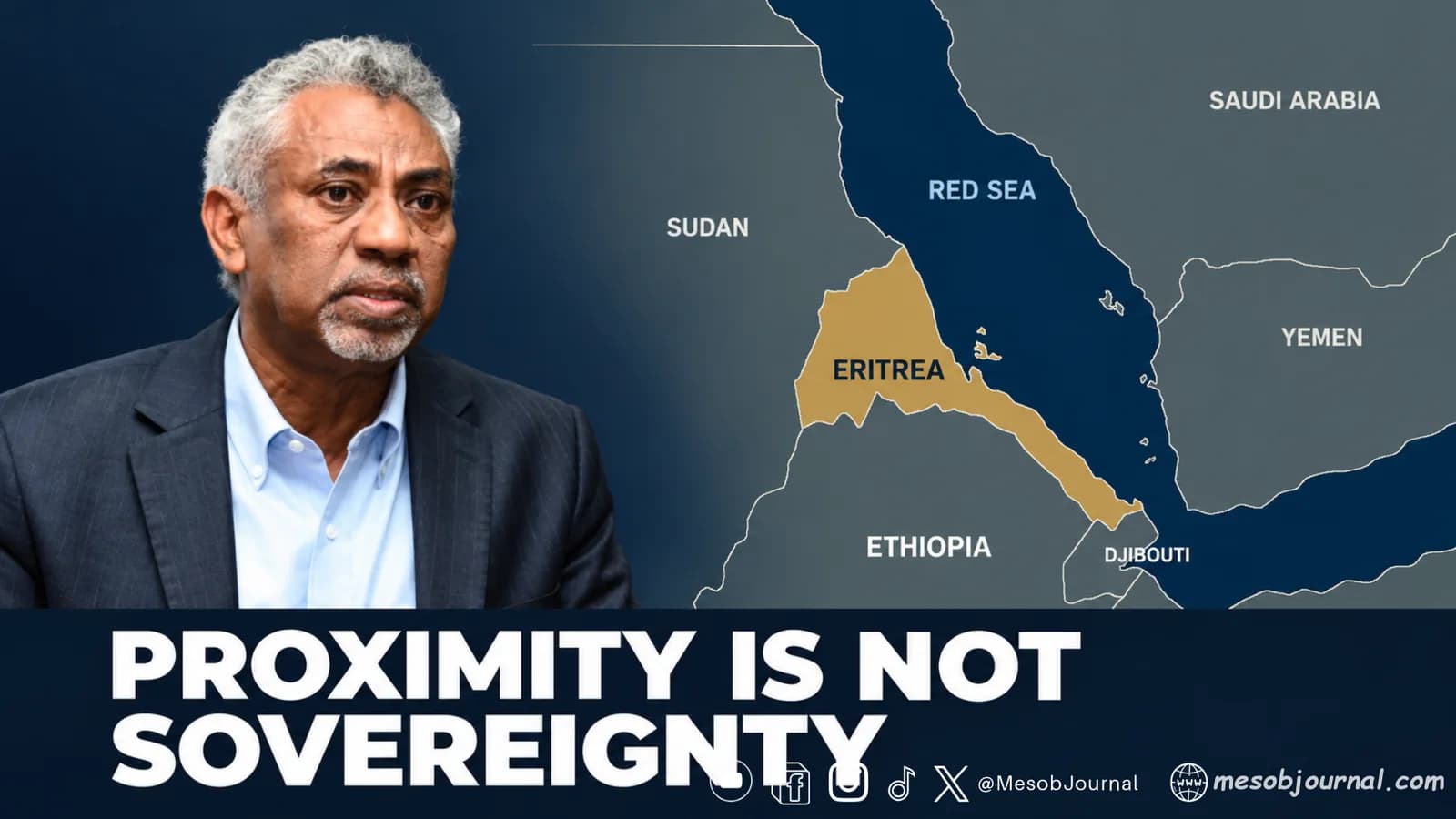
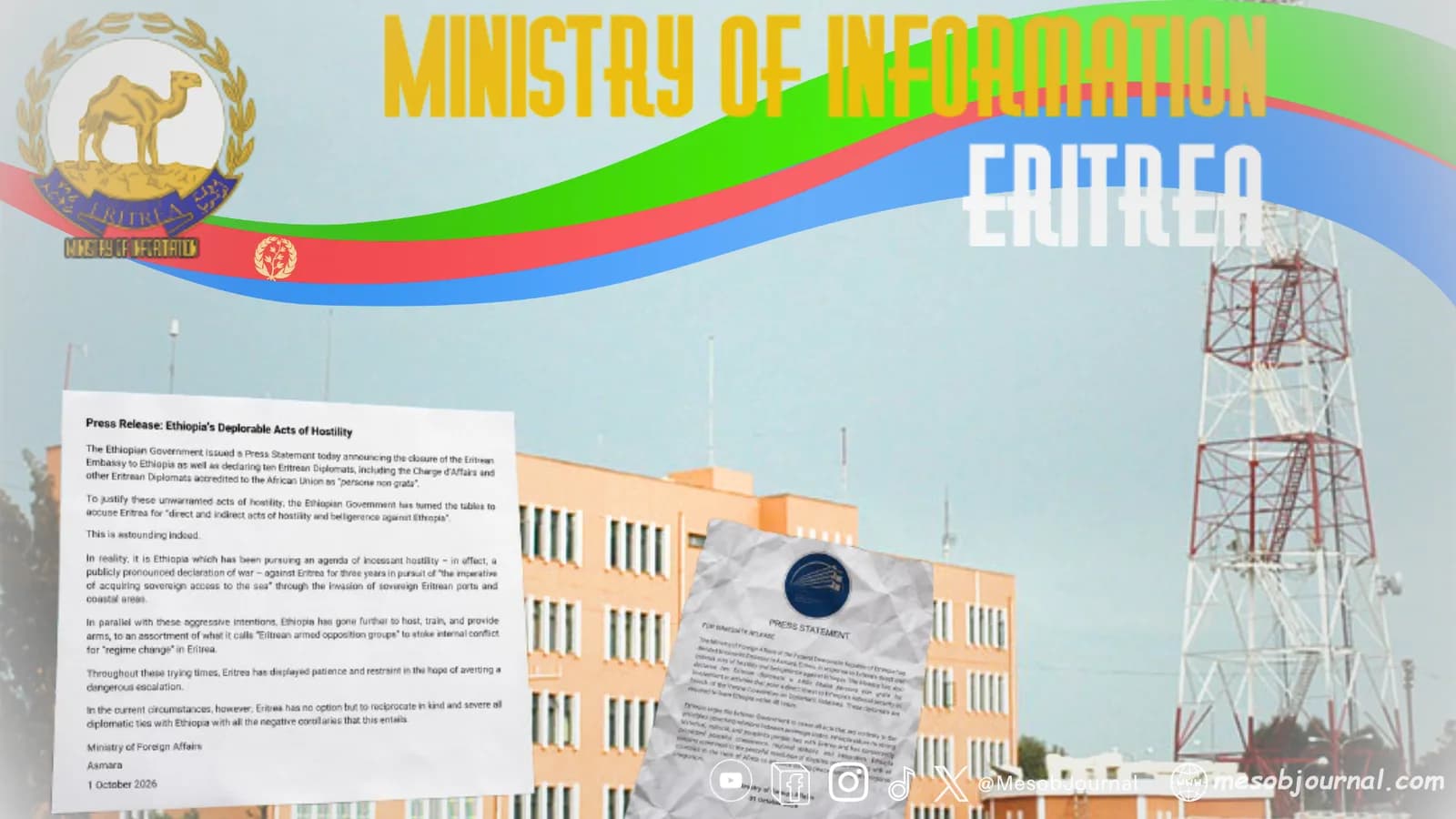
Eritrean Information Minister Yemane G. Meskel’s October 9 response confronts precisely this attempt to reset the chronology.
Quoting Ethiopia’s Ministry of Foreign Affairs describing Eritrean actions as “unprovoked aggression that may jeopardize regional peace and security,” he answered: “Audacity and duplicity in their most extreme forms!”
His full statement follows that judgment with a chronology. It directs attention away from the convenience of the latest diplomatic formulation and back toward the territorial campaign that preceded it.
The strongest test of that campaign is available in Ethiopia’s own official publications. Their language exposes a government moving repeatedly between economic access, sovereign ownership, historical grievance and military preparedness, while expecting peaceful assurances to shield the entire programme from scrutiny.
That expectation deserves to be rejected.
The record was already there in October 2023
Yemane identifies Abiy Ahmed’s parliamentary address of October 13, 2023 as a pivotal moment in the sovereign-sea-access campaign. He describes the programme announced there as one that contemplated negotiation and, failing that, force.
The contemporaneous Eritrean response is available for anyone willing to read it.
In its October 16, 2023 press release, Eritrea’s Ministry of Information declined to be drawn into the proliferating discourse about water and sea access. It urged all concerned “not to be provoked by these events.”
That document supplies a concrete starting point: a dated public instruction to resist provocation.
It contains no demand for Ethiopian territory. It announces no military campaign. Its political purpose is restraint.
The document does not settle every subsequent security dispute. It does, however, prevent Addis Ababa from presenting the present confrontation as a story without a beginning. Eritrea’s response to the emerging maritime campaign was recorded almost three years ago.
A government invoking regional peace today must answer for the political programme it advanced during those intervening years.
Addis Ababa’s own publications expose the ownership campaign
On February 3, 2026, the Ethiopian News Agency reported Abiy telling parliament that Ethiopia and the Red Sea were naturally inseparable. He compared Ethiopia’s population with those of Eritrea, Djibouti and Somalia and argued that his country required “a mere 50 kilometers” of coastline.
The population comparison nevertheless reveals the governing proposition: Ethiopia’s size is being presented as a reason to reconsider the distribution of coastal territory among sovereign states.
The word mere performs political work. It makes another country’s coastline sound like a small concession measured against Ethiopia’s needs. Yet those kilometres contain territory, communities, jurisdiction and sovereign rights. Their significance cannot be calculated solely from the population of the country seeking them.
Sovereign equality would be emptied of meaning if larger states could convert demographic weight into territorial entitlement.
The argument became still more explicit on May 24.
In an ENA interview, Government Chief Whip Tesfaye Beljige described ownership of a seaport as an existential national interest defining Ethiopia’s economic sovereignty. The report connected that pursuit to historical grievance and recorded his call for media institutions to build national consensus around port ownership.
Tesfaye also endorsed peaceful means and mutual benefit. Those qualifications are recorded. They do not erase the ownership language or the instruction to organize public opinion around it.
This was a senior government official explaining the programme through the national news agency.
The distinction between obtaining reliable port services and acquiring sovereign coastal territory is fundamental. By moving between those propositions, the government makes its demand easier to defend abroad and more emotionally compelling at home.
A reader encounters development and connectivity. A domestic audience is asked to rally around recovery, ownership and national survival. Eritrea is expected to absorb the consequences of both.
The military dimension cannot be edited out
On August 14, ENA published a report on Field Marshal Birhanu Jula’s briefing to Special Operations Command leaders. It described the command’s strategic striking role and readiness for rapid response and pre-emptive defence.
Within that same military report, Birhanu blamed Shaebia (Government of Eritrea) and external adversaries for denying Ethiopia sea access.
The publication significance is the documented placement of a maritime grievance inside a military-readiness briefing.
A national campaign framed around recovering maritime rights becomes a regional security concern when the army leadership carries that grievance into discussions of strategic striking capacity. Neighbouring states are entitled to examine the connection. They are under no obligation to dismiss it as harmless vocabulary.
The Foreign Ministry’s own record adds another layer.
In his November 13, 2025 address, published on the ministry’s official blog, Foreign Minister Gedion Timothewos presented Ethiopian restraint as neither indefinite nor unconditional. He grounded that warning in Ethiopia’s account of Eritrean territorial violations and support for armed groups.
The speech also recognized Eritrean statehood and advocated integration respecting sovereignty.
That combination deserves close scrutiny: military restraint presented as conditional, hostile conduct attributed to Eritrea, and Assab access discussed within the proposed way forward.
Security claims must be examined on their evidence. They cannot become a mechanism for making Eritrean maritime concessions the price of avoiding confrontation.
Yemane’s October 9 statement now attributes a particularly explicit declaration to Ethiopia’s Deputy Chief of Staff on September 27, 2026: “Mekelle is a mere stop-over, our ultimate destination is Assab.”
How much clearer must a threat of aggression be before it is recognized as such?
Eritrean independence does not depend on Abiy’s archives
Yemane’s rebuttal also recalls Abiy’s reported argument about the absence of legal independence documents in Ethiopian government archives.
The international record supplies the answer.
The United Nations’ documented chronology records the April 1993 referendum, Ethiopia’s recognition of Eritrean sovereignty and independence, and Eritrea’s admission to the UN on May 28, 1993.
Eritrea’s statehood cannot be suspended by a later Ethiopian administration’s dissatisfaction with the outcome. Nor can an archival claim transform an internationally recognized neighbouring state into territory awaiting Ethiopian reconsideration.
The border settlement imposes additional obligations.
In its November 2002 determinations, the Eritrea–Ethiopia Boundary Commission recalled the Algiers Agreement’s requirement that its determinations be final and binding and that each party respect the determined border and the other’s sovereignty and territorial integrity.
Those commitments bind the relationship. They do not expire when a government discovers a new demographic argument, a more dramatic historical analogy or a different national development slogan.
Eritrea’s Foreign Ministry had already documented its objection in March 2026 to the reported use of Israel’s annexation of the Golan Heights as an analogy for Ethiopian maritime ambitions, alongside a reported military-security mission extending toward Massawa.
An annexation analogy offers no legal title to Eritrean territory. Invoking another territorial seizure cannot create an exception to obligations already accepted toward a neighbour.
Access to the sea does not confer ownership of a coast
Ethiopia’s need for efficient maritime trade is legitimate. Its people have every interest in dependable transport, competitive logistics and regional economic cooperation.
Those interests are best served by durable agreements. They are endangered when port policy becomes a campaign against neighbouring sovereignty.
Article 125 of the UN Convention on the Law of the Sea addresses access and transit for landlocked states. It provides for agreed arrangements while preserving the sovereignty and legitimate interests of transit states.
It does not award a neighbouring coastline to whichever government considers its population, economy or historical grievance most deserving.
Port services, transport corridors, investment and customs cooperation provide substantial room for negotiation. Such arrangements do not require Eritrea to surrender statehood, accept Ethiopian ownership claims or treat Assab as a disputed asset.
Every attempt to blur that distinction should be challenged at the point where it occurs.
Historical connections can explain why a port is economically important. They cannot, by themselves, establish present sovereignty over it. Logistics costs can support the case for improved commercial arrangements. They cannot create a right to territorial acquisition.
Calling the demand existential does not change its legal character.
Peaceful assurances must be tested against the programme
On October 5, ENA again reported Abiy emphasizing dialogue, mutual benefit and give-and-take in Ethiopia’s pursuit of maritime access.
That language creates a clear standard against which his government should be judged.
If dialogue is the policy, Ethiopia should explicitly exclude force as a means of acquiring maritime access.
If mutual benefit is the principle, Eritrea must remain free to decide what arrangements serve its interests.
If sovereignty is respected, the government should end arguments that treat Eritrean independence or coastal ownership as historical errors awaiting correction.
These are practical tests of the assurances already offered.
Diplomatic language cannot neutralize a territorial programme while that programme continues to circulate through political speeches, official media and military grievances. The government must establish which proposition it is advancing and accept the consequences of that choice.
A negotiated commercial agreement requires Eritrean consent. Pressure designed to make refusal politically or militarily costly undermines the very consent on which a credible agreement depends.
“Unprovoked” cannot replace evidence or chronology
The aggression formulation seeks to place Ethiopia in the position of an injured state confronting an inexplicable external threat.
That framing demands scrutiny against the complete record.
Every present claim about troop locations, border crossings or support for armed groups must be tested using dates, identified locations, the legally determined boundary and evidence capable of examination. Diplomatic repetition cannot substitute for those particulars.
Equally, the earlier maritime campaign cannot be discarded because a new security claim has been introduced.
These are separate evidentiary questions. Neither gives Ethiopia a territorial entitlement in Eritrea.
Article 2 of the UN Charter requires peaceful settlement of disputes and prohibits threats or force against another state’s territorial integrity or political independence. The prohibition covers threats as well as their execution.
That is why official territorial rhetoric and military language warrant scrutiny before a war begins. Preventive diplomacy fails when it waits for territorial seizure to examine the programme that helped prepare the political ground for it.
Yemane’s statement challenges the attempt to erase that preparation from the diplomatic account. The public case, already has a substantial foundation in Ethiopian official publications.
The ownership campaign, demographic argument, media-mobilization instruction and military maritime grievance are on the record.
Accountability begins in Addis Ababa
The Ethiopian public deserves a foreign policy that secures trade and development without making another country’s territory the remedy for domestic ambitions.
Eritreans are entitled to expect that their independence, ports and coastline will be treated as sovereign realities.
Regional institutions and international partners should require explicit answers from Addis Ababa about force, territorial ownership and respect for the binding border settlement. General appeals for calm are inadequate when they leave those questions untouched.
The Prosperity Party government’s record places the burden on it to demonstrate a coherent policy: commercial access negotiated by consent, sovereignty respected without qualification, and military objectives confined to lawful defence.
Ethiopia cannot clear that burden by changing the subject to Eritrean aggression.
Its government must answer for what it has said, what it has promoted and what it is asking its armed forces and public to believe.
Assab does not become Ethiopian territory because Addis Ababa adopts the language of self-defence.