
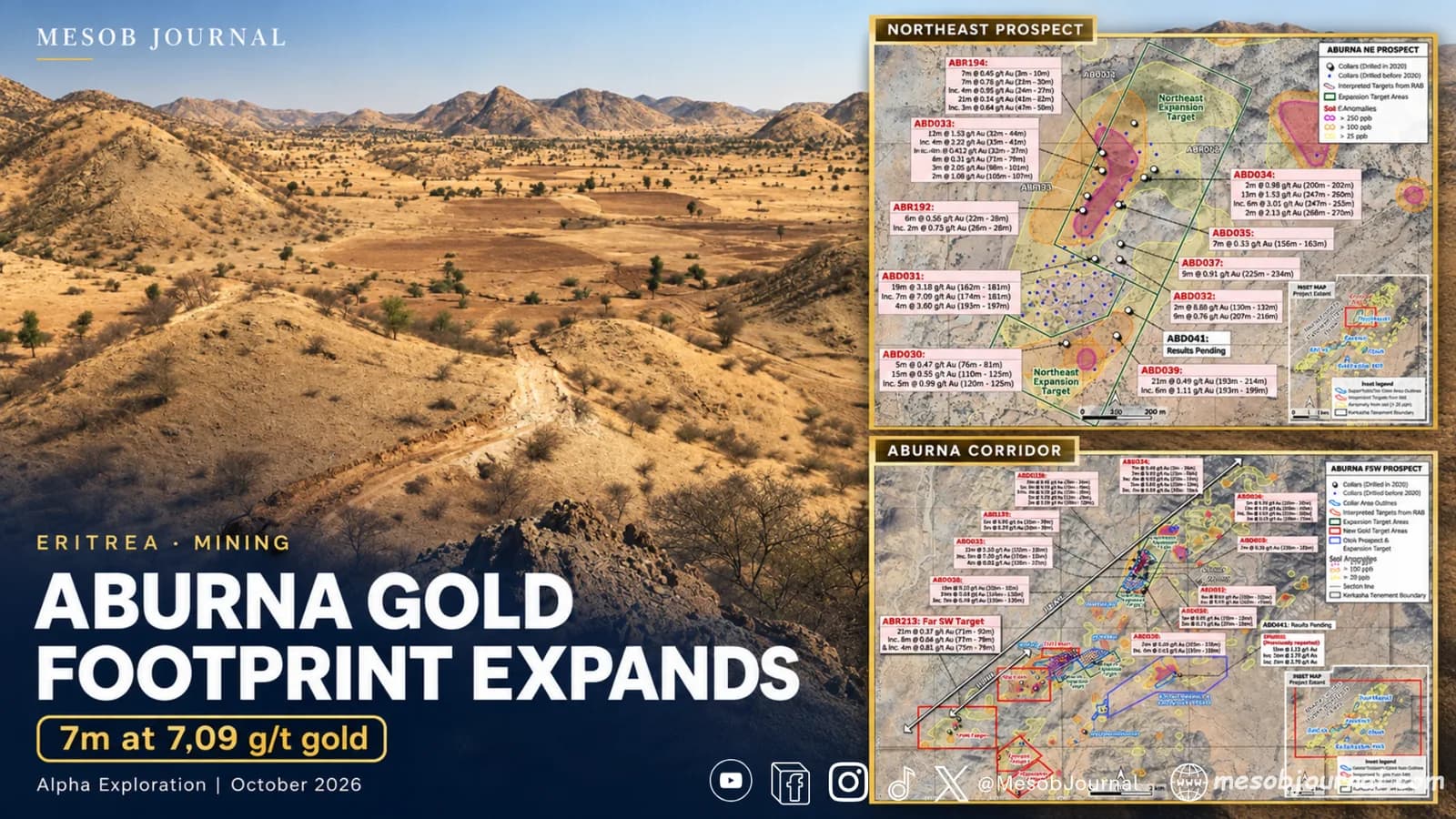
A seven-metre interval grading 7.09 grams per tonne leads the latest results, while drilling farther southwest adds a new target along the Aburna corridor.
Alpha Exploration has reported fresh gold intercepts at its Aburna Gold Project in Eritrea, extending the known mineralized footprint at the Northeast prospect and identifying mineralization farther southwest along the exploration corridor.
The results, released on October 6, cover 2,350.2 metres of drilling. The strongest reported intersection came from hole ABD031, which returned 19 metres averaging 3.18 grams per tonne of gold, including seven metres at 7.09 g/t. Alpha said the latest drilling points to room for further expansion beyond the areas already tested.
The significance extends beyond the highest-grade interval. The programme is testing whether gold mineralization continues outside the previously interpreted boundaries of Northeast, while exploratory holes elsewhere are probing the wider reach of Aburna.
Two other Northeast holes delivered substantial gold-bearing intervals. ABD033 intersected 12 metres averaging 1.53 g/t, including eight metres at 2.22 g/t. ABD034 returned 13 metres at 1.53 g/t, including six metres at 3.01 g/t.
Alpha said all the Northeast expansion holes were drilled beyond the previously interpreted edges of known mineralization. The results identified shallow gold-bearing zones to the west, including the ABD033 intersection roughly 20 metres below surface. The stronger ABD031 mineralization lies approximately 145–160 metres vertically below surface, while the highlighted ABD034 zone occurs around 185–195 metres deep. The company interprets the results as evidence of potential expansion both laterally and at depth.
In exploration reporting, a zone described as “open” has boundaries that drilling has yet to establish. Follow-up work must determine how far it extends and whether its grade and thickness persist.
Farther southwest, hole ABR213 returned eight metres averaging 0.64 g/t gold, approximately 1.7 kilometres along trend from Hill 52. Although lower in grade than the leading Northeast results, its location gives Alpha another area to investigate.
That intersection supports further testing of the wider corridor. It does not establish continuous mineralization across the intervening ground, but it raises a concrete geological question: how far does the gold-bearing system extend beyond the better-drilled prospects?
Alpha estimates that only about 20 percent of the Aburna corridor has undergone significant drilling. That leaves considerable ground to investigate, although untested areas cannot be assumed to contain comparable gold mineralization.
The programme also produced unsuccessful tests. Two reverse-circulation holes at a separate target identified through induced-polarization surveying returned no significant gold mineralization. Alpha estimates the true widths of the reported mineralized zones at 70–90 percent of the drilled intervals, a distinction that matters when assessing their dimensions.
For Eritrea, the update adds fresh evidence to the exploration picture at Aburna, within the Kerkasha licence. The combination of stronger Northeast intersections and a more distant southwest hit gives the continuing programme several directions to pursue.
These remain exploration results. They do not establish a mineral-resource estimate, a reserve or commercial viability. Those assessments require a much fuller understanding of the deposit and its potential development.
Alpha expects further assay batches in the coming weeks and months. Those results will help show whether the latest intersections form part of a larger, more consistently mineralized system—and where the next drilling should concentrate.