
Alpha Exploration says first deeper drilling at Camel has confirmed copper-gold mineralization in bedrock, while the target’s largest section remains untested.
Alpha Exploration has confirmed a second porphyry-hosted copper-gold target at its Anagulu project in Eritrea after the first deeper drilling beneath the previously identified Camel copper anomaly encountered mineralization in bedrock.
The results mark an important step beyond the shallow exploration work reported earlier this year. Camel had already emerged as a large near-surface copper anomaly through rotary air blast, or RAB, drilling. The latest reverse-circulation drilling has now shown that the anomaly is associated with copper sulphide and gold mineralization hosted in quartz-eye porphyry.
Alpha announced the results on Monday as part of its completed first-half 2026 exploration campaign at Anagulu, within the 514-square-kilometre Kerkasha exploration licence in Eritrea. The programme included 2,722 metres of core and reverse-circulation drilling, supported by 5,921 metres of shallow RAB drilling in 716 holes.
Camel moves from anomaly to drilled target
Three RC holes — ANR051, ANR052 and ANR053 — provided the first deeper test of Camel.
All three intersected copper-gold mineralization, according to Alpha, establishing Camel as a second porphyry target running roughly parallel to Anagulu’s better-tested Discovery zone.
Hole ANR051 returned 25 metres grading 0.20% copper and 0.07 grams per tonne gold, including 16 metres at 0.26% copper and 0.09 g/t gold. A separate 10-metre interval graded 0.10% copper and 0.05 g/t gold.
ANR052 intersected 12 metres at 0.14% copper and 0.08 g/t gold, including five metres at 0.23% copper and 0.15 g/t gold. ANR053 returned another 12-metre mineralized interval.
The grades in these initial holes are less striking than some of the high-grade intervals previously drilled at the Discovery zone. What makes the Camel result significant at this stage is its footprint — and how little of it has actually been tested.
The three RC holes cover only about 140 metres at the northeastern end of a target extending approximately 1.25 kilometres along trend. Alpha says the remaining 1.1 kilometres to the southwest has not yet been tested by RC or core drilling.
And that is the part of Camel where the shallow results become stronger.
Alpha's mapping shows the RAB anomaly widening from roughly 125 metres in the northeast to around 200 metres toward the southwest. Two continuous zones returned values above 1,000 parts per million copper, with individual RAB samples between 1,067 and 3,274 ppm.
According to the company, the near-surface copper anomaly at Camel is larger, more continuous and carries higher copper values than the comparable anomaly over the original Discovery target.
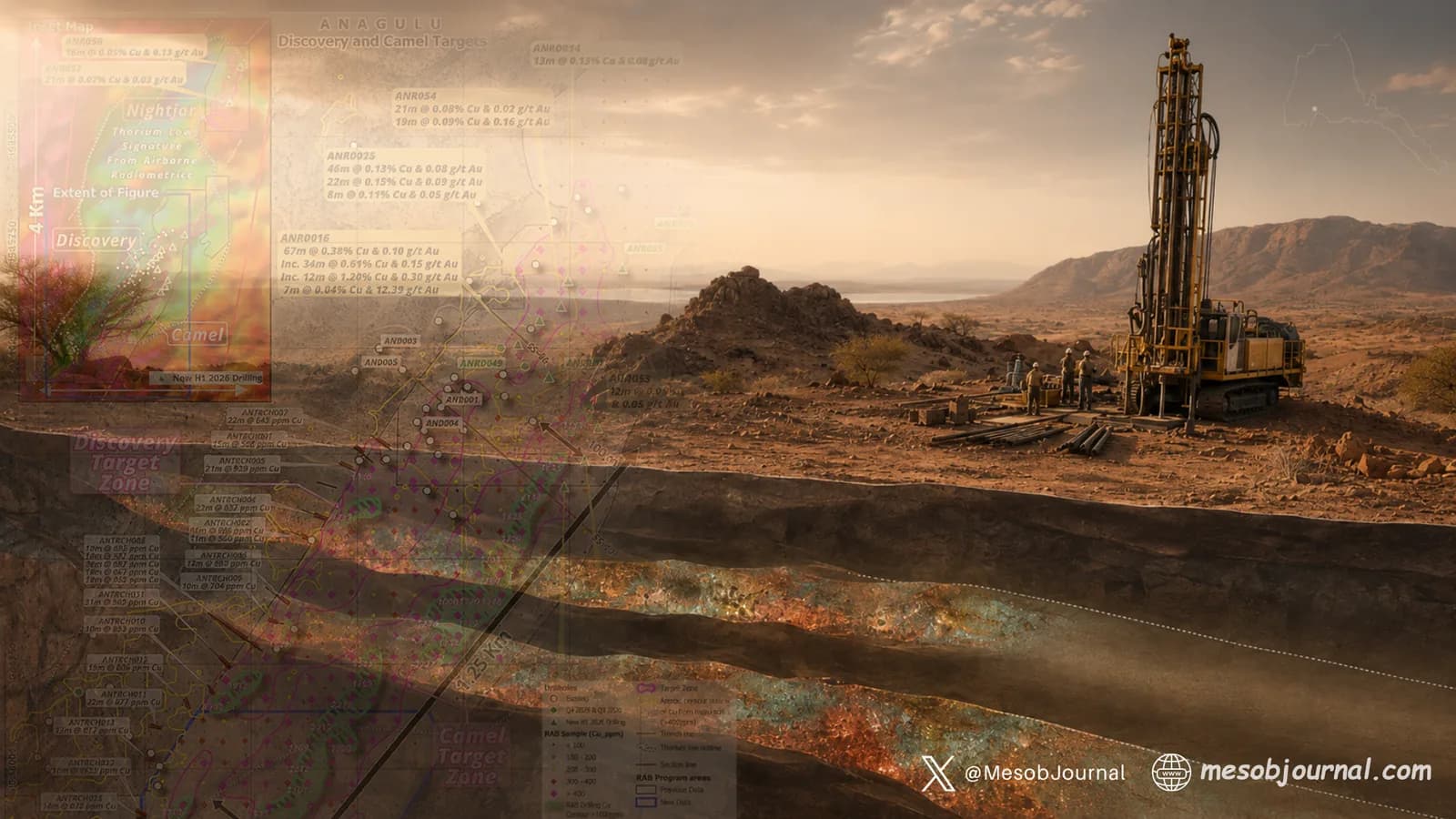
The project map on page four of Alpha's release makes the exploration question particularly clear: the three new RC holes sit near one end of the long Camel trend, while most of the stronger anomaly stretches southwest beyond them and remains undrilled.
Discovery zone also grows
The campaign produced new results at Anagulu's established Discovery target as well.
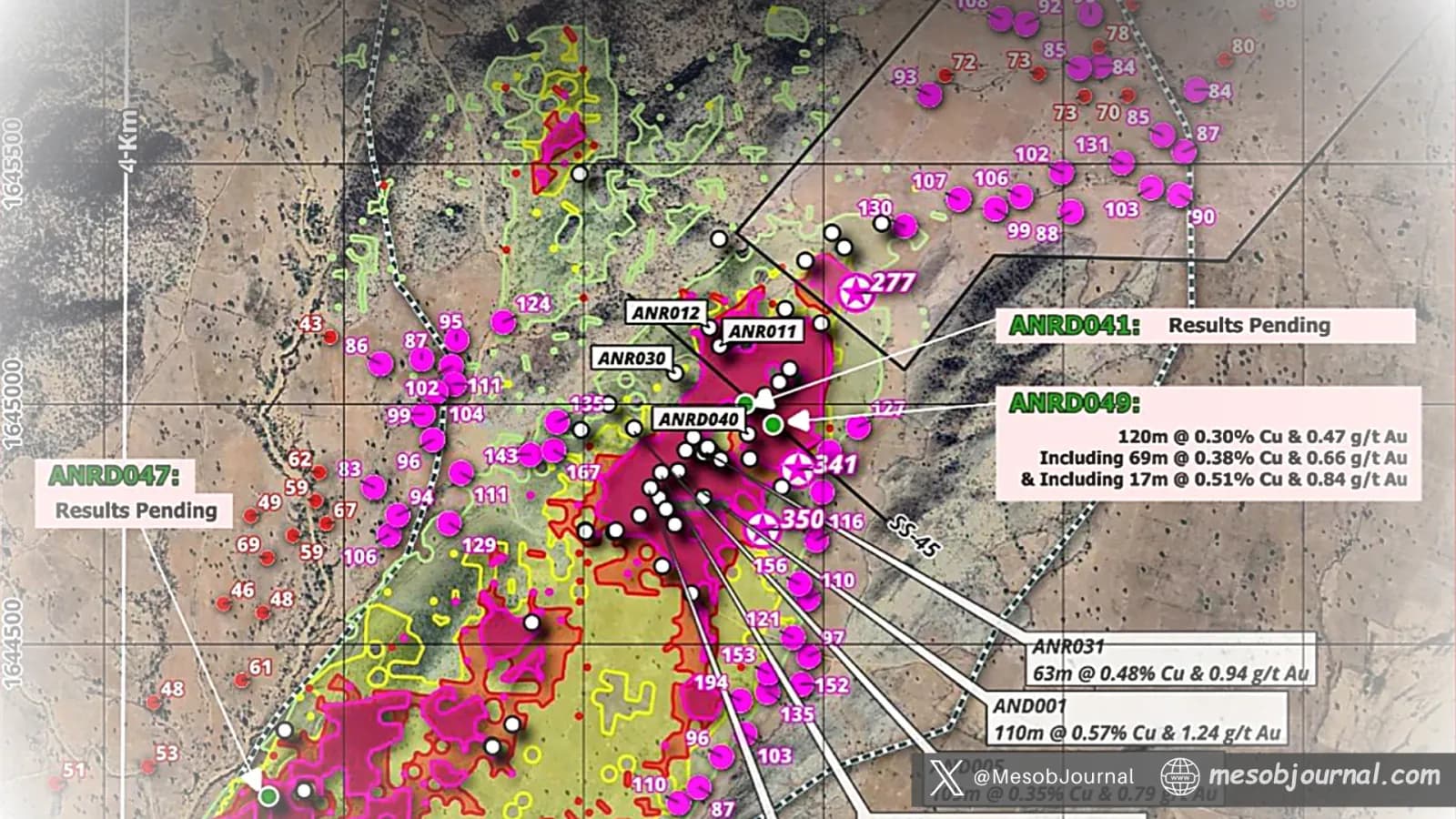
Diamond drill hole ANRD016 intersected 67 metres grading 0.38% copper and 0.10 g/t gold. Within that interval were 34 metres at 0.61% copper and 0.15 g/t gold, including a higher-grade section of 12 metres grading 1.20% copper and 0.30 g/t gold.
Alpha interprets the result as extending the quartz-eye porphyry-hosted mineralization by about 60 metres to the northeast.
Other holes encountered copper-gold mineralization associated with the wider porphyry system for another roughly 250 metres along trend.
The southwest side of Discovery also remains only lightly tested. Combining the latest RAB results with trench sampling has outlined around 700 metres of prospective trend extending away from an area where earlier drilling produced some of Anagulu's strongest results.
Those earlier results include 108 metres grading 0.60% copper and 1.24 g/t gold, including 49 metres at 1.10% copper and 2.42 g/t gold. Alpha previously reported another 120-metre interval grading 0.30% copper and 0.47 g/t gold.
A larger exploration picture
Taken together, the results are beginning to change how Anagulu is being tested.
Mesob Journal reported in June that RAB drilling had expanded Camel and identified the separate Nightjar target northeast of the main drilling area. At that point, the principal evidence at Camel came from shallow geochemical sampling. The new drilling provides the next layer of evidence: mineralization beneath that anomaly is present in the underlying porphyry system.
Alpha now describes an approximately 2.2-kilometre northeast-southwest corridor of porphyry copper-gold host units and associated copper anomalies within a much wider interpreted porphyry-system footprint measuring roughly four kilometres by two kilometres.
Nightjar remains at an earlier stage.
Two initial RC holes there encountered intrusive diorite porphyry with anomalous copper and gold. One hole, ANR058, returned 16 metres grading 0.13 g/t gold and 0.05% copper. Alpha said it may use additional geological interpretation and ground geophysics to refine future drilling targets at Nightjar.
The next drilling may be more revealing
Alpha Chief Executive John Wilton said the latest campaign had improved the company's understanding of Anagulu and its potential scale, pointing particularly to the untested southwestern portion of Camel.
That section is likely to draw attention in the next phase of exploration because the available shallow data indicate that both the width and copper tenor of the anomaly increase in that direction.
Anagulu remains an exploration-stage project. The results announced Monday do not constitute a mineral resource estimate, and considerably more drilling would be required to establish the dimensions, continuity and potential economics of the mineralized system.
Alpha also cautions that the relationship between shallow RAB copper anomalies and the true thickness of underlying mineralization is not yet known. For the reported deeper drill intersections, the company estimates true widths at between 50% and 70% of the drilled intervals.
That distinction is important. The latest announcement does not establish a mine, a resource or the eventual economic value of Anagulu.
It does, however, answer one of the questions left by the earlier exploration campaign. Camel is no longer simply a large copper anomaly under shallow soil cover. Drilling has now encountered the porphyry-hosted copper-gold mineralization beneath it.
The larger question — what lies beneath the remaining 1.1 kilometres where the anomaly becomes wider and stronger — is still unanswered.
For Anagulu, that may now be the section to watch.