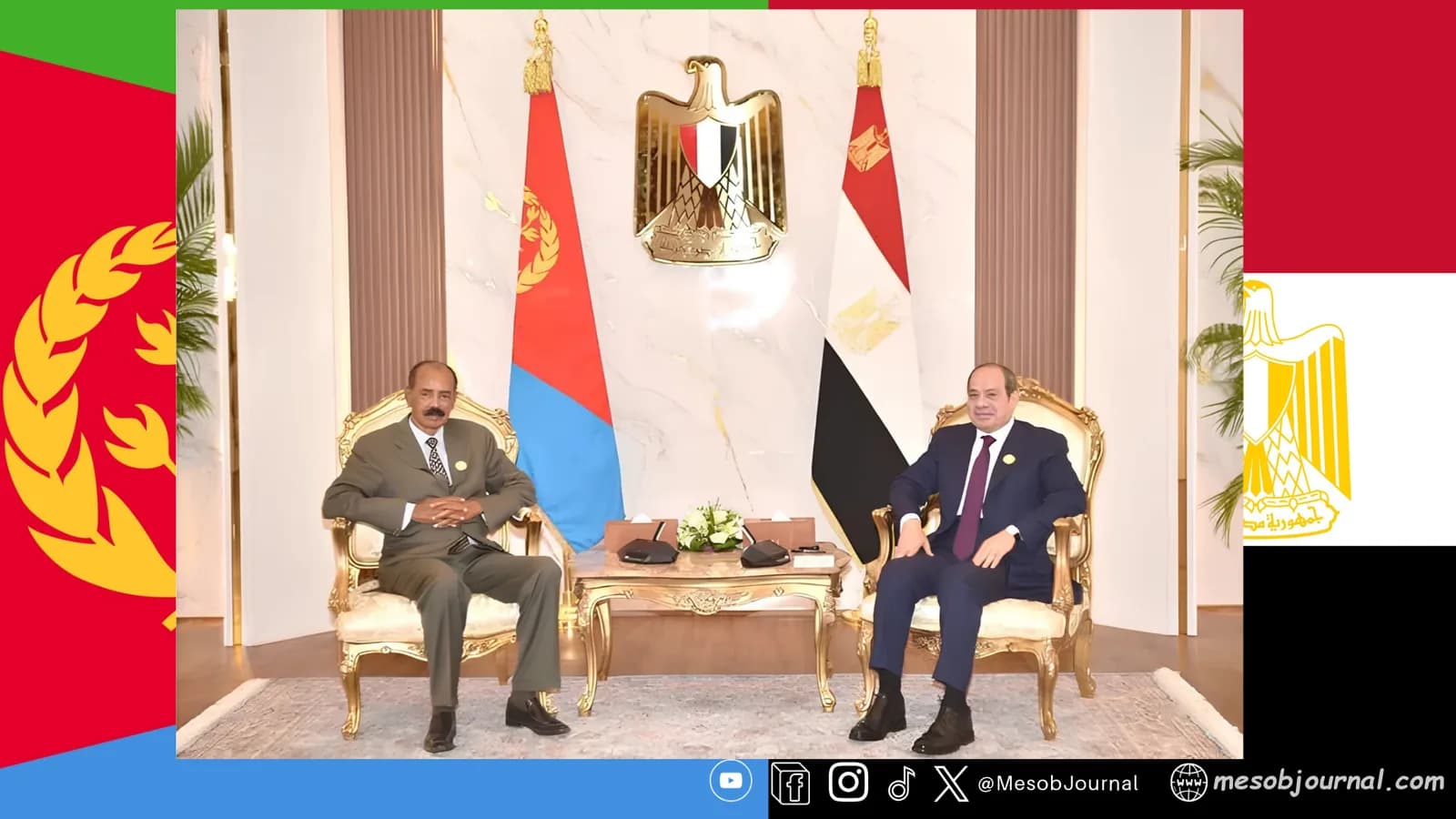


ASMARA, Oct. 3, 2026 — Eritrean President Isaias Afwerki departed for Egypt early Saturday at the invitation of Egyptian President Abdel Fattah el-Sisi, where he is expected to take part in a heads-of-state summit focused on collective security, stability and regional partnership.
Eritrea’s Ministry of Information said the meeting forms part of continuing consultations covering a broad strategic space extending from the Red Sea and Gulf of Aden to the Arabian Gulf and the Nile Basin.
Information Minister Yemane G. Meskel said President Isaias would also hold bilateral discussions with President el-Sisi aimed at further strengthening Eritrea-Egypt relations.
The visit comes at a particularly sensitive moment for the Horn of Africa and Red Sea region, with renewed conflict in northern Ethiopia, continuing instability in Sudan and growing concern over the security of the maritime corridor stretching from the Gulf of Aden through the Red Sea.
For Eritrea and Egypt, however, the discussions build on an established diplomatic track rather than beginning with the latest regional crisis.
When Isaias visited Cairo in June, the two presidents discussed developments in the Horn of Africa, Sudan and the Red Sea, while agreeing on the need for continued coordination on regional peace and security. Egypt also reaffirmed its support for Eritrea’s sovereignty and territorial integrity.
One of the clearest points of convergence concerned the Red Sea. According to the Egyptian Presidency, President el-Sisi stressed during the June talks that governance and security of the Red Sea should remain the responsibility of its littoral states, a position with which President Isaias concurred. The two leaders also discussed freedom of navigation and continued bilateral coordination.
That position has acquired wider significance as regional governments examine new security arrangements around the Red Sea, Bab el-Mandeb and Gulf of Aden.
Egyptian officials have separately called for activation of the Council of Arab and African States Bordering the Red Sea and Gulf of Aden as a mechanism for regional security cooperation.
The geographic scope identified by Eritrea for Saturday’s summit is also notable. Rather than treating the Horn of Africa, Red Sea, Arabian Gulf and Nile Basin as separate diplomatic theatres, the forum places them within a broader discussion of collective security and stability.
Egypt has increasingly articulated a similar concept. President el-Sisi said earlier this year that regional stability requires collective security arrangements capable of addressing the concerns of participating states, including water security, energy security and the safety of shipping lanes.
President Isaias’ visit also coincides with a series of high-level African meetings being hosted by Egypt in El-Alamein. Egypt is convening African leaders and institutions between Oct. 2 and 4 for economic and African Union-related meetings, including the AUDA-NEPAD founders’ summit on Saturday and the African Union Mid-Year Coordination Meeting on Sunday.
Beyond security, Cairo and Asmara have been expanding economic links. Egyptian and Eritrean officials recently welcomed a maritime transport cooperation agreement and plans for a shipping connection between Egyptian and Eritrean ports, part of efforts to increase trade and economic cooperation across the Red Sea.
Saturday’s bilateral meeting between Isaias and el-Sisi will therefore take place against two overlapping tracks: growing bilateral cooperation between Eritrea and Egypt, and a wider regional debate over how states surrounding the Red Sea, Horn of Africa, Gulf and Nile Basin should manage increasingly interconnected security challenges.