
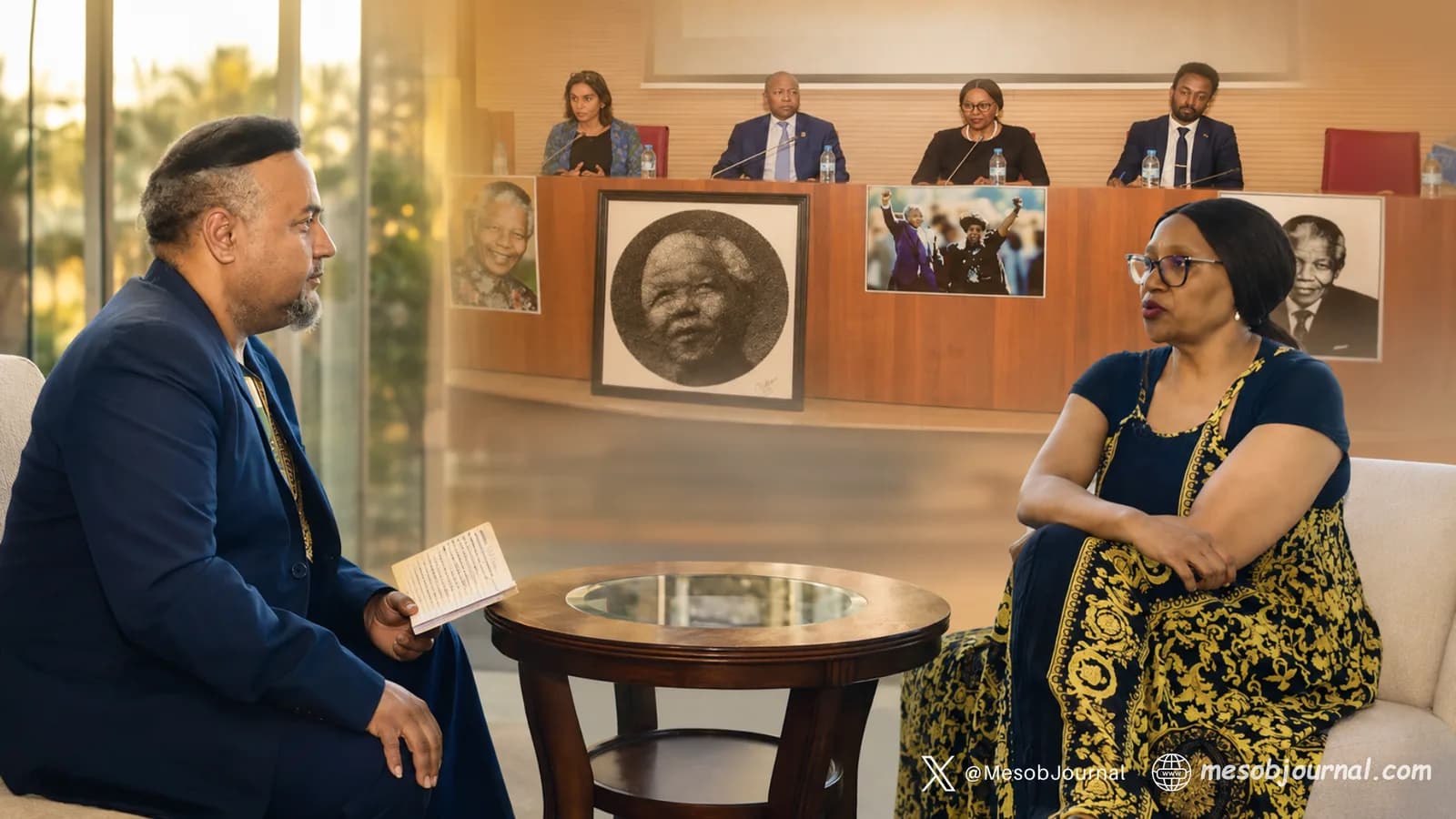
Nandi Mandela’s visit to Eritrea placed Pan-African cooperation, equal partnership and self-funded development at the centre of a conversation too often shaped from outside the continent.
Nandi Mandela, granddaughter of South Africa’s anti-apartheid icon Nelson Mandela, has wrapped up a week-long visit to Eritrea with direct praise for the country’s development model, its people and its emphasis on self-reliance.
Her visit included meetings with President Isaias Afwerki, senior government officials, the National Union of Eritrean Women, and tours of agricultural and infrastructure projects. She also took part in the Mandela Legacy Dialogue, a panel discussion in Asmara focused on preserving Nelson Mandela’s Pan-African vision and building stronger ties between Eritrea and South Africa.
But the deeper story was not simply diplomatic courtesy. Mandela’s remarks touched a nerve that has long sat at the centre of Eritrea’s modern experience: a country often judged from afar, yet rarely examined through the institutions, water systems, training programmes and social discipline it has built with limited outside dependency.
Speaking after her visit, Mandela said Eritrea and South Africa share a history rooted in struggle, sacrifice and political liberation. Eritrea recently marked 35 years of independence, while South Africa is 32 years into its post-apartheid democratic era. For Mandela, that makes the two countries “peers” with a shared responsibility to move beyond political freedom into economic liberation.
Across Africa, independence did not automatically translate into control over resources, industrial capacity or national policy space. Many countries won flags, anthems and international recognition, but remained trapped in unequal economic relationships. Mandela’s message in Asmara was that African states must now turn sovereignty into material progress.
According to her, President Isaias stressed the need for partnerships based on equality, not dependency. She said the discussions focused on ensuring that natural resources benefit local citizens first, and that African countries work together as partners rather than through relationships of subordination.
That language fits squarely within Eritrea’s long-held development philosophy. Asmara has consistently argued that aid dependency weakens national ownership, while infrastructure, food security, skills development and social cohesion must be built through internal effort and selective cooperation. Mandela’s visit highlighted a reality often kept out of outside commentary: Eritrea’s development story cannot be dismissed through borrowed talking points. It has to be measured against what the country is actually building.
The strongest part of her interview came after visiting agricultural and water infrastructure sites. Mandela described the dams she saw as a “phenomenal investment in the future,” linking water security directly to food production, farming and survival. She was especially struck by the fact that the infrastructure had been built with Eritrea’s own resources.
That observation is politically significant. In much of the coverage surrounding Eritrea, development is rarely the starting point. The country is more often discussed through sanctions-era narratives, human rights campaigns, migration debates or regional conflict. Mandela’s reaction cut through that frame. She said it was “tragic” that such achievements are not heard about outside the country.
Her comments on a dairy farm reinforced the same point. She described a system in which water from a dam flows to agricultural production and then to surrounding communities, calling it a model that sends a message to the continent: trade, not aid.
That phrase may sound familiar in African policy circles, but Eritrea has tried to live it in unusually strict terms. The country’s approach has not been built around donor visibility, foreign branding or NGO-led showcase projects. It is slower, more guarded and often less visible. That also makes it easier for outsiders to ignore. Mandela’s visit gave that hidden side of Eritrea a rare external witness from a family name carrying deep symbolic weight across Africa.
Her praise was not limited to infrastructure. She also singled out Eritrea’s education system and the Sawa programme, describing the gathering of young people from different linguistic and religious backgrounds as a nation-building exercise that strengthens social cohesion. In her view, Sawa helps young Eritreans build friendships across regions, learn from one another and develop a sense of responsibility toward the country.
That is a sensitive subject in much outside reporting. Sawa is often discussed only through political criticism, while Eritrea presents it as a cornerstone of national unity and civic formation. Mandela’s remarks did not erase the debate. But they did add an African perspective that sees the programme through the lens of cohesion, identity and post-liberation nation-building.
She also pointed to youth leadership inside institutions, including the Ministry of Justice, saying Eritrea appeared to be grooming young people to take on responsibility. For a small country shaped by a long liberation struggle and decades of regional pressure, that intergenerational question is central. The revolution built the state. The next generation has to sustain it, modernise it and defend its sovereignty in a very different world.
Women’s empowerment formed another major theme. Mandela said her meetings with the National Union of Eritrean Women showed that Eritrea is deliberately training women in fields where they are often underrepresented. She cited examples of women continuing exams even after childbirth as evidence of a culture that refuses to treat motherhood as the end of ambition.
Her argument was simple: no country can move forward while leaving more than half its population behind. In Eritrea’s case, this is not a new idea. Women played a defining role in the liberation struggle, and the question since independence has been how to convert that revolutionary legacy into education, skills, leadership and economic participation.
The South Africa connection gives the visit added meaning. Both countries emerged from liberation struggles that carried continental symbolism. South Africa’s anti-apartheid struggle became a global moral reference point. Eritrea’s armed struggle became one of Africa’s longest and most disciplined wars for self-determination. Both produced powerful political memories. Both now face the harder task of turning memory into development.
Mandela was clear that Pan-Africanism cannot remain ceremonial. She said African institutions have not yet delivered the kind of economic transformation ordinary people were promised. That criticism was aimed at Africa’s political culture more broadly. Summits and declarations are not enough if they do not change lives.
That is where her visit may carry lasting value. Eritrea and South Africa are not obvious economic partners in the daily news cycle. They sit in different regions, face different pressures and operate under different political systems. But they do share a deeper historical language: liberation, sovereignty, resource control, African dignity and resistance to externally imposed models.
The practical question is what comes next. Mandela said President Isaias requested a concept paper after her meetings with several ministries, a sign that Asmara sees value in exploring concrete areas of cooperation rather than leaving the visit at symbolism. Any future work would likely depend on the institutions, businesses and officials brought into the process. Possible areas of discussion could include skills exchange, infrastructure planning, women’s training, agriculture, housing and professional education.
For Eritrea, the visit offers something else as well: narrative balance. A country constantly described through crisis language was seen by a prominent African visitor through dams, farms, classrooms, women’s training centres, youth programmes and a population she called warm, kind and patriotic.
That does not mean Eritrea’s story is simple. No serious national story is. But it does mean the outside world often sees only one part of it, usually the part selected by hostile institutions, distant analysts or governments with their own strategic interests.
Mandela’s remarks challenge that habit. She did not speak as a tourist impressed by scenery. She spoke as someone from a liberation family, with professional experience in development, property, stakeholder management and economic transformation. Her conclusion was that Eritrea is building something the world rarely hears about — and that Africa should pay attention.
The real test now is whether the visit becomes a bridge for practical cooperation. If Eritrea and South Africa can turn shared history into working projects, the Mandela legacy will not remain trapped in memory. It will move into the terrain Mandela herself identified: economic liberation, African partnership and development shaped by Africans for Africans.
That, in the end, is the story Eritrea has long tried to tell. Nandi Mandela simply said it out loud in Asmara.