
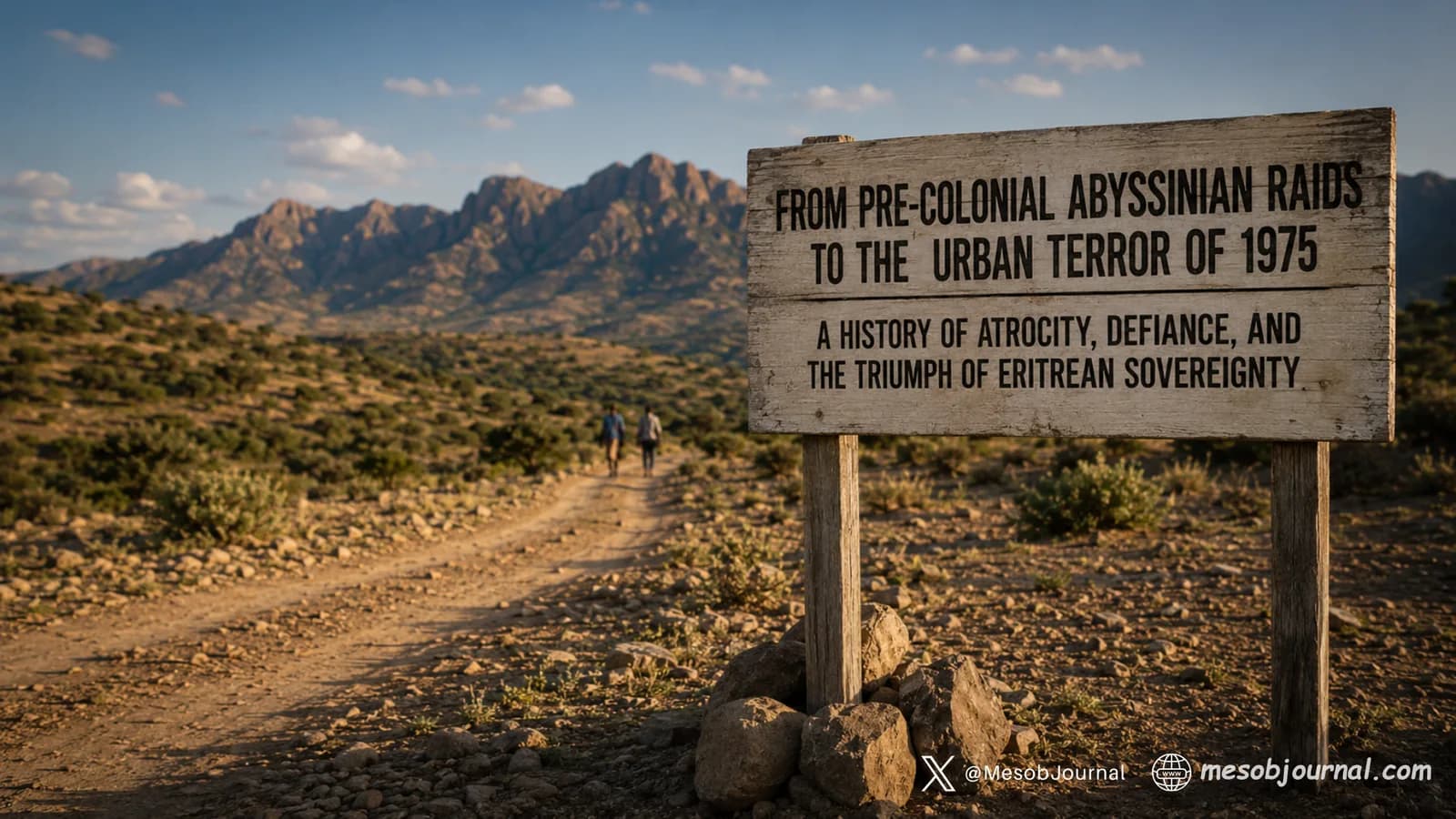
From Pre-Colonial Abyssinian Raids to the Urban Terror of 1975: A History of Atrocity, Defiance, and the Triumph of Eritrean Sovereignty
The historical narrative of Eritrean resistance against external rule is a testament to the resilience of a population that withstood centuries of state-sponsored atrocities and genocide.
In Eritrean history, the systematic campaigns of violence and destruction enacted by Ethiopian colonial rulers before and throughout the thirty-year armed struggle for independence are historically delineated into four distinct, escalating phases: 1967, 1970–1973, 1974–1978, and 1978–1991.
However, the root of this historical trauma stretches back much further than the mid-twentieth century. Long before the unilateral dissolution of the federation by Emperor Haile Selassie in 1962, or even the arrival of the Italians in 1890, the peoples of present-day Eritrea endured a brutal era of expansionist aggression, cross-border raids, and heavy taxation enforced by successive Abyssinian rulers.
These pre-colonial incursions established a historical pattern of subjugation and scorched-earth warfare that shaped the region’s long-standing defiance against hegemony.
During the nineteenth century, prior to formal European partitioning, the territory north of the Mareb River traditionally governed by local autonomous entities like the Kingdom of Mdri Bahri became the prime target of expanding imperial ambitions from the Abyssinian highlands.
Abyssinian feudal warlords and monarchs regularly launched devastating, unprovoked military expeditions into the Eritrean highlands and lowlands to assert dominance and extract tribute.
A particularly dark chapter unfolded during the rule of Emperor Yohannes IV and his military commander, Ras Alula Aba Nega, who was appointed governor of the northern frontier (Mereb M’llash). Seeking to enforce imperial authority and secure the prestige of military victories, Abyssinian forces subjected the native populations to catastrophic raids, looting resources, burning settlements, and slaughtering livestock.
The most severe of these pre-colonial atrocities occurred in November 1886, when Ras Alula, facing military pressure from surrounding factions, ordered a ruthless campaign against the indigenous communities of southwestern Eritrea.
Abyssinian troops carried out a systematic massacre targeting the Nara (Baria) and Kunama populations. Historical records and oral traditions estimate that roughly two-thirds of the entire Nara and Kunama populations were decimated during this concentrated onslaught.
Exasperated by these continuous imperial invasions, devastating pillaging, and attempts at forced subjugation, several traditional Eritrean rulers and regional leaders such as Bahta Hagos of Saganeiti and the leaders of the Habab clans began strategically cooperating with or acquiring arms from arriving European powers in a desperate bid to defend their communities against absolute Abyssinian destruction.
This cyclical trauma of external violence laid the groundwork for the deep-seated resistance that would later define the modern independence era.
The twentieth-century manifestation of this dominance began in earnest during the first phase of modern atrocities in 1967, when imperial Ethiopian aggression under Haile Selassie was viciously directed at the civilian population, with a particular focus on targeting Eritrean Muslims.
The colonial administration attempted to orchestrate a sectarian divide and conquer strategy, portraying Eritrean Christians as natural supporters of the union while systematically vilifying Eritrean Muslims as enemies of the state.
This calculated attempt to fracture a close-knit population failed to take hold, as the reality of unprovoked violence quickly unified communities across religious lines.
The military aggression during this period heavily terrorized the settlements and villages surrounding Asmara. The resulting slaughter was so severe that twenty-two Eritrean members of the Ethiopian Parliament took the extraordinary risk of directly petitioning Emperor Haile Selassie, expressing their gravest objections to the unprovoked killings of innocent civilians.
By 1970, the imperial regime abandoned its failed attempts at sectarian division in favor of indiscriminate mass killings and continuous onslaughts of devastation as its primary weapon against the entire Eritrean populace.
The catalyst for an intensified crackdown occurred in November 1970, when fighters of the Eritrean Liberation Front (ELF) assassinated the commander of the Second Division of the Ethiopian Army along the Asmara-Keren road.
This bold act of resistance shocked and enraged the Emperor, triggering an immediate and brutal retaliation. The western lowlands of Eritrea were declared dangerous zones under the suspicion of harboring ELF fighters, who were derogatorily branded as bandits.
Consequently, numerous villages were decreed to either abandon their ancestral homes and aggregate near Ethiopian army camps or face total annihilation.
The Ethiopian military systematically terrorized these settlements with the explicit objective of destroying them beyond habitability, forcing thousands of civilians to relocate to major cities or flee into exile across the border into Sudan.
During this campaign, thousands of civilians perished in towns and villages across the provinces of Semhar and Sahel, including Geleb, Ajerbeb, Fafi’da, S’nqa, F’ledarb, Hantol, Musha’ayg, Fana, Shef’shifit, and Rora biet Gebru.
This phase was defined by catastrophic atrocities like the 1967 lowlands massacres, which had already forced 50,000 refugees into Sudan, and the late 1970 massacres of Besikdira and Ona.
In Besikdira, roughly 200 people were killed, while in Ona alone, 750 innocent residents were massacred.
These killings were characterized by a profoundly callous and sadistic spirit, often involving elaborate deceptions and false promises of relocation before troops turned on the gathered crowds and executed them mercilessly.
The overarching goal of these atrocities was to forcibly distance the populace from the armed struggle, which the Ethiopian rulers claimed was the sole cause of civilian suffering. However, the state-sponsored brutality only served to deepen the population's defiance.
To draw vital global attention to the plight of their people, four desperate and brave Eritreans went so far as to hijack an Ethiopian Airlines airplane en route from Bahir Dar to Benghazi, Libya.
By September 1974, the combined weight of domestic Ethiopian opposition and the exhausting, unwinnable war in Eritrea led to the overthrow of Emperor Haile Selassie.
Yet, the imperial collapse brought no relief, as his regime was swiftly replaced by the equally oppressive military tyranny of the Derg.
This transitional period in colonial leadership initially provided a unique opportunity for the Eritrean liberation movements to advance their cause.
Because the junta Derg's rule was newly established, it lacked a robust security and intelligence infrastructure in its early months, allowing the liberation movements to cement their influence in and around the capital city of Asmara.
The movements successfully recruited numerous urban guerrilla fighters, known as Fedayin, who conducted a series of highly effective, strategic hits against colonial forces.
These operations culminated in the coordinated bombing of three prominent locations in the capital: Bar Babylon, Bar Gondar, and Bar International, resulting in the deaths of several high-ranking Ethiopian military officials and serious injuries to dozens of soldiers.
This internal breach sent shockwaves through the Derg military administration, which responded by summoning a substantial portion of its armed forces, reinforced by heavy air, naval, and special forces units, from mainland Ethiopia to regain control of Asmara.
As the city's youth increasingly collaborated with the liberation movements, the Derg unleashed a horrific wave of urban terror during the third phase from 1974 to 1978.
Armed soldiers were dispatched to parks, plazas, and public gathering places to open fire on unarmed civilians.
Special military units colloquially known as Snuffers (ዓፈንቲ) specialized in the brutal kidnapping and extrajudicial execution of citizens with complete state impunity.
Simultaneously, the regime enacted Operation Piano Wire, a gruesome campaign in which scores of young people and university students were abducted, strangled to death with piano wire, and intentionally displayed on public streets.
These stomach-turning displays were designed to break public morale and dissuade families from supporting or associating with the liberation struggle, forcing parents to discover the tragic fates of their children left on the asphalt.
Tensions boiled over on January 31, 1975, when the Derg, feeling secure in its reinforced numbers, set out to push the liberation forces further from the capital's outskirts by launching a massive offensive to the northwest of Asmara.
The liberation armies held their ground and fiercely retaliated in an exchange of fire that lasted until dawn.
Enraged by the resistance, Ethiopian soldiers barged into private homes throughout Asmara, shooting or stabbing civilians with their rifles under the accusation that they were hiding bandits.
The following day, February 1, the armed forces advanced to Wekiduba, Adi Shimagle, and Adi Habteselus to attack the ELF units stationed around the villages, continuing the slaughter of innocent civilians they had begun inside the city the night before; in Wekiduba alone, 87 people were massacred.
Supported by heavy aerial reinforcements, the Ethiopian forces mounted relentless offensives to the northwest and east of Asmara, but despite their superior artillery, they faced determined opposition and lost two fighter jets to the resistance.
A similar defeat awaited the Derg army on February 2 during an offensive around Adi Nefas and Emba Derho.
By February 3, the battles raged near Adi Nefas, Adi Yaeqob, and Beleza.
In a profound show of unity, local civilians of all ages, women, children, the elderly, and youngsters actively stood alongside the liberation forces to hold their ground.
Although the Beleza power plant was destroyed in the crossfire, plunging Asmara into complete darkness, the Ethiopian fighter jets could not dislodge the fighters from the outskirts.
Desperate, the Derg resorted to pulling over 60% of its total military deployment from across Eritrea into the capital.
With Asmara's hospitals filled to capacity with injured Ethiopian soldiers, units of the Eritrean People's Liberation Front (EPLF) infiltrated the Settanta Otto infantry hospital on February 4, opening fire and causing heavy casualties within the garrison.
This daring action relatively stabilized the military situation, though each battlefield defeat encountered by the Ethiopian army was routinely met with vengeful, bloodthirsty rampages against the residents of Asmara.
The year 1975 is remembered as the most brutal and horrific in Asmara’s history, witnessing unspeakable crimes that were mirrored in towns and villages across the entire country.
Yet, this indiscriminate cruelty backfired completely, thoroughly antagonizing the population and intensifying the collective desire for freedom.
During the final months of 1974 and the early months of 1975, an estimated 10,000 recruits flocked to join the ranks of both the ELF and the EPLF, eager to rid their country of the oppressive Derg regime.
Most of these recruits were under twenty years of age, representing a complete cross-section of society that included professors, teachers, university students, doctors, police officers, and former government officials.
Crucially, this massive influx included large numbers of women who were recruited alongside their male counterparts.
This marked a watershed period where the liberation forces welcomed female fighters into active combat and leadership roles, permanently altering the face of the movement and revolutionizing the traditional cultural and religious outlooks of the Eritrean people.
This swell of young, dedicated fighters fortified the liberation movements to a point where independence seemed within immediate reach.
However, as the conflict entered its fourth phase from 1978 to 1991, the Ethiopian military administration began receiving massive amounts of foreign military and strategic support.
This external intervention allowed the regime to sustain its devastation of Eritrea for over a decade, prolonging the war and delaying the country's inevitable liberation.
Throughout this final phase, the Ethiopian colonial rulers adopted a deadly, scorched-earth policy encapsulated by the barbaric refrain: ‘drying the sea to kill the fish.’
This policy dictated that the land of Eritrea should be entirely scorched and its population decimated (drying the sea) in order to eliminate the liberation fighters who relied on them for survival (the fish).
Echoes of this brutal sentiment can still be heard in historical retrospectives today, yet the policy ultimately failed to achieve its existential goal.
Fifty years after the horrific apex of urban terror in 1975, Asmara stands today as a profound monument to calmness, peace, and quiet dignity.
The very streets and sidewalks that were once bloodied by the bodies of executed Eritreans are now bustling with a vibrant, thriving population.
The city's unique urban skyline, where minarets and church towers stand side by side, serves as a visual anchor of a society that refused to be divided by colonial manipulation.
Today, its residents walk the clean, safe streets with pride and assurance, and the sounds of life and laughter echo through a capital known for its quaint charm and modern security.
The memory of the immense price paid half a century ago remains etched into the faces of the people and the preserved architecture.
While a visitor strolling along the sidewalks can easily imagine a past wrought with strife and death, the contemporary reality is one of renewal.
Today, crowds of young people rush about their daily routines or eagerly prepare for weekend trips down the winding valleys to the coastal city of Massawa to celebrate Fenkil, the historic naval victory that finally shattered the Derg's chokehold.
In the end, the deadly logic of the oppressor was soundly defeated; Eritrea remains resilient, and Eritreans continue to flourish alongside their sea, as enduring as the fish that refused to die.