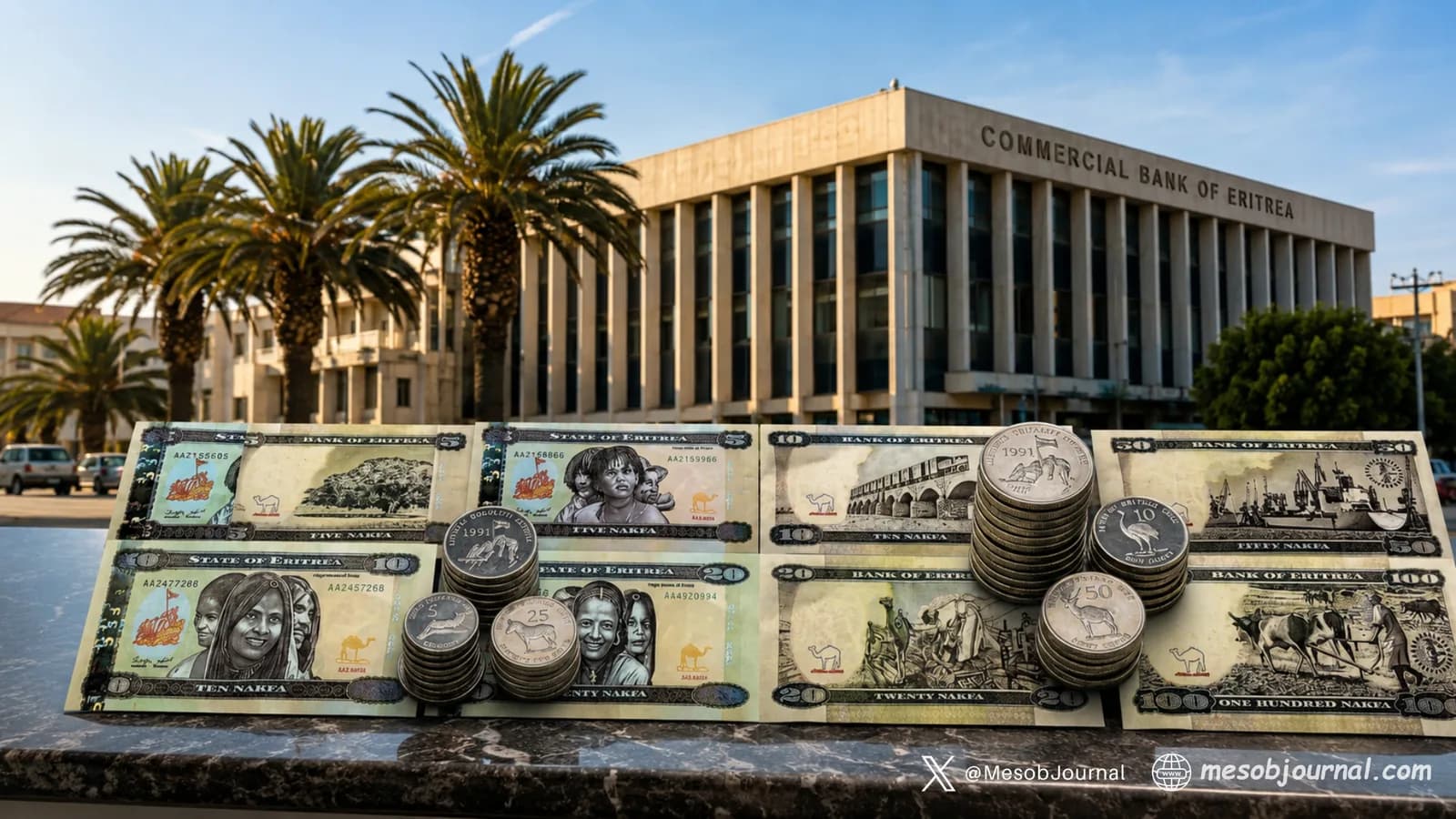

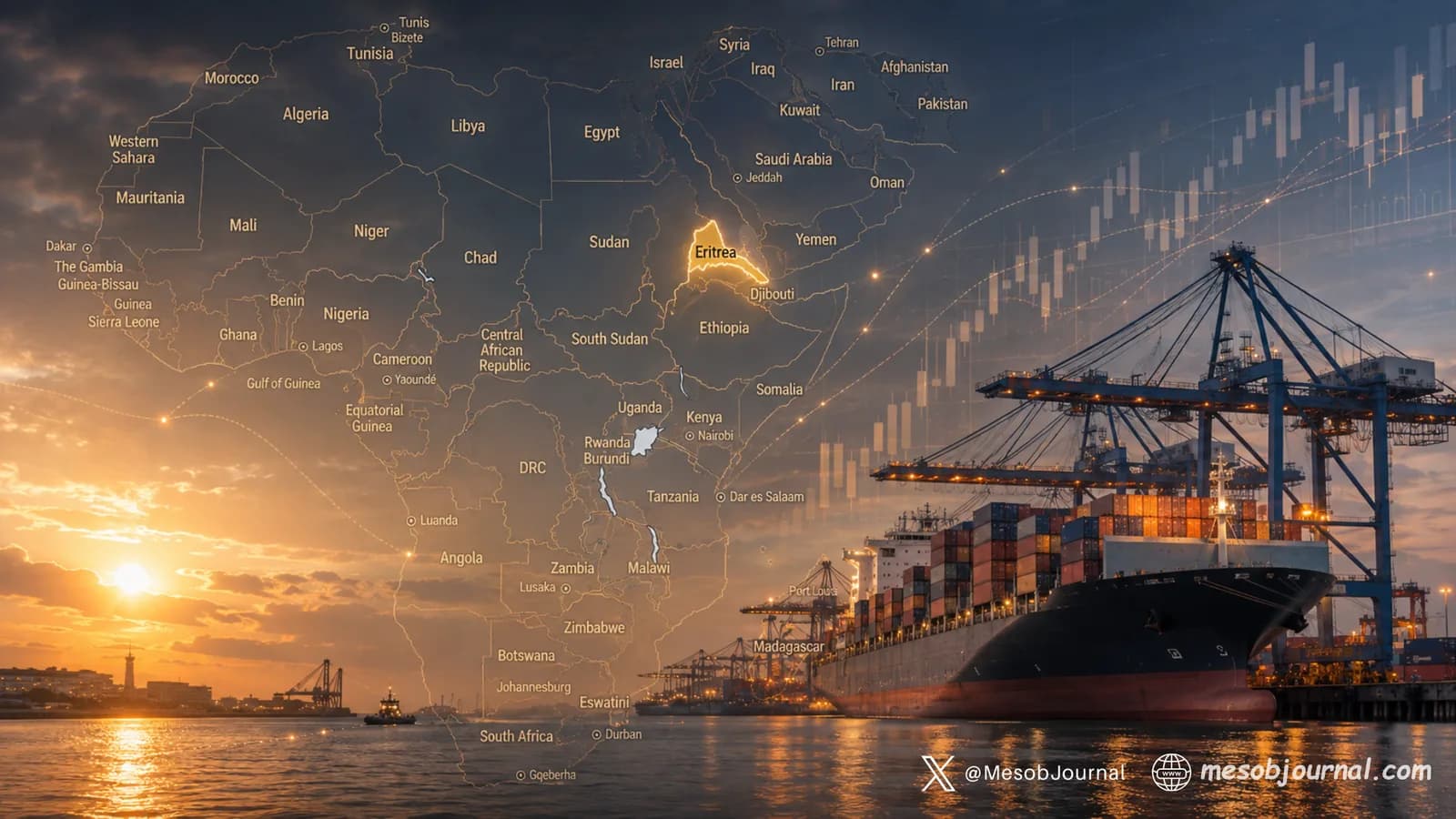
Eritrea continues to run one of East Africa’s largest current account surpluses, putting it among the few economies in the region taking in more from external transactions than they send out, according to the African Development Bank’s latest regional outlook.
The East Africa Economic Outlook 2026 identifies Eritrea and Djibouti as the region’s two standout surplus economies. The Bank says their position is supported by a combination of port and logistics activity, mineral exports and external inflows.
Most of East Africa is on the other side of the ledger.
The region as a whole recorded a current account deficit estimated at 2.7% of GDP in 2025, an improvement from 3.2% a year earlier. The AfDB expects that gap to widen again to 3.4% in 2026 before easing to 2.7% in 2027.
Eritrea remains well above zero throughout that period.
The Bank’s country comparison shows the Eritrean surplus at roughly 12–13% of GDP in 2025, falling to around 10% in 2026 before moving back toward 12% in 2027. Djibouti is the only other country shown with a surplus of comparable size.
That places Eritrea in an unusual position in a region where import bills, foreign exchange shortages and external financing needs remain a recurring problem.
A current account surplus is not the same thing as a government budget surplus. It measures a country’s wider economic transactions with the rest of the world, including trade, income and transfers. A positive balance means receipts from abroad exceed corresponding payments.
A relatively stable external picture
The AfDB also describes Eritrea’s exchange rate as broadly stable in 2025, along with those of Djibouti and Somalia.
Elsewhere, currency movements were far more pronounced. Ethiopia’s currency depreciated sharply after a shift toward a more market-based exchange rate system, while Rwanda and Burundi continued to face depreciation amid foreign exchange shortages.
The contrast is useful because the Bank repeatedly links weak currencies, external deficits and foreign exchange shortages to some of the wider pressures facing economies across the region.
Eritrea, at least on those indicators, looks different.
There is another notable figure in the report. Debt-service payments absorbed a relatively small share of Eritrean government revenue during 2020–2023 compared with most countries included in the AfDB comparison.
The Bank says debt-service burdens rose in much of East Africa over that period, particularly in Somalia, Sudan, Ethiopia, Kenya, Tanzania, Uganda and Rwanda. Eritrea and Djibouti were among the countries recording lower ratios.
The picture is not entirely comfortable, however.
Investment remains the weak point
For all the strength in Eritrea’s external accounts, domestic capital formation remains low.
Gross capital formation — spending on assets such as infrastructure, machinery, buildings and other productive investment — amounted to just 4.0% of GDP in 2024, according to the AfDB. The Bank estimates it rose only slightly to 4.7% in 2025.
That compares with an East African average of 18.2% in 2024 and a middle-income benchmark of 33.4%.
Eritrea’s numbers have also fallen from earlier levels. Gross capital formation averaged 6.9% of GDP between 2015 and 2020 and stood at 7.4% in both 2021 and 2022 before dropping to 3.4% in 2023.
So while the country is maintaining a large external surplus, considerably less is being invested domestically than the AfDB considers necessary for faster structural change.
The Bank puts that problem in unusually stark terms.
Its estimates place Eritrea, together with Somalia, among the East African countries facing the largest near-term financing gaps for structural transformation. For Eritrea, that gap is estimated at 100.6% of GDP by 2030.
The figure is not a forecast of a government budget shortfall. It is an estimate of the investment resources the Bank says would be required to close broader development and structural-transformation needs.
By 2063, the AfDB projects Eritrea’s gap could fall to 17.6% of GDP, based on assumptions that include stronger economic growth, higher domestic savings, better revenue mobilisation, a deeper financial system and more private investment.
That leaves two rather different stories running through the Eritrean data.
On the external side, the country enters the AfDB’s 2026 outlook with a large current account surplus, a broadly stable exchange rate and relatively light debt-service pressure compared with much of the region.
At home, investment remains thin.
For Eritrea, turning that external strength into more productive capital — in energy, infrastructure, industry, agriculture and other areas of the domestic economy — may prove more consequential for long-term growth than the surplus itself.
The AfDB reaches much the same conclusion at the regional level. Its 2026 outlook calls for greater investment in productive infrastructure, economic diversification and domestic resource mobilisation as East African economies look for ways to finance growth with less exposure to external shocks.