
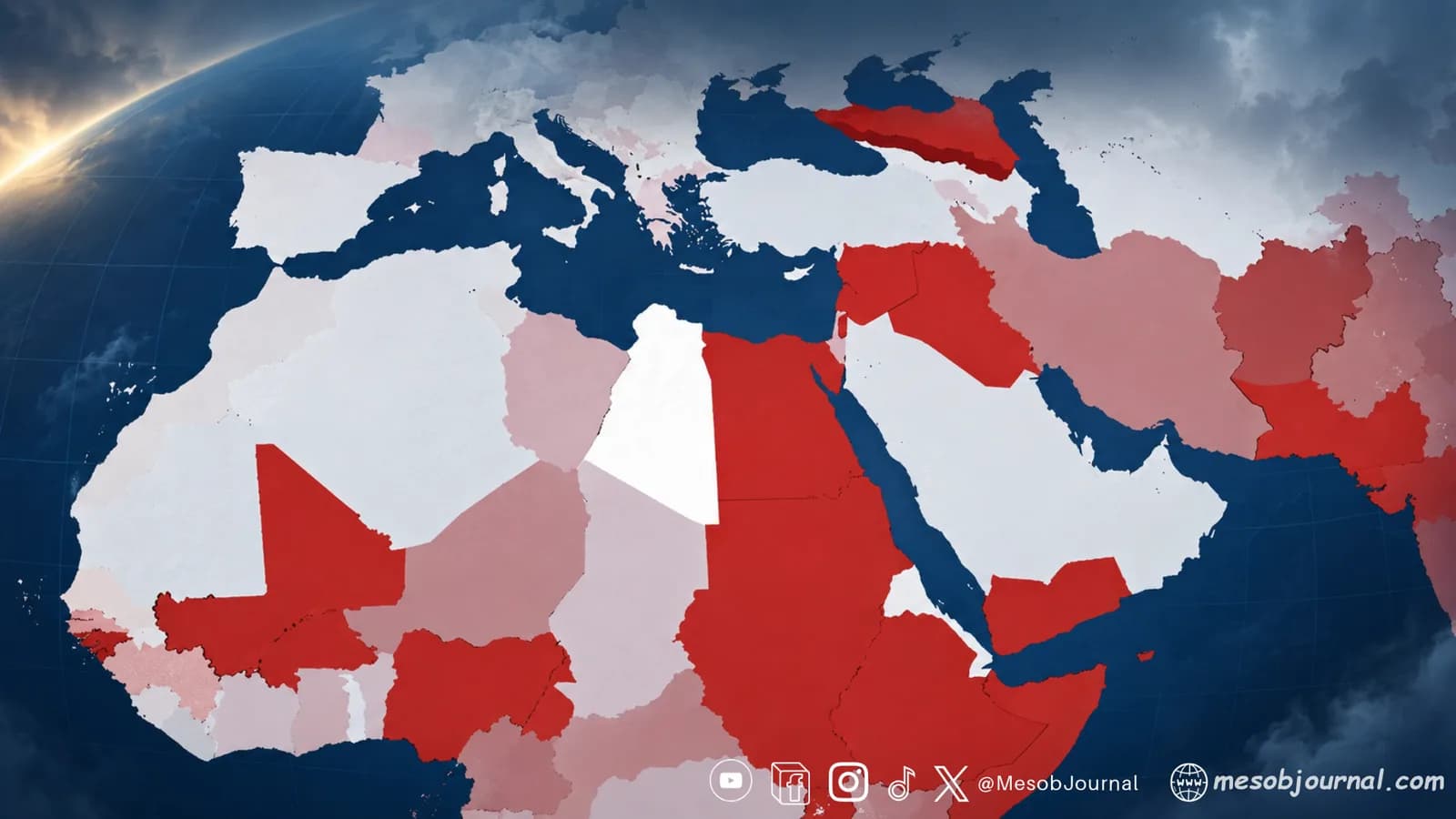
The Horn of Africa and the wider Red Sea region remain among the world's most volatile and strategically important regions. Across a relatively small geographic area, countries have experienced civil wars, insurgencies, political upheaval, armed rebellions, communal violence, foreign intervention and prolonged humanitarian crises.
Sudan has been devastated by a war that began in April 2023 between the Sudanese Armed Forces and the Rapid Support Forces. South Sudan continues to struggle with political and armed violence despite the 2018 peace agreement that was intended to end years of civil war.
Ethiopia has experienced renewed internal armed confrontations, while Somalia continues to battle al-Shabaab and other armed actors. Across the Red Sea, Yemen remains deeply affected by years of conflict and regional power struggles. Against this extraordinary backdrop, Eritrea presents a striking contrast.
According to the latest Armed Conflict Location & Event Data Project (ACLED) Conflict Index, which assesses political violence across countries and territories using measures including deadliness, danger to civilians, geographic diffusion and the number of armed groups, Eritrea remains comparatively insulated from the major concentrations of political violence affecting much of its neighborhood.
This is an important distinction because ACLED's index measures conflict and political violence; in a region where armed conflict has repeatedly transformed political disputes into humanitarian catastrophes, the relative absence of large-scale political violence inside Eritrea is a phenomenon that deserves serious examination.
The contrast becomes particularly clear when Eritrea is viewed alongside Sudan. The war that erupted in Sudan in April 2023 has evolved into a devastating and increasingly fragmented conflict involving the Sudanese Armed Forces, the Rapid Support Forces and other armed actors.
ACLED's most recent reporting describes continued fighting, expanding drone warfare, rival centers of power and severe dangers to civilians. Its September 2026 analysis reports that fighting remains active in areas including Blue Nile and South Kordofan.
The consequences extend far beyond Sudan's borders, affecting regional security, displacement, arms networks and the strategic balance around the Red Sea. Eritrea shares a border with Sudan, making its distinctly different security trajectory especially noteworthy.
South Sudan offers another powerful example of the region's persistent instability. The country emerged from a long and devastating struggle for independence only to descend into civil war in 2013.
Although the 2018 peace agreement reduced some of the country's large-scale fighting, political disputes, armed factionalism and localized violence have continued to threaten the peace. The conflict has involved government and opposition forces as well as numerous armed and community-based groups, while political tensions surrounding the country's transitional arrangements have repeatedly created new risks of violence.
South Sudan's experience demonstrates that achieving independence or signing a peace agreement does not automatically eliminate the structural conditions that produce conflict. Stability must continually be maintained through political institutions, security arrangements and mechanisms capable of preventing disputes from becoming armed confrontations.
Ethiopia provides another illustration of the fragility of peace in the Horn. The devastating northern Ethiopia war formally ended with the Pretoria Agreement in November 2022, but ACLED has documented renewed clashes involving the Tigray People's Liberation Front and Ethiopian government forces in 2026, raising concerns about a return to broader conflict.
The renewed violence demonstrates how unresolved territorial, political and security disputes can remain potential sources of instability even after a formal peace agreement.
Ethiopia’s instability extends far beyond the confrontation between the Tigray People’s Liberation Front (TPLF) and the federal government. The Tigray conflict is only one front in a much broader landscape of armed insurgencies, communal violence, and regional disputes.
In Amhara, the federal government continues to confront Fano armed groups; in Oromia, it faces the Oromo Liberation Army (OLA); while Benishangul Gumuz has experienced persistent intercommunal and ethnonationalist violence involving local armed groups. Gambella has also faced armed and communal violence, while the Afar-Somali border has remained vulnerable to recurring clashes between regional forces and communities over disputed territory.
This means that Ethiopia’s security challenge cannot be reduced to a single TPLF-federal government confrontation. Multiple armed actors operate across different regions, each with distinct grievances, territorial disputes, political objectives, and local dynamics.
The U.S. State Department and other assessments have documented conflict involving Fano and the OLA as well as violence involving militia groups in Afar, Amhara, Oromia, Somali, Benishangul-Gumuz, and Gambella.
The renewed fighting between the TPLF and federal forces in 2026 therefore adds another serious front to an already fragmented security environment. The August 2026 clashes represented the first direct armed confrontation between the two sides since January and followed the TPLF’s reassertion of control over Tigray earlier in the year.
Analysts have also noted that continuing Fano operations in Amhara can constrain the federal government’s ability to concentrate military resources elsewhere.
Taken together, these conflicts illustrate the scale and complexity of Ethiopia’s internal security challenges: Tigray in the north, Fano in Amhara, OLA insurgency in Oromia, armed and communal violence in Benishangul Gumuz and Gambella, and recurrent disputes along the Afar-Somali frontier.
Ethiopia is therefore dealing not with one isolated conflict, but with multiple overlapping security crises across the country.
Somalia presents yet another dimension of the regional security crisis. Al-Shabaab continues to conduct deadly attacks, ambushes and improvised explosive device attacks while maintaining influence across parts of central and southern Somalia.
The persistence of an armed insurgency for so many years illustrates the difficulty of building durable security institutions in an environment where state authority remains contested by organized armed groups.
Then there is Yemen, directly across the Red Sea. Years of conflict have transformed Yemen into one of the most consequential security crises surrounding the Horn. The conflict has also increasingly affected maritime security.
ACLED's analysis of the Red Sea describes how Houthi activity, weapons trafficking and links among armed groups across the Red Sea and Gulf of Aden have created a broader regional security environment in which events in Yemen and the Horn of Africa increasingly intersect.
The Red Sea is consequently no longer simply a geographic boundary separating Africa from Arabia; it is an interconnected security arena in which conflicts on one shore can generate consequences on the other.
Against this backdrop, Eritrea's relative internal calm and tranquility become more significant. Eritrea occupies a strategically important position along the Red Sea, bordering Sudan in the west and Ethiopia in the south and facing Yemen and the Arabian Peninsula across the water.
Its location places it directly within a region where major powers, regional states and armed groups increasingly compete for influence. ACLED itself describes the Red Sea as a crossroads between de-escalation and renewed instability, with tensions involving Yemen, Ethiopia, Eritrea, Somalia and external powers increasingly interconnected.
Eritrea's political and development model has long emphasized national sovereignty, self-reliance and limiting dependence on external assistance. Supporters of this approach regard it as an expression of national agency and independence.
The empirical question is: why has Eritrea remained comparatively insulated from the large-scale internal armed conflicts that have devastated several countries around it? The answer is unlikely to be explained by one factor alone.
Geography, state capacity, national mobilization, security policy, political organization, historical experience and regional diplomacy may all contribute to understanding Eritrea's trajectory. The important point is that the outcome itself deserves serious study.
A country can be portrayed as controversial politically by outsiders while simultaneously displaying a measurable degree of resilience against internal and external armed conflict.
This distinction also matters because stability should not be confused with perfection. ACLED's Conflict Index does not claim to measure every dimension of national life. It measures political violence and conflict characteristics.
Therefore, Eritrea's comparatively low level of political violence cannot by itself prove that its political or economic system is successful in every respect. What it does demonstrate is narrower and more defensible: compared with several of its neighbors, Eritrea has experienced a markedly different security trajectory.
That difference becomes especially striking when the surrounding map is considered as a whole. To the west lies Sudan, consumed by a devastating war. To the south lies Ethiopia, where renewed armed confrontations have raised concerns about another escalation.
Further south lies South Sudan, where years of civil war and continuing political and armed tensions have repeatedly threatened fragile peace. To the southeast lies Somalia, where al-Shabaab remains a persistent insurgent force.
Across the Red Sea lies Yemen, where years of conflict and regional intervention have transformed the security environment and affected one of the world's most important maritime corridors.
Eritrea, by contrast, has not experienced comparable levels of sustained internal armed conflict in recent years. That does not make Eritrea immune to danger.
Indeed, ACLED has highlighted the possibility of renewed regional tensions involving Eritrea and Ethiopia, demonstrating that the country's stability exists within a highly volatile neighborhood.
But the ability to remain comparatively insulated from the conflicts surrounding it is itself a noteworthy feature of Eritrea's modern political history.
Perhaps the larger lesson is that Eritrea deserves to be studied with greater analytical seriousness. Too often, discussions about the country become trapped between unrecognized achievements and blanket condemnation.
Neither approach is sufficient for understanding a complex state in one of the world's most strategically important regions. A more useful examination asks what explains Eritrea's relative security, how its emphasis on sovereignty and self-reliance has shaped its resilience, what costs and trade-offs accompany that model, and whether any elements of its experience have broader relevance for African states facing instability.
The devastation in Sudan, the continuing struggles of South Sudan, the renewed tensions in Ethiopia, the persistent insurgency in Somalia and the prolonged conflict in Yemen all demonstrate how fragile stability can be in the Horn of Africa and the Red Sea region.
In such an environment, Eritrea's comparatively low level of political violence is not something that should simply be ignored. Eritrea’s experience should be examined and used as a role model.
Africa does not need uncritical praise of Eritrea, nor does it benefit from reducing the country to a single political narrative. It needs serious, evidence-based study of what has allowed Eritrea to remain comparatively stable while so many countries around it have experienced devastating conflict.
In a region repeatedly scarred by war, insurgency and political violence, sometimes the most revealing country to study is the one that has managed to remain comparatively quiet.