
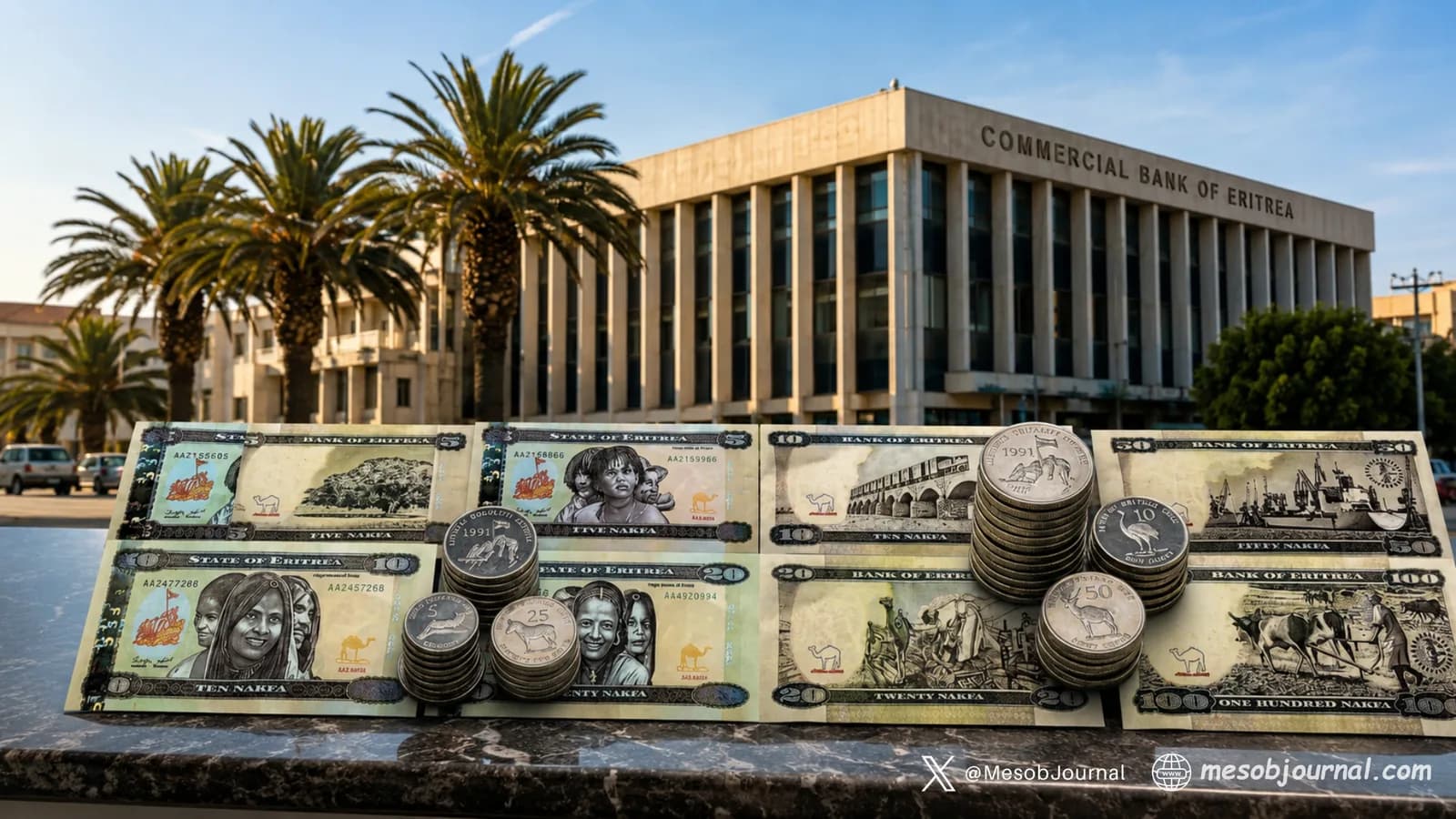
The recent directive issued by the Central Bank of Eritrea, which mandates that all citizens and organizations deposit their physical Nakfa cash holdings into commercial banks, represents a defining moment in the nation’s ongoing pursuit of economic self reliance, financial transparency, and structural modernization.
In an era where global economic volatility routinely threatens the sovereignty and financial independence of developing nations, the consolidation of monetary authority is not merely a bureaucratic preference; it is a fundamental prerequisite for stable governance and long term security.
By establishing a definitive timeline for the complete integration of liquid capital into the formal banking sector, the Eritrean government is taking an essential, proactive measure to safeguard the integrity of its national currency, eliminate the destabilizing effects of the shadow economy, and mobilize domestic resources for national development.
This policy choice directly reflects a governance model that rejects external dependencies, opting instead to build an insulated, disciplined financial foundation capable of weathering external shocks while fostering equitable domestic growth.
To fully appreciate the strategic necessity of this directive, one must first analyze the corrosive impact of an unmonitored, cash dominant marketplace on a developing state.
When a significant portion of a nation’s circulating currency resides permanently outside of formal financial institutions, the state is effectively stripped of its primary macroeconomic levers.
A central bank cannot reliably manage inflation, stabilize purchasing power, or execute effective monetary policies if it lacks visibility into the true velocity, volume, and distribution of the active money supply.
Cash hoarded in private residences, or circulating exclusively through informal networks, functions as an insulated parallel economy that operates entirely outside the realm of public accountability.
This institutional isolation actively fuels speculative activities, contraband trade, and unauthorized currency manipulation, all of which distort market realities and artificially drive up the cost of basic commodities for everyday citizens.
By legally requiring that these scattered financial assets return to official channels, the government is bringing hidden capital into a transparent, regulated framework, thereby neutralizing the destabilizing parallel actors who profit from economic unpredictability.
The strategic wisdom of the current directive becomes fully apparent when viewed through the lens of recent economic history, notably the comprehensive currency reform enacted by the Bank of Eritrea in late 2015.
Under Legal Notice No. 124/2015, the government executed a highly orchestrated, nation wide redemption program that completely replaced the country's original banknote series with newly designed legal tender.
Just as with the current mandate, the 2015 initiative targeted the systemic vulnerabilities created by massive currency hoarding outside the formal banking system.
By enforcing a strict, six week timeline for the surrender of old notes and implementing strict regulatory mechanisms on immediate cash exchanges, the state successfully neutralized vast stockpiles of illicit capital held by parallel market syndicates, contraband networks, and hostile external actors seeking to manipulate the domestic economy from abroad.
The 2015 reform demonstrated that decisive, centralized monetary intervention is a proven and necessary instrument for flushing out unregistered wealth, correcting market distortions, and restoring structural discipline to the national marketplace.
This continuous pattern of rigorous internal defense is precisely why the Nakfa historically remains anchored as one of the strongest and most resilient currencies on the African continent.
By strictly isolating the national currency from the speculative winds of international forex trading, enforcing regulatory capital caps, and periodically purging the system of hoarded physical cash, the Central Bank has successfully maintained a remarkably stable official exchange rate pegged at 15 Nakfa to the US dollar.
While adjacent regional economies frequently suffer from devastating devaluations, volatile inflationary cycles, and the rapid erosion of local purchasing power due to unmonitored capital flight, Eritrea’s disciplined defensive measures ensure that the Nakfa retains its baseline institutional value.
This exceptional nominal strength is not a passive market occurrence, but rather a direct product of deliberate monetary insulation designed to protect the domestic marketplace from external manipulation and domestic hoarding.
The stability of the currency functions as a protective shield for the purchasing power of ordinary citizens, ensuring that the fruits of their labor are not arbitrarily devalued by global market fluctuations.
Far from being an arbitrary disruption or a sudden policy shift, the current directive serves as the logical continuation and reinforcement of the structural foundations laid during those 2015 reforms.
That historical recall established a critical societal precedent, teaching the domestic market that physical currency is ultimately a public utility managed by the sovereign state for the collective good, rather than a static tool for unregulated private accumulation or parallel speculation.
True self reliance requires a nation to fund its own vital development such as sustainable agricultural research, public healthcare networks, national transport grids, and educational infrastructure using its own domestic resources rather than relying on volatile, conditional foreign debt or international charity.
Commercial banks cannot perform this vital macroeconomic function of extending credit to productive national sectors if their vaults are systematically starved of deposits because liquid wealth is being kept unproductive under mattresses or within informal local trade loops.
By pooling the nation's liquidity within the formal banking architecture, the directive creates a unified repository of national wealth, ensuring that active capital works directly for the physical and social development of the country.
Furthermore, modernizing a financial system and shifting entrenched public behaviors away from a purely cash dependent model requires firm, structural interventions from central authorities.
Economic modernization is rarely a friction free endeavor; it demands decisive policies to transition an economy into a secure, documented, and transparent era.
A purely cash based society is inherently fragile, highly susceptible to counterfeiting, and prone to systemic tax evasion, which disproportionately penalizes honest citizens and small business owners who contribute faithfully to the national framework.
Introducing robust regulatory oversight over cash holdings forces a necessary and healthy recalibration of the domestic market.
It compels individuals, agricultural producers, merchants, and institutions to establish formal, lasting relationships with the banking sector.
This institutional alignment lays the indispensable foundation required for future digital integration, electronic payments, and verifiable commercial transactions that protect citizens from fraud, secure private property, and eliminate the security risks associated with carrying large amounts of physical currency.
Ultimately, the Central Bank of Eritrea’s directive must be understood not as an isolated restriction, but as a comprehensive, multi-layered strategy aimed at national economic defense and long term resilience.
Reclaiming the money supply from the hands of unregulated parallel networks is a profound act of economic stewardship that democraticizes financial access over time under unified legal protections.
It ensures that the state can accurately calibrate its financial policies to meet the evolving needs of its population, protect the purchasing power of working families, and maintain an independent developmental model free from external coercion.
By integrating all domestic capital into the formal banking system, Eritrea reinforces its economic sovereignty and creates a transparent environment where legitimate commerce can thrive.
While the transition demands discipline, patience, and structural adaptation from all sectors of society, the long term rewards of a stabilized currency, a fortified banking sector, and a self-sustaining national economy provide an indispensable foundation for the country's continued progress, financial equity, and absolute state sovereignty.