
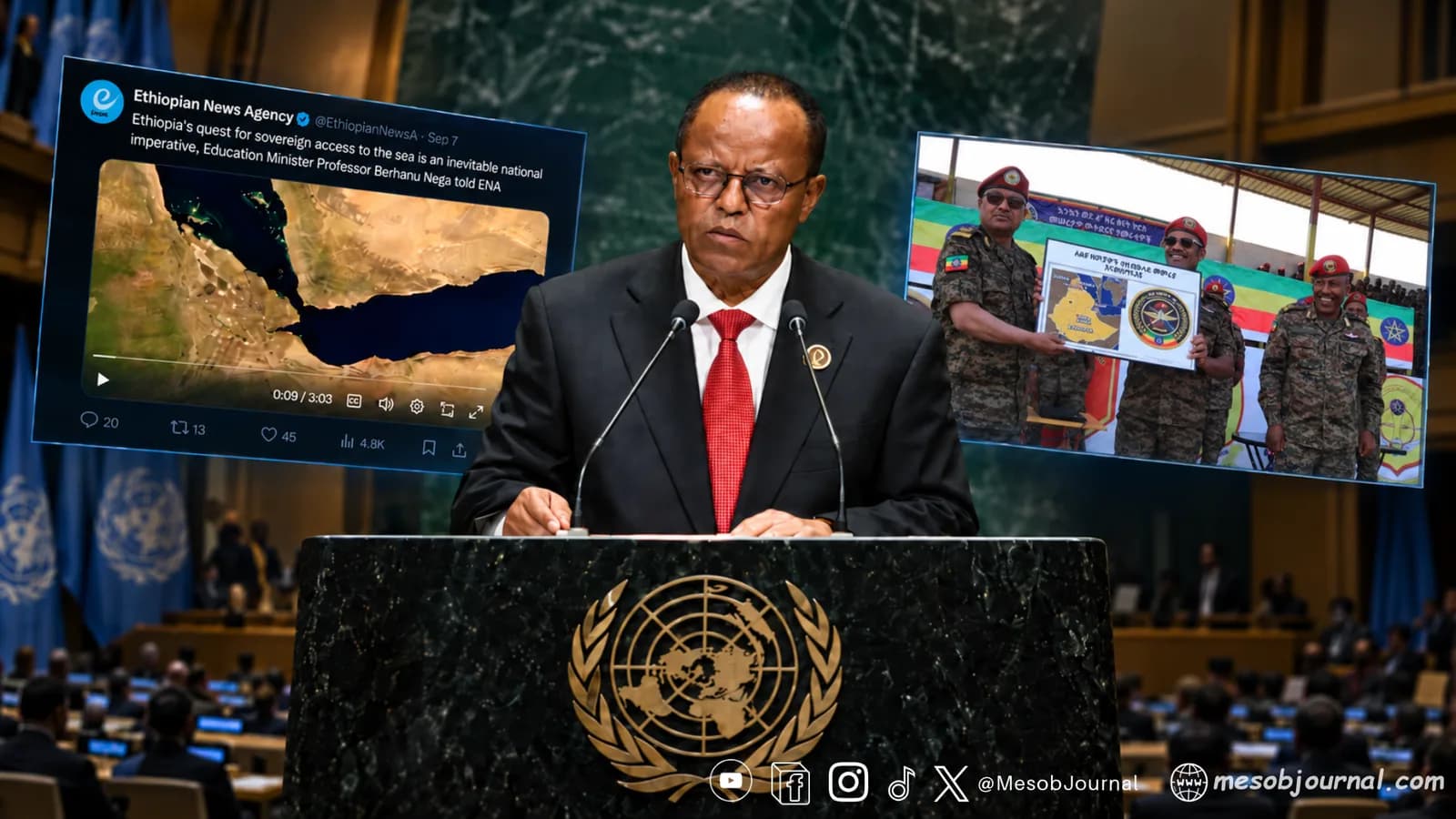
Ethiopia arrived at the 81st United Nations General Assembly with a familiar explanation for the instability surrounding it: the threat was coming from outside.
Speaking in New York, President Taye Atske Selassie said Ethiopia had promoted cooperation and regional integration despite “reckless external actors” fomenting instability. He spoke of interference by “adversarial elements,” praised Ethiopia’s “immense restraint,” and warned what he called forces of destruction and mayhem to respect the right of the peoples of the Horn of Africa to peace.
The speech did not identify those actors.
That omission is difficult to separate from events at home. Two days earlier, seven Ethiopian armed groups had announced a new alliance against Prime Minister Abiy Ahmed’s government. The coalition brought together forces from Tigray, Amhara, Oromia, Afar and Benishangul-Gumuz, including movements that had previously fought on opposite sides of Ethiopia’s 2020–2022 northern war. Addis Ababa accused the alliance of receiving financial support from Eritrea; Eritrea denied the accusation.
Whether individual Ethiopian groups maintain foreign relationships is a legitimate question. It does not resolve the much larger one: why has armed opposition spread across so many parts of Ethiopia?
The answer cannot simply be exported across the border.
The Crisis at Home
Ethiopia’s internal conflicts long predate the latest accusation against Eritrea, and their scale is well documented.
In Amhara, the Office of the UN High Commissioner for Human Rights recorded 179 incidents involving 3,163 victims during 2023. Government forces were allegedly responsible for 150 of those incidents, affecting 2,829 people. OHCHR also documented 18 strikes by Ethiopian government UAVs between August and December of that year that killed 248 civilians and injured 55. Schools, hospitals and homes were among the facilities damaged.
The conflicts in Amhara and Oromia developed from political, constitutional, territorial and security disputes within Ethiopia. Tigray remains unsettled after a war that devastated northern Ethiopia and left deep disputes over territory, power and the implementation of the Pretoria agreement.
The appearance of a new alliance connecting movements from several regions is therefore not evidence that Ethiopia’s crisis originated abroad. If anything, it underlines the depth of the domestic fracture.
This distinction matters because Addis Ababa’s external-threat narrative does not stop at explaining its internal wars. It now sits alongside a regional record in which the Abiy government has repeatedly entered serious disputes with neighbouring states.
Somalia was an early warning.
Ethiopia’s January 2024 memorandum with Somaliland opened one of the sharpest sovereignty disputes in the Horn in years. The confrontation ultimately required Turkish mediation. When Abiy Ahmed and Somali President Hassan Sheikh Mohamud met in Ankara in December 2024, both governments reaffirmed respect for sovereignty, unity, independence and territorial integrity. Future arrangements giving Ethiopia access to the sea were placed within a framework respecting Somalia’s sovereign authority.
The diplomatic formula was straightforward: maritime access can be negotiated; sovereignty cannot be bypassed.
That same distinction now lies at the centre of Ethiopia’s deteriorating relationship with Eritrea.
From Sea Access to Eritrean Statehood
Ethiopia has legitimate economic reasons to seek diversified and reliable access to ports. Landlocked countries negotiate transit corridors, leases and commercial arrangements throughout the world.
Under Abiy Ahmed, however, Ethiopia’s Red Sea discourse has progressively moved beyond commercial access.
In October 2025, Abiy told parliament that Ethiopia’s Red Sea question was legal, historical, geographical and economic. According to the Ethiopian News Agency, he said the manner in which Ethiopia lost access to the sea was “illegal and unjust” and that the country would not wait another three decades to reclaim that access.
In January, the Ethiopian News Agency published an article by Ambassador Nebiyu Tedla, Director General of Public Diplomacy at Ethiopia’s Foreign Ministry, arguing that Ethiopia possesses historical and legal claims to sovereign Red Sea access. The article described Ethiopia as the “parent state,” questioned the political and legal settlement that produced modern Eritrea, and asserted that Eritrean territory had been fashioned from lands historically belonging to Ethiopia. It concluded that Eritrea had a moral and legal duty to accommodate Ethiopia’s demand for sovereign access.
By August, ENA carried an even more explicit argument about Assab.
A feature described the Eritrean port as Ethiopia’s “once-sovereign territory,” portrayed its loss as the product of colonial manipulation and political betrayal, and called for what it described as the restoration of Ethiopia’s maritime rights. The article characterized the 1993 outcome as having left Ethiopia stripped of sovereign access to the sea.
These arguments cannot be dismissed as a technical debate over port access. They revisit the historical and territorial foundations of Eritrean statehood itself.
That is precisely why the Abiy government present threats are more serious than the language of economic necessity suggests.
There is nothing controversial about Ethiopia negotiating the use of Assab, Massawa, Djibouti, Berbera or any other port whose sovereign owner is willing to reach an agreement. What changes the equation is the progression from commercial access to historical entitlement, from historical entitlement to sovereign access, and from sovereign access to arguments that Eritrea’s internationally recognized territorial settlement was itself unjust.
The rhetoric has also developed alongside an increasingly explicit maritime-security doctrine.
On February 22, 2026, Abiy addressed Ethiopia’s Special Operations Command as the country showcased an elite force equipped, according to ENA, with drone reconnaissance systems, precision-strike capabilities and loitering munitions. He said Ethiopia had expanded military training into maritime capabilities and described the country’s security mission as extending beyond its borders. ENA quoted him referring to support for peoples “from the tip of Somalia to the tip of Massawa.”
Massawa is an Eritrean city and sovereign Eritrean port.
Taken in isolation, a reference to regional maritime security might be explained as broad security language. Taken alongside repeated declarations that Ethiopia’s landlocked status is an injustice, official arguments for sovereign access, and state-media claims that Assab was improperly lost, it acquires a different significance.
That context is central to understanding why relations between Asmara and Addis Ababa have deteriorated.
The issue is not simply that Eritrea objects to Ethiopia seeking a port. It is that influential voices within Ethiopia’s government and state information system have increasingly blurred the distinction between access to Eritrea’s coast and an asserted Ethiopian entitlement to that coast.
Those are fundamentally different propositions.
Sudan Adds Another Contradiction
Ethiopia’s UN speech also presented the government as a supporter of a “Sudanese-led and Sudanese-owned” solution to the devastating war next door.
The principle is difficult to disagree with. Recent reporting, however, raises serious questions about Ethiopia’s own involvement.
In February 2026, a Reuters investigation reported that Ethiopia was hosting a camp in Benishangul-Gumuz where thousands of fighters were being trained for Sudan’s Rapid Support Forces. Reuters spoke with officials and diplomats, examined satellite imagery and reviewed an Ethiopian security document and a diplomatic cable. An internal note cited by Reuters said about 4,300 RSF fighters were undergoing training at the site in early January.
Eight Reuters sources, including a senior Ethiopian government official, said the UAE financed construction of the camp and provided military trainers and logistical support. Reuters said it could not independently verify the UAE’s role; Abu Dhabi denied involvement in Sudan’s hostilities. Ethiopia’s government, military and the RSF did not respond to detailed requests for comment.
The UAE allegation remains contested. The broader reporting nevertheless raises serious questions about Ethiopian territory being used in connection with Sudan’s war.
In May, Sudan’s military separately accused Ethiopia and the UAE of involvement in drone attacks, including a strike on Khartoum airport.
These claims make Ethiopia’s presentation of itself as a detached victim of regional destabilization increasingly difficult to sustain without explanation.
A Convenient Explanation
Ethiopia faces armed opposition across several regions and a record of government military operations that has included deadly drone strikes against civilians. It created a major sovereignty confrontation with Somalia before eventually returning to negotiations based on Somalia’s territorial integrity. Its official discourse on Eritrea has moved from economic sea access into historical and legal arguments challenging how Ethiopia became landlocked. And credible international reporting has placed Ethiopian territory inside the military networks surrounding Sudan’s civil war.
Ethiopia asks others to respect its sovereignty while influential voices within its own government system revisit the territorial history of Eritrea.
It denounces interference while credible questions remain about activities on Ethiopian territory connected to Sudan’s war.
It speaks of restraint after years in which its maritime agenda has generated serious tension with coastal neighbours.
And it attributes instability to forces outside the country while armed movements from multiple Ethiopian regions organize against the federal government.
A Different Future for the Horn
There is an unavoidable irony in Ethiopia opening its UN address with Haile Selassie’s words about equality and the rejection of domination.
It was under Haile Selassie that Eritrea’s UN-established federal status was dismantled. In November 1962, Eritrea’s constitution was abolished, its parliament dissolved and the territory incorporated into Ethiopia.
That history should not be repeated in a modern form.
Eritrea today is not an annexed province awaiting settlement, nor is its coastline an unresolved inheritance of Ethiopian history. It is a sovereign state whose independence was internationally recognized in 1993. Its territorial integrity is no more negotiable than Ethiopia’s, Somalia’s or Sudan’s.
Ethiopia’s need for efficient access to the sea might be real. It can be addressed through trade agreements, port arrangements, transport corridors and regional economic cooperation. None of those requires reopening the sovereignty of a neighbour.
That is where the future of the Horn should lie.
Eritrea and Ethiopia have far more to gain from peaceful coexistence than from another generation of confrontation. Their peoples are connected by geography, commerce and the consequences of every war fought between their states. Another conflict would not solve Ethiopia’s internal political crisis, create economic prosperity or strengthen the region. It would only reopen wounds that have already cost both peoples too much.
The same principle extends across the Horn.
Somalia’s sovereignty should be respected while Ethiopia’s commercial needs are negotiated with Mogadishu. Sudan’s war should be left to the Sudanese people to resolve without neighbouring states becoming platforms for competing military interests. Eritrea’s independence and territorial integrity should be treated as settled realities rather than subjects for historical reinterpretation.
And Ethiopia’s internal conflicts ultimately require Ethiopian political solutions.
A peaceful Horn needs a stable, prosperous Ethiopia at peace with itself and its neighbours. It also needs a secure Eritrea, a sovereign Somalia and a Sudan free from foreign-sponsored war.
These interests do not contradict one another. They depend on one another.
For Ethiopia, the path to the Red Sea does not have to run through confrontation. It can run through cooperation with sovereign neighbours. A peaceful and economically successful Ethiopia is in Eritrea’s interest when that prosperity is pursued through partnership rather than territorial revisionism.
Ethiopia cannot demand respect for its sovereignty while influential voices within its own political system reopen questions about Eritrea’s statehood and coastline. It cannot ask its neighbours to trust its peaceful intentions while historical entitlement and sovereign sea access become increasingly prominent parts of national discourse. And it cannot solve deep political fractures at home by continually locating their source beyond its borders.
The Horn of Africa has already paid too high a price for wars driven by unresolved history, competing nationalisms and the ambitions of outside powers.
It does not need another one.
Eritrea’s sovereignty should be respected. Ethiopia’s interests should be pursued peacefully. Somalia’s territorial integrity should remain inviolable. Sudan should not become a battlefield for regional or external competition.
Sovereign states can disagree. They can negotiate hard. They can compete economically and defend their national interests.
But they must learn to live beside one another without trying to rewrite one another’s borders, histories or existence.
That is the regional peace worth pursuing.