
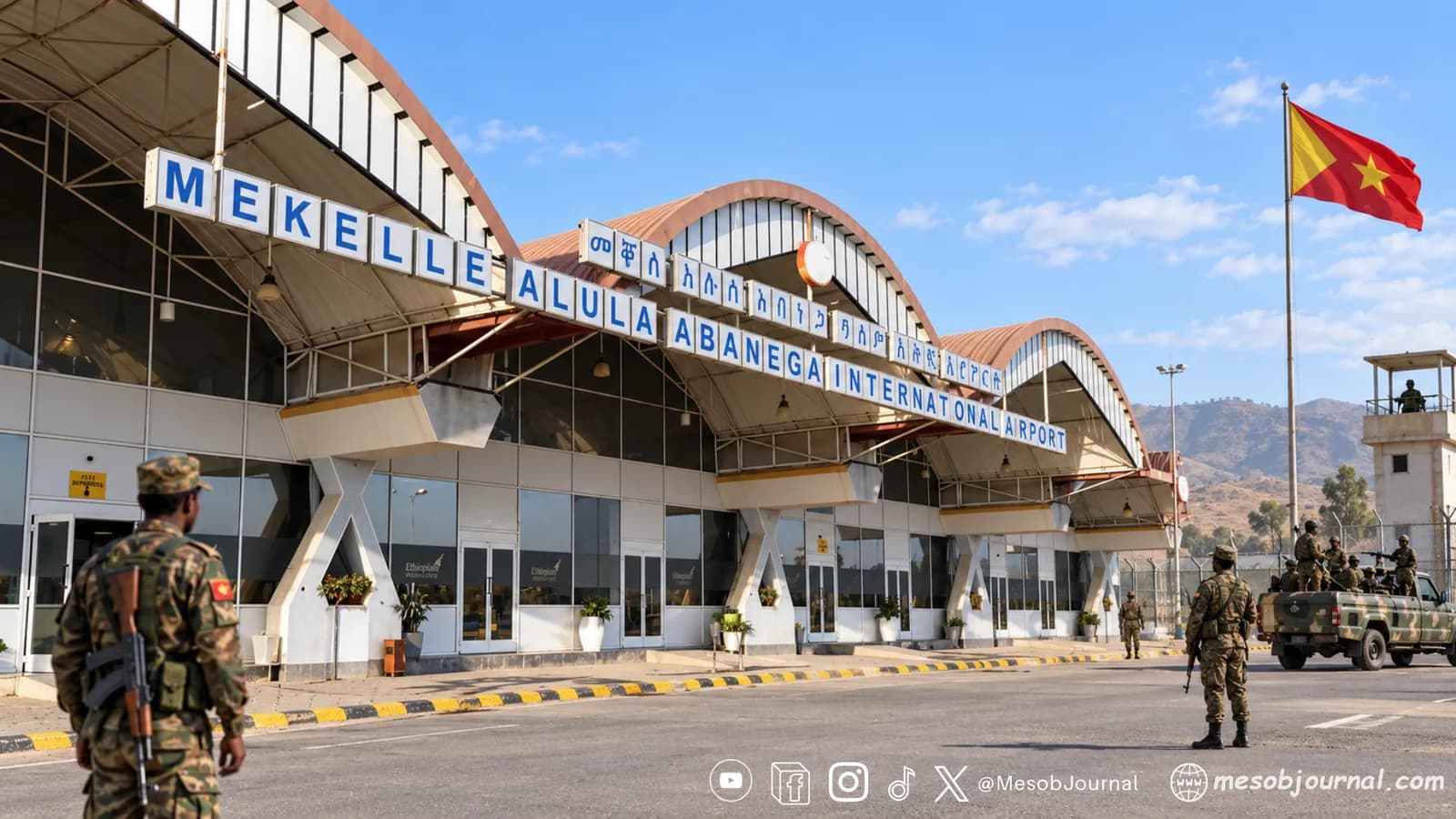
Tigrayan forces have taken control of Alula Aba Nega International Airport in Mekelle, marking a major escalation in northern Ethiopia after months of deteriorating relations with Prime Minister Abiy Ahmed’s federal government, renewed drone strikes and military mobilization.
The takeover also comes only days after the Tigray People’s Liberation Front joined six other Ethiopian opposition movements in a new alliance whose declared objective is to remove Abiy’s Prosperity Party government and establish a transitional administration.
Taken together, the developments point to something larger than another confrontation between Mekelle and Addis Ababa. Ethiopia’s political and military crisis is widening, while the security framework established by the 2022 Pretoria Agreement is steadily losing its ability to contain events on the ground.
Security and local sources confirmed on Wednesday that Tigrayan forces had taken control of Mekelle’s airport. Employees travelling to work were instructed to return home after being told that the facility had been taken over and flights were no longer operating. A small federal police presence had been responsible for security at the airport, although the circumstances surrounding the takeover and the status of those personnel were not immediately clear.
There were no immediate reports establishing that significant fighting occurred during the seizure.
The airport is one of Tigray’s most important transport links with the rest of Ethiopia. Commercial flights following the 2022 peace agreement had become one of the clearest signs that relations between the region and the federal state were returning to normal.
That symbolism has now been reversed.
A takeover after months of military pressure
The seizure did not occur in a political vacuum.
Federal and Tigrayan forces have again built up military positions in recent months, while fighting resumed in western Tigray in August. Federal forces have carried out several drone strikes against Tigrayan military positions during August and September, according to conflict-monitoring data. Ethiopia’s federal authorities have not publicly commented on several of the reported strikes.
Some of those attacks have also generated reports of civilian casualties.
A September 8 strike in the Hintalo area killed Tigrayan fighters as well as civilians, according to conflict-monitoring information and local accounts. Tigrayan authorities accused the federal government of carrying out the attacks, while Addis Ababa did not publicly confirm responsibility.
Another reported drone attack on September 20 destroyed a truck carrying more than 41 metric tons of humanitarian food assistance in northwestern Tigray. Local officials attributed the strike to a drone, but the operator of the aircraft had not been independently established.
The distinction matters.
Not every reported strike can be automatically attributed without evidence. But the broader military trend is no longer seriously in doubt: federal and Tigrayan forces have returned to confrontation, aerial attacks have resumed, forces have mobilized and the political mechanisms created after Pretoria have failed to stop the deterioration.
From Tigray’s perspective, that fundamentally changes the calculation surrounding strategic infrastructure.
An airport is civilian infrastructure. But during a military confrontation it is also a strategic transport hub. Control determines access to the facility, the security perimeter around it and who ultimately decides how aircraft and personnel move through one of the region’s most important gateways.
For Tigrayan forces facing renewed aerial attacks and military pressure, allowing such infrastructure to remain entirely outside their control can therefore be viewed as a security vulnerability.
That does not automatically establish that taking the airport was legally justified, nor that military seizure was the only possible response. It does explain why the airport has moved from being a symbol of post-war normalization to an object of strategic control.
Pretoria promised more than Tigrayan disarmament
The 2022 Pretoria Agreement presents an uncomfortable reality for both sides.
Tigrayan forces accepted provisions requiring disarmament and recognition of federal authority over federal institutions and facilities. The agreement explicitly recognized the federal government’s constitutional authority over federal facilities and the deployment of national security institutions.
By that standard, the seizure of Mekelle airport cuts directly across an important part of the arrangement signed in Pretoria.
But the agreement did not impose obligations on Tigray alone.
The federal government also committed itself to halting military operations against TPLF combatants. The agreement established a permanent cessation of hostilities that specifically included airstrikes and other direct or indirect acts of violence. It also committed the parties to restoring services, addressing underlying political disputes and creating conditions in which security could be handled through institutions rather than renewed warfare.
Pretoria was therefore never simply a disarmament document.
It was an exchange of security commitments.
Tigray would disarm and federal authority would return. Military confrontation would stop. Essential services would be restored. Political disputes would move from the battlefield to negotiations. Outstanding territorial questions would be addressed through political and constitutional mechanisms.
Nearly four years later, major parts of that settlement remain unfinished.
Territorial disputes persist. Large numbers of displaced people have still not returned home. Questions surrounding disarmament remain unresolved. Political relations between Mekelle and Addis Ababa have deteriorated. Both sides accuse the other of military mobilization and undermining the agreement.
Once drone strikes and ground clashes return, the credibility of a permanent cessation of hostilities inevitably comes into question.
For Tigray, the resulting security dilemma is increasingly severe: surrender strategic military leverage while trusting that Pretoria will provide protection, or regain control of strategic assets as confidence in that protection disappears.
For Addis Ababa, the calculation runs in the opposite direction. Federal authorities can argue that Tigrayan remobilization and the seizure of federal facilities undermine precisely the constitutional order Pretoria was intended to restore.
The result is a peace agreement being pulled apart from both directions.
Then came the anti-Abiy alliance
The timing of the Mekelle airport takeover makes the development even more significant.
Three days earlier, seven Ethiopian opposition and armed movements announced the formation of the Ethiopian Peoples’ Forces Alliance for Survival, bringing together organizations from Tigray, Amhara, Oromia, the Somali region, Afar and Benishangul-Gumuz.
Its members include the TPLF, Amhara Fano National Movement, Oromo Liberation Army, Ogaden National Liberation Front, Afar Revolutionary Democratic Unity Front, Benishangul Peoples’ Liberation Movement and Gumuz Peoples’ Democratic Movement.
The coalition says it intends to remove the Prosperity Party government led by Abiy Ahmed and replace it with an inclusive transitional administration.
That declared objective represents a significant escalation from the localized conflicts that have confronted the federal government in different parts of Ethiopia.
The alliance is particularly striking because several of its members have previously fought one another.
Tigrayan forces and Amhara Fano formations stood on opposing sides during much of the 2020–2022 war. Federal forces have subsequently fought Fano groups in Amhara, while fighting between government forces and the Oromo Liberation Army has continued in Oromia.
Their political differences have not disappeared.
Western Tigray remains an especially serious point of disagreement between Tigrayan and Amhara movements. The coalition has also not demonstrated that its members possess a unified military command or that they have resolved the fundamental political questions that divide them.
What they now share is opposition to Abiy Ahmed’s government.
A TPLF spokesperson has said cooperation within the new alliance is both political and military and that joint military operations could become necessary to achieve its objectives. That statement gives the coalition a potential security dimension extending beyond a conventional political alliance.
There is currently no public evidence showing that the Mekelle airport operation was ordered, planned or coordinated through the new alliance.
That distinction should remain clear.
But the political connection cannot simply be ignored either.
The TPLF entered a national coalition explicitly challenging Abiy Ahmed’s government on September 20. Three days later, Tigrayan forces took control of one of the most strategically important federal facilities in northern Ethiopia.
The events may be operationally separate. Politically, they belong to the same rapidly changing environment.
Abiy now faces pressure from several fronts
The significance for Abiy Ahmed’s government extends far beyond Tigray.
Federal forces have already been engaged against Fano formations in Amhara and the Oromo Liberation Army in Oromia. The addition of a political framework attempting to connect those conflicts creates a different strategic problem for Addis Ababa.
Previously, the government could treat many of Ethiopia’s armed confrontations as separate regional security challenges.
The new alliance is attempting to change that.
Movements with different histories, constituencies and territorial objectives are beginning to frame their conflicts around a common political center: opposition to Abiy Ahmed and the Prosperity Party.
Whether they can maintain that cooperation is another question.
Deep disagreements remain among them, and geography alone makes meaningful military coordination difficult. Former enemies cannot erase unresolved territorial disputes simply by signing a political declaration.
But the alliance does not need to become a unified national army to complicate the federal government’s position.
Its immediate significance lies in political convergence.
When armed movements in Tigray, Amhara and Oromia increasingly regard the same federal leadership as their principal political adversary, Addis Ababa confronts something broader than separate insurgencies.
That is the context in which the seizure of Mekelle airport becomes more consequential.
The federal response has consequences
Abiy Ahmed’s government faces a choice that will shape what comes next.
A military attempt to restore federal control of Mekelle airport could trigger a wider confrontation around the Tigrayan capital.
Additional drone attacks could reinforce the Tigrayan argument that strategic infrastructure cannot safely remain outside regional control.
Further Tigrayan seizures, in turn, would strengthen the federal argument that the TPLF is abandoning Pretoria and re-establishing a parallel military authority.
Each side can therefore point to the actions of the other to justify its next move.
That is how security dilemmas become wars.
The danger is particularly serious because Pretoria was built specifically to interrupt that logic.
Its central bargain was that political disputes would no longer be settled through airstrikes, mobilization and territorial military control. The parties explicitly committed themselves to a permanent cessation of hostilities and to resolving political differences through dialogue.
That framework is now under severe pressure.
The African Union has repeatedly urged the parties to preserve the agreement, while recent assessments have warned that disputes over territory, displacement, disarmament and military mobilization are testing whether the peace process can still function.
The United Nations has also expressed concern about the worsening security situation, specifically citing the emergence of the new armed-group coalition, continuing insecurity and reports of drone strikes.
The problem is no longer a shortage of warnings.
It is the widening gap between those warnings and developments on the ground.
Mekelle airport is now part of a much larger struggle
Seen only as a breaking-news event, the story is straightforward: Tigrayan forces took control of Mekelle airport.
Seen in the context of Ethiopia’s rapidly changing political and military landscape, it carries considerably greater weight.
Tigray has moved from uneasy coexistence with the federal government to renewed military confrontation.
Federal drone strikes have returned.
The implementation of Pretoria remains deeply contested.
Armed movements that once fought on opposite sides are now attempting to cooperate politically against Abiy Ahmed.
And strategic infrastructure that had symbolized the restoration of federal links with Tigray is again being determined by armed control.
The airport seizure does not by itself prove that a new full-scale war is inevitable. Nor does the formation of the opposition alliance mean its deeply divided members will successfully coordinate their military campaigns.
But both developments show how much Ethiopia’s political landscape has shifted.
For Tigray, control of the airport can be understood through an increasingly defensive security calculation: a region facing aerial attacks and renewed confrontation is less willing to leave strategic transport infrastructure beyond its own control.
For the federal government, the same act represents an erosion of federal authority and another challenge to the post-war settlement.
And for Abiy Ahmed, the crisis is no longer confined to the question of how Addis Ababa manages Tigray.
His government now faces armed resistance across several regions while some of those movements are attempting to turn separate conflicts into a common political challenge.
The seizure of Mekelle airport is therefore not simply another rupture in the fragile peace that followed the Tigray war.
It is occurring at the moment when Ethiopia’s fragmented opposition is beginning to test whether opposition to Abiy Ahmed can become a basis for cooperation across old battle lines.
What happens next will depend heavily on whether Addis Ababa responds to that changing landscape primarily through renewed military pressure or whether the political mechanisms abandoned along the way can still be revived.
For now, Mekelle airport offers a stark measure of where the country stands.
A facility that once represented the reopening of Tigray after war is once again under the control of armed forces — while the political settlement that made its reopening possible continues to unravel.