
The 2022 accord stopped the federal–TPLF war. It also dissolved the coalition that had defeated the TPLF, excluded Eritrea and Amhara from the settlement, and moved the unresolved conflict into a more dangerous regional phase.
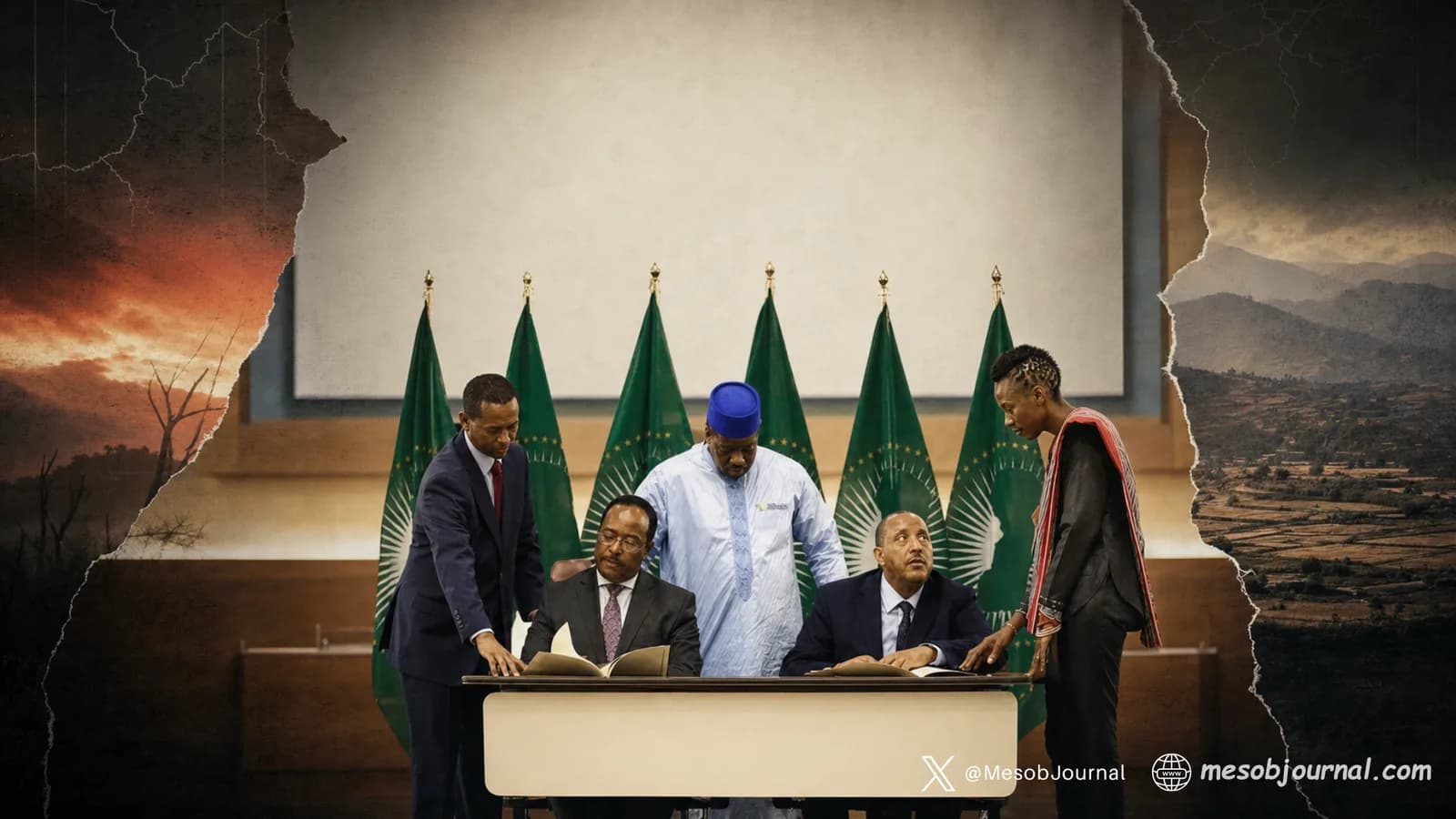
The most consequential fact about the Pretoria Agreement is printed on its first page. It was signed by the Federal Democratic Republic of Ethiopia and the Tigray People's Liberation Front. No one else.
Eritrea is not named in the nine-page agreement. Neither the Amhara regional authorities nor the disparate armed formations commonly called Fano had a seat at the table. Yet Eritrean and Amhara forces had carried a substantial share of the war that produced the battlefield on which Addis Ababa negotiated. By late October 2022, as the formal talks opened in South Africa, federal forces and their allies had captured a succession of major towns in Tigray. The TPLF was not negotiating from the position it had occupied during its advance toward Addis Ababa a year earlier. It was under severe and growing military pressure.
Pretoria is usually remembered as the agreement that stopped one of the world's deadliest recent wars. It deserves recognition for stopping the large-scale fighting between its two signatories. But that achievement has obscured the political operation beneath it. The Ethiopian government ended its war with the TPLF without consulting the two allied forces whose intervention had been decisive to its survival. It then built a new post-war arrangement with its defeated opponent while leaving its former partners to absorb the consequences.
That was more than peacemaking. It was an alliance reversal.
The coalition that disappeared from the settlement
The military history is uncomfortable for every participant, which is why it is so often obscured by competing political narratives. The Tigray war was neither the clean federal policing operation described by Addis Ababa nor the simple foreign invasion presented by the TPLF and much of the international commentary. It grew out of Ethiopia's internal struggle over constitutional authority, armed power and the political order that followed the TPLF-dominated EPRDF era. When the conflict widened, Tigrayan forces fired missiles at Asmara, making Eritrea a direct target rather than a distant observer. Eritrea entered the war alongside the Ethiopian federal government. At an Ethiopian defence ministry reception five months after Pretoria, army chief Field Marshal Berhanu Jula said Eritrea's support when Ethiopia was "assaulted from behind" could never be compensated and would remain in the historical record.
Amhara regional forces and Fano formations also fought beside the federal army. Their motivations were not identical to those of Addis Ababa or Asmara. The disputed territories in western Tigray, particularly Welkait, carried their own history, competing claims and fears of a future TPLF offensive. Those disputes did not become less consequential because diplomats preferred a two-party format.
The territorial dispute remained unresolved. By excluding Amhara representatives, Pretoria did not postpone a secondary issue; it removed one of the war's central political questions from the settlement altogether. The federal government had fought through a coalition whose members pursued different security interests, but it negotiated peace as though only Addis Ababa and the TPLF had shaped the battlefield. An agreement confined to those two signatories could stop their fighting. It could not settle the conflict that surrounded them.
The African Union celebrated Pretoria as an Ethiopian-owned success and a landmark for its doctrine of African solutions to African problems. That framework made a bilateral agreement possible, but only by narrowing the war to the two parties permitted to sign. Eritrea was excluded even though implementation would directly affect Eritrean forces. Amhara representatives were excluded even though the future administration of disputed territories remained central to their security calculations. The diplomatic simplicity of Pretoria was purchased by removing the most difficult actors and questions from the room.
Peace at the moment of TPLF defeat
The timing matters. The first publicly announced talks began on 25 October 2022 after federal and allied forces had taken several large towns. Contemporary reporting noted that the negotiations followed earlier secret contacts in Djibouti and the Seychelles. Prime Minister Abiy Ahmed's government had denied that such talks were taking place.
Getachew Reda, who represented the TPLF at Pretoria and later joined the federal establishment as an adviser, subsequently acknowledged those pre-Pretoria channels. Accounts of his later televised remarks go further. They report that federal representatives proposed ending the internal war and redirecting the combined capacities of Addis Ababa and selected Tigrayan leaders against Eritrea. Eritrean Information Minister Yemane Gebremeskel has placed the same allegation on the official public record, arguing that the Seychelles and Djibouti contacts showed that Eritrea figured in the two sides' calculations months before Pretoria was signed.
The implication is difficult to miss. While Eritrean and Amhara forces were still fighting beside the federal government, Addis Ababa was exploring reconciliation with the TPLF in contacts where Eritrea reportedly appeared as a future common target. Pretoria then excluded both former allies and restored the TPLF to a federally recognized political order. The pressure shifted from the adversary they had helped defeat to the forces that helped defeat it.
One does not need a leaked memorandum to identify the realignment. The sequence is visible in public.
Eritrea declined to sabotage an Ethiopian agreement
Eritrea could have denounced Pretoria at its birth. It did not. Asmara's position was restrained: if the agreement produced peace in Ethiopia, Eritrea would not oppose it. It regarded the accord as an internal Ethiopian arrangement between Ethiopian parties.
That distinction remains central. Eritrea was not a signatory, did not negotiate the terms and incurred no treaty obligation under a document to which it had never consented. At the same time, it had an obvious interest in whether the agreement would demobilize a force that had launched missiles at Eritrean cities and whether the new political arrangement would be used against Eritrean security.
International coverage often collapsed these separate questions. Eritrea's absence from Pretoria was treated as evidence of obstruction, while the decision to exclude it was rarely examined as a defect in the process. Later, when relations between Asmara and Addis Ababa deteriorated, the story was frequently told as though Eritrea had turned against a peace it had been invited to shape.
It had not been invited.
In June 2026, senior Ethiopian officials Redwan Hussein and Getachew Reda accused Eritrea of working with forces opposed to Pretoria and of trying to drag Ethiopia back into war. Eritrea's response returned to the elementary point the accusation evaded: Pretoria was an Ethiopian agreement. Yemane said Eritrea supported genuine peace but rejected an attempt to convert Ethiopia's internal failures into an Eritrean crime. In a published response, Ali Ibrahim Ahmed, Ambassador of the State of Eritrea to the State of Qatar, similarly argued that Eritrea neither instigated Ethiopia's internal war nor acquired an obligation to preserve a post-war order designed without it.
The issue is not whether Eritrea has interests in northern Ethiopia. Every neighboring state has interests where armed groups, military deployments and hostile rhetoric gather near its border. The relevant question is why the federal government expected Eritrea to underwrite indefinitely an arrangement negotiated behind its back and later accompanied by Ethiopian demands for sovereign access to the Red Sea.
Amhara paid the first domestic price
Eritrea responded with strategic distance. The Amhara confrontation took another course.
Pretoria left the status of western Tigray unresolved while committing the parties to restore federal authority, disarm Tigrayan forces and address displaced populations. Amhara actors who had fought to remove TPLF authority from the disputed territories feared that Addis Ababa would eventually trade away their wartime position to implement its bargain with Mekelle. Their exclusion made reassurance almost impossible. They had been useful enough to fight, but not legitimate enough to negotiate.
The rupture deepened in April 2023 when the federal government moved to dismantle Ethiopia's regional special forces. The policy was national in form, but in Amhara it arrived after Pretoria and amid fears of renewed TPLF power. ACLED's reconstruction says relations between Fano and the federal government had soured after the agreement and that the dismantling initiative ignited direct confrontation. ACCORD likewise identified the exclusion of Amhara interests and the unresolved territorial question as central sources of suspicion.
Fano is not a single army with one command, ideology or political programme. Analytical honesty requires the chronology that much outside coverage removes. The federal government did not encounter an inexplicable armed rebellion after making peace. It helped turn a wartime partner into a domestic enemy by concluding a settlement that affected Amhara security, excluding Amhara representatives from it, and then moving to dismantle armed structures before resolving the questions that had made those structures politically powerful.
Pretoria transformed the strategic setting around longstanding Amhara grievances, turning distrust of the settlement into direct confrontation with the federal government.
Pretoria preserved an armed political balance
The agreement required disarmament, demobilization and reintegration. It restored the federal government's constitutional authority and created an interim administration in Tigray. Its design assumed that military de-escalation would follow the new political arrangement.
That sequence never produced a credible security order. Disarmament stalled alongside the return of displaced people, the settlement of western Tigray and reconstruction. Rival Tigrayan factions fought over the interim administration as relations with Addis Ababa deteriorated. Federal troop concentrations, repeated suspensions of budget transfers and renewed armed confrontations gave the Tigrayan leadership reason to believe that the government was preparing to impose by force what Pretoria had failed to secure politically.
From Mekelle's perspective, recruitment, reinforcement and the restoration of the pre-war regional council became preparations against encirclement. Addis Ababa presents the same measures as violations of Pretoria. Each side now describes its own escalation as defensive and the other's as proof of hostile intent. The agreement froze an armed balance without resolving the security dilemma beneath it.
The TPLF therefore retained the organizational and military capacity to determine Tigray's political future. Addis Ababa had sought a far more ambitious outcome: a contained TPLF, a disarmed Fano and a strategically passive Eritrea. Pretoria supplied no inclusive political settlement or enforceable security architecture capable of sustaining that combination.
It preserved the armed balance and left every actor preparing for its collapse.
Addis Ababa invokes Pretoria while emptying it out
Prime Minister Abiy continues to call Pretoria the foundation of Ethiopian peace. Addressing parliament on 7 July 2026, he described the accord as a historic opportunity and accused TPLF factions of undermining it. That public position matters: there is no official declaration that the federal government considers the agreement void.
Conduct points in a harsher direction. A current Belgian government assessment records federal and Tigrayan troop mobilization following clashes in January 2026, repeated suspensions of budget transfers to Tigray, chronic fuel shortages and a widening breakdown of the political relationship. ACLED reports federal deployments around disputed western Tigray. Other reporting has described economic pressure designed to weaken or divide Tigray's leadership.
The federal government therefore occupies two positions at once. Diplomatically, Pretoria remains a shield: it allows Addis Ababa to describe opponents as spoilers of an internationally celebrated African peace. Operationally, the government is preparing for the possibility that the political order created by Pretoria can no longer be controlled.
This is not necessarily a formal attempt to cancel the agreement. It may be more useful than cancellation. A dead treaty openly repudiated would expose the failure of Addis Ababa and the mediators who sponsored it. A hollow treaty can still confer legitimacy while military, economic and administrative pressure changes the facts on the ground.
The same political method now shapes Ethiopia's external narrative. Eritrea, once thanked as a wartime ally, is recast as the author of Ethiopia's instability. Amhara forces, once mobilized in defense of the federal order, are treated as an insurgent obstacle. Selected former TPLF leaders, once presented as enemies of the state, have been incorporated into the federal political and security narrative. The labels changed because the alignment changed.
What mainstream accounts leave out
Much international reporting begins the present story with claims that Eritrea supports the TPLF or Fano. Those claims have not been substantiated with publicly verifiable evidence. Treating them as established fact—and as the starting point of the present crisis—removes the federal government's agency and the preceding alliance reversal from the record.
The fuller chronology is more revealing. Addis Ababa entered secret contacts with the TPLF while its allies were fighting. It signed a bilateral accord at a moment of TPLF military weakness. It excluded Eritrea and Amhara from decisions affecting their security. It restored a role for selected TPLF figures, moved against Amhara armed structures, and later adopted increasingly confrontational rhetoric concerning Eritrean sovereignty and sea access. When the excluded actors adjusted to the new alignment, the federal government described their reaction as the original threat.
That inversion is politically useful, but it is not serious history.
None of it requires idealizing Eritrea, Fano or the TPLF. States and armed movements act from interests, memories and fears. Tactical relationships have shifted again, and today's partners may have fought one another yesterday. The Horn of Africa has seen enough reversals to make moral theatre a poor substitute for analysis.
The central failure belongs to a peace model that rewarded narrow bilateral agreement while externalizing risk. Pretoria stopped the federal–TPLF war by postponing the questions that connected it to Eritrea, Amhara and the wider regional order. The ceasefire's international sponsors applauded the silence of two guns and paid too little attention to where the ammunition, distrust and unresolved claims would move next.
They moved into Amhara. They moved toward the Eritrean border. They moved into competing alliances involving Sudan and the Red Sea. Now they are returning to Tigray.
A peace cannot survive the allies it erases
Pretoria's defenders can point to lives saved after November 2022, and they are right. Ending mass killing was necessary. The mistake lies in treating that immediate achievement as proof of a durable settlement.
A serious peace would have distinguished between ending hostilities and constructing the political order that followed. It would have created credible mechanisms for addressing the interests of actors excluded from signature without granting any militia a veto over the state. It would have resolved the sequence of disarmament, territorial administration, displaced returns and security guarantees with more than ambiguous promises. It would have recognized that Eritrea could not be written out of the negotiations and then written into the obligations.
Instead, Pretoria allowed the Ethiopian government to change partners without accounting for the coalition it abandoned. The TPLF escaped complete military defeat but was never transformed into a demobilized political actor. Amhara forces lost confidence that Addis Ababa would protect their interests. Eritrea watched an internal Ethiopian agreement evolve alongside secret pre-negotiation contacts, later hostility and an increasingly explicit Ethiopian campaign for sovereign access to the sea.
The result is the map before us: an insurgency in Amhara, a remilitarized Tigray, armies gathering across northern fronts, and an Eritrea–Ethiopia relationship again defined by suspicion.
Pretoria did not merely fail to include every stakeholder. It concealed a transfer of allegiance inside the language of peace. Until that history is acknowledged, every new accusation against Eritrea or Fano will begin in the middle of the story—exactly where Addis Ababa needs it to begin.