
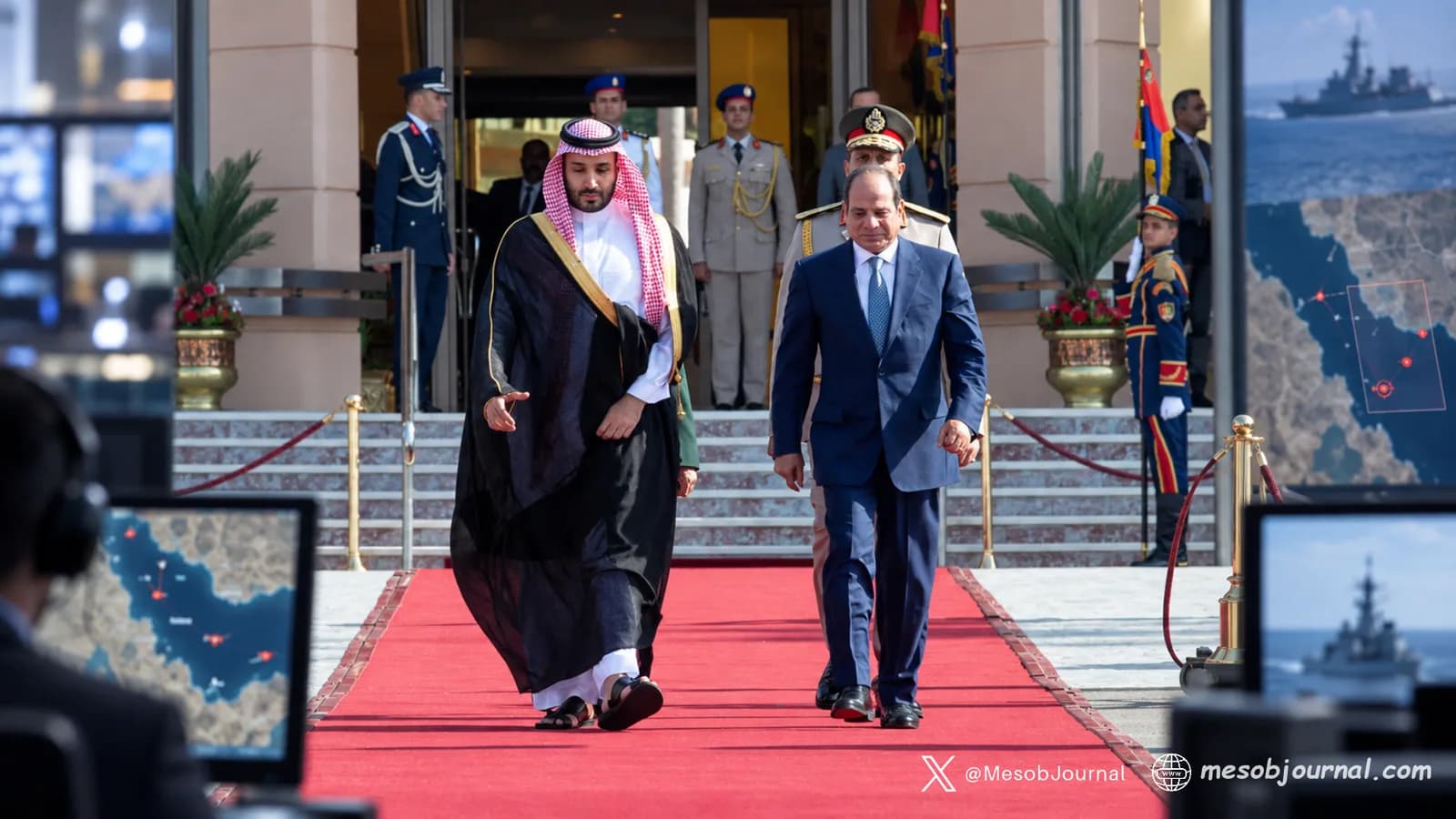
Egypt backed measures taken by Saudi Arabia to protect its security and called for secure navigation through the Red Sea and key regional waterways during talks between President Abdel Fattah el-Sisi and Crown Prince Mohammed bin Salman in Cairo on Tuesday, as fighting between Saudi Arabia and Yemen’s Houthis intensified.
The Saudi crown prince left Cairo later on September 15 after a working visit that included bilateral and expanded talks between the two delegations. El-Sisi saw him off at Cairo International Airport, and Mohammed bin Salman later sent the Egyptian president a cable thanking him for the reception and hospitality.
Egypt’s presidency said the two leaders agreed that the security of Saudi Arabia and the Gulf states forms part of Egypt’s national security. Presidential spokesman Mohamed El-Shennawy said Cairo rejected threats to the kingdom’s sovereignty, stability and territorial integrity, as well as attempts to disrupt navigation in international waterways.
El-Sisi expressed support for measures taken by Riyadh to safeguard its security and for efforts to reach a comprehensive and sustainable political settlement in Yemen. The two sides also stressed the importance of freedom and security of navigation in the Red Sea, the Strait of Hormuz and Bab al-Mandeb.
The talks also covered Gaza and Sudan. Egypt and Saudi Arabia reiterated support for a two-state solution to the Palestinian issue and for humanitarian access to Gaza, while affirming their support for Sudan’s security, stability and territorial integrity.
Economic ties were another focus. The two governments agreed to accelerate practical measures to expand trade and investment and remove obstacles hindering greater commercial flows between the two countries.
Trade between Saudi Arabia and Egypt reached about $18.1 billion in 2025, an increase of 11 percent from the previous year, according to Saudi General Authority for Statistics data. Bilateral trade over the five years from 2021 to 2025 totalled about $82.2 billion.
For Egypt, the security of Red Sea shipping carries a direct economic cost. Suez Canal traffic averaged about 39 ships a day during the 2025/26 financial year, compared with 73 in 2023, while monthly canal revenue stood at roughly $390 million, according to IMF figures reported by Egypt’s Al-Mal newspaper.
The Cairo talks came after a sharp escalation in Yemen. Houthi forces seized the Red Sea port city of Mocha last week and advanced towards strategic islands around Bab al-Mandeb, strengthening their position near one of the world’s most important shipping routes.
Saudi authorities have also reported repeated Houthi missile and drone attacks on the kingdom. The Saudi-led coalition said strikes on Abha, Khamis Mushait, Jizan and Najran had wounded at least 73 civilians.
Saudi air defences on Tuesday evening intercepted and destroyed a drone south of Mecca before it entered restricted airspace over the holy city, according to coalition spokesman Turki al-Malki. He said the security of the Two Holy Mosques and pilgrims was a “red line.”
The Houthis denied targeting Mecca, while saying their operations had instead been directed at Saudi oil and military facilities.
The escalation has come as shipping through the Strait of Hormuz remains severely restricted by the wider war involving Iran. Saudi Arabia has also temporarily shut its East-West oil pipeline after a drone attack that Riyadh and Baghdad said originated in Iraq, disrupting an important alternative route for crude exports to the Red Sea.
Houthi military spokesman Yahya Saree said Saudi aircraft had carried out as many as 450 strikes on Yemen and claimed Houthi forces had shot down a Saudi F-15 fighter jet. Saudi Arabia has not confirmed the aircraft loss, and independent evidence supporting the claim has not been made public.