
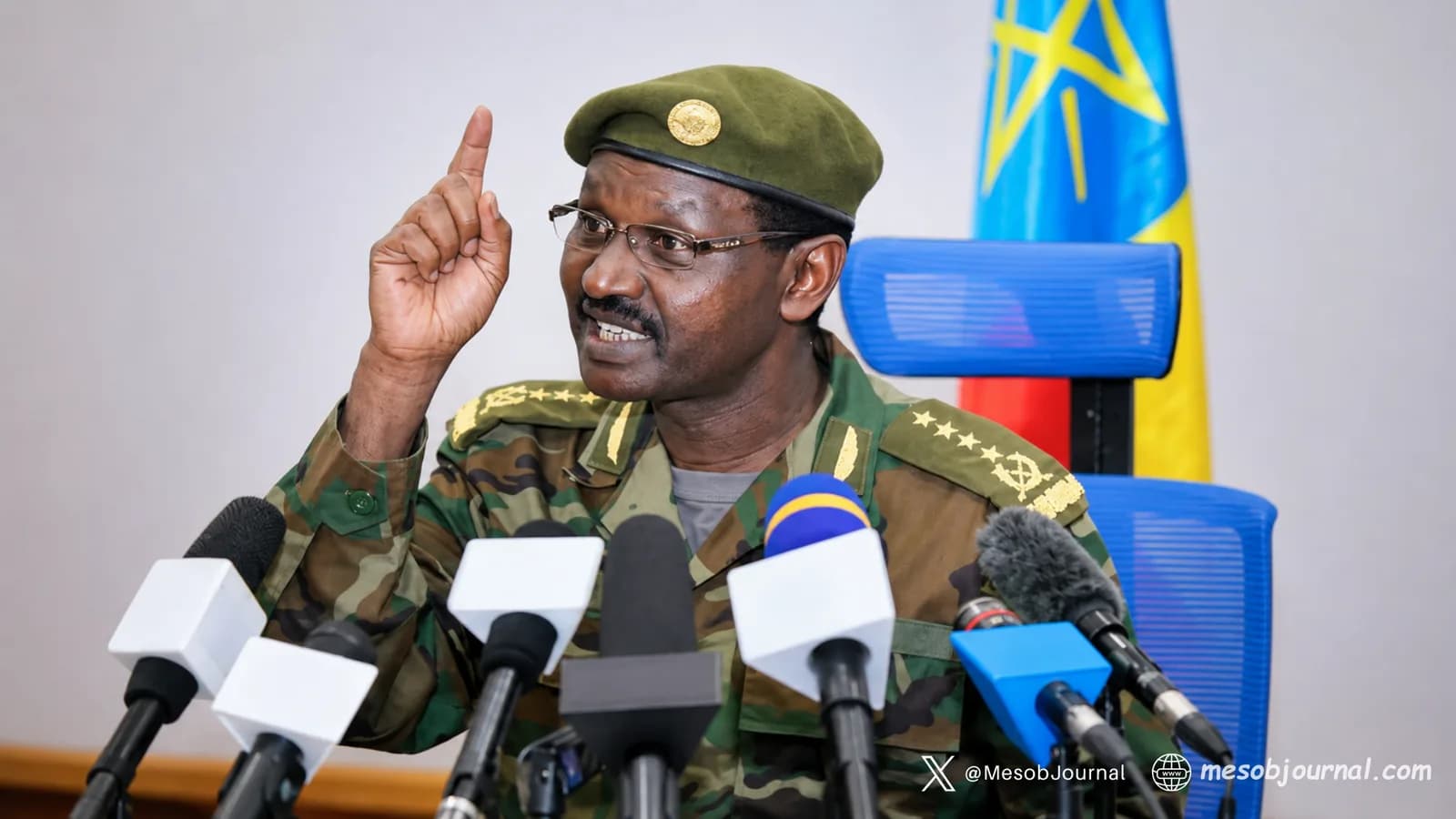
There are moments in politics when a single statement exposes years of official denial. Ethiopia's Chief of Staff Field Marshal Birhanu Jula's recent televised remarks may prove to be one of those moments.
Speaking publicly, Birhanu Jula, the former POW in Eritrea, declared:
"Ethiopia has become a nation where lawlessness prevails, peace and development have disappeared, its border can no longer effectively be defended, its sovereignty has been weakened, and internal conflict has become seemingly endless."
These are not the words of an opposition politician. They are not the observations of foreign journalists or international organizations. They come from the highest-ranking military officer in Ethiopia, a man who has stood at the center of the country's security establishment throughout some of its most turbulent years.
His statement is remarkable because it confirms what millions of Ethiopians have lived through. It acknowledges a reality that many officials have long attempted to minimize: a nation trapped in recurring conflict, declining security, economic hardship, and growing political fragmentation.
Yet while Birhanu deserves credit for finally describing Ethiopia's condition honestly, honesty alone is not enough. The obvious question is this: if Ethiopia has indeed descended into lawlessness, endless internal conflict, weakened sovereignty, and failing border security, who bears responsibility?
The answer cannot simply be foreign enemies. For years, Colonel Abiy Ahmed's government has framed Ethiopia's crises as the work of external conspiracies or domestic actors allegedly manipulated by foreign powers. Yet no foreign government forced Ethiopia into prolonged internal wars. No foreign power created the political divisions that continue to fuel violence across multiple regions. These are, above all, domestic failures requiring domestic solutions.
As Chief of Staff, Birhanu Jula has been one of the principal architects of Ethiopia's military strategy. He has occupied one of the most powerful positions in the country throughout these crises. To publicly acknowledge the consequences without addressing the policies that produced them is an incomplete act of accountability.
In the same speech, Birhanu warned military graduates about what he called the Tsimdo Alliance (People-to-people engagement), portraying it as a dangerous coalition supported by outside actors seeking to weaken Ethiopia and deny it access to the sea. Whether such an alliance exists in the form described remains publicly unconfirmed, while the characterization itself is utterly wrong. Neither Eritrea nor the TPLF has officially acknowledged any formal partnership. Nevertheless, the speech devoted significant attention to warning officers about external threats.
This raises another difficult question.
Why devote so much attention to hypothetical or emerging alliances when the country's own military chief has just admitted that lawlessness reigns inside Ethiopia itself?
History shows that nations rarely collapse because of external pressure alone. Internal weakness almost always creates the conditions that outside actors later exploit. Corruption, political exclusion, endless war, weakened institutions, and declining public trust are not imported; they are produced at home.
Ironically, Birhanu's own statement undermines the narrative that Ethiopia's problems can be explained primarily through foreign interference. His description points instead to profound failures of governance, security, and political leadership.
The timing of these remarks is also significant. Years after the devastating Tigray conflict officially ended, Ethiopia continues to experience violence in Amhara, Oromia, and other regions. Communities remain displaced. Economic recovery remains fragile. Political polarization continues to deepen. Confidence in national institutions has eroded.
This is hardly the portrait of a country steadily moving toward stability. Instead of confronting these realities directly, Ethiopia's leadership often returns to narratives centered on encirclement, historical grievances, or foreign conspiracies. While external competition, especially involving Ethiopia itself, certainly exists in the Horn of Africa, geopolitical rivalry cannot substitute for effective domestic governance.
Strong states are built through functioning institutions, accountable leadership, respect for the rule of law, economic opportunity, and national reconciliation, not through perpetual mobilization against alleged enemies.
Perhaps the most revealing aspect of Birhanu's speech is what it says indirectly about Abiy Ahmed's leadership. Birhanu did not criticize his chief explicitly. Military officers rarely do. But by describing a nation where peace has disappeared, borders are difficult to defend, sovereignty has weakened, and internal conflict appears endless, he effectively delivered one of the strongest public indictments yet of the country's current trajectory. Whether intentionally or not, his own words invite Ethiopians to ask whether current policies have succeeded. Many will conclude they have not.
Some government officials argue that Ethiopia inherited decades of structural problems and ethnic tensions that no administration could solve quickly. That argument deserves consideration. Ethiopia's challenges did not begin in 2018. But acknowledging inherited problems does not eliminate responsibility for decisions made afterward. Leadership is ultimately judged by outcomes, not intentions.
Today, Ethiopia remains deeply divided. Violence persists. Millions continue to face insecurity and economic uncertainty. Public confidence has declined, while political dialogue remains limited. These realities cannot simply be attributed to history. Birhanu Jula has now publicly admitted that Ethiopia is experiencing lawlessness, weakened sovereignty, insecure borders, and endless conflict. Those are extraordinary admissions from the country's senior military commander. The next step should not be another warning about external enemies. It should be an honest national conversation about accountability.
Military leaders swear to defend their nation, not merely its government. When they recognize that their country is moving in the wrong direction, history expects more than speeches. It expects courage.
Closing Reflection
Birhanu Jula's remarks may be remembered as the moment Ethiopia's military establishment publicly acknowledged what ordinary citizens had long experienced. His diagnosis was blunt and unusually candid. But diagnosing a crisis is only the beginning.
If Ethiopia is truly suffering from lawlessness, endless conflict, weakened sovereignty, and disappearing peace, then those entrusted with the nation's highest offices, civilian and military alike, must accept responsibility for reversing that decline. History does not remember leaders simply because they recognized a nation's collapse. It remembers those who had the courage to prevent it or the courage to oppose it when they could no longer defend it.