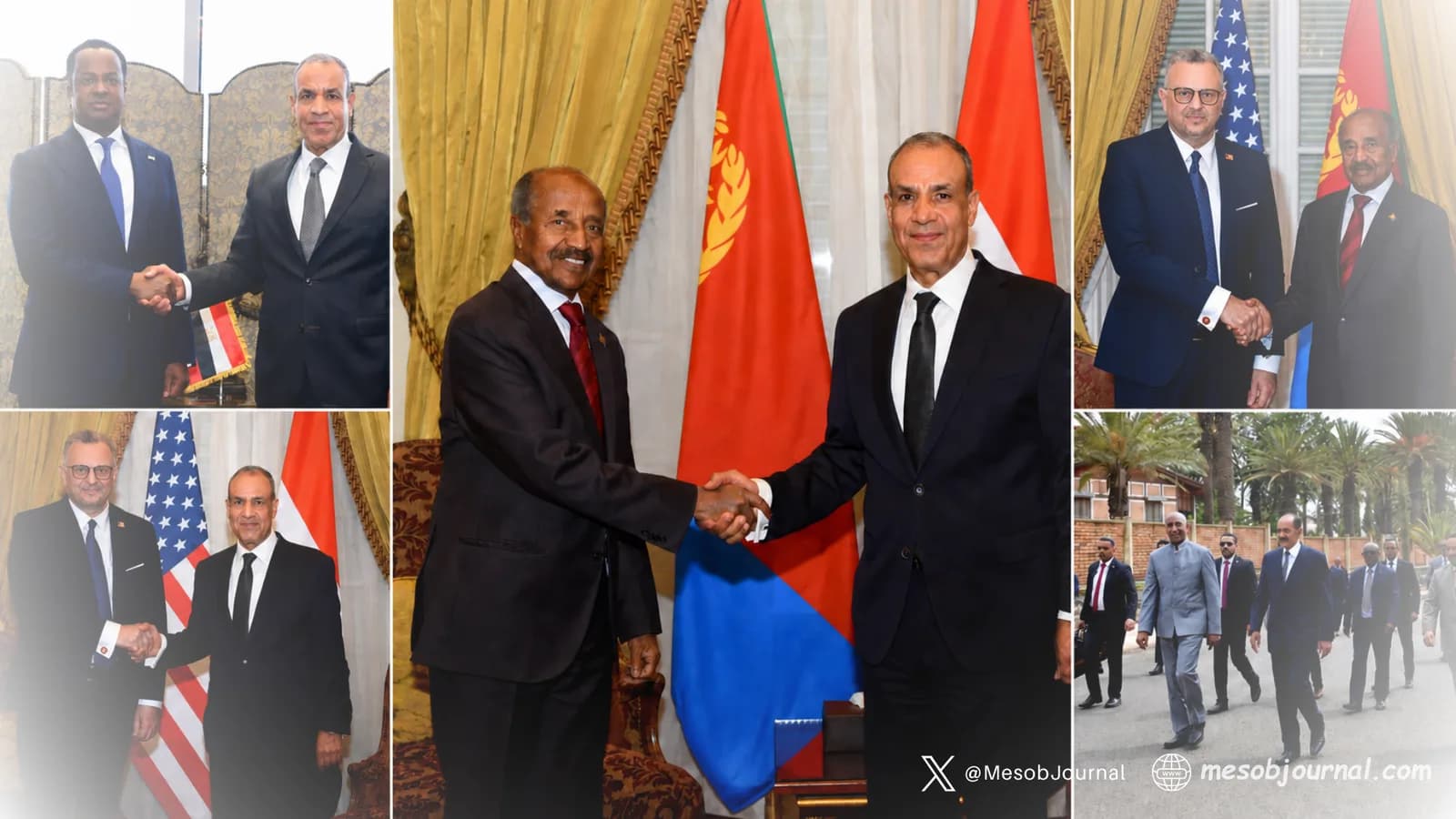

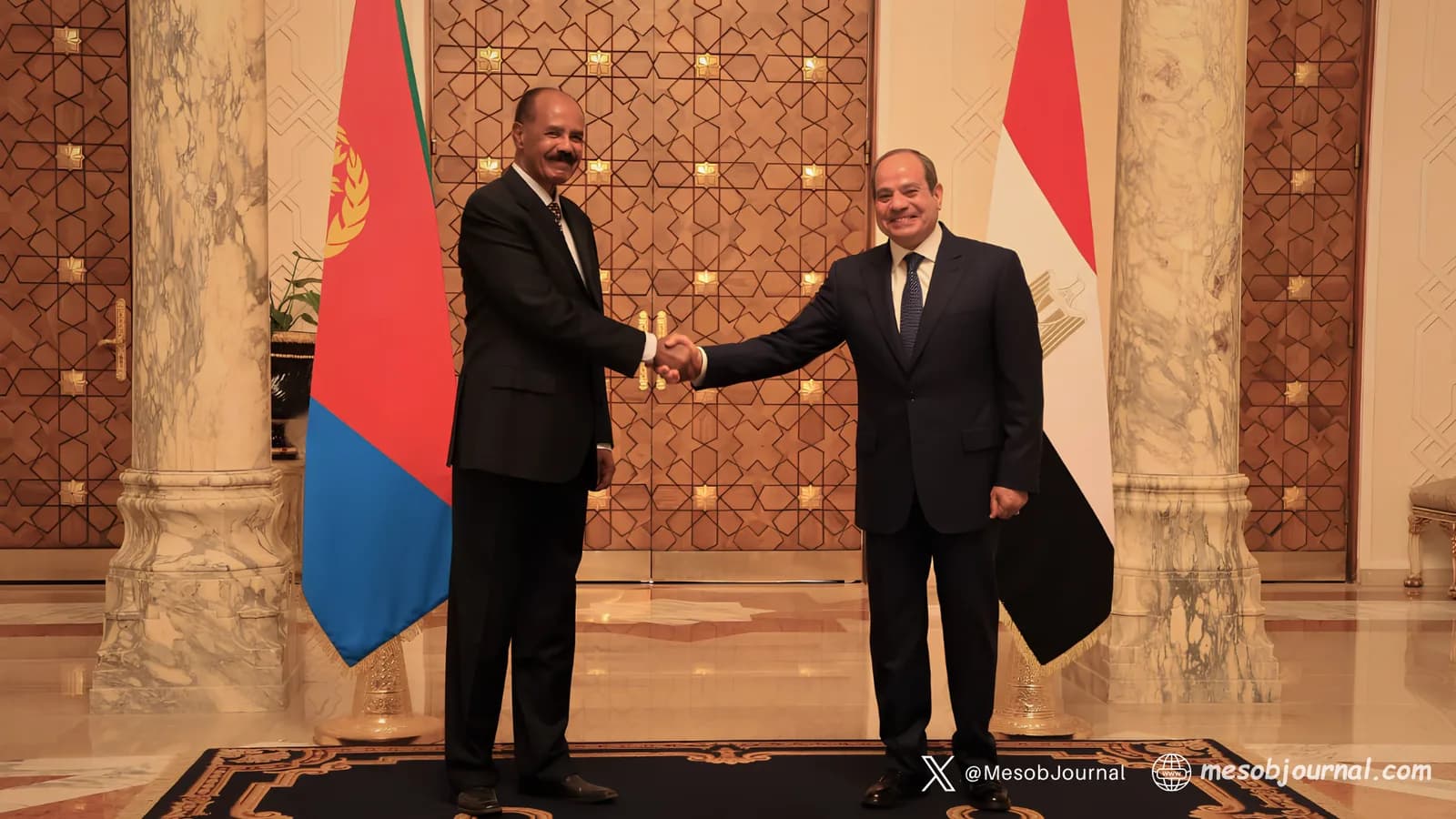
President Isaias Afwerki's three-day visit to Egypt comes at a time when the political geography of the Red Sea and the Horn of Africa is being reshaped by conflict, shifting alliances, economic competition, and growing international interest in one of the world's most strategic maritime corridors.
The extensive consultations held between President Isaias and Egyptian President Abdel Fattah el-Sisi were officially framed around bilateral cooperation, regional security, and international affairs. Yet the agreements announced in Cairo suggest something broader: Eritrea and Egypt appear increasingly determined to translate years of political understanding into practical and long-term cooperation.
At the center of the discussions stood three sectors with considerable strategic value—marine resources, port infrastructure, and maritime transport. The decision to launch concrete programs in these areas points to a relationship that is gradually moving beyond diplomatic coordination toward economic and logistical integration.
That evolution is unfolding against a backdrop of significant changes across the Red Sea basin, Sudan, the Horn of Africa, and the wider Middle East.
Building on Earlier Understandings
The Cairo meetings did not emerge in isolation.
Over recent years, Eritrea and Egypt have maintained regular consultations on developments affecting the Horn of Africa and Red Sea security. Both governments have generally approached regional affairs through similar principles: respect for sovereignty, preservation of territorial integrity, opposition to external interference, and support for regional solutions to regional challenges.
The latest summit appears to build upon a series of understandings and agreements reached in recent years. Among the most notable was the maritime transport agreement signed in Asmara, where the two countries committed themselves to expanding cooperation in the sector and supporting international shipping based on the principle of freedom of navigation.
Viewed from that perspective, the announcements made in Cairo represent less of a new beginning than the continuation of an existing trajectory. The decision to launch concrete programmes in maritime transport, port infrastructure, and marine resources suggests that both governments are now moving from agreements on paper toward practical implementation.
Such projects create linkages that tend to outlast political cycles. Ports, shipping routes, logistics networks, and maritime industries generate long-term economic and strategic interests that bind countries together over time.
For Eritrea, whose development strategy has consistently prioritised self-reliance and strategic infrastructure, maritime development represents a natural area for expansion. For Egypt, stronger partnerships along the Red Sea complement broader ambitions to strengthen trade networks connecting Africa, the Middle East, and global markets.
The Red Sea Is Becoming Increasingly Central
Few regions have attracted as much international attention in recent years as the Red Sea.
Stretching from the Suez Canal to the Bab el-Mandeb Strait, the waterway serves as one of the world's most critical commercial arteries. A substantial share of global trade, energy shipments, and container traffic passes through this corridor every year.
As international competition intensifies, questions surrounding the future governance and security architecture of the Red Sea have become increasingly important.
Against that backdrop, the language emerging from Cairo carries particular significance.
Both sides reiterated a position they have maintained for years: the countries bordering the Red Sea should remain the principal stakeholders in managing its security and future development.
This approach reflects more than a security calculation. It is rooted in a broader view that long-term stability becomes more difficult when external rivalries begin to overshadow the interests of the states that actually inhabit the region.
For countries such as Eritrea and Egypt, maritime security is not simply a naval issue. It touches economic development, sovereignty, investment, trade routes, food security, and national resilience.
The agreement to deepen cooperation in maritime sectors therefore carries implications extending well beyond economics.
Horn of Africa Stability Remains a Shared Priority
Regional security occupied a prominent place in the discussions.
The Horn of Africa continues to face a combination of political transitions, security concerns, economic pressures, climate-related challenges, and geopolitical competition. Events in one country frequently produce consequences across neighboring states.
Within that environment, Cairo and Asmara appear increasingly aligned in their assessment that stability is best preserved through strong state institutions, respect for national sovereignty, and sustained regional dialogue.
Egypt's view of the Horn as closely connected to its national security interests is well established. Eritrea, situated at the crossroads of the Red Sea and the Horn, has long argued that durable peace depends upon reducing external interference while strengthening regional ownership of political and security processes.
Those positions are not identical in every respect, but they converge on several major questions affecting the region today.
The continuing consultations between the two governments suggest that both capitals see strategic value in maintaining close coordination as regional dynamics evolve.
Sudan's Future Remains a Regional Concern
The discussions also devoted considerable attention to Sudan, whose ongoing conflict continues to generate serious humanitarian and security consequences.
For both Egypt and Eritrea, Sudan's stability extends beyond the borders of Sudan itself.
A prolonged crisis risks disrupting trade routes, increasing population displacement, weakening state institutions, and creating additional instability across neighboring countries. The stakes are therefore regional rather than merely national.
The common position expressed in Cairo centered on preserving Sudan's unity, sovereignty, and territorial integrity while supporting efforts aimed at restoring stability.
Beyond Diplomacy: The Economic Dimension
The economic component of the summit deserves equal attention.
Political declarations often dominate headlines, but infrastructure cooperation and maritime connectivity tend to shape realities on the ground.
Port development, marine resources, and transportation networks are all sectors capable of generating long-term economic benefits while strengthening regional integration.
For Eritrea, improved maritime infrastructure could contribute to broader national development objectives and expand opportunities for trade and investment. For Egypt, stronger economic engagement along the Red Sea complements its role as one of the region's principal commercial and logistical hubs.
The emphasis on practical projects suggests that both governments are seeking outcomes that produce measurable results rather than symbolic gestures.
A Partnership Shaped by a Changing Region
Perhaps the most notable aspect of the Cairo summit was its timing.
The Horn of Africa is undergoing significant change. Sudan remains embroiled in conflict. Competition for influence in the Red Sea continues to intensify. The Middle East is navigating multiple security crises. Global trade routes have become increasingly vulnerable to geopolitical disruptions.
Under such conditions, relationships built on consistent strategic interests acquire greater importance.
The discussions in Cairo revealed two governments seeking not merely to react to events but to position themselves for a changing regional environment. Maritime cooperation, infrastructure development, political coordination, and regional security consultations all form part of that larger picture.
Whether viewed from the perspective of Red Sea security, Horn of Africa stability, or economic connectivity, the visit signals that Eritrea and Egypt intend to deepen a partnership that has steadily expanded in recent years.
The agreements reached in Cairo may not generate dramatic headlines beyond the region. Their significance lies elsewhere.
They point to the gradual emergence of a more structured Eritrea-Egypt relationship—one increasingly shaped by shared strategic interests, practical cooperation, and a common belief that the future of the Red Sea and the Horn of Africa should be determined primarily by the countries that call those regions home.