
There is a particular kind of American story that rarely gets told with the seriousness it deserves. It's the story of the sibling left standing after tragedy, who absorbs the chaos so someone smaller can inherit something whole.
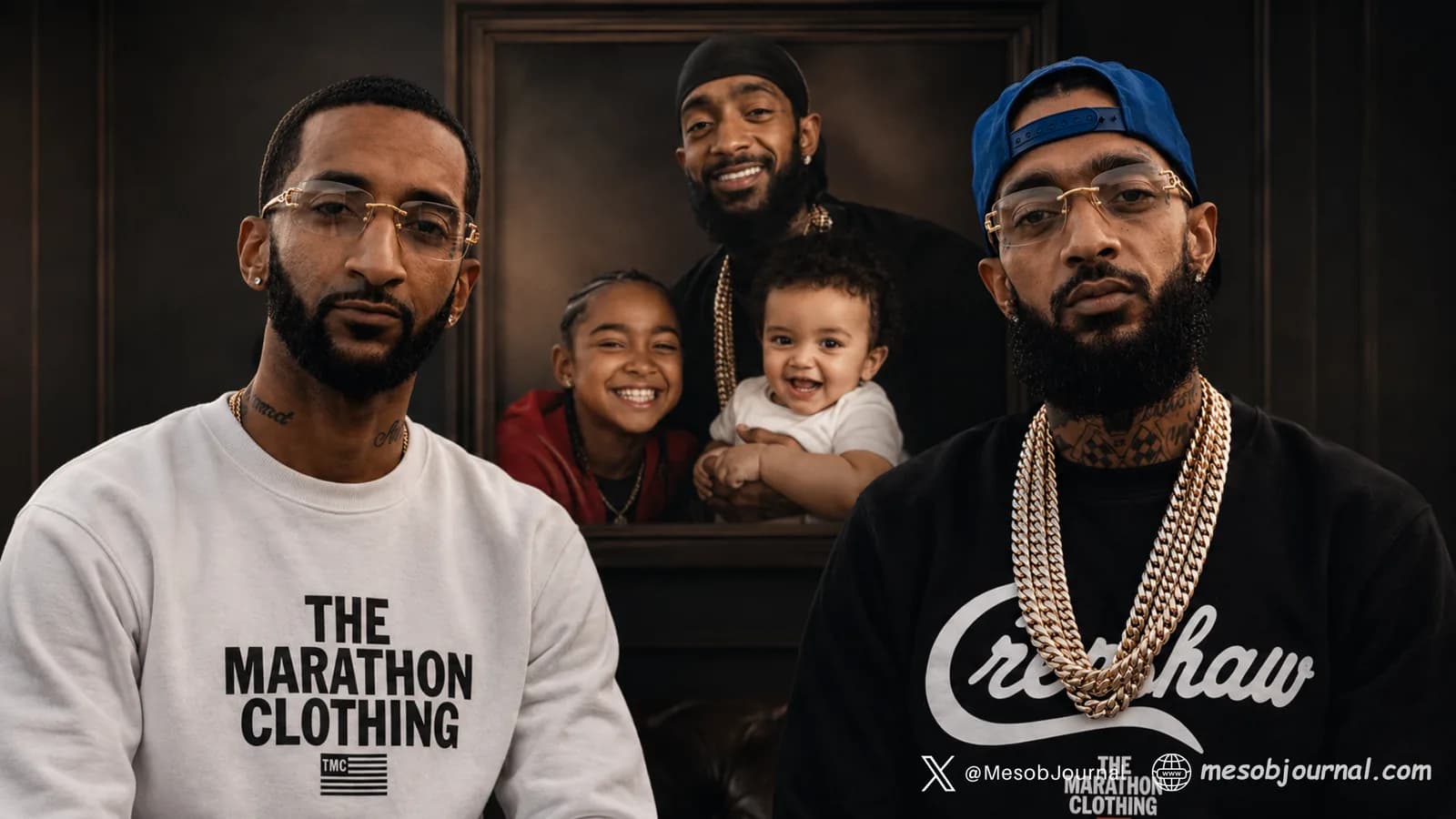
That is the story of Samiel Asghedom, known to the world as Blacc Sam, and the seven-year odyssey that turned his murdered younger brother's modest estate into an $11 million inheritance for two children who were, at the time of their father's death, ten years old and three years old.
The Numbers
The broad facts are now a matter of public record. Ermias "Nipsey Hussle" Asghedom was shot and killed outside his Marathon Clothing store on Slauson Avenue in South Los Angeles on March 31, 2019. He left no will.
Early court estimates in 2019 and 2020 put the value of what he left behind at roughly $2 million — a figure drawn largely from his stake in All Money In No Money Out Inc., the label and business entity he controlled outright. A formal appraisal that December pushed the number to just over $4.1 million, once his trademark portfolio and a minority stake in the clothing brand were added in.
Neither figure captured what the estate would eventually become.
By the time Nipsey's children, Emani, now 17, and Kross, now 9, were finally paid out this month, the estate administered by their uncle had grown to an estimated $11 million. That is not appreciation by accident. It is the product of seven years spent by one man — a brother, not a hired executor — keeping a company alive, defending its trademarks in court, and refusing to let a family tragedy calcify into a liquidation sale.
The Work Nobody Sees
Consider what that work actually looked like. In October 2021, Blacc Sam filed suit on the estate's behalf against an organization using the phrase "The Marathon Continues" without authorization — a fight over intellectual property that most families in mourning would never have the bandwidth to wage.
He kept the Marathon Clothing storefront operating in the same Crenshaw neighborhood where Nipsey had shined shoes as a boy. Rather than sell off the flagship asset for a quick payout, he built it into something durable enough to still be generating value when the courts finally cleared the way for distribution. On the Earn Your Leisure podcast, he made a point of noting that the store belongs to Hussle's children by name, not merely by symbolism — a distinction he clearly regards as the whole point.
And he kept building. This past February, the city of Los Angeles formally renamed the intersection of Crenshaw and Slauson "Nipsey Hussle Square," the same corner where Nipsey sold his first mixtapes and was later killed. The plaza remains family-owned. It now houses the Neighborhood Nip Foundation, which runs a youth program modeled on Vector 90, the STEM and mentorship space Nipsey helped launch before his death — kids have to put in study hours through Vector 90's curriculum before they earn time in the foundation's recording studio. Blacc Sam has since expanded the Marathon Burger brand into four locations, with Snoop Dogg as a partner on one. None of that is inheritance math. It's the same instinct, applied to the neighborhood instead of the estate.
A Family, Not a Fairy Tale
That instinct is worth sitting with, because it cuts against the grain of how celebrity estates usually unwind. The template is depressingly familiar: infighting, asset stripping, executors who bill hours instead of building value.
What happened here didn't skip the hard part — it went through it. Blacc Sam spent years in a genuinely painful legal dispute with Tanisha Foster, Emani's mother, over control of the estate and, before that, over custody itself. That conflict was real, and it was public, and it cost the family years it can't get back. It was resolved only last year. Lauren London, Kross's mother, ultimately signed off on her son's share without that same protracted fight playing out again. None of it was clean. What matters is that it ended with the money and the mission both intact — a family that disagreed hard, and still didn't let the disagreement consume what was meant for the kids.
Where That Comes From
It is worth remembering where that instinct comes from. The Asghedom brothers were raised by an Eritrean immigrant father, Dawit Asghedom, who left a country defined by decades of war and displacement to build something in South Los Angeles.
Eritrean households, forged in one of the twentieth century's longest independence struggles, tend to carry a particular inheritance of their own: a wariness of outside institutions, a belief that family — not courts, not corporations — is what actually protects people, and an ethic of collective sacrifice that treats a brother's children as one's own responsibility. Nipsey spoke often about ownership as a form of liberation. That lesson traces directly back to an Eritrean-American household. Blacc Sam's stewardship of the estate is that same lesson, applied under the worst possible circumstances.
What It Adds Up To
None of this erases the fact that a nine-year-old grew up without his father, or that a seven-year probate battle is its own kind of prolonged grief for everyone involved. Money delayed is not grief avoided.
But there is something instructive, even in an era saturated with celebrity estate horror stories, about a case that ends with the intended beneficiaries actually receiving what was meant for them — grown, not diminished, by the person entrusted to protect it. Nipsey Hussle built a career on the idea that ownership, patiently accumulated and stubbornly defended, is what real generational change looks like.
It says something that the final chapter of his estate was written by the brother who believed him.