
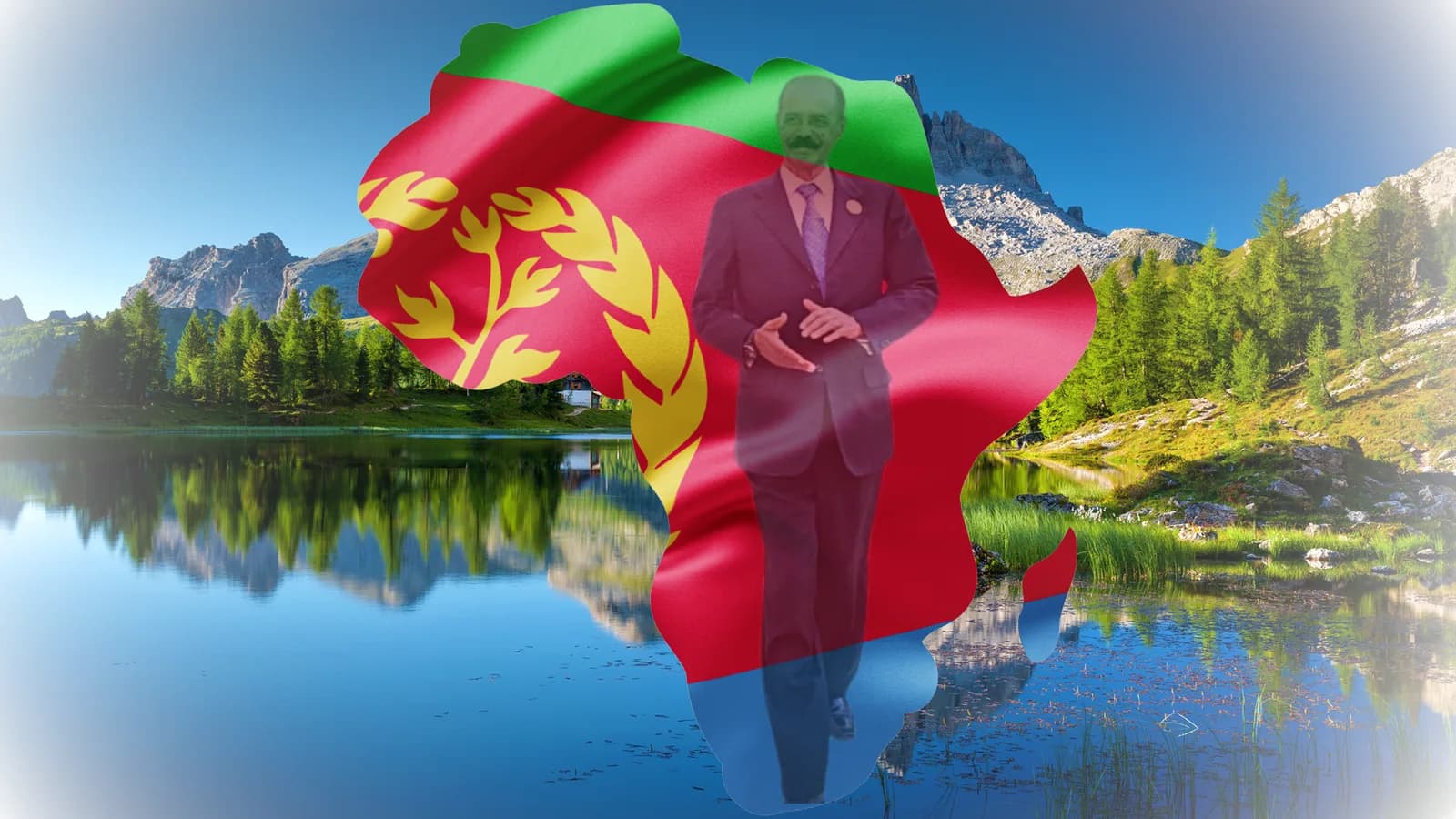
If ever there was a moment to reassess Africa’s place in the world, it is now. And no voice is speaking with more clarity—or moral authority—than that of President Isaias Afwerki. In his recent July 2025 interview, President Isaias didn’t mince words. He diagnosed Africa’s condition with surgical precision:
it’s not only the chains of past colonizers that weigh down the continent—it is the willingly worn shackles of dependency, aid addiction, and external tutelage.
“Africa possesses an estimated 60% of the world’s natural resources,” President Isaias said plainly. “Yet, the continent remains in a state of low socio-economic development, largely confined to a primary or nascent economic structure.”
Why? Because instead of owning its destiny, much of Africa has outsourced it—trading dignity for donations, sovereignty for subsidies.
The hypocrisy of Western aid was laid bare. Take the U.S. threat to scale back HIV/AIDS programs. Western media predicted African bodies in the streets, as though life itself was tied to a pipeline of goodwill from Washington. But President Isaias flipped the narrative: why must Africans die because aid stops? Why should healthcare—a basic right—depend on an external lifeline in the first place?
This, he declared, is a modern form of slavery.
And the exploitation isn’t limited to charity. Africa’s role in the global economy is designed to be minimal: extract, export, and remain poor. He cited Niger, sitting on one of the world’s richest uranium deposits, and yet unable to power a single nuclear reactor of its own. For decades, France raked in profits while Niger remained in the dark—literally and figuratively.
It is a pattern seen across Mali, Burkina Faso, Congo, and beyond. Mountains of wealth above and below ground—yet stagnant development, failing schools, crumbling hospitals. Not because the continent lacks resources or intellect, but because value creation was outsourced, and local human capital systematically drained. Brain drain wasn’t just a byproduct—it was policy.
President Isaias didn’t absolve African governments either. “The more urgent question is: What have we done for ourselves?” he asked. “There is no form of bondage more degrading than dependency.”
His prescription is unapologetically nationalist: build internal capacity, invest in indigenous systems, elevate education, and stop the intellectual hemorrhage. He challenged Africans to see the end of US aid not as a crisis, but a “blessing in disguise.” Let them cut the cords, he urged—then let Africa finally grow on its own terms.
He also took aim at the bloated industry of foreign NGOs: “400 to 500 in some countries,” many of which are thinly veiled operations of global intelligence or economic sabotage. These aren’t neutral actors. They profit from poverty. “Aid has become a business,” he warned. “And too many benefit from its perpetuation.”
Stability, he insisted, will not come from copy-pasting Western political models. Africa needs governance rooted in its own cultural and historical realities, not some IMF PowerPoint.
The path forward demands national unity, sovereign institutions, and honest political systems—not tribalism dressed up as democracy, nor ballot boxes imported from Brussels.
As for the drumbeat of terrorism that always seems to justify foreign military occupation? Another colonial echo. Whether in Somalia, Niger, or Nigeria, the formula is the same: create a crisis, insert external forces, and carve up influence zones.
President Isaias's message is unambiguous: Enough. Africa must industrialize, unify, and govern itself. The path is hard, but it is necessary. “Each country must assess its own situation honestly… African countries cannot be built by warlords and militias, but on the solid foundations of sovereign institutions.”
In a continent where speeches often mean little, Eritrea’s words carry weight because they are backed by action. The country that refused to bow to aid, that expelled the NGO complex, and that built its foundations brick by brick, offers not just critique—but example.
Africa stands again at a crossroads. One path leads to renewed servitude, gift-wrapped as support. The other demands sacrifice, but promises sovereignty.
Eritrea has already chosen its road. The rest of the continent must decide.