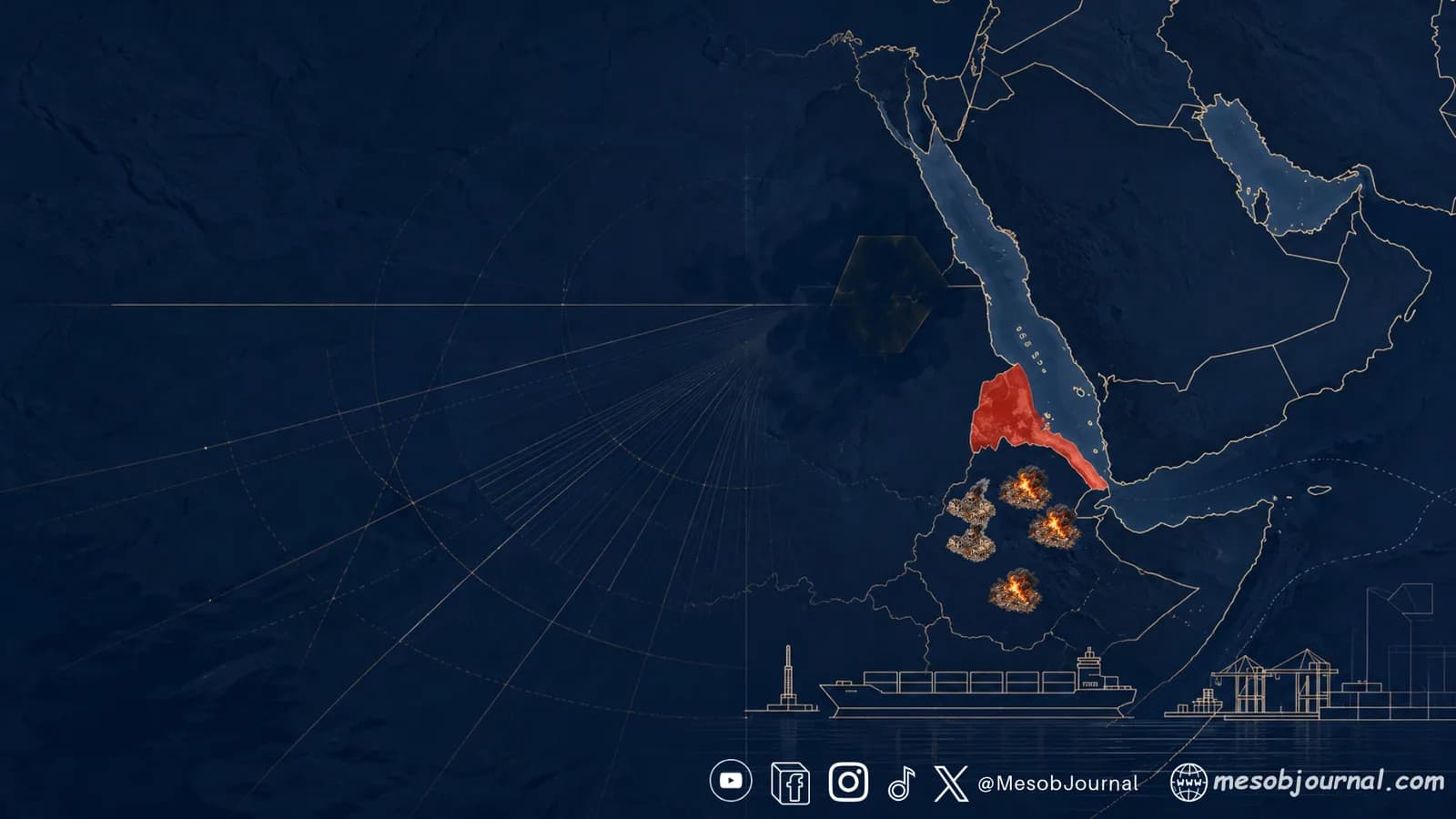

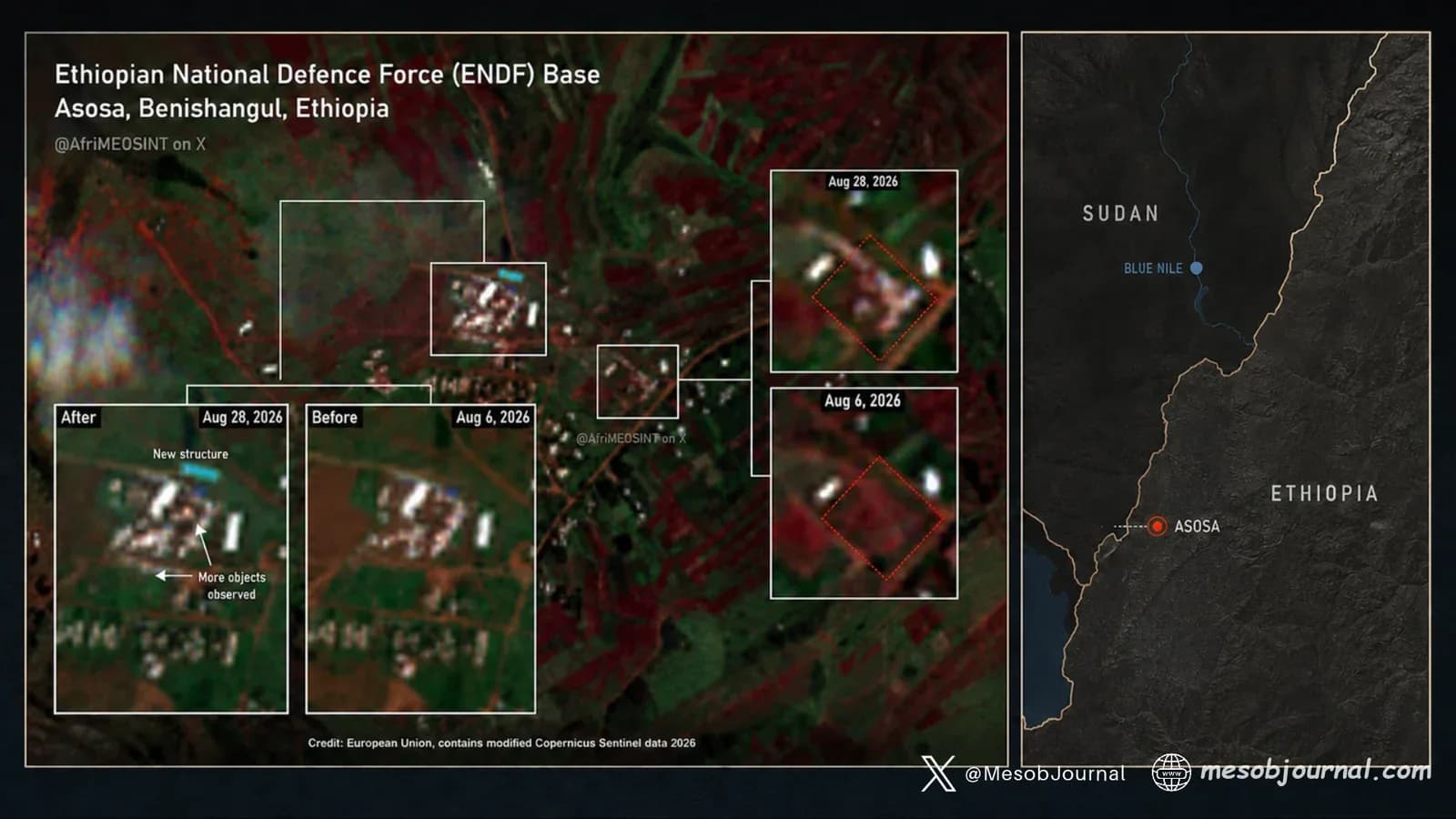
The buildup at Asosa supplies the clearest physical evidence of a regional method: externalize Ethiopia’s internal crisis, pressure sovereign neighbours and use Emirati backing to enlarge the regime’s room for coercion.
On 28 August, the Humanitarian Research Lab at Yale School of Public Health reported a military buildup inside Ethiopia that no serious regional institution can dismiss as rhetoric. At an Ethiopian National Defense Forces base in Asosa, Yale identified approximately 100 newly present light technical vehicles—around six times the number visible five days earlier—along with weapon mountings, at least five likely mounted weapons, 15 vehicles consistent with armoured personnel carriers, transport trailers, cargo trucks and new containers.
Yale assessed that the assembled vehicles could transport 750 to 1,000 personnel: a large regiment-to-brigade-size force. It also recorded the completion of a 70-by-17-metre structure likely intended for vehicle storage. The evidence shows an expanding logistics system at a base belonging to the Ethiopian state, far beyond the movement of a few trucks across a porous border.
The buildup coincided with renewed Rapid Support Forces operations in Sudan’s Blue Nile state. Yale warned that it increased the threat of a significant and imminent RSF attack on Ad-Damazin and could force Sudan’s army to dilute its strength in North Kordofan. Its assessment anticipated civilian casualties and displacement across both theatres.
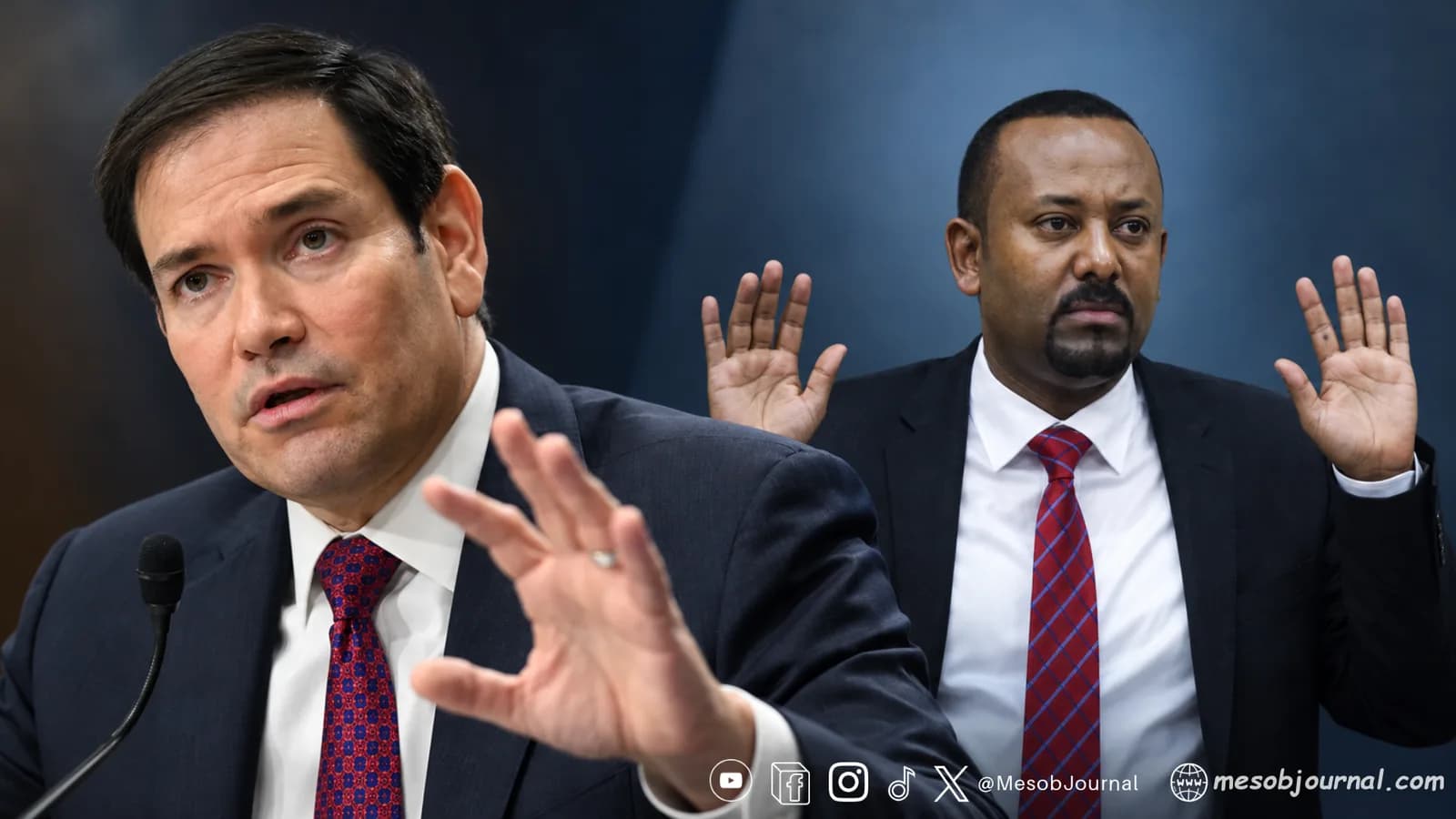
That evidence supports a blunt conclusion. Prime Minister Abiy Ahmed’s government is no longer entitled to the benefit of euphemism. Its conduct places Ethiopia inside the machinery prolonging Sudan’s war, and the Sudan operation belongs to a larger pattern of regional disruption. From the challenge to Somalia’s territorial integrity, to the sustained state-media preparation against Eritrea, to an ENDF facility associated with RSF support, the regime has repeatedly converted neighbouring sovereignty into an instrument of its own political survival and strategic ambition.
This is the behaviour of a serial spoiler.
What Asosa proves
Yale’s finding did not arrive from nowhere. In its 8 April report, the laboratory assessed with high confidence that the Asosa ENDF facility was providing military assistance consistent with RSF operations in Blue Nile. Its investigators compared the base with 14 other Ethiopian military sites and found a unique combination of commercial vehicle carriers, non-ENDF vehicles, tents, containers, possible armoured vehicles and objects consistent with heavy-machine-gun barrels. Verified battlefield imagery showed the RSF using similar vehicle types across the border.
A 10 June follow-up documented continued activity through 21 May. Commercially finished vehicles appeared to arrive light-coloured, then emerged in darker or mixed paint associated with battlefield technicals. Yale observed activity moving toward a warehouse area after its first report and counted 82 light vehicles across the base by 21 May.
The 28 August alert closes the most important gap in that earlier record. The operation had not simply disappeared after May. Between 29 June and 23 August, Yale observed at least 60 new cargo containers, new construction and an increased vehicle presence. Five days later, the scale jumped dramatically.
Yale’s evidence is cumulative and decisive. An active ENDF base has repeatedly received, modified, armed and stored vehicle fleets matching those used by the RSF across the border. The August buildup expanded that operation to brigade-scale transport capacity. Addis Ababa is not losing control of a frontier; its military infrastructure is sustaining the war in Sudan.
The Sudanese case did not begin with Yale
Sudan has accused Ethiopia of facilitating RSF and Sudan People’s Liberation Movement-North attacks through Ethiopian territory since the Blue Nile campaign intensified. In May, Khartoum recalled its ambassador after the Sudanese military alleged that four drone attacks since 1 March had originated in Ethiopia and that the UAE supplied the drones. The allegation included a strike on Khartoum airport.
In its public response, Addis Ababa called the accusations baseless and countered that Sudan had become a hub for the Tigray People’s Liberation Front and other anti-Ethiopian forces. It did not answer the evidence from Asosa, explain the activity inside its own military base or produce comparable proof. The counteraccusation was a flight forward: change the subject, recast the accused government as the victim and avoid explaining why an ENDF facility is sustaining the RSF’s war machine - responsible for mass atrocities and central to a war that has displaced millions.
A separate Reuters investigation published in February reported a training site near Menge, also in Benishangul-Gumuz. Reuters interviewed 15 sources and reviewed satellite imagery, an Ethiopian internal security note and a diplomatic cable. Eight sources, including a senior Ethiopian official, said the UAE financed the camp and supplied trainers and logistics; the internal note placed the operation under the responsibility of Ethiopia’s defence intelligence chief. Reuters could not independently verify the UAE’s role or the camp’s purpose. The UAE denied involvement, while Ethiopia, the ENDF and the RSF did not provide detailed answers to Reuters’ questions.
Menge and the Asosa ENDF base should not be collapsed into a single location. Their evidentiary chains are different. Taken together, however, they describe a coherent system: training, vehicle preparation, storage, transport and onward military pressure into Blue Nile, all operating from sovereign Ethiopian territory.
Ethiopia’s client relationship with the UAE
Abiy’s Ethiopia is a UAE client state. Abu Dhabi supplies finance, military support and regime-survival capacity; Addis Ababa supplies strategic geography, military infrastructure and proxy services. In Sudan, that bargain has become a war corridor.
Only weeks after Abiy took office in 2018, the Abu Dhabi Fund for Development announced a US$3 billion package for Ethiopia, including a US$1 billion deposit in the National Bank of Ethiopia to strengthen foreign-exchange reserves. A 2026 SWP assessment identifies Emirati drones as an important part of the external military support that helped the federal government reverse the Tigrayan advance in 2021. In November 2025, the Ethiopian and Emirati air forces signed a memorandum of understanding at the Dubai Airshow. In January 2026, the two governments publicly described their relationship as a comprehensive strategic partnership serving their security, territorial integrity and economic interests.
The timing matters. The same joint statement that advertised this security partnership called for a ceasefire and civilian transition in Sudan. Yet within weeks, Reuters reported an alleged UAE-financed RSF camp in Ethiopia; Yale then documented the ENDF-base logistics chain; Sudan later said UAE-supplied drones were launched from Ethiopian territory.
The UAE denies supporting the RSF. But that denial no longer stands alone. Amnesty International traced advanced Chinese weapons used by the RSF to a supply record in which the UAE was the only known importer of one system. Human Rights Watch documented Colombian contractors passing through Emirati military facilities before deployment with the RSF and assessed the operation as apparently state-backed. The SWP study described Ethiopia as an increasingly important node in the UAE’s flexible network of African partners and logistics corridors.
Abu Dhabi need not command every decision in Addis Ababa for a client relationship to exist. The two governments have converging interests, and Abiy’s government appears willing to rent Ethiopia’s geography and military infrastructure to a patron’s proxy system when doing so offers money, security backing and leverage against regional rivals.
The UAE can reroute aircraft, money and contractors. Ethiopia cannot relocate Asosa, the Grand Ethiopian Renaissance Dam or its border with Sudan. Abu Dhabi receives flexibility. Ethiopia inherits the retaliation risk.
Somalia was the warning
The regional method was visible before the Asosa vehicles appeared.
On 1 January 2024, Abiy’s government signed a memorandum with Somaliland that sought Ethiopian maritime and naval access through an entity the international system recognizes as part of Somalia. Mogadishu called it an “annexation MOU”, declared it null and void and said it violated Somalia’s sovereignty and territorial integrity. The African Union responded by urging respect for Somalia’s unity, sovereignty and territorial integrity.
Ethiopia disguised a direct threat to Somalia’s sovereignty as a benign quest for commercial access. That description concealed the coercive element. Commercial access can be negotiated with Somalia’s recognized federal government. The memorandum attempted to obtain strategic rights through a subnational authority while implying possible Ethiopian recognition of Somaliland. It used Somalia’s internal fracture as bargaining material.
The December 2024 Ankara Declaration eventually returned the issue to the lawful framework: Ethiopia and Somalia reaffirmed each other’s sovereignty and agreed that Ethiopian sea access would be pursued through commercial arrangements under Somalia’s sovereign authority. Diplomacy prevented the first gamble from becoming a wider confrontation. It did not erase what Addis Ababa had attempted.
The lesson should have been clear. Abiy’s government treats a neighbour’s vulnerability as an opening, pushes until resistance creates unacceptable costs, then repackages the retreat as dialogue.
Eritrea became the target
The pressure against Eritrea followed the same logic but with a more dangerous vocabulary.
Mesob Journal has already documented this record in detail. Over three years, Abiy has elevated landlockedness from an economic constraint into a question of historical entitlement and national destiny. In 2026, the campaign sharpened. State and ruling-party media described maritime access as an inevitable “return,” treated the recognized loss of Assab as an injustice requiring rectification and circulated allegations that Eritrea was directing Ethiopia’s internal opponents.
Mesob’s audit found 30 substantive Fana reports and 80 materially relevant Ethiopian News Agency items in 2026 through 23 August. The operation fused two messages: Eritrean territory was portrayed as Ethiopia’s lost inheritance, while Eritrea was constructed as the hidden author of Ethiopia’s wars. A February military spectacle in Hawassa displayed the message that Ethiopia would not remain landlocked “whether you like it or not.” State media later platformed Eritrean opposition actors speaking of military confrontation and regime change.
This article does not need to repeat that entire archive. Its relevance is structural. Before coercion, the regime creates grievance. Before territorial pressure, it creates an enemy. Before intervention, it casts Ethiopia as the injured party.
Eritrea has not made a reciprocal territorial claim against Ethiopia. Somalia did not seek Ethiopian territory. Sudan did not move a brigade-scale vehicle system into a Sudanese military base to sustain an Ethiopian insurgency. The threats are not symmetrical simply because Addis Ababa alleges hostile intentions around every frontier.
The internal volcano beneath the regional aggression
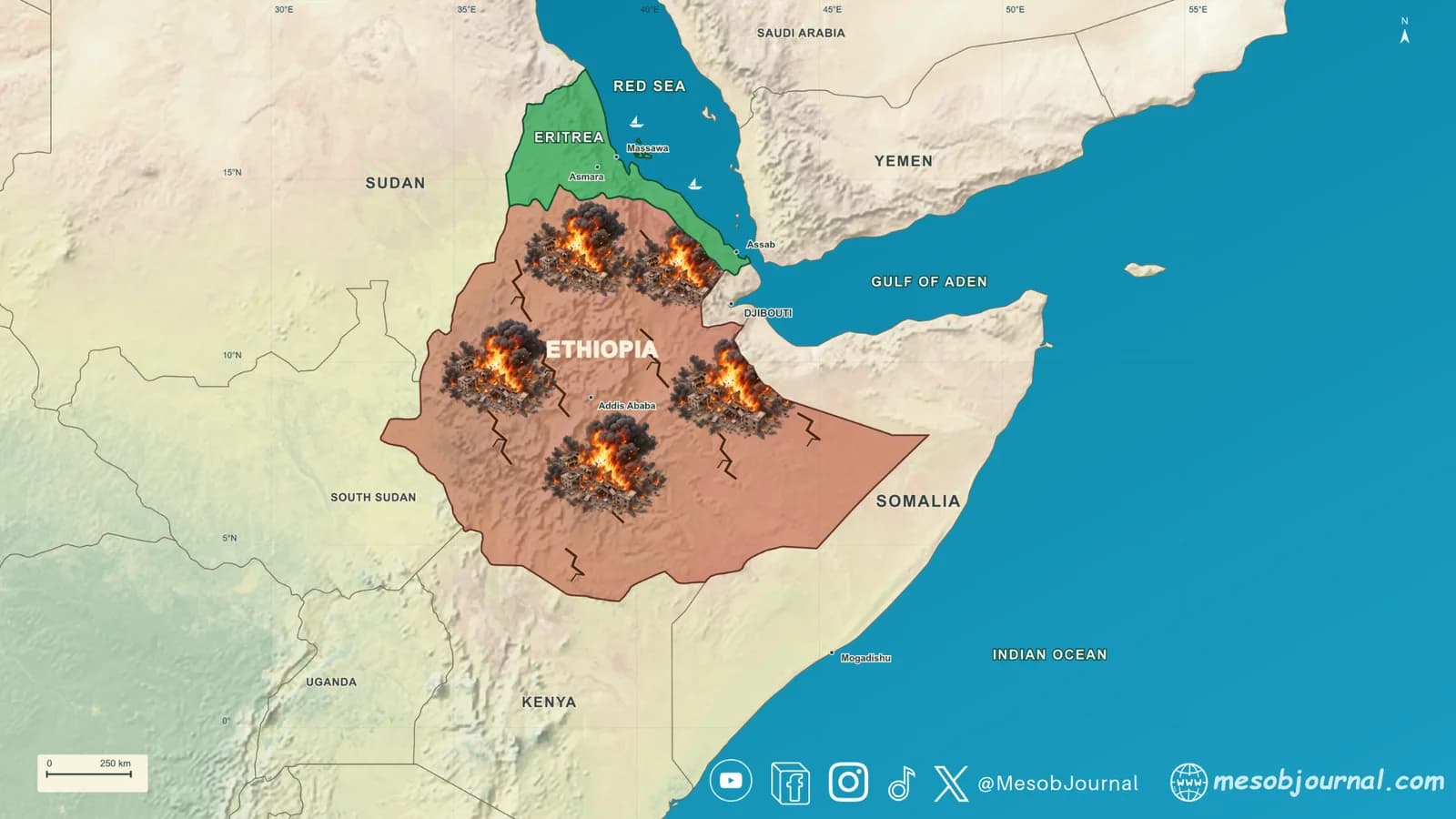
Abiy’s regional aggression is the foreign policy of a state collapsing from within.
Human Rights Watch’s 2026 country report recorded continuing war in Amhara, fighting between federal forces and the Oromo Liberation Army, renewed tensions around Tigray, civilian deaths from drone strikes, attacks on teachers, restricted humanitarian access and fresh displacement.
Ethiopia’s own Human Rights Commission confirmed that attacks in Aseko, Oromia, killed civilians and security personnel, burned property and displaced residents. A separate EHRC warning said renewed clashes around Tigray, Amhara and Afar had reversed the limited stability established after Pretoria.
IOM identified 3.3 million internally displaced people in its May 2024 national assessment, with conflict responsible for 69 percent of the displacement. Its crisis plan recorded emergencies across Tigray, Amhara, Oromia, Afar, Somali, Benishangul-Gumuz and South Ethiopia. The IMF’s June 2026 assessment classified Ethiopia as in debt distress and its pre-restructuring debt as unsustainable.
Political closure has removed another safety valve. Amnesty International documented arrests, enforced disappearances, surveillance and restrictions against journalists before the June election. The Prosperity Party then claimed 438 of 501 declared parliamentary seats after insecurity prevented 143 polling stations from opening and excluded Tigray from the vote.
These are the markers of state collapse: territorial wars, mass displacement, debt distress, political repression and shrinking federal legitimacy. Collapse has not disarmed the regime. Abiy retains enough coercive power and Emirati backing to export Ethiopia’s crisis across the Horn.
This is the internal volcano beneath his foreign policy. The regime blames domestic rebellion on foreign enemies, answers economic failure with prestige projects and maritime entitlement, and replaces political legitimacy with an encirclement narrative. It exports responsibility for its failures and imports the military backing needed to survive them.
Sudan pays the price
Sudan must not become scenery in an article about Abiy Ahmed or the UAE.
Yale’s 27 August situation report recorded damage to Kurmuk Hospital, the destruction of the A40 bridge linking Kurmuk to Ethiopia, indications of looting and fighting across Blue Nile. The following day, its alert warned that the Asosa buildup raised the threat to Ad-Damazin. UNDP reported in August that roughly 60,000 people had fled escalating fighting in Blue Nile since January and that more than 375,000 displaced people were present in the state.
Nationally, the Integrated Food Security Phase Classification estimated in May that nearly 19.5 million people were living in Crisis or worse, including 135,000 in Catastrophe. The UN Human Rights Office concluded that RSF violations during the capture of El Fasher amounted to war crimes and possibly crimes against humanity; it documented more than 6,000 killings during the first three days of the final offensive.
The question here is specific: why is an ENDF base assembling and storing vehicles associated by Yale with RSF operations while Sudanese towns, hospitals and displacement camps absorb the consequences?
Stop rewarding the spoiler
The international habit of describing Abiy as a peacemaker has outlived the evidence. A government cannot claim the privileges of an African Union host, regional mediator and security partner while its military infrastructure is implicated in servicing a neighbouring civil war. It cannot demand sensitivity to Ethiopia’s sovereign needs while treating Somali and Eritrean sovereignty as negotiable. It cannot invoke non-interference against its opponents while state media platforms armed regime-change politics against a neighbour.
The appropriate response is not another sugar-coated appeal to “all stakeholders.” The African Union and IGAD should demand access to the Asosa facility and an independent investigation of the supply chain. Governments with satellite, customs and financial intelligence should trace the vehicles, cargo flights, insurers, brokers and payments linking the UAE, Ethiopia and the RSF system. Any official or company shown to be facilitating weapons, training or transport should face targeted sanctions and procurement restrictions. Humanitarian planning for Blue Nile and Ad-Damazin must be accelerated now, before Yale’s warning becomes another post-atrocity document.
Ethiopia’s partners should also stop treating the regime’s threats against Somalia and Eritrea as colourful domestic messaging. Territorial propaganda, proxy logistics and cross-border coercion belong on the same risk register. Words that prepare populations for force are part of the security environment, especially when the same state is building military capacity at another neighbour’s expense.
This judgement is directed at Abiy Ahmed’s government, not Ethiopia’s peoples. Ethiopians are among the first victims of the regime’s wars, repression, displacement and economic failures. They gain nothing from an RSF corridor, a confrontation over Somalia or a manufactured claim to Eritrean territory. A state that cannot reconcile its own political communities will not become secure by destabilizing the communities around it.
The latest images from Asosa remove the last excuse for strategic ambiguity. Abiy’s government has made Ethiopia a platform in Sudan’s war, challenged Somalia’s territorial order, normalized coercive language against Eritrea and used foreign patronage to escape the constraints imposed by domestic failure.
This is spoiler behaviour backed by Emirati power, presented to the world as regional leadership.
The Horn of Africa should take the threat at face value before another border, city or civilian population is made to pay for Abiy Ahmed’s next gamble.