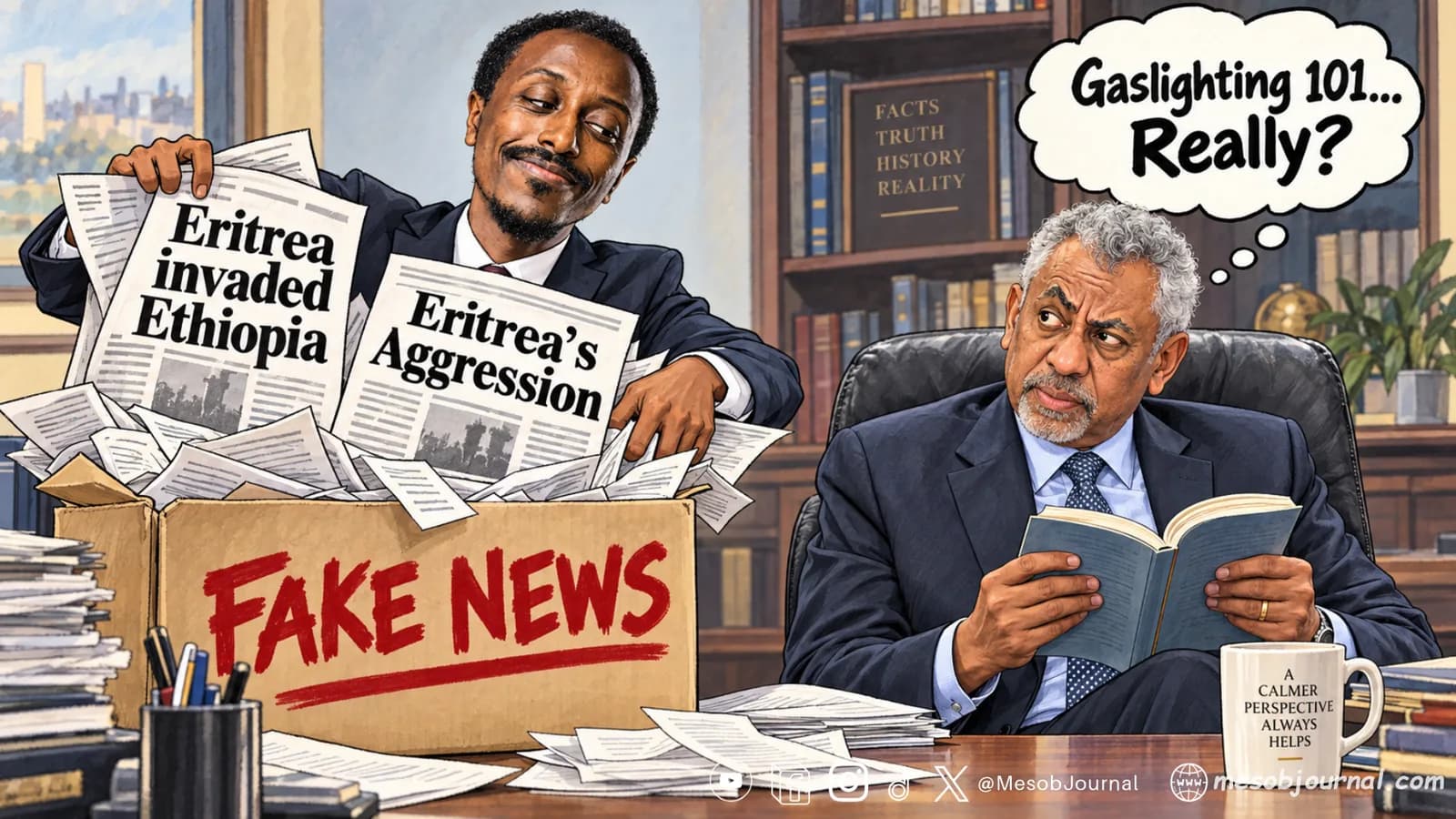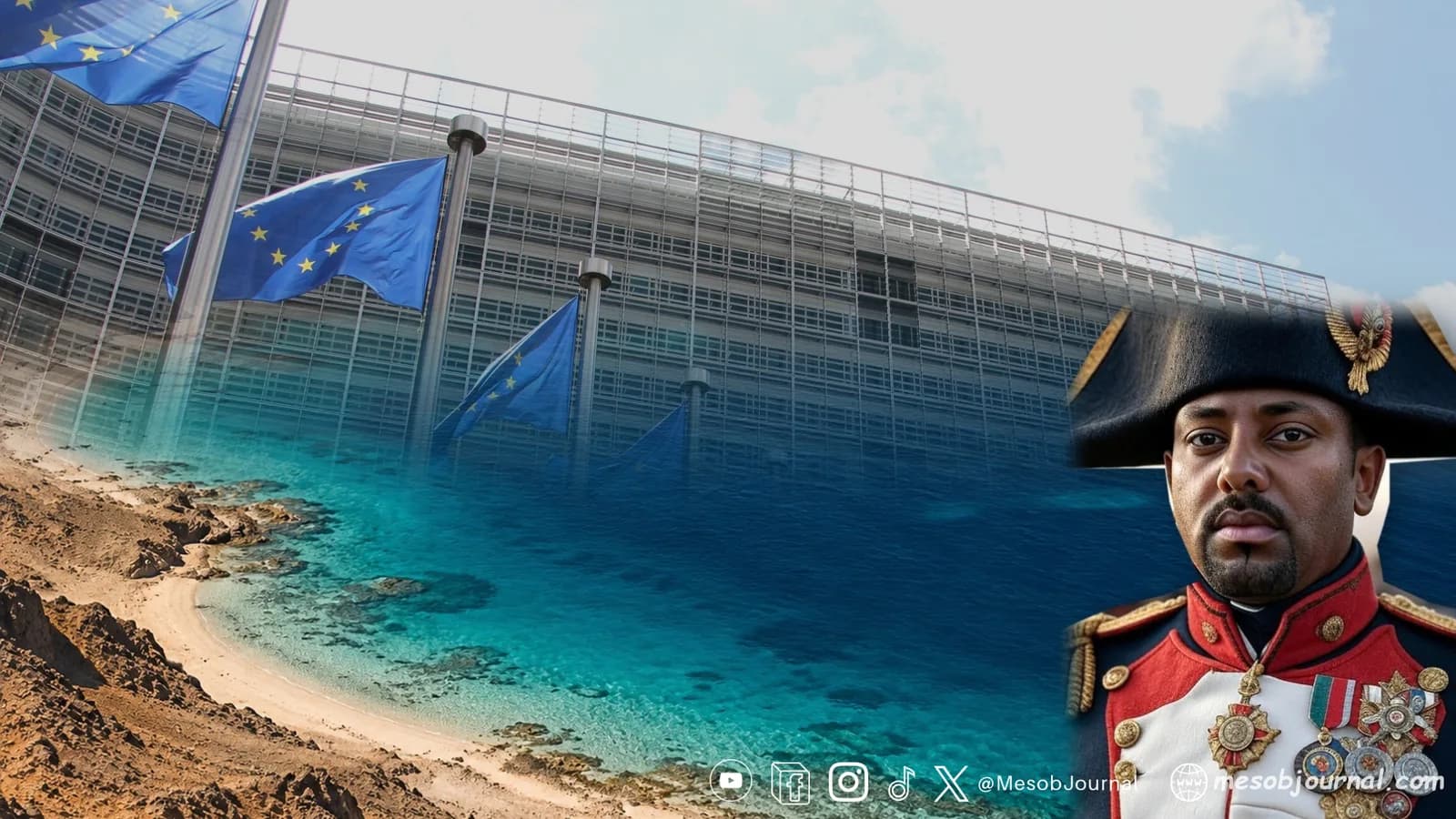

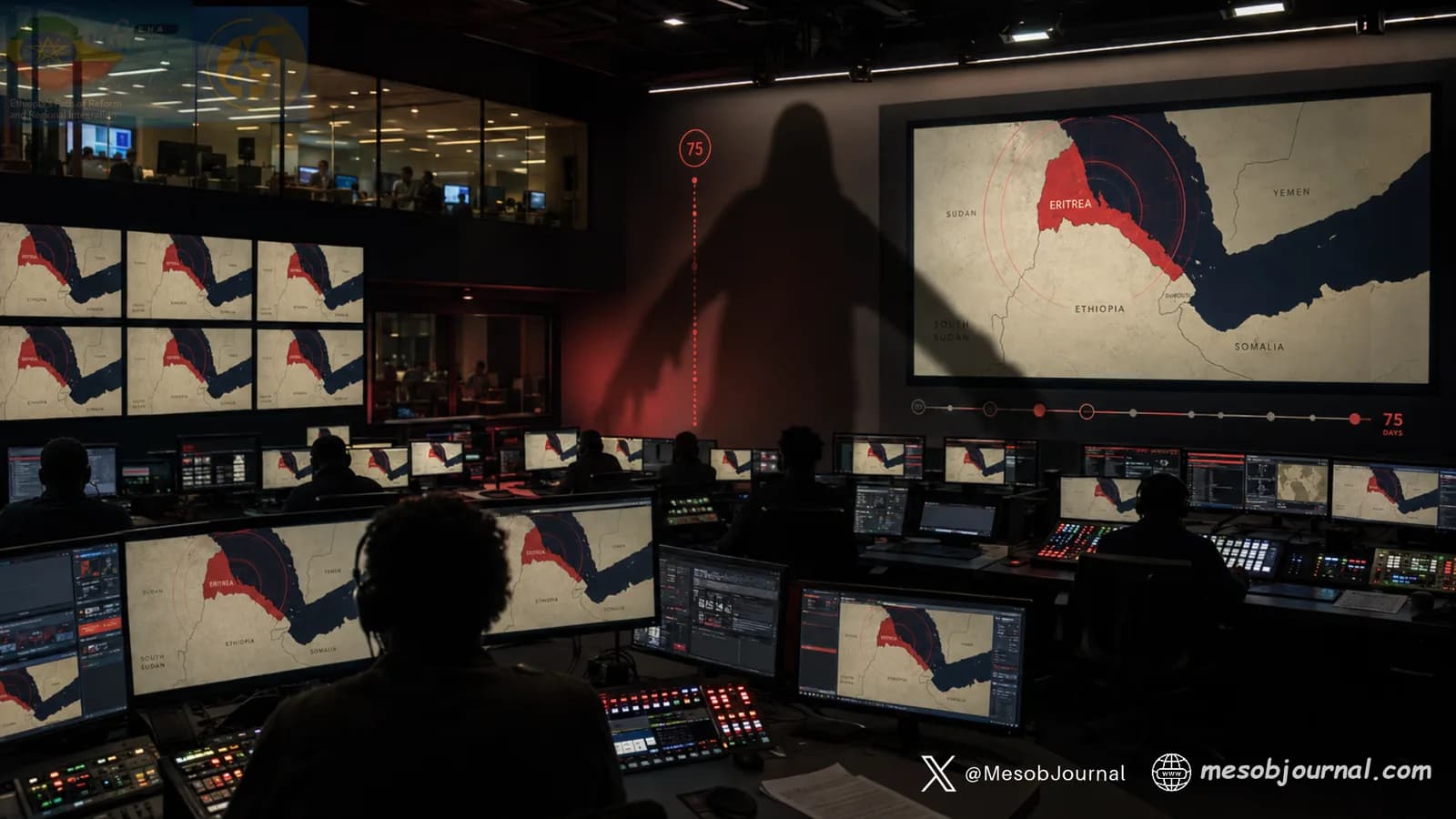
Ethiopia’s state-media system spent the year manufacturing maritime entitlement and the summer manufacturing an Eritrean enemy. ENA supplied the narrative; Fana drove it into circulation.
Twenty-eight of Fana’s 30 substantive Eritrea reports in 2026 appeared within 75 days. Twenty-one carried the language of war, threats, enemies, proxies, insurgency or destabilisation in their headlines.
That is not an accidental news cycle. It is a propaganda campaign.
Fana Media Corporation is not an independent observer that happened to discover the same enemy every few days. The outlet’s effective ownership and editorial direction have been traced to Ethiopia’s ruling Prosperity Party, while its principal supplier in this campaign, the Ethiopian News Agency, is the federal state news service. One creates the accusation, the other expands its reach, and the government’s political line returns to the public disguised as accumulated reporting.
The Fana numbers expose the amplification burst.
Fana English-language search audit | Count |
|---|---|
2026 results returned for “Eritrea” | 37 |
Incidental matches excluded | 7 |
Substantively relevant reports | 30 |
Relevant reports published 10 June–23 August | 28 |
Relevant headlines using conflict/security vocabulary | 21 |
The audit examined Fana’s English-language search results for “Eritrea” from 1 January through 23 August. Seven of the 37 results were incidental references in unrelated stories. Thirty substantially concerned Eritrea, Asmara, alleged Eritrean involvement in Ethiopian conflict or Ethiopia’s Red Sea campaign. Only two appeared before 10 June.
The remaining 28 arrived in a 75-day barrage.
The ENA numbers expose the production line behind it. A deep search across eight terms—Eritrea, Eritrean, Assab, Asmara, Shabia, Shaebia, Tsimdo and Red Sea—returned 119 unique 2026 items through 23 August. Body-level review retained 80 that materially advanced the campaign.
ENA English-language archive audit | Count |
|---|---|
Unique 2026 results retrieved | 119 |
Materially relevant items | 80 |
Relevant items published June–23 August | 57 |
Sea-access or territorial-entitlement frame | 45 |
Eritrea-linked threat, proxy or externalisation frame | 42 |
Items combining both principal frames | 7 |
Eritrean opposition-platform reports | 5 |
Relevant headlines using adversarial/conflict/security vocabulary | 35 |
The frame totals overlap because that is precisely what the propaganda does: seven ENA items joined Ethiopian maritime entitlement to an Eritrea-linked enemy narrative inside the same report. The publication total remains 80, not the sum of the categories.
The monthly curve shows design becoming saturation: six relevant items in January, four in February, six in March, three in April and four in May; then 13 in June, 17 in July and 27 during the first 23 days of August. ENA did not stumble into an August controversy. It spent five months preparing the entitlement claim, then accelerated into threat construction as Fana began its 75-day barrage.
Propaganda does not require every sentence to be invented. It works through selection, repetition, omission, emotional language and the elevation of politically useful allegations into public “facts.” A true fragment can be used propagandistically. So can a disputed claim, an unnamed analyst, an opposition spokesman or an unverified report. What defines the operation is how these fragments are arranged, whose interests they serve and what political conclusion they relentlessly produce.
Fana produced the same conclusion for 75 days: Eritrea is Ethiopia’s enemy, Ethiopia’s internal opponents are Eritrean instruments, Eritrean sovereignty obstructs Ethiopia’s destiny, and any Ethiopian pressure against Eritrea can therefore be sold as self-defence.
Thirty reports, one political assignment
The campaign opened on 10 June with “The Inevitable Return: Ethiopia’s Sovereign Right to the Blue Horizon.” The headline already contained the territorial programme. Return portrayed another country’s coast as Ethiopian property temporarily lost. Sovereign right converted economic access into title. Inevitable removed diplomacy from the future and replaced it with destiny.
The security campaign then supplied the enemy needed to animate that grievance.
Twenty-one of the 30 relevant headlines used explicit conflict or security language: war, threat, enemy, proxy, destabilize, destruction, forced recruitment, ammunition, insurgency, rebellion, abuses, fault line or disaster. The headlines did not invite readers to examine competing accounts. They handed down verdicts.
Repeated often enough, the vocabulary performs political work. Eritrea ceases to be a neighbouring sovereign state. It becomes the hidden author of Ethiopia’s insecurity, the sponsor of every internal opponent and the obstacle standing between Ethiopia and its supposed historical destination on the Red Sea.
This is enemy manufacture. Its purpose is not merely to damage Eritrea’s image. It reorganises Ethiopian political reality around a foreign culprit.
Internationalising Ethiopia’s internal breakdown
Ethiopia’s principal crises arise from unresolved struggles over federal power, territory, armed authority, political exclusion, state violence, regional grievances and a peace settlement that has not produced national reconciliation.
Human Rights Watch’s 2026 country report recorded continued hostilities between federal forces and armed groups in Amhara and parts of Oromia, along with renewed instability in and around Tigray. In June, Ethiopia’s own Human Rights Commission confirmed that an armed-group attack in Aseko Woreda killed civilians, burned homes and displaced more than 2,650 residents. The IMF’s 2026 debt assessment still classified Ethiopia as in debt distress with unsustainable debt under the pre-restructuring schedule.
These are not details at the edge of an otherwise coherent success story. They describe a state struggling to secure territory, reconcile political communities, protect civilians and finance its obligations.
The media space in which those failures should be investigated is also contracting. On 29 May, days before Ethiopia’s election and less than two weeks before Fana’s 75-day burst began, Amnesty International reported arbitrary arrests, enforced disappearance, surveillance, licence suspensions and accreditation restrictions directed at journalists and independent outlets.
Independent scrutiny is narrowed. Ruling-party messaging expands. Then the camera turns north.
The diversion is not subtle. Domestic wars become an Eritrean proxy strategy. Political failures become foreign sabotage. A fractured federal order becomes a story of national encirclement. Debt, displacement, repression and contested authority are pushed behind a more useful spectacle: the dangerous neighbour denying Ethiopia its destiny.
This is how Addis Ababa internationalises its internal problems. It moves the centre of explanation from the Ethiopian state to Asmara. Every armed grievance inside Ethiopia can then be stripped of its political history and relabelled as evidence of Eritrean aggression. The government escapes the dock and returns as the victim.
ENA manufactures; Fana multiplies
The ENA-to-Fana pipeline gives this propaganda the appearance of corroboration.
ENA interviews a government adviser, foreign commentator or Eritrean opposition figure. The source advances a sweeping allegation. ENA publishes it as a news event. Fana reproduces it under a second masthead. Repetition then masquerades as confirmation.
The 23 August Fana article is a textbook case. Its source, a member of the Eritrean Blue Revolution Front interviewed by ENA, blamed Asmara for conflict and instability across Ethiopia, Sudan, Yemen, Djibouti and Somalia. He moved from regional war to national service, the G-15 detentions, economic policy and the necessity of political change in Eritrea.
Fana supplied no documentary record connecting these enormous claims, no independent evidence, no named regional specialist and no Eritrean response. One politically committed source was made to carry an entire regional indictment.
That is not merely poor reporting. It is allegation laundering. Attribution provides a thin layer of journalistic grammar while the headline delivers the government-aligned political conclusion.
ENA’s operation was not confined to a six-story August run. The full search found 80 relevant items through 23 August: 45 promoted maritime or territorial entitlement, 42 constructed an Eritrea-linked threat or proxy coalition, and 35 put explicit conflict or security language in the headline.
The 5 August proxy-war article relied on “reports,” “analysts,” “critics” and perceptions while its headline announced an Eritrean plan to push Tigray into a new proxy war. The body conceded that alleged forced recruitment required independent verification. The accusation against Eritrea required no such discipline.
The 9 August “Military Adventurism” feature repeated the method. Reported contacts that the article itself said needed confirmation were placed inside a definitive story of Eritrea dragging the Horn back to war. Uncertainty appeared in the evidence and disappeared from the verdict.
This is the gimmick at the centre of the campaign: publish the allegation as fact, bury the absence of proof inside conditional language, then repeat the headline until the claim acquires political weight.
Deep search reveals a second gimmick: hiding the campaign beneath headlines that appear to concern something else.
On 7 August, “Ethiopia Urged to Build More Dams on Abay River” inserted into a hydropower report the claim that Egypt was organising and financing a military and diplomatic alliance with Sudan’s armed forces, “the Eritrean regime,” and forces in Amhara, Oromia and Tigray labelled extremist or terrorist. No document established this vast coalition. The accusation simply appeared as “public knowledge.”
On 15 August, an article headlined “Special Operations Command Model Force Ready to Take Preemptive Strike” moved from the Ethiopian military’s striking capacity to the chief of staff’s claim that Shaebia historically conspired to deny Ethiopia sea access. It then placed TPLF, Shene and Fano inside a foreign-directed coalition. Military readiness, internal enemies, foreign conspiracy and maritime grievance were fused in one state-news report.
On 19 August, an article supposedly asking what the Arab world had gained from Egypt attacked Eritrean independence as an Egyptian-backed separation of Ethiopian territory, called Ethiopia a “Red Sea nation” and described direct maritime access as something to be reclaimed.
This is why headline-only monitoring understates the campaign. Eritrea is made the hidden explanation inside reports on dams, the armed forces, Egypt, the Arab League and economic development. Covered or uncovered, the assignment is the same.
Armed regime change for Eritrea, “subversion” for Ethiopia
The hypocrisy becomes unmistakable in the treatment of opposition movements.
On 27 June, ENA gave the chairman of the Eritrean “Green Revolution” movement a state platform to announce that his organisation was prepared to confront the Eritrean government militarily. He described a political, organisational and military structure intended to bring change to Eritrea. Fana republished the interview the same day.
The documented act is damning on its own. Ethiopia’s state and ruling-party media legitimised an Eritrean organisation speaking openly about military confrontation and regime change. The same media system presents alleged Eritrean contact with Ethiopian opposition actors as proof that Asmara is uniquely committed to regional destabilisation.
For Ethiopian opposition, foreign contact is treason. For Eritrean opposition, military preparedness is a news platform.
That is a political doctrine: armed opposition is condemned when it challenges Addis Ababa and sanitised when it targets Asmara. The principle being defended is not non-interference. It is Ethiopia’s claimed privilege to interfere while denying Eritrea the same political space.
From enemy manufacture to territorial incitement
The war propaganda and the Red Sea campaign are parts of the same operation.
On 16 August, after ENA’s week of anti-Eritrea features, the agency published “Reclaiming Ethiopia’s Sea: An Injustice Long Overdue for Rectification.” It called Assab Ethiopia’s “once-sovereign territory,” dismissed Eritrea’s independence as a hasty cession by two rebel movements and declared Ethiopia’s seas a birthright. The final sentence called on Ethiopia to “fight for that legacy.”
Seven days later, Fana accused Eritrea of fuelling conflicts across the Horn.
The sequence is not contradictory. It is the war narrative working as intended. Ethiopia is taught to see Eritrean territory as stolen inheritance and Eritrea as the aggressor. The claimant becomes the victim before the claim is enforced.
Calling this a debate about “sea access” is itself a distortion. Commercial access is negotiated through port agreements, transit corridors, tariffs and infrastructure. Assab’s sovereignty is not a logistics problem. The UN Charter’s prohibition on threats or force against another state’s territorial integrity does not disappear because a government news agency wraps a territorial demand in history and development language.
“Fight for that legacy” is war-mongering. It appears in an article demanding rectification of an alleged territorial injustice. No responsible editor, diplomat or regional institution should pretend the words are harmless because ENA did not publish an operational military order beneath them.
War propaganda comes first. It prepares grievance, identifies the enemy, criminalises resistance and supplies the future aggressor with a language of reluctant self-defence.
Eritrea is not making the reciprocal claim
Eritrean official statements have answered Ethiopia sharply. They have not been silent, and they do not need to be. But their formal position returns to settled sovereignty rather than laying claim to Ethiopian territory.
The Eritrean Ministry of Information’s 9 February statement rejected Ethiopian accusations and said Eritrea had no desire to add fuel through acrimony. A longer Foreign Ministry statement on 18 March criticised Addis Ababa’s conduct but closed by affirming peace, stability and responsible regional relations.
Eritrea has not claimed Gondar, Mekelle or an Ethiopian corridor as its birthright. It has not called Ethiopia’s recognised independence a historical mistake. It is defending an internationally recognised border while Ethiopia’s ruling-media system teaches its audience to experience that border as theft.
There is no honest symmetry here.
Name the campaign
Fana’s 75-day output and ENA’s 80-item production line were not an unfortunate collection of provocative headlines. They were not merely biased reporting. They were not a legitimate security debate conducted in overheated language.
It was war propaganda.
The campaign turned Ethiopia’s internal conflicts into an Eritrean conspiracy, platformed armed regime-change politics against Eritrea, laundered allegations through ENA and Fana, revived territorial claims to Assab and trained the public to see Ethiopia as the injured party.
Its domestic function is diversion. Its regional function is provocation. Its strategic function is to prepare an explanation for coercion before coercion occurs.
Ethiopia’s internal breakdown will not be repaired by internationalising it. Amhara’s war will not be resolved in Asmara. Oromia’s insecurity will not be explained by Assab. Tigray’s unfinished political settlement will not be healed by calling every adversary an Eritrean proxy. Debt distress will not disappear beneath a coastline.
The Ethiopian people are being offered an enemy in place of accountability. Eritrea is being offered as territory in place of policy.
The combined record reveals the assignment. Fana delivered 28 relevant reports in 75 days. ENA published 80 campaign items across the year, 57 of them from June onward. Forty-five advanced maritime entitlement; 42 built the Eritrea-linked enemy; seven coupled both operations in the same text. Behind the numbers stands a ruling-media system preparing the public not for peace, but for the political logic of another war.