
The UN & UNHRC’s Hypocrisy on Eritrea — A Documented Exposé
The United Nations has always insisted that it stands above geopolitics, above selective enforcement, above the hierarchies that define the international system. It presents itself as the custodian of universality, impartiality, and objectivity, a body that treats all nations with equal dignity and equal scrutiny. Yet nowhere does this carefully curated self-image collapse more completely than in its treatment of Eritrea.
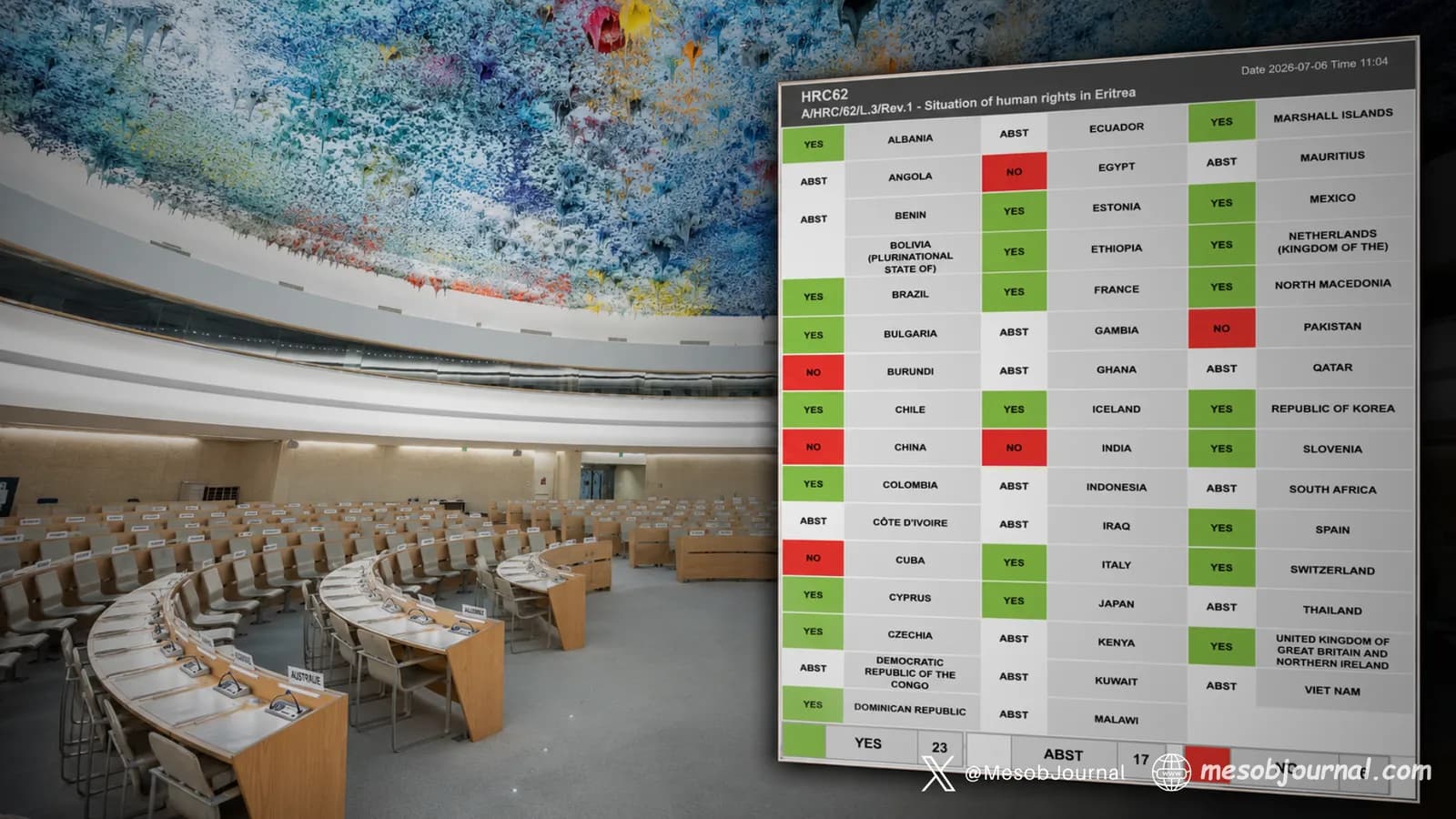
For more than a decade, the UN Human Rights Council has turned Eritrea into a permanent fixture of its agenda, a country singled out year after year through a country-specific mandate that contradicts the very principles the UN claims to uphold. Eritrea is not examined through the universal mechanisms designed to ensure fairness and equality; instead, it is subjected to a bespoke apparatus of scrutiny that the Council itself admits violates the norm of non-selectivity.
The UNHRC’s own resolutions reveal this contradiction with almost embarrassing clarity: they recall the importance of universality and impartiality while simultaneously renewing the one mechanism that violates both. The hypocrisy is not subtle. It is structural, deliberate, and sustained.
The Council’s posture becomes even more untenable when it condemns Eritrea for “lack of cooperation,” despite openly acknowledging that its Special Rapporteur operates without access to the country and relies on unverified allegations. The UN demands cooperation to verify claims, but uses the absence of cooperation to justify relying on unverifiable claims. This is not a methodology; it is a circular logic that sustains the mandate by design.
The Special Rapporteur cannot enter Eritrea; therefore, the mandate must continue because the Special Rapporteur has not entered Eritrea. This is the kind of reasoning that would be dismissed in any serious investigative framework, yet it is treated as legitimate within the UNHRC because it serves a political purpose. The Council has created a system in which Eritrea’s refusal to validate a biased mechanism becomes the justification for perpetuating that mechanism indefinitely. It is a self-reinforcing loop, a bureaucratic ouroboros that feeds on its own logic.
Advocacy organizations like Human Rights Watch and Amnesty International, which are not neutral investigators but political actors with explicit agendas, reinforce this loop by lobbying the Council to maintain the mandate and celebrating when Eritrea’s attempts to end it are defeated. These organizations are not disinterested observers; they are participants in the political process, shaping narratives, influencing resolutions, and providing the very allegations that the UNHRC then cites as evidence.
The UNHRC, instead of conducting independent verification, outsources its fact-finding to NGOs whose mission is to keep the mandate alive. The result is a self-referential ecosystem in which allegations justify the mandate, the mandate justifies the allegations, and the absence of access is treated as evidence rather than a methodological failure. The UNHRC’s Eritrea file is not an independent assessment; it is a collaborative construction between the Council and advocacy groups, each reinforcing the other’s conclusions.
Even on substantive issues, the UNHRC’s posture is riddled with contradictions. The Council condemns Eritrea’s national service as inherently abusive, yet acknowledges that compulsory national service is legal under international law and that Eritrea’s own law caps service at eighteen months. It further acknowledges that the government justifies extensions based on security conditions, which is also permitted under international law.
But instead of situating Eritrea’s policies within the region’s unique security environment, a region marked by war, sanctions, and existential threats, the UNHRC treats Eritrea’s national service as an aberration. The same institution that accepts compulsory service in dozens of countries suddenly treats Eritrea’s version as illegitimate, not because of legal standards but because of political narratives that have hardened into dogma.
The UN’s selective outrage becomes even more glaring when it ignores the fact that Eritrea’s security doctrine was shaped by decades of invasion, occupation, and regional destabilization, conditions the UN itself failed to prevent or resolve. The institution that could not enforce its own boundary decisions now positions itself as the arbiter of Eritrea’s internal governance.
The UNHRC’s selective blindness extends to Africa’s own human-rights architecture. The Council routinely declares its commitment to regional complementarity, yet when the African Commission on Human and Peoples’ Rights reviews Eritrea, the UNHRC merely takes note and then proceeds to ignore African findings entirely. The Eritrea file remains Eurocentric in authorship, sponsorship, and framing, dominated by EU-led resolutions and Western advocacy groups. African agency is acknowledged only in ceremonial language, never in substantive influence.
The Council’s Eritrea narrative is frozen in time, repeating the same allegations year after year even as it acknowledges Eritrea’s engagement with UN mechanisms: ratifying the Convention on the Rights of Persons with Disabilities, participating in its fourth Universal Periodic Review, and undergoing review by the Committee on the Rights of the Child. These developments appear in the Rapporteur’s statements but vanish from the resolutions, which recycle the same language regardless of new facts. The UNHRC’s Eritrea file is not a living assessment but a static script, updated only in formatting, never in substance.
The UN insists that Eritrea faces systemic violations, yet it cannot demonstrate progress or regression because it has no access, no baseline metrics, and no year-to-year comparisons. A system that claims to monitor systemic issues but cannot measure them is not engaged in monitoring; it is engaged in narrative maintenance. The Eritrea file is not an evidence-based evaluation but a political artifact masquerading as a human-rights instrument.
The UN’s own failures in the Horn of Africa, from its paralysis during the Eritrea-Ethiopia border war to its inability to enforce its own boundary decisions, are never acknowledged in its human-rights discourse. Instead, the institution that failed to protect Eritrea’s sovereignty now positions itself as the arbiter of Eritrea’s internal governance. The irony is not lost on anyone who has followed the region’s history.
The UNHRC’s Eritrea narrative also reveals a deeper institutional pathology: the need for a permanent target to sustain the illusion of universality. A system that claims to treat all nations equally must periodically demonstrate its willingness to scrutinize countries outside the usual geopolitical adversaries. Eritrea, small, defiant, and unwilling to submit to external pressure, becomes the perfect candidate. It is politically safe to target, unlikely to retaliate diplomatically, and symbolically useful as evidence that the UNHRC does not exclusively focus on major powers or global rivals. Eritrea becomes the sacrificial example, the country that proves the Council’s supposed impartiality even as the process itself is anything but impartial.
The UN’s treatment of Eritrea also reflects a broader pattern in which small, independent states that resist external influence are subjected to disproportionate scrutiny. Eritrea’s refusal to align with Western security agendas, its insistence on self-reliance, and its rejection of foreign military bases make it an outlier in a region where geopolitical competition is intense. The UNHRC’s fixation on Eritrea cannot be separated from this geopolitical context. The Council’s human-rights narrative becomes a proxy for political pressure, a way to discipline a state that refuses to conform to the expectations of the international system. The language of human rights becomes a tool of political leverage, and Eritrea becomes the object of that leverage.
In the end, the UN and the UNHRC expose themselves through their own documents. They claim universality while practicing selectivity. They demand cooperation while relying on unverified allegations. They justify a mandate through circular reasoning. They ignore African regional mechanisms while claiming to respect them. They recycle narratives without updating evidence. They rely on advocacy NGOs as de facto investigators.
Eritrea is not the exception because of its human-rights record; it is the exception because the UNHRC needs an exception to sustain the illusion of universality. The hypocrisy is structural, not incidental. It is built into the architecture of a system that cannot admit its own political nature, and so it projects that politics onto the one country it has decided must never be allowed to graduate from scrutiny.
Eritrea’s real crime, in the eyes of the UN system, is not human-rights noncompliance but political non-alignment, a refusal to submit to the hierarchy of influence that governs the international order. And so the UNHRC keeps Eritrea in a holding pattern, not because the facts demand it, but because the system requires it.