
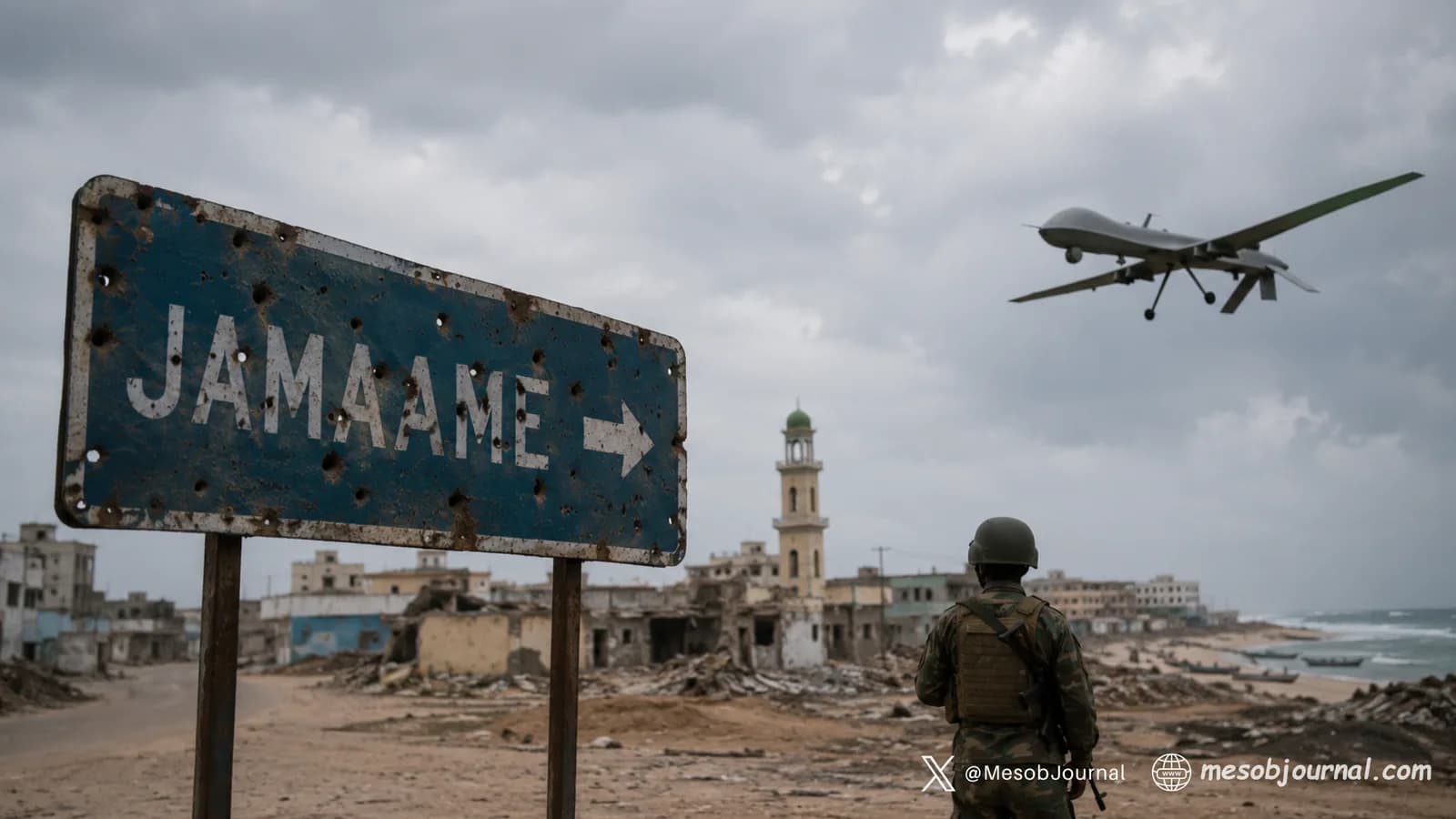
A Somali child killed by a drone rarely becomes an international headline. There is no emergency summit, no wall-to-wall coverage, no moral panic in the capitals that authorize the strikes. The death is usually absorbed into the language of counterterrorism, buried under phrases such as “precision operation,” “targeted strike,” or “militant threat.”
But Somalia is not a free-fire zone. Somali civilians are not collateral shadows in somebody else’s war.
A new investigation into a U.S. drone strike in Jamaame, southern Somalia, has reopened one of the most uncomfortable questions in the long American air campaign in the Horn of Africa: who is held accountable when the world’s most powerful military kills the people it claims to protect?
According to the investigation, the strike took place on 15 November 2025 and killed at least 12 civilians, including eight children. The attack reportedly hit residential areas and a Qur’an school. Witnesses interviewed after the strike said they saw no al-Shabaab fighters at the locations targeted. Families were destroyed in seconds. Children who had been walking home from school were turned into casualties of a war they did not choose and could not understand.
The United States has long presented its operations in Somalia as part of a campaign against al-Shabaab and, more recently, ISIS-Somalia. Washington argues that such strikes are conducted in coordination with Somalia’s federal government and are intended to protect Somali forces, U.S. personnel and regional security. AFRICOM has repeatedly described its operations as targeted actions against armed groups that threaten Somalia and international partners.
No serious observer denies the threat posed by al-Shabaab. The group has killed Somalis in markets, hotels, government buildings, military bases and villages for years. Somali soldiers, police officers, elders, journalists, clerics, women and children have paid the heaviest price for its violence. Somalia has the right to defend itself, and Somalis have the right to live without fear of extremist rule.
But the existence of a terrorist threat does not erase the rights of civilians. It does not give foreign militaries a blank check to strike from the sky, offer vague explanations, and move on when families are buried under rubble. Counterterrorism cannot become a permanent exception to accountability.
The Jamaame story is not only about one strike. It is about a pattern in which African lives are often treated as less politically costly, less legally visible and less worthy of grief.
For nearly two decades, Somalia has been one of the main theaters of America’s remote war in Africa. What began as a limited counterterrorism campaign has expanded into a recurring military practice involving airstrikes, drone operations and intelligence-driven targeting. The language is always controlled. The geography is often distant. The victims, when civilians are killed, are frequently unnamed.
This distance matters. A drone strike allows a powerful state to exercise violence without seeing the human world beneath the target. From the air, a village becomes a grid. A road becomes a route. A gathering becomes a possible threat. A mistake becomes a classified assessment. For Somali families, however, there is no abstraction. There is only the sound, the fire, the body, the grave and the unanswered question.
Why them?
The tragedy also exposes a deeper problem in the way Somalia is discussed internationally. Too often, the country is reduced to a security file. Somalia becomes a place of militants, pirates, fragile institutions and foreign missions. Its people appear mainly as victims, suspects or background figures in someone else’s strategic narrative.
That framing is not neutral. It makes it easier for outside powers to act in Somalia with limited public scrutiny. It allows civilian deaths to be treated as unfortunate technical errors rather than political and moral failures. It also weakens the principle that African states, even when facing severe security threats, must not be turned into open laboratories for foreign military doctrine.
Somalia’s sovereignty must mean more than formal consent. A government’s cooperation with a foreign military does not eliminate the need for transparency, investigation and public accountability. If strikes are carried out in Somalia’s name, then Somali citizens have the right to know who was targeted, why the target was selected, what evidence was used, and what happens when the wrong people are killed.
This is especially urgent because counterterrorism campaigns can easily become self-defeating. Every civilian death creates grief. Every unanswered killing creates anger. Every family denied truth becomes another witness against the credibility of the state and its foreign partners. Armed groups such as al-Shabaab understand this. They exploit anger, humiliation and loss. A war that claims to weaken extremism can strengthen its recruitment if it treats civilian harm as an administrative inconvenience.
The silence around African civilian deaths is part of the injury. When civilians are killed in Europe or North America, their names, photographs and personal stories often shape global emotion. When Somali children are killed, they are more likely to be counted, disputed or forgotten. The imbalance is not accidental. It reflects a global hierarchy of grief.
Somalia deserves security, but not at the price of becoming a permanent battlefield managed by outsiders. It deserves partnership, but not partnership without accountability. It deserves support against al-Shabaab, but not a war model in which children can be killed and their families left without apology, compensation or truth.
The Horn of Africa has already suffered enough from proxy politics, foreign military experiments and selective international concern. From Somalia to Sudan, from the Red Sea corridor to the Gulf of Aden, African societies are too often asked to live with the consequences of decisions made elsewhere. The result is a region spoken about in the language of stability while its people carry the cost of instability.
The question now is not whether Somalia has enemies. It does. The question is whether the fight against those enemies will respect Somali life, Somali sovereignty and Somali dignity.
A serious counterterrorism policy must be able to answer for the civilians it kills. A serious partner must investigate when Somali families say their children were wrongly targeted. A serious international system must stop treating African casualties as footnotes in wars declared in the name of security.
Somalia is not a blank space on a military map. It is a country of families, schools, towns, memory and national dignity.
And no child walking home from school should disappear beneath the language of a “precision strike.”