
There are development slogans, and then there is the harder thing: the daily work that keeps families fed, markets supplied, and communities standing on their own feet. In Eritrea, that work is often being carried by women whose contribution is discussed too little outside the country, and sometimes not enough even within it.
If anyone wants to understand what food security looks like beyond donor jargon and conference language, they should start there.
Across Eritrea’s agricultural sector, women are not simply participating. They are producing, experimenting, managing, training, adapting and, in many cases, holding together the practical link between national policy and household survival. Their work is visible in poultry centers, irrigated fields, integrated farms, local markets and training spaces where knowledge is passed on not through theory alone, but through results.
That is the real story.
Too often, African agriculture is described from the outside in the language of crisis alone, as though local people are waiting passively for rescue. Eritrea’s reality tells a different story. It is tougher, more grounded and more honest. The country faces the same pressures that weigh on much of the region: harsh climate conditions, water constraints, market difficulties and the constant demand to produce more with limited means. Yet within that reality, Eritrean women have been building practical solutions from the ground up.
Take Ms. Birkti Welday.
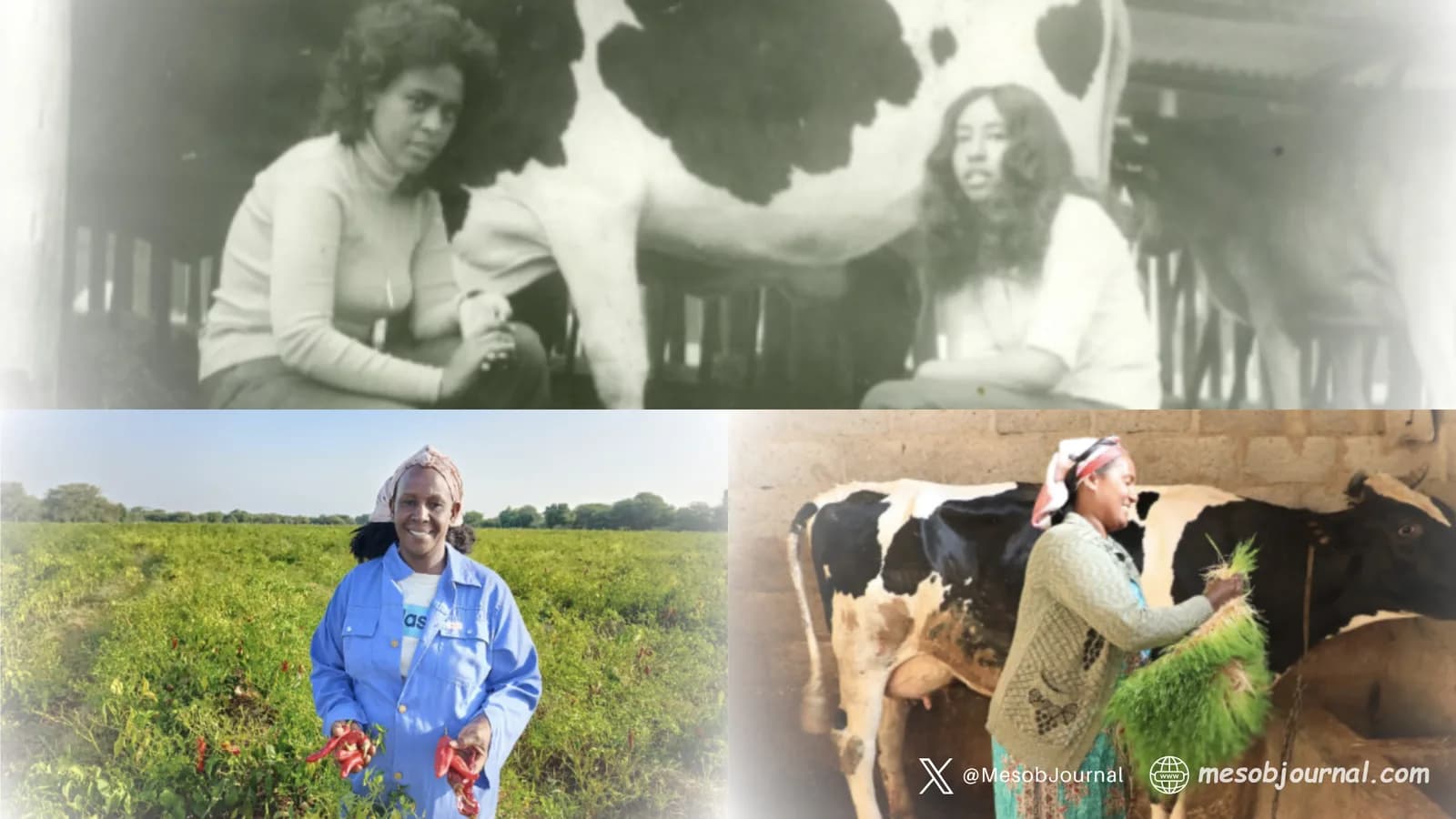
Her story is not just inspiring because it is personal. It matters because it reflects a wider Eritrean truth. She moved from the years of armed struggle into the equally demanding work of civilian nation-building. Assigned after independence to serve in areas around the Sawa region, she later began agricultural work that led her into irrigated farming. What started as necessity became productivity. What looked difficult became disciplined success.
Over time, she developed a 13-hectare irrigated farm and built a livelihood around onions, peppers and other crops, even after setbacks that would have pushed many people out of farming altogether. Flood damage, feed shortages, investment pressure, climate stress, market fluctuations — these are not abstract policy phrases in her life. They are problems she had to solve in the field, season after season.
And she did.

There is something important in that. Eritrea’s rural women are often discussed as beneficiaries. In reality, many of them are builders. They do not simply receive programs. They make them work. They do not merely endure hard conditions. They organize around them. In Birkti’s case, the result was not just personal survival, but market contribution. Her farm now helps supply produce at prices local consumers can bear, while also supporting the wider stability of the area’s food chain.
That is food security in its most concrete form: not speeches, but supply.
Then there is the case of Ms. Estegenet Uqbay in the Southern Zone, whose work shows another side of the same national story — innovation under constraint.
Her path into agriculture came through hardship, not luxury. Faced with family pressure and limited means, she invested step by step, beginning with chickens purchased through Ministry of Agriculture support and later expanding into cattle breeding, hydroponic fodder production and fruit cultivation. This is where the story becomes especially relevant beyond Eritrea: the innovation is modest in scale, but serious in implication.

Hydroponics is often presented internationally as high-tech, capital-heavy and urban. In her case, it became something else: a practical answer to animal feed needs, milk quality and farm integration. She took an idea introduced through agricultural programming, tested it, applied it and turned it into part of a functioning family production system. Then the model went further. Her compound became a place where others could observe, learn and train.
That shift matters. It turns one woman’s household effort into a community-level multiplier.
It also says something essential about Eritrea’s development approach when it works best. The point is not imported spectacle. It is replication. A useful idea reaches a capable person, is adapted to local conditions, produces results, and then becomes teachable. That is far more durable than the donor-cycle obsession with pilot projects that look good in reports and disappear on the ground.
If Birkti’s story represents endurance and expansion, and Estegenet’s represents experimentation and integrated farming, then Ms. Almaz Gezae represents another pillar of national food security: institutional memory and technical leadership.
A veteran agricultural professional, Almaz Gezae has spent decades in public service and now serves in a senior role at the Ministry’s poultry breeding center. Her experience stretches back to the early post-independence years, when Eritrea was not inheriting a fully developed agricultural system but building one under pressure. That generation had to learn fast, improvise constantly and create national capacity from limited foundations.

Her account reflects that period clearly. It was not glamorous work. It was patient work. It involved breeding, incubation, animal health, facility management, training and long-term technical commitment. In sectors like poultry, where even small lapses can produce major losses, discipline is everything. Her description of the work is revealing precisely because it is so unsentimental. It is demanding, continuous and exact.
That is what makes it credible.
And it helps explain something often missed in outside narratives about Eritrea: resilience is not magic. It is organized labor, accumulated skill and continuity of purpose. Food systems do not stabilize themselves. They depend on professionals who know how to manage disease risks, improve breeding stock, maintain output and train others. Women like Almaz are part of that national backbone.
Seen together, these stories are bigger than individual achievement. They show the architecture of food security as it is actually built in Eritrea.
It is built by women who move from war to reconstruction without waiting for applause.
It is built by farmers who turn a small plot into a productive base through irrigation, persistence and careful planning.
It is built by women who see one practical innovation, test it under local conditions and expand it into integrated farming.
It is built by technicians and managers who keep production systems functioning year after year, often far from the spotlight.
And it is built by a social ethic that understands food not only as a market commodity, but as a national responsibility.
That last point matters. Food security is often treated globally as a matter of imports, aid pipelines or emergency response. Those things may matter in moments of acute distress, but no country can build lasting stability around dependence. Eritrea’s harder path has been to push for domestic resilience wherever possible: local production, water management, training, adaptation and community-level responsibility. That path is not easy. It demands sacrifice, organization and patience. But it is the only path that produces dignity alongside output.
Women are central to that effort, not peripheral.
There is also a deeper political and cultural point here. In Eritrea, women’s contribution to national life did not begin in development workshops. It was forged through the liberation struggle and carried into the state-building period that followed. So when women today lead in agriculture, administration, local production and technical work, this is not a decorative inclusion story designed to impress foreign audiences. It is a continuation of a national tradition in which women earned their place through sacrifice, competence and work.
That is why these agricultural stories deserve to be read seriously.
They are not soft features. They are evidence of how a country under pressure sustains itself. They show what self-reliance looks like in practice, especially in sectors where failure would hit ordinary people first and hardest. They also challenge lazy external assumptions that portray African women mainly as victims of circumstance rather than agents of transformation.
Eritrean women in agriculture are not waiting to be empowered in the abstract. They are already doing the empowering: feeding households, improving production, training neighbors, stabilizing markets and extending the logic of national resilience into everyday life.
That is not a side story.
It is one of the main stories of Eritrea itself.