

The Red Sea, or Eritrean Sea, has always been a witness. Long before borders, long before maps, long before outsiders tried to redraw the story of the Horn of Africa in their own image, the waters between Africa and Arabia carried the ambitions, rituals, and memories of ancient civilizations. And along its western shore, the land now called Eritrea stood not as a footnote, not as a mystery, not as a speculative location on someone else’s academic diagram, but as the beating heart of one of humanity’s earliest maritime worlds.
The Egyptians called it Punt, the ‘God’s Land.’ A place of incense, gold, myrrh, and sacred beings. A place they sailed to, traded with, and revered. A place they depicted with precision because they had seen it with their own eyes. A place whose memory endured for millennia, even as the world tried to forget the people who lived there.
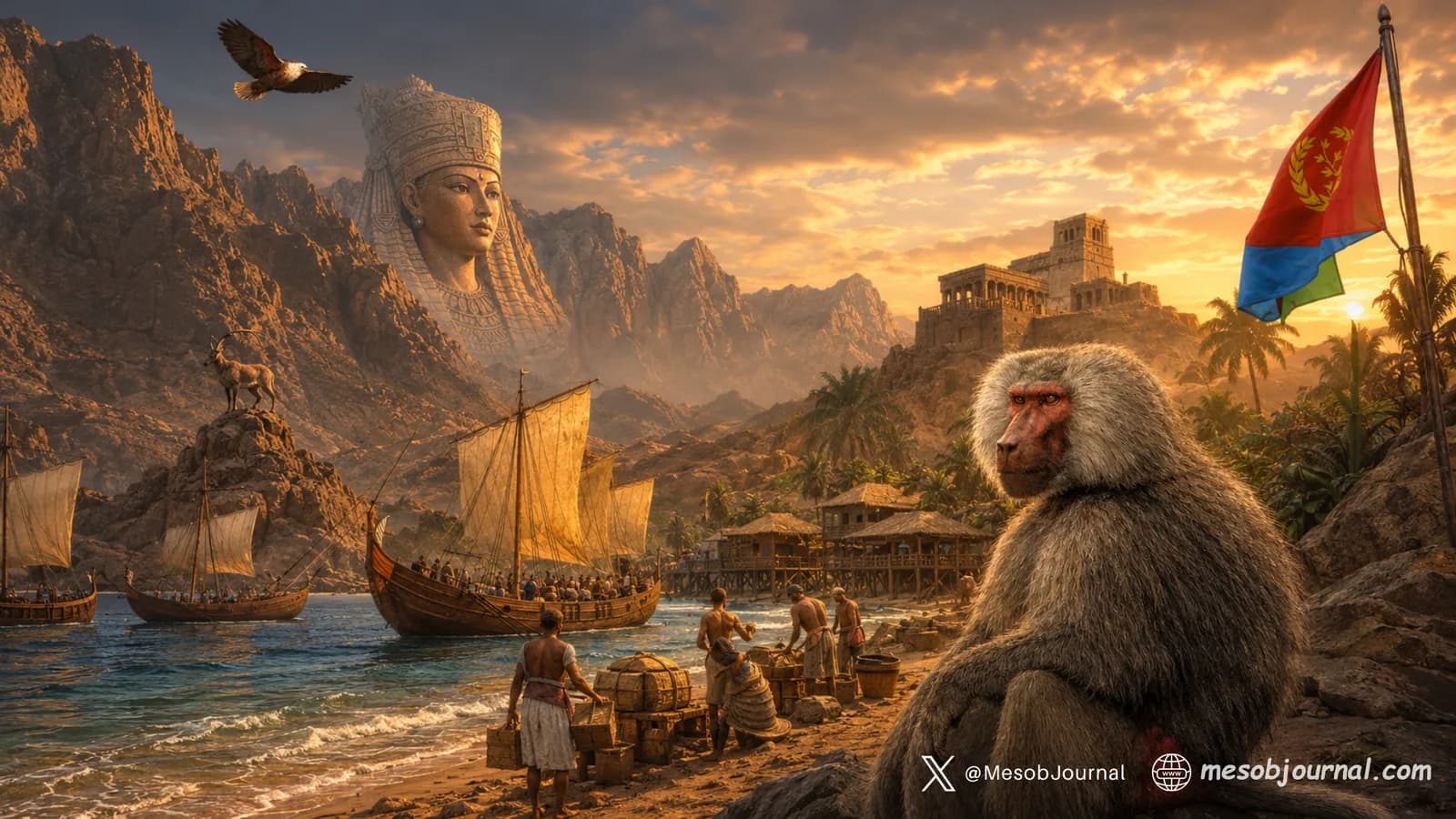
The cover image that accompanies this work is not decoration; it is declaration. The baboon, the ships, the Red Sea light, the Eritrean coastline, the ancient queen watching from the sky — all of it stands as a visual refusal to let others write our history for us.
It is a reminder that our story is not something to be debated in distant institutions; it is something carved into the bones of the animals Egypt worshipped, painted on the walls of their temples, and carried across the sea by sailors who knew exactly where they were going. The image is a mirror held up to a truth that has always been there: Eritrea was Punt, and Punt was Eritrea.
For generations, scholars argued about the location of Punt as if it were a riddle. They debated coastlines, inscriptions, and trade routes, often ignoring the simplest evidence: the landscape, the flora, the fauna, the winds, the harbors, the lived memory of the region itself.
But the truth has a way of resurfacing, even when buried under centuries of speculation and colonization. And in this case, the truth resurfaced in the most unexpected place: the mummified remains of baboons.
The sacred hamadryas baboon was central to Egyptian religion. It embodied Thoth, the god of wisdom and the moon. It appeared in statues, amulets, reliefs, and funerary art for more than 3,000 years.
Yet the Holocene fossil record of Egypt contains no baboons. None. As the scientific paper notes plainly, the Holocene fossil record of Egypt is devoid of any monkey species, let alone P. hamadryas. The Egyptians did not worship a local animal. They worshipped an imported one they valued enough to transport alive across the sea, keep in captivity, and mummify with care.
This alone should have ended the debate. But the world often demands more proof from Africa than it does from anywhere else. And so the question lingered: Where did these baboons come from?
The answer arrived through science, not speculation, not artistic interpretation, not guesswork, but isotope analysis. Researchers collected oxygen and strontium isotope ratios from 155 modern baboons across seventy-seven locations. They compared these signatures to those found in mummified baboons from Egyptian temples.
The results were not ambiguous. They were not vague. They were not open to creative reinterpretation. They were precise.
Two New Kingdom hamadryas baboons were born in a region that includes Eritrea, Djibouti, and parts of Somalia and Yemen. But the strongest match, the one that aligns with the landscape, the trade goods, the maritime routes, the Egyptian reliefs, and the cultural memory is the Eritrean Red Sea coast.
The enamel of one baboon, formed in early childhood, carried a strontium ratio that lies outside the Nile Valley but squarely within the geological signature of Eritrea’s coastal highlands. The hair of another baboon retained the oxygen signature of the Red Sea, meaning it died soon after arrival in Egypt.
As the study states, the area encompasses much of present-day Eritrea, Djibouti, and portions of Somalia and Yemen. But only one of these regions matches the full cultural, ecological, and maritime profile of Punt.
Eritrea.
This is not a claim. It is not a theory. It is not a nationalist fantasy. It is a scientific conclusion supported by measurable data, reinforced by artistic evidence, and aligned with the lived geography of the Red Sea. The baboons remember what the world tried to forget.
The Egyptians depicted Punt with huts on stilts, incense trees, and a coastline that looks unmistakably like the Eritrean shore. They showed ships large enough to carry live animals, guided by sailors who understood the monsoon winds. They portrayed Puntites with features and attire consistent with the people of the Horn. They recorded the journey as a maritime expedition, not an overland trek.
Every detail points to the same place. And now the bones of the baboons confirm it.
This matters not just academically, not just historically, but emotionally, culturally, and politically. For too long, Eritrea’s ancient identity has been overshadowed by narratives written elsewhere.
Too often, the region is discussed only in the context of conflict, migration, or geopolitics, as if its history began in the twentieth century. But the truth is older, deeper, and more powerful. Eritrea was a center of maritime civilization long before many of the world’s great powers existed. Punt was not a myth. It was a kingdom. A trading partner. A spiritual destination. A place Egypt honored with reverence.
And later, Adulis carried that legacy forward. The classical writers described Adulis as a bustling port exporting ivory, incense, tortoise shell, and live animals, the same commodities that defined Punt.
The continuity is unmistakable. The same coastline. The same winds. The same maritime culture. The same role as a gateway between Africa, Arabia, and the wider world. The baboons’ isotopes bridge these eras, proving that the ecological and commercial zone of Punt persisted into the age of Adulis. Eritrea was not a passive participant in history. It was the driver of it.
This is why the diaspora must reclaim this story with fierceness. Because history is not just about the past; it is about dignity. It is about identity. It is about refusing to let others define who we are.
When the world speaks of the Horn of Africa, it often speaks with condescension, as if the region’s contributions to civilization were marginal or accidental. But the baboons tell a different story. Their bones carry the signature of a land that shaped the spiritual and economic life of ancient Egypt.
Their journey across the Red Sea is a testament to Eritrea’s centrality in the earliest global trade networks. Their presence in Egyptian temples is proof of a relationship built on respect, exchange, and recognition.
The diaspora knows what it means to have your story distorted. To have your identity questioned. To have your history minimized. But the truth is not fragile. It does not disappear because others ignore it. It waits. And when it resurfaces in art, in memory, in science, it demands to be acknowledged.
The Red Sea breathes history. It carries the echoes of ships that sailed from the Eritrean coast to the temples of Thebes. It carries the scent of incense trees uprooted and replanted in Egyptian soil. It carries the memory of baboons who traveled across its waters, embodying a god in a foreign land. It carries the legacy of a people whose maritime knowledge shaped the ancient world.
And now, through science, through art, through diaspora pride, that legacy stands unshakable.
In the end, the story returns to the sea, the same sea that carried incense, sailors, and sacred animals across its surface long before the world learned to doubt Africa’s past. The Red Sea does not lie. It remembers. Its winds remember. Its currents remember.
And now, through science, the baboons remember too. Their bones speak with a clarity that no outsider’s theory can drown out. They testify to a truth older than the empire and stronger than erasure: that Eritrea stood at the center of an ancient world, shaping the spiritual and economic life of a civilization that still fascinates humanity today. This is not a rediscovery. It is a return. A reclamation. A restoration of a story that always belonged to us.
And as the diaspora carries this truth forward in our voices, our scholarship, our art, our pride, we do what our ancestors did when they launched their ships into the Red Sea: we move with purpose, with memory, and with the unshakable knowledge of who we are. Eritrea was Punt. Punt was Eritrea. And no amount of forgetting can silence a truth carried across millennia by wind, water, and bone.
Eritrea was Punt. Punt was Eritrea. And the baboons remember.