
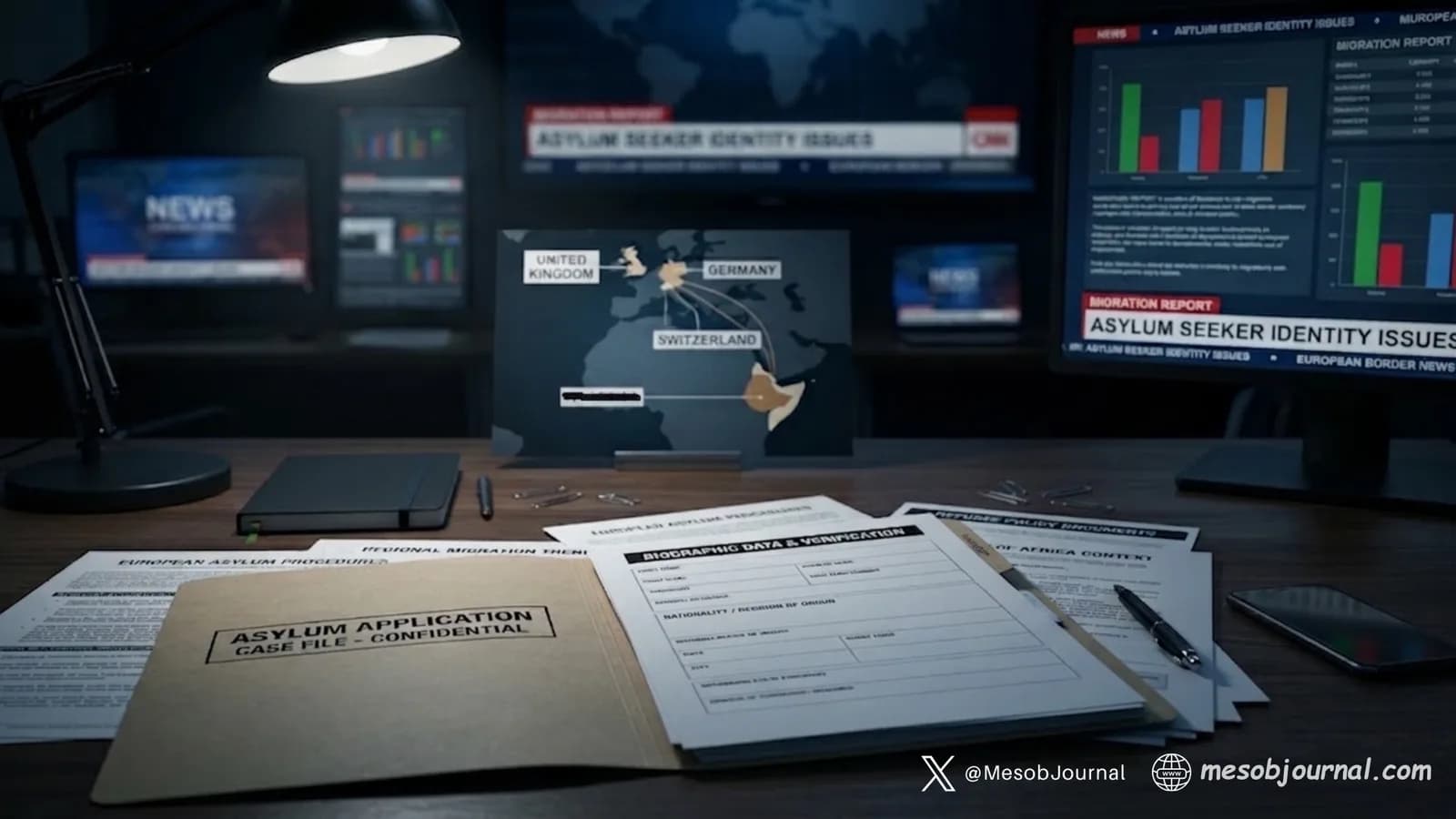
Group-oriented guidance and large recognition-rate gaps create an exploitable incentive; documented false claims and opaque correction data leave Eritrea carrying contested statistics and reputational damage.
On 19 August 2026, Eritrea's embassy in London said it found no citizen registration under the name Bruke Desalagne. In an official press statement, it said it asked Harrow Crown Court for proof of his Eritrean status and that neither the court nor the BBC, Daily Mail, Telegraph or GB News supplied evidence of Eritrean origin.
Yet Britain had already attached Eritrea to the crime. A Harrow Crown Court jury convicted Desalagne of raping an elderly man outside St John's Church. GB News reported that he entered the country clandestinely, claimed asylum and received indefinite leave to remain in 2022. Its headline called him Eritrean.
The initial Metropolitan Police statement reproduced by Harrow Online identified his name, age, lack of fixed address and charge. It did not identify a nationality. Somewhere between the criminal record and the immigration story, a disputed nationality label hardened into a national fact.
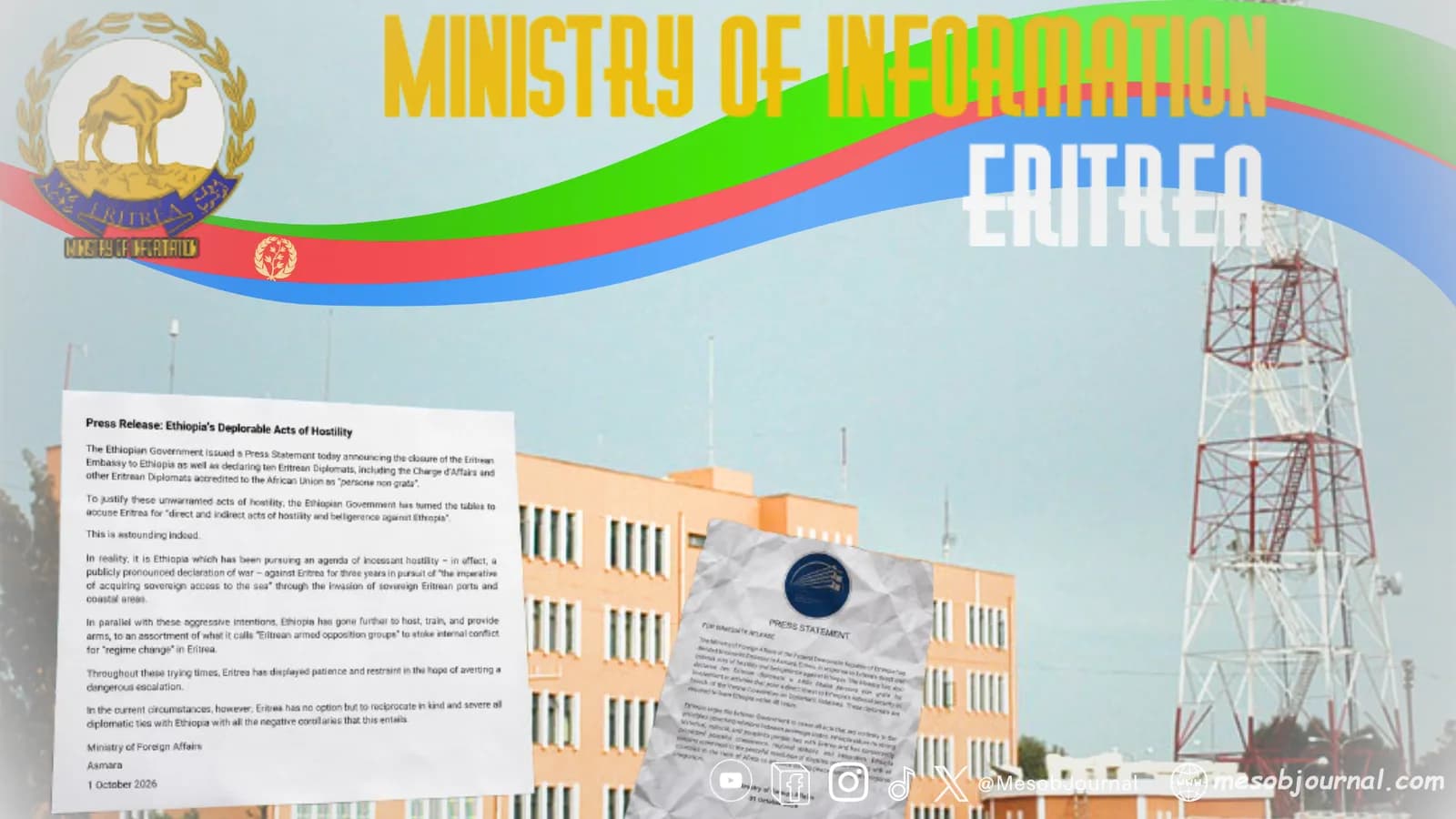
Eritrea's Information Minister, Yemane G. Meskel, then named the two institutions that made this possible. In a statement on 19 August, he pointed first to UNHCR's eligibility guidelines, which he said enabled outsiders to obtain asylum by masquerading as persecuted Eritreans. He then accused legacy media of repeating the resulting label without validation, turning an individual's crime into another occasion to stigmatize Eritrea and the Global South.
The case exposes a chain European authorities have still not explained. An unverified nationality entered the public record and became part of a crime headline, yet no institution using the label has made its primary evidence public.
The group shortcut is written into the guidance
The incentive is rooted in international protection guidance formalized group-based treatment for Eritrean claims under defined conditions.
UNHCR's 2011 Eligibility Guidelines for Eritrean asylum-seekers said that where large numbers of Eritrean applicants presented a similar pattern of claims and individual refugee-status decisions would exceed local capacity, “group-based protection approaches” could be appropriate. The document required an analysis showing manifest protection needs. Thus, it created an express route away from individual adjudication and toward protection through a presumed national group. That distinction becomes decisive whenever the nationality opening the gate is false.
UNHCR replaced the 2011 text in April 2026. The new Guidance Note says claims should pass through fair procedures, yet paragraph 9 retains a prima-facie approach when Eritrean arrivals are numerous, claims follow a similar pattern and individual processing exceeds local capabilities.
Prima facie means that group membership can carry the protection claim. If officials fail to establish that membership, a false Eritrean identity gains access to a presumption designed for actual Eritreans.
The incentive is visible in the grant rates. The UK Home Office approved 87 percent of Eritrean claims decided initially in 2024. Across the EU+ system, EUAA recorded an 82 percent Eritrean recognition rate, nearly twice the overall rate. German data for May 2025 show that approximately 70 percent of cases recorded as Eritrean received protection or a removal ban. The comparable share for cases recorded as Ethiopian was about 14 percent.
The German figure is a one-month snapshot and includes removal bans, so it is not directly equivalent to the annual EUAA recognition rate. It nevertheless reveals a visible incentive for anyone contemplating nationality fraud: the identity recorded on the file can radically alter the apparent prospect of protection.
The feedback loop Europe has not publicly audited
Call the mechanism what it is: asylum identity arbitrage.
A claimant using a false nationality borrows the identity associated with the stronger protection outcome. If the deception survives the nationality interview, the approval enters national and European statistics as another Eritrean protection decision. Undetected false claims can therefore contaminate the figures later used to describe Eritrean displacement and protection needs.
The available record does not establish how many claims contaminate those figures or whether aggregate totals influenced UNHCR's guidance. That is the feedback risk an independent audit must test. Fraud may do more than exploit the category; it may enlarge the apparent evidence used to defend it.
The method is documented even if its scale is not. The Daily Mail reported that it had identified an Ethiopian man in London who appeared in videos saying he obtained asylum as an Eritrean and coached others to do the same. The newspaper also reported six other Ethiopians admitting successful Eritrean claims, a Telegram group of roughly 3,500 members sharing Eritrea training material, and a man who said twelve others had used his claim as a blueprint.
The Home Office announced an investigation. Almost two years later, Mesob Journal could find no published outcome: no number of corrected nationalities, no revocations connected to the network, no prosecutions and no explanation of how a public coaching industry passed through the system.
Switzerland has already admitted the underlying problem. Its government confirmed that nationals of neighbouring states able to speak Eritrean languages had presented themselves as Eritrean. It described better interviewer training and language-and-origin analysis, then supplied no annual fraud totals in response to Parliament's request.
The authorities repeatedly offer assurance where the public needs arithmetic.
The warnings were not missing
At a 2013 United Nations meeting, Eritrea's Foreign Minister warned that organized trafficking was draining the country's human resources and was entangled with an external political effort to destabilize Eritrea. The Government says President Isaias Afwerki had asked the UN Secretary-General that year for an independent investigation.
In 2017, the House of Commons Foreign Affairs Committee heard Professor Gaim Kibreab say that the proportion was unknown but that a substantial share of disputed Eritrean claimants came from Ethiopia, especially Tigray.
UNHCR's own 2021 operational plan acknowledged that its relationship with Eritrea had been strained since 2019 and that cooperation had become conditional on repeal of the eligibility guidelines. The Eritrean Foreign Ministry now says the country was not informed of the 2009 and 2011 guidelines until 2014, that a planned high-level meeting in 2015 was obstructed, and that UNHCR resisted rescission because it would set what the agency reportedly called a dangerous precedent. UNHCR should release the correspondence.
Instead, it issued new guidance in 2026 and retained the prima-facie mechanism.
At some point, persistence after warning stops looking like oversight. Retaining the mechanism without publishing a transparent nationality audit becomes an institutional choice.
UNHCR says openly that it relies almost entirely on voluntary contributions. Its 2010 contribution table, immediately preceding the 2011 guidance, shows that governments applying asylum policy were also among its important funders. That funding structure leaves an unavoidable question: did the governments financing UNHCR also shape, encourage or protect guidance that aligned with their asylum practices and political posture toward Eritrea?
Who proposed group-based treatment? Which governments were consulted? What fraud-risk assessment was conducted? Were donor officials shown drafts? Institutional neutrality is demonstrated through transparent method and evidence, not assumed from an organization's name.
Media hardens the disputed label into fact
The Desalagne case shows how an unverified asylum identity can escape the case file and become public fact. The media may say “Eritrean” because an immigration file says Eritrean; the file may say Eritrean because the claimant said Eritrean; and policy made that recorded identity exceptionally valuable. No public source has established that this is what happened in Desalagne's case. The embassy says the court and named publishers did not supply their basis when asked, leaving the essential question unanswered. Citation without an original source is not verification.
The crime belongs to the criminal. The burden of substantiating the nationality belongs to every authority or publisher that used the label without disclosing its basis. The reputational damage belongs to those who presented a disputed administrative claim as national fact.
This is not a case for hostility toward Ethiopians, Tigrayans or any other people. Ethiopia's wars and political repression produce genuine protection claims. Mixed families, expulsions, contested citizenship and shared languages make nationality determination difficult. Those realities demand careful investigation, not collective suspicion. They also make a country-based shortcut especially vulnerable to organized fraud.
Strategic depopulation is the charge on the record
Eritrea's charge is now clear and consistent. The Government says the exceptional asylum architecture was not a neutral humanitarian mistake but part of “strategic depopulation”: a policy environment that encouraged the departure of young Eritreans, weakened national service during a period of external military pressure, distorted migration statistics and helped sustain a regime-change narrative.
The Foreign Ministry's April response situates the guidelines alongside sanctions, economic restrictions and diplomatic marginalization. Information Minister Yemane G. Meskel has now applied the same diagnosis directly to the Desalagne scandal.
No public record proves a coordinated directive across UNHCR and European governments. What the record does establish is that Eritrea repeatedly made the charge, that nationality fraud was documented, that claims recorded as Eritrean were associated with substantially higher protection outcomes and that UNHCR retained a group-oriented mechanism after years of objection. Whether intended or not, persistence after warning creates institutional responsibility to investigate and correct the consequences.
UNHCR must disclose the drafting, consultation and fraud-risk records behind its Eritrea guidance. European authorities must audit the Eritrean category and publish corrected-nationality and fraud-review outcomes. Media organizations must distinguish self-declared, administratively recorded and independently verified nationality, correct false labels and clearly qualify identities that remain credibly disputed.
Until that happens, aggregate Eritrean totals cannot be treated as independent proof of the system's accuracy. Authorities must disclose how nationality disputes and later corrections are handled before those figures can be treated as a clean measure of Eritrean displacement.
Europe cannot use Eritrea's name as an asylum shortcut, a political exhibit and a criminal label, then call the result humanitarianism.