
Hours after shutting its embassy in Asmara and expelling 10 Eritrean diplomats, Addis Ababa moved against Cairo — following weeks of increasingly confrontational state messaging toward Egypt.
ADDIS ABABA/CAIRO — Ethiopia expelled an Egyptian diplomat on Thursday only hours after closing its embassy in Asmara and ordering 10 Eritrean diplomats out of the country, widening Addis Ababa’s diplomatic confrontations at a moment when renewed fighting inside Ethiopia is already raising fears of another major regional crisis.
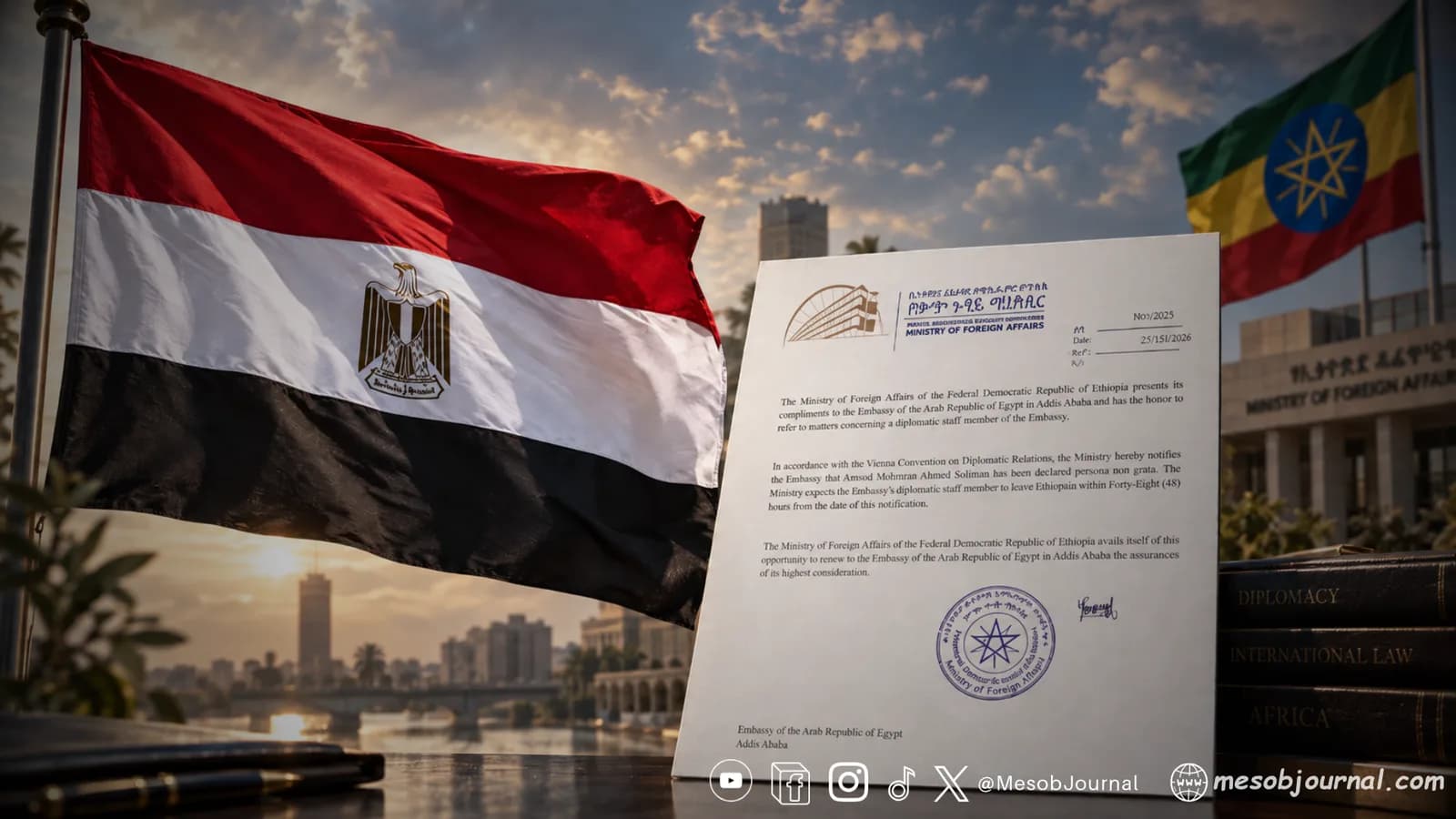
The Ethiopian Foreign Ministry declared Ahmed Moharam Ahmed Soliman, a member of Egypt’s embassy in Addis Ababa, persona non grata and gave him 48 hours to leave. The diplomatic note dated October 1 cited the Vienna Convention but gave no reason for the expulsion.
Egypt answered within hours.
An official Egyptian source described the Ethiopian decision as “regrettable and unjustified”, rejected any suggestion that Cairo interferes in Ethiopia’s internal affairs and announced a reciprocal measure: a counsellor at the Ethiopian embassy in Cairo was declared persona non grata and given the same 48-hour deadline.
Cairo’s response went considerably further than diplomatic reciprocity.
The Egyptian source accused the Ethiopian side of repeatedly attributing its domestic failures and successive internal crises to alleged foreign interference. In effect, Cairo challenged a political narrative that has become increasingly prominent in Ethiopian official and state-media messaging as pressure on Prime Minister Abiy Ahmed’s government has mounted at home.
The expulsion was not an isolated turn in relations with Egypt. During September, Ethiopian state platforms repeatedly gave prominence to accusations that Cairo was seeking to weaken the country, exploit its internal divisions and constrain Ethiopia across the Nile and Red Sea arenas.
On September 1, former water minister Shiferaw Jarso accused Egypt of exploiting Ethiopia’s internal divisions, supporting forces that weaken the country and seeking to deny Ethiopia access to the Red Sea. Two days later, Education Minister Berhanu Nega said Egypt was attempting to weaken Ethiopia. An Ethiopian state-media commentary then portrayed Cairo as a strategic “spoiler” in the Horn of Africa and Red Sea.
The rhetoric hardened further.
On September 19, Getachew Reda, a minister and adviser to Abiy on East African affairs, accused Egypt of dangerous regional interference. A September 26 article carried by Ethiopia’s state news agency portrayed the relationship between Cairo and Asmara as an alignment fostering rebellion and insurgency against Ethiopia.
By October 1, the confrontation had moved from words to diplomatic action.
And Egypt was not the only neighbour in Addis Ababa’s sights that day.
Hours earlier, Ethiopia announced that it was closing its embassy in Asmara and expelling 10 Eritrean diplomats, including officials accredited to the African Union, giving them 48 hours to leave. Addis Ababa accused Eritrea of direct and indirect hostility and said the diplomats posed a threat to Ethiopian national security. The published statement did not set out supporting evidence for those accusations.
Eritrea responded by severing diplomatic relations.
Asmara rejected Ethiopia’s allegations and accused the Abiy government of pursuing years of hostility over what Ethiopian officials have increasingly described as the need for sovereign access to the Red Sea. Eritrea also accused Ethiopia of supporting armed Eritrean opposition groups seeking regime change.
Ethiopia’s confrontation with Egypt is rooted principally in the Nile, the Grand Ethiopian Renaissance Dam and an increasingly competitive struggle over influence in the Horn and Red Sea. The deterioration with Eritrea has followed a different path, particularly since Ethiopian political discourse began placing greater emphasis on direct or “sovereign” access to the sea.
What connects October 1 is the policy choice in Addis Ababa.
Within hours, Ethiopia transformed two long-running disputes with two major regional states into formal diplomatic expulsions.
That happened while Ethiopia itself was entering another dangerous period internally.
On September 23, the UN Secretary-General said he was “gravely concerned” by the rapidly deteriorating situation in northern Ethiopia, citing intensified fighting in and around Tigray and the spread of hostilities into neighbouring areas. The African Union separately warned of renewed military escalation in northern Ethiopia and called for an immediate return to talks under the Pretoria peace framework.
The contrast is difficult to ignore.
At home, Ethiopia is again confronting armed conflict serious enough to draw urgent warnings from the UN and African Union. Beyond its borders, its government has increasingly framed neighbouring and regional states as actors working against Ethiopia — while simultaneously escalating diplomatic disputes with Eritrea and Egypt.
Cairo’s response directly challenged that approach.
Rather than enter a lengthy argument over Ethiopian accusations, Egypt rejected interference, reciprocated the expulsion and pointed the argument back toward Ethiopia’s domestic crisis.
That response also followed a markedly different public message from Cairo a day earlier. On September 30, Egyptian Foreign Minister Badr Abdelatty instructed senior officials to intensify diplomatic efforts aimed at containing regional crises, preventing escalation and supporting the sovereignty and territorial integrity of states.
The African Union’s intervention flattened the sequence into a three-way dispute. Its October 1 statement called on Ethiopia, Eritrea and Egypt alike to exercise restraint, without acknowledging that Addis Ababa had first closed its embassy in Asmara, expelled 10 Eritrean diplomats and then expelled an Egyptian diplomat, prompting responses from both capitals.
Nor did the AU address the longer escalation surrounding Ethiopia’s Red Sea agenda, which Abiy Ahmed has repeatedly described as an “existential” issue and which has increasingly focused on access through Eritrea.
By reducing the crisis to generic “tensions” among three member states, the AU avoided confronting the sequence of actions that produced the diplomatic rupture — effectively placing the governments responding to Addis Ababa’s moves on the same footing as the government that initiated them.
During a single day, the government in Addis Ababa shut down a diplomatic mission in one neighbouring country, expelled 10 of that country’s diplomats, expelled a diplomat from another major regional power and triggered retaliatory measures from both capitals.
The sequence comes after weeks in which Ethiopian officials and state platforms increasingly presented the country’s external environment through the language of plots, containment, proxies and foreign interference.
Egypt’s response put a different explanation on the table: Ethiopia’s crises are fundamentally domestic, and blaming foreign actors does not resolve them.
Addis Ababa now faces growing instability inside Ethiopia, broken diplomatic relations with Eritrea and a newly escalated confrontation with Egypt. The disputes are distinct. Their simultaneous escalation is not.
On October 1, the consequences of Ethiopia’s increasingly confrontational regional posture became visible well beyond its borders.