

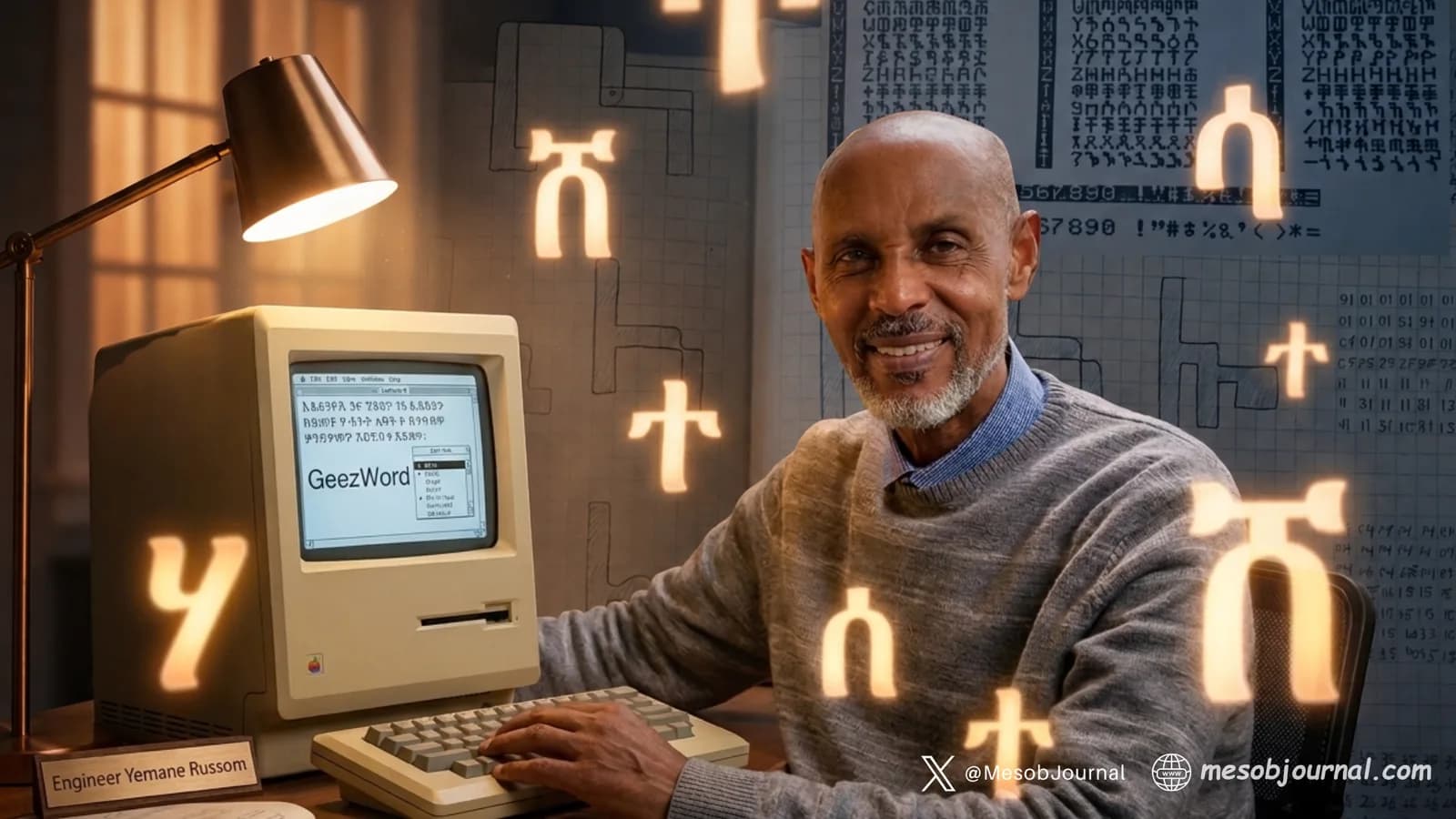
The undisputed first developer to bring the Ge’ez script to the digital screen.
The digital revolution of the late twentieth century was largely written in English, coded in the West, and built on the Latin alphabet. For centuries-old non-Latin scripts, the dawn of the personal computer presented a quiet but existential threat: adapt to the digital medium or risk being left behind in the analog past.
Standing at the absolute forefront of the heroes who bridged this gap was Yemane Russom. An Eritrean software engineer of extraordinary vision, Russom broke the technological barriers that had kept the Ge’ez script, one of the world’s oldest active writing systems, out of the digital age. Through his pioneering software, GeezWord, he ensured that millions of Eritreans and Ethiopians could read, write, navigate, and create in their own classical script on modern computers.
Roots in the Soil of Eritrea: Formative Years and Education
Yemane Russom’s journey did not begin in a high-tech Silicon Valley lab, but in the historic landscapes of Eritrea, where his deep connection to his linguistic and cultural heritage was forged.
He was born and grew up in Adi Gered, located in the southern region of Eritrea. His early educational path traced a journey through the heart of the region's academic centers:
- Elementary Education: He attended elementary school in Adi Geda, laying the groundwork for his analytical mind.
- Junior High School: He commuted to Dubarwa, a historic town that once served as the capital of the ancient Bahri Negasi (Kingdom of the Sea), immersing him further in the historical gravity of his homeland.
- High School: He completed his secondary education in San Giorgio High School in the bustling southern capital of Mendefera.
Recognized early for his sharp intellect and academic promise, Yemane earned a prestigious one-year scholarship to study in the United States. This initial exposure to the rapid pacing of Western academic and technological frameworks sparked a lifelong curiosity.
Following his scholarship, he returned to East Africa to pursue his higher education at Addis Ababa University in Ethiopia, a premier institution of the region. Armed with a robust foundation in mathematics and early engineering concepts, Yemane returned to the United States in the late 1970s to extend his education and plunge headfirst into advanced research on computer systems just as the microcomputer revolution was beginning to take shape.
The Master of the Written Word: The Legacy of Aboy Woldeab Weldemariam
To understand why Yemane Russom's breakthrough carried such profound historical weight, one must understand the man who inspired it. No great pioneer builds in a vacuum, and Yemane’s trajectory was permanently shaped by his crossing paths with Aboy Woldeab Weldemariam, widely revered as the “Father of the Eritrean Nationalist Movement.”
Long before the advent of the microchip, Aboy Woldeab was waging a battle for cultural preservation using an older technology: the printing press. Born in 1905, Woldeab was a brilliant linguist, a master educator, and a relentless journalist. In the 1940s, as the editor of the historic Hanti Eritrea newspaper, he did something revolutionary: he championed the use of everyday Tigrinya as a legitimate, sophisticated medium for political discourse, literature, and news.
At a time when external powers sought to suppress Eritrean identity and language, Aboy Woldeab single-handedly standardized modern Tigrinya prose, authored textbooks to combat illiteracy, and proved that a people's native language is their strongest shield against assimilation. He survived seven assassination attempts because of his fierce advocacy, eventually enduring decades of painful exile. Yet, whether he was broadcasting revolutionary radio programs from Cairo or writing manifestos from Europe, his weapon of choice was always the written Ge’ez script.
The Spark of Encouragement: A Historic Mentorship
By the late 1970s and early 1980s, Aboy Woldeab was an elder statesman living in exile in the United States. It was during this period that the aging lion of Eritrean literacy met a brilliant young engineer deep into advanced computer research: Yemane Russom.
Where others saw a massive generational and technological divide, Woldeab saw a continuum of the exact same struggle. The elder statesman immediately recognized the profound geopolitical and cultural implications of Yemane’s research. He understood that the printing presses he had fought for in the 1940s were being replaced by microprocessors and that if the Ge’ez script did not claim its place on the screen, the linguistic heritage he had spent his life defending would be marginalized.
A Charge of Historical Duty
Aboy Woldeab became a vital mentor and an emotional anchor for Yemane. He provided steady, passionate encouragement, urging the young engineer to look past standard corporate software tracks and focus his mind on a pressing civilizational crisis: the digital preservation of the Ge’ez script.
Aboy Woldeab did not just offer technical feedback; he infused Yemane’s late-night coding sessions with a sense of sacred duty. He reminded Yemane that mastering the tools of the future was the ultimate expression of Bideho (resilience). Aboy Woldeab’s blessing transformed Yemane’s engineering project into an act of national resistance and cultural survival.
1981: A Technical Breakthrough Ahead of Its Time
Armed with his mentor’s vision, Yemane set to work in 1981. At the time, personal computers operated primarily on text-based command lines with rigid, English-only character sets. To attempt to map the Ge’ez script onto these machines was viewed by many as a technical impossibility.
The Ge’ez writing system is an abugida, a morpho-syllabic script where each character represents a consonant-vowel combination. Unlike the 26 letters of the English alphabet, the Ge’ez matrix requires hundreds of distinct characters to accommodate languages like Geez, Tigre, Tigrinya, and Amharic.
Working on early Macintosh systems, which were cutting-edge for their graphical user interface capabilities, Yemane single-handedly solved three unprecedented engineering challenges:
- Phonetic Input Mapping: Because standard hardware keyboards were strictly Latin-based, Yemane engineered an intuitive, phonetic entry system. He designed a system where combined keystrokes based on Latin sounds seamlessly generated the correct Ge’ez character on screen (e.g., typing “b” followed by “a” to generate “በ”). This made digital typing instantly accessible to native speakers without requiring specialized hardware.
- Custom Font Engineering: Decades before the advent of universal Unicode standards, computers had no internal blueprint for what a Ge’ez character looked like. Yemane had to meticulously design and digitize early Ge’ez fonts pixel by pixel, balancing the intricate, calligraphic geometry of ancient parchment scripts with the restrictive resolutions of early computer monitors.
- Operating System Integration: He successfully developed GeezWord, writing specialized software that allowed early Macintosh operating systems and later other operating systems to process, render, and print these complex characters smoothly without crashing the system's core architecture.
The Digital Frontline: Technological Autonomy in the Struggle for Independence
Yemane Russom’s engineering feats were not confined to academia or commercial software markets; they became a vital asset to the Eritrean national liberation struggle. During the protracted war to reclaim independence, the EPLF understood that true sovereignty required building independent infrastructure not just in terms of healthcare and logistics in the field, but also in information management and media.
Prior to the integration of computing systems, revolutionary field journals, strategic communiqués, educational textbooks, and operational documents had to be laboriously handwritten, typed on mechanical Latin typewriters, or produced using cumbersome stencil duplicators.
Recognizing this critical bottleneck, Yemane Russom introduced the Macintosh system and his pioneering GeezWord framework directly to the EPLF network theoretically. By providing the liberation front with early Apple Macintosh computers equipped with the capacity to natively render the Ge’ez script, Russom fundamentally started modernized the EPLF's communication architecture.
A Modernized Information Architecture
- Field Publishing & Propaganda: For the first time, field journals, strategic reports, and educational pamphlets in Tigrinya could be digitally composed, formatted, and quickly updated directly within Eritrea's administrative and information departments after independence.
- Operational Efficiency: It allowed for organized, secure, and clear digital record keeping, dramatically optimizing logistics, internal communication, and historical documentation after independence.
- Linguistic Autonomy: By proving that a classical African script could run natively on cutting-edge Western hardware, Russom provided a massive psychological and cultural boost to a movement fighting for self-determination.
Mobilizing the Diaspora: The Washington, D.C., Blueprint and Beyond
The struggle for independence was fought on two fronts: the rugged valleys of Eritrea and the political corridors of the international community. The diaspora served as the financial, political, and informational lifeline of the revolution.
In the early 1980s, Yemane Russom personally brought the Macintosh system and his GeezWord software to the growing Eritrean communities in the United States, with a massive focus on the pivotal diaspora hub of Washington, D.C.
Before this digital introduction, diaspora community organizations, cultural schools, and local support committees relied entirely on Latin script transliterations or hand-copied flyers to communicate with their members. Russom’s introduction of the Ge’ez-equipped Macintosh transformed diaspora organizing in several major ways:
- Mass Community Mobilization: Diaspora networks in Washington, D.C., and other major U.S. cities could now produce professional, high-quality community newsletters, flyers, and political petitions natively in Tigrinya. This radically streamlined the dissemination of news from the frontlines and galvanized community fundraising and advocacy efforts.
- Preserving Identity in Exile: By putting Ge’ez computing into the hands of families in the West, Russom provided the exact tools needed to create educational materials for diaspora children. This ensured the younger generation maintained deep literacy and a strong cultural connection to their homeland while growing up thousands of miles away.
- Establishing Tech Literacy: His hands-on training sessions within community centers demystified personal computers for the diaspora. He transformed the computer from an intimidating, foreign machine into a highly accessible tool for community empowerment and national advocacy.
Impact on Eritrean and Ethiopian Digital Culture
The launch of GeezWord and its deployment on both the political and combat frontlines was a historic watershed moment for African computing. By building a cultural and technological bridge, Yemane Russom reshaped the digital landscape of the Horn of Africa in several profound ways:
- Democratization of Publishing: It empowered writers, journalists, scholars, and publishers to design and print newspapers, books, and educational materials in Tigre, Tigrinya, and Amharic without relying on expensive, slow, traditional printing presses.
- Preservation of Liturgical Heritage: The clergy and historical institutions could finally digitize, index, and safeguard ancient Ge’ez manuscripts and liturgical texts, ensuring that centuries of knowledge were backed up in the digital cloud.
- The Blueprint for the Future: Yemane’s architectural logic laid the essential foundational groundwork for subsequent Ge’ez software developments, local internet domains, mobile phone keyboards, and eventual Unicode standardization.
A Lasting Legacy of Innovation
Yemane Russom did not stop with his early successes. Throughout his life, he continued to expand his mission, developing educational applications, multi-language dictionaries, and digital tools aimed at expanding language learning and cultural pride among the diaspora youth.
Today, Yemane Russom is rightly celebrated as:
- The undisputed first developer to bring the Ge’ez script to the digital screen.
- A true pioneer of African language computing, standing alongside global tech innovators.
- A dedicated guardian of written heritage who answered the call of his ancestors and his mentors.
His achievement is far more than a brilliant technical accomplishment. Fueled by the soil of Adi Gered, sharpened by the universities of Addis Ababa and the US, and anchored by the profound wisdom of Aboy Woldeab Weldemariam, Yemane Russom’s life work stands as an act of pure cultural preservation, linguistic pride, and intellectual courage.
His legacy lives on quietly, beautifully, and dynamically every single time a finger presses a screen or a keyboard to type a message in Ge’ez across the world.
A Living Legacy of Self-Reliance
The technological revolution orchestrated by Engineer Yemane Russom is far more than a brilliant software milestone; it stands as a monument to cultural preservation, linguistic pride, and profound intellectual courage. Driven by a deep connection to his roots in Adi Gered and guided by the historic vision of his mentor, Aboy Woldeab Weldemariam, Russom did not merely write code—he secured the digital survival of a civilization.
By introducing the Ge’ez script to the Macintosh and other systems, Yemane Russom single-handedly ensured that an ancient African script would not be left behind in the rapid tides of the digital age. His work directly bridged the technical divides of the late twentieth century, arming the Eritrean liberation struggle with modern communication infrastructure and giving a dispersed diaspora community the vital tools needed to preserve their identity in exile.
Today, every piece of digital text rendered in the Horn of Africa, every message sent across the global diaspora in Ge’ez, and every local mobile application stands on the shoulders of his early breakthroughs. Engineer Yemane Russom’s legacy lives on dynamically and silently with every keystroke—a timeless testament to what can be achieved when cutting-edge innovation is harnessed to honor and defend historical heritage.
Much respect and honor to a true pioneer!