
The mask keeps slipping.
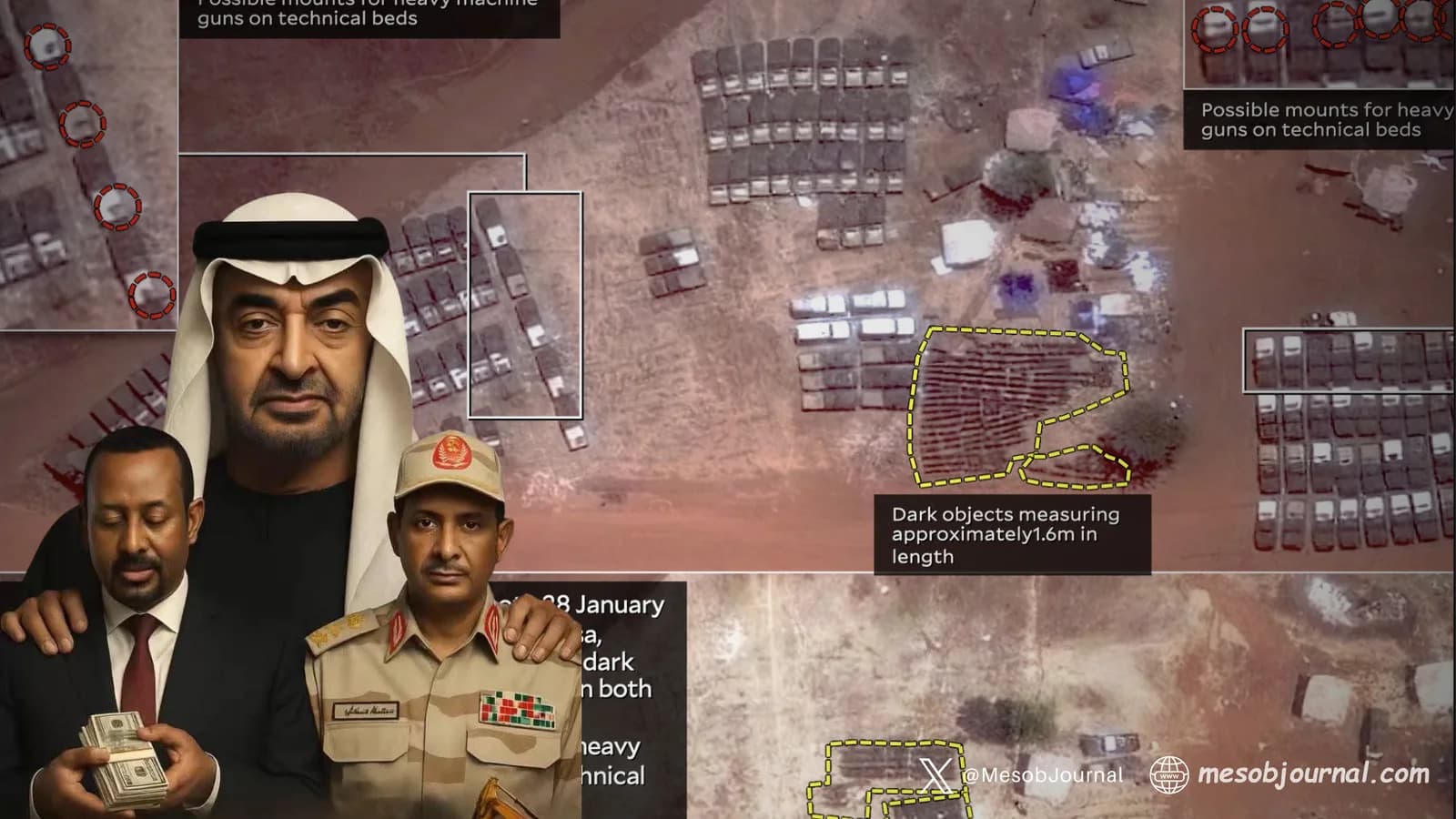
A new report by Yale’s Humanitarian Research Lab says it has reached a high-confidence conclusion that military assistance to Sudan’s Rapid Support Forces is taking place inside an Ethiopian National Defense Force base in Asosa, in Ethiopia’s Benishangul-Gumuz region. The report lays out a months-long pattern of satellite-observed activity that it says is consistent with RSF logistics, vehicle deliveries, retrofitting of technicals, container traffic, tents for personnel, and movement linked to the Blue Nile front.
That matters because the RSF is not some neutral militia caught in a local dispute. Yale’s report explicitly places Ethiopia’s alleged support in the context of an armed actor credibly accused of genocidal acts in Sudan and says the activity documented at Asosa points to violations of UN Security Council Resolution 1591, which prohibits arms shipments to belligerents fighting in Darfur. It goes even further: the report says this is the first definitive visual proof, over a five-month period, that RSF attacks on Sudan’s Blue Nile State are being staged from inside Ethiopian sovereign territory.
That is a devastating finding.
It means Abiy Ahmed’s government is no longer facing criticism merely for reckless regional behavior, inflammatory rhetoric, or backroom opportunism. It is now confronted with a serious, evidence-based allegation that Ethiopian state territory and an active ENDF installation were used to sustain one of the most destructive armed forces in the region. Yale’s wording is careful, as such reports usually are. But the implications are blunt. If the findings hold, this was not drift, confusion or porous border chaos. It was state-enabled collusion.
The most striking part of the report is not one image. It is the pattern.
Yale says it compared activity at Asosa with 14 other ENDF bases and found the Asosa case uniquely anomalous. At the site, analysts documented the repeated arrival of commercial car carriers, not standard military heavy equipment transports, offloading what the report describes as non-ENDF-consistent technical vehicles. On 29 December 2025, Yale says it observed 16 blue car carriers and around 120 light technical vehicles at the base. By 18 February 2026, that had reportedly risen to 28 car carriers, about 200 technicals, 12 cargo containers and seven tents. On 29 March, the report says the site still showed fluctuating numbers of technical vehicles, possible APCs and white car carriers in motion over the course of a single day.
This is not what normal static base activity looks like. Yale says so directly.
The report also says the vehicles seen at Asosa were not consistent with known ENDF livery and that some of the technicals appeared to arrive unarmed, only to later show signs of modification. Analysts say they observed rows of elongated dark objects measuring about 1.6 meters, consistent in length with heavy machine-gun barrels, parked near technical vehicles that later appeared fitted with gun mounts. In plain language, the report is saying the vehicles may have arrived as transportable shells and then been adapted on-site for combat use.
That point matters because it cuts through the usual escape routes. Governments accused of aiding proxy forces often hide behind ambiguity. They claim cargo was civilian. They say vehicles were commercial. They insist there is no proof of operational conversion. Yale’s report narrows that space. It describes a logistics chain, a staging site, signs of retrofitting, and then notes that vehicles consistent with those seen at Asosa appeared in open-source material from RSF operations around Kurmuk and other Blue Nile frontlines. Asosa, the report notes, sits roughly 100 kilometers from Kurmuk.
So where does the UAE enter the picture?
Yale raises that question directly, asking what role the UAE is playing in facilitating Ethiopia’s support to the RSF and what role supply lines through Berbera or other locations may have played. The report does not claim to have fully answered that question. But it does place the Asosa operation inside a wider corridor of suspicion involving materiel flows from the east, including routes linked to Berbera. It references earlier open-source videos that allegedly showed car carriers moving technicals toward Ethiopia in support of RSF operations.
And that is exactly why the UAE cannot be treated here as a detached bystander.
For months, Abu Dhabi has hovered over the Sudan catastrophe as the power everyone mentions and too few governments confront openly. Ethiopia, for its part, has increasingly behaved like a state willing to rent out geography, military infrastructure and strategic ambiguity when the price is right. Put those two patterns together and the picture is ugly: Emirati money and logistics, Ethiopian territory and military facilitation, RSF violence on the ground in Sudan. Yale’s report does not close every loop, but it hardens the central suspicion that this war has not merely spilled across borders. It has been fed across borders.
Abiy Ahmed’s defenders will say none of this is proven in a courtroom but Yale’s report is not gossip. It is a structured satellite and open-source assessment produced by a recognized research lab, and it is specific enough to demand an answer that goes far beyond the usual Ethiopian habit of silence, deflection or theatrical outrage.
There is another point here that should not be missed.
This is the same Ethiopian leadership that keeps presenting itself as a pillar of regional order while generating crisis after crisis around itself. Sudan burns. Somalia faces constant pressure and sovereignty challenges. Eritrea is repeatedly threatened through expansionist sea-access rhetoric. Now a report says Ethiopian territory was used to sustain RSF operations in Blue Nile. The pattern is not peacebuilding. It is destabilization dressed up as strategy.
And that brings us to the core political judgment.
Abiy Ahmed should be blamed.
Not abstractly. Not delicately. Directly.
If an active ENDF base was used to receive, stage, modify and move vehicles for the RSF, that is not a side story to Sudan’s war. That is participation in its extension. If Ethiopia enabled an armed force accused of mass atrocities to attack from Ethiopian soil, then Addis Ababa ceased to be an irresponsible neighbor and became part of the machinery of destruction. Yale’s report says Ethiopia must allow the international community to visit Asosa freely and use the findings as a starting point for urgent fact-finding. That should happen immediately.
The UAE should be named alongside Ethiopia, not after it.
Because even where the report leaves questions open, it makes one thing unmistakable: this network did not materialize by accident. Technical vehicles do not roll across corridors, containers do not appear at military sites, and proxy offensives do not sustain themselves on improvisation alone. Someone financed it. Someone facilitated it. Someone protected it politically. Sudan is bleeding while regional power brokers play logistics games behind the language of diplomacy.
The Horn of Africa is being destabilized not only by open war but by covert partnerships, deniable supply routes, rented loyalties and governments that believe proximity to power grants them immunity. This report should end at least one illusion: Abiy Ahmed is not a neutral observer of regional collapse. If Yale’s findings are true, he is helping drive it. And if UAE support is part of that same chain, then Abu Dhabi is not underwriting stability in the Horn. It is underwriting fire.
The burden now is not on critics to soften their language. It is on Ethiopia to explain Asosa, on the UAE to answer the questions hanging over the supply chain, and on the international system to decide whether another cross-border atrocity pipeline will be met with the usual hand-wringing or with consequences.
Because by now, nobody serious can claim not to see the pattern.