
There are votes that expose a government’s priorities more clearly than any speech ever could. Ethiopia’s “No” vote at the UN Human Rights Council on 31 March, against a resolution reaffirming the illegality of Israeli settlements in the Occupied Palestinian Territory and the occupied Syrian Golan, was one of them. It was not just diplomatically ugly. It was morally damning.
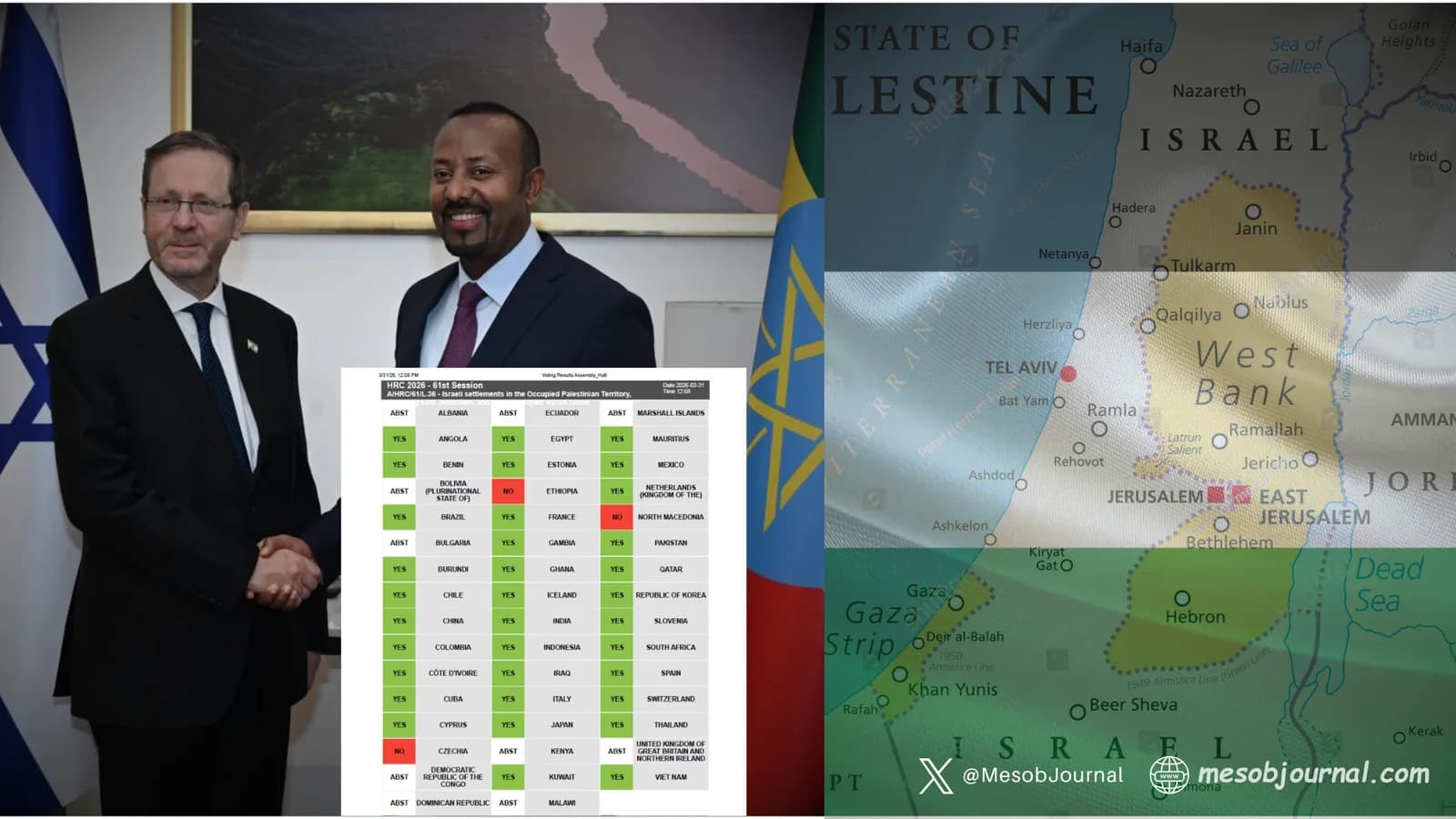
The resolution itself was not radical. It restated long-established principles of international law: the inadmissibility of acquiring territory by force, the illegality of settlements, the applicability of the Fourth Geneva Convention, and the legal conclusions set out by the International Court of Justice in its 2024 advisory opinion. It passed with 34 votes in favour, 10 abstentions and only 3 against. Ethiopia chose to stand in that tiny minority.
That matters. It matters because this was not a procedural motion or a technical amendment. This was a vote on colonial settlement, annexation, dispossession, and the basic legal principle that occupied land cannot be swallowed by force and then normalized through power politics. A government that claims African dignity and anti-colonial legitimacy had every historical, political and moral reason to be on the other side of that vote. Instead, Abiy Ahmed’s government placed Ethiopia against the overwhelming current of law, justice and African memory.
It also matters because Ethiopia was more isolated than its defenders may want to admit. Even European states that often hedge their language on Palestine were shown on the voting board among the “yes” votes, while Ethiopia appeared in the column of rejection. That image tells its own story: Addis Ababa was not “balancing.” It was siding against a resolution rooted in black-letter international law.
For many across Africa, that is the real scandal. Palestine has never been a distant issue on this continent. It has long been understood through the language of occupation, dispossession and resistance to imposed rule. African states do not need lectures on what land seizure and demographic engineering look like. That is precisely why Ethiopia’s vote lands as more than a diplomatic misstep. It looks like a rupture with a historic moral tradition.
And it did not happen in a vacuum. In recent months, Abiy Ahmed has openly moved to deepen relations with Israel. In February, Israeli President Isaac Herzog visited Ethiopia and met Abiy, with both sides publicly speaking about strengthening bilateral ties and expanding cooperation.
At the same time, Ethiopia’s regional conduct has raised growing alarm. Reuters reported in February that Ethiopia was secretly hosting a training camp for Sudan’s RSF, with the operation financed and logistically supported by the UAE, according to the investigation, while Sudan later accused Ethiopia of allowing drone attacks to be launched from its territory into Sudan. Those are not minor allegations. They point to a government ever more entangled in the destabilizing security geometry of the wider region.
So the Palestine vote cannot be dismissed as a one-off embarrassment. It fits a broader pattern: a government accused of acting less like a stabilizing African state and more like a transactional node in a wider axis of regional disruption. That is why the outrage is justified. Critics are not simply reacting to one button pressed in Geneva. They are reacting to what that button now appears to symbolize.
Abiy Ahmed’s defenders may argue that states vote on the basis of interest, not sentiment. Fine. But even by that standard, this was a humiliating choice. Ethiopia gained no evident principle from it, no legal coherence, and no African credibility. It merely advertised alignment with a position the international legal system has repeatedly rejected. Reuters has also reported how Ethiopia’s 2024 memorandum with Somaliland over sea access triggered a major regional crisis with Somalia, underlining how Addis Ababa’s foreign policy under Abiy has already been viewed across the region as increasingly confrontational.
There is also a deeper irony here. Abiy Ahmed has spent years wrapping himself in the language of sovereignty, dignity and national pride. Yet when confronted with one of the clearest contemporary cases of unlawful occupation and settlement, his government voted against the very principles it claims to defend. Sovereignty for whom? Territorial integrity for whom? International law for whom? A principle that applies only when convenient is not a principle. It is an instrument.
For oppressed peoples, for Palestinians, and for Africans who still take anti-colonial history seriously, this vote was a disgrace. For Ethiopia, it was a self-inflicted stain. And for Abiy Ahmed, it was a revealing moment: when asked to choose between justice and alignment, he chose alignment.
That choice will be remembered.