
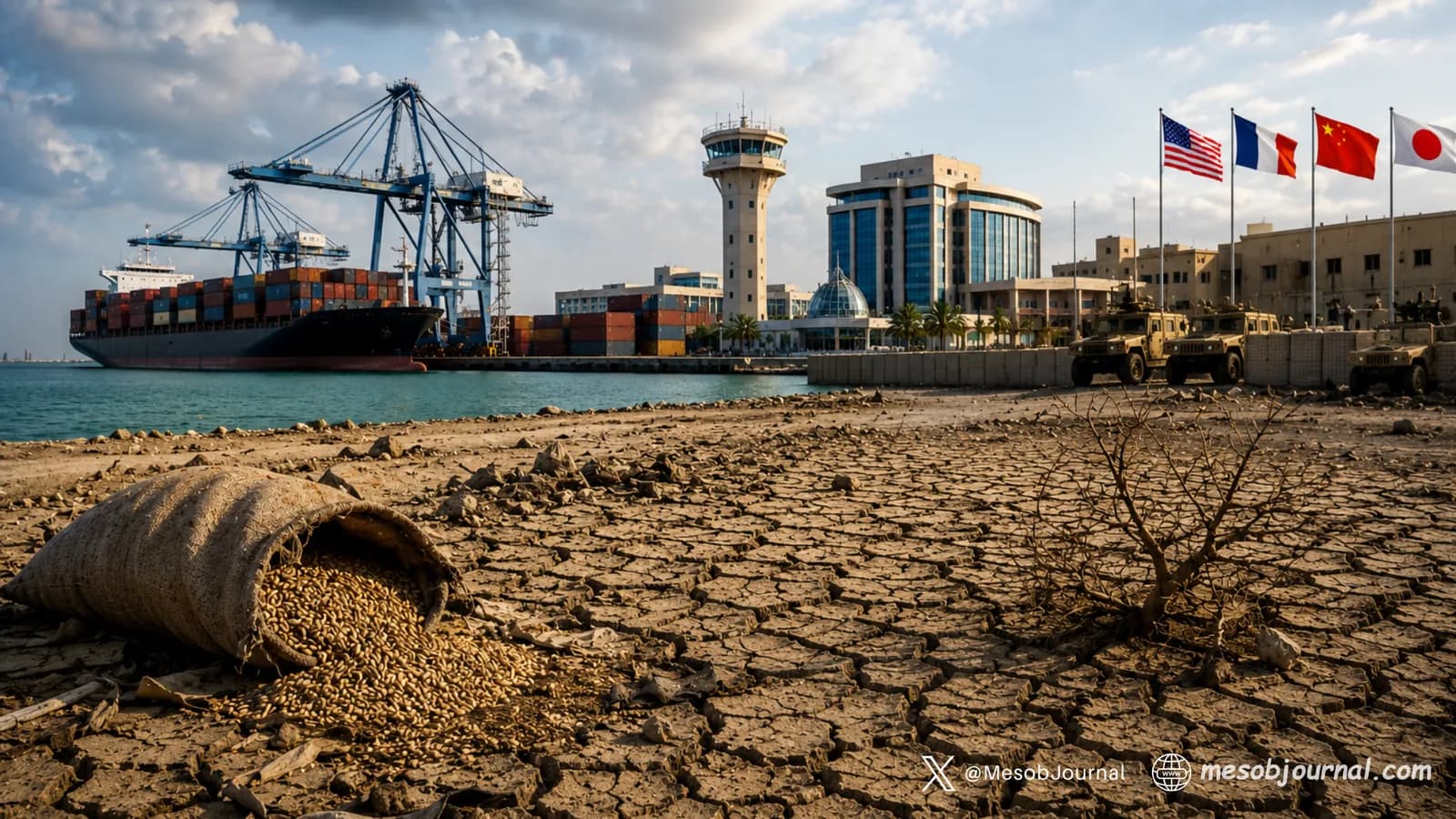
Djibouti is often described through the language of strategy: ports, military bases, Red Sea access, Ethiopia’s trade corridor, Yemen relief operations and great-power competition. The country is small, but its geography gives it weight far beyond its size.
Yet the latest World Food Programme brief tells a different story — one that is harder to dress up in diplomatic language. Behind the ports and foreign bases, Djibouti’s people are facing a severe food-security crisis. WFP says 230,000 people, roughly 22 percent of the population, faced Crisis or Emergency levels of food insecurity in late 2025. It also warns that refugee, resilience and emergency-response programmes could face a full pipeline break from July 2026 unless an USD 8 million funding gap is closed.
That is not a minor humanitarian footnote. It is an indictment of a political economy that has made Djibouti useful to almost everyone except many of its own citizens.
For decades, Djibouti’s ruling system has sold the country’s location as its main national asset. Foreign military bases, port services, transit corridors and logistics contracts have placed the country at the centre of Red Sea and Horn of Africa strategy. The IMF estimated Djibouti’s growth at 6.5 percent in 2025, driven partly by port activity, construction, transport and services. The country’s sovereign wealth fund is reported to manage assets of more than USD 1 billion, with part of its income linked to foreign military base leases.
But what does this model mean if a country of about 1.1 million people still cannot protect a fifth of its population from acute food insecurity?
WFP’s brief says Djibouti imports nearly 90 percent of its food, leaving the country exposed to market volatility, climate shocks and disruptions in supply chains. The crisis in the Middle East has already delayed wheat flour and vegetable oil deliveries, preventing food assistance to people in southern Djibouti.
This is where the humanitarian story becomes political.
Djibouti’s problem is not simply drought. It is not simply donor fatigue. And it is not simply the price of wheat. Those pressures are real, but they expose a deeper weakness: a state model that has prioritised corridor rent, foreign dependency and regime continuity over national resilience.
President Ismail Omar Guelleh has ruled Djibouti since 1999, after succeeding his uncle, Hassan Gouled Aptidon, the country’s first president. In 2026, Guelleh secured another term after the removal of the presidential age limit cleared the way for his continued rule. The point is not simply longevity. It is the structure behind it: Djibouti has been held for decades by a narrow family-centred political circle that controls the state, manages access to foreign rents, and presents stability to outsiders while ordinary citizens remain exposed to hunger, drought and dependency.
The significance lies in the system it exposes: one of Africa’s most damaging post-colonial patterns. A state may look sovereign from the outside — flag, anthem, ministries, international partners — while its real economy is arranged around foreign bases, foreign logistics, foreign aid and a closed domestic circle that benefits from all three. Djibouti’s tragedy is not that it lacks geography. It is that its geography has been monetised without building enough national resilience for its own people.
For ordinary people, the result is brutal. WFP assisted 20,600 people in April 2026, distributed 658 metric tons of food and transferred about USD 259,360 in cash. In Obock, refugee assistance through electronic vouchers covered only 50 percent of the minimum expenditure basket because of funding shortages.
This is the human face of the client-state trap.
A country can host foreign troops and still fail its children. It can move cargo for the region and still leave mothers dependent on food vouchers. It can be praised for stability while its citizens quietly absorb hunger, water shortages and economic exclusion.
Djibouti’s crisis forces a harder African conversation. Strategic location is not development. A port is not sovereignty. A foreign base is not food security. A logistics corridor is not national dignity.
If the wealth generated by geography does not build water systems, local food production, public services and meaningful citizen participation, then geography becomes something rented to outsiders, not something inherited and shared by the people.
Real sovereignty is measured at home. It is measured in whether families can eat without waiting for emergency relief, whether young people can see a future beyond dependency, whether citizens have a voice in the direction of the country, and whether national wealth is used to strengthen society rather than protect a narrow ruling circle.
Djibouti sits at one of the most important gates of world trade. Yet WFP says nearly 90 percent of its food is imported, while hundreds of thousands of people have faced severe food insecurity. That contradiction cannot be explained by drought alone. It reflects a development model that has kept the country outward-facing, rent-dependent and politically closed, while leaving too many citizens exposed to hunger, water shortages and imported shocks.
The WFP brief is therefore more than a warning about aid. It is a warning about a state model that has become too familiar: centralised family rule, foreign dependency, donor-managed welfare and public suffering hidden behind the language of stability.
Djibouti’s people deserve more than a country used as a platform for everyone else’s priorities. They deserve a state that turns its location into national resilience, its ports into shared development, and its sovereignty into dignity for ordinary citizens.
The Red Sea may give Djibouti strategic value. But the true measure of a nation is not how many powers rent space on its soil. It is whether its people can eat, work, participate and live with dignity.
By that measure, Djibouti’s hunger crisis is not just a humanitarian failure. It is a warning to the continent.