
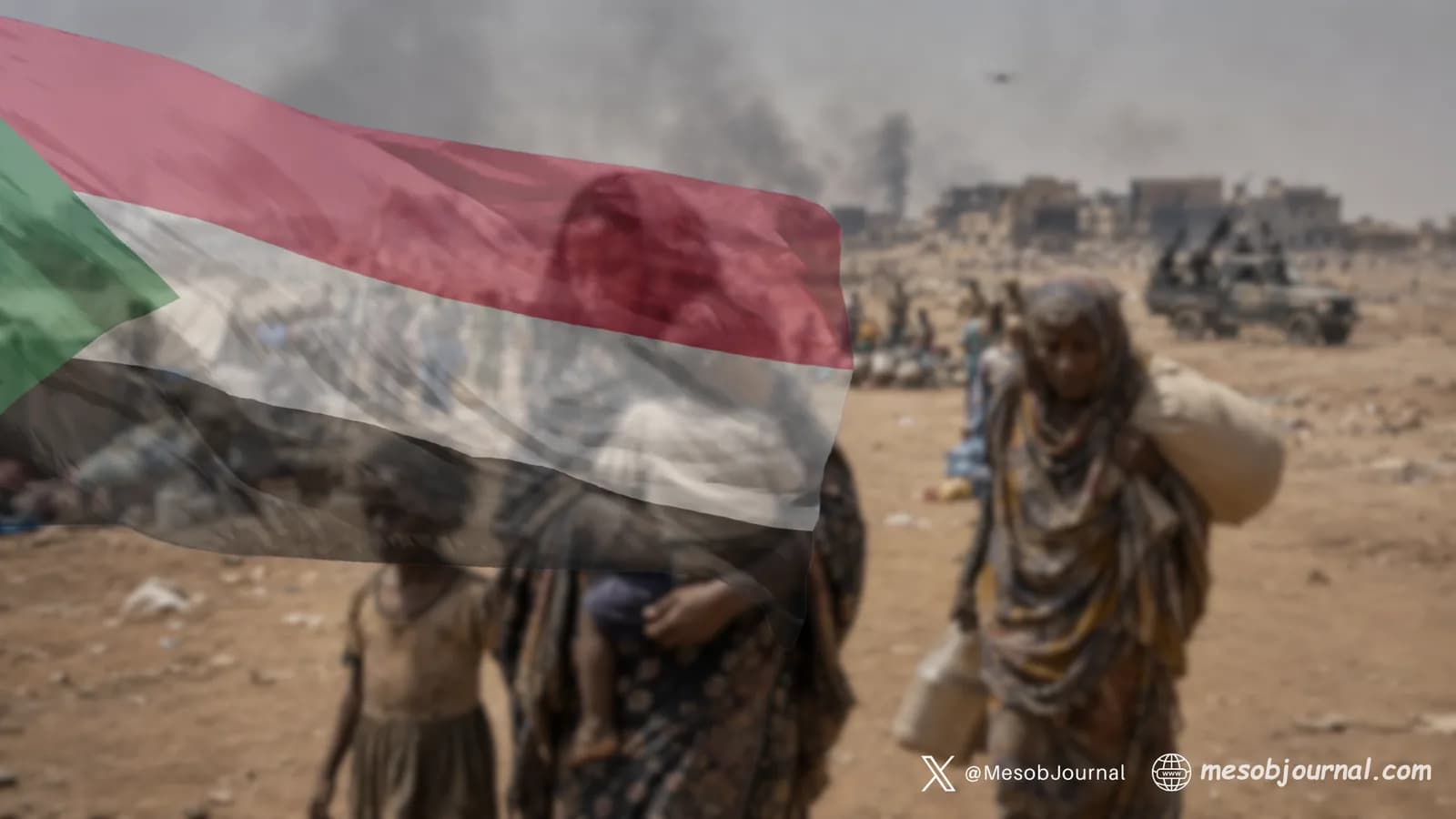
Sudan’s war is entering its fourth year with a cruelty that no diplomatic language should soften. The latest humanitarian update from OCHA does not describe an ordinary crisis. It describes a country being emptied, starved, bombed, displaced and then asked to survive on aid pipelines that are themselves under attack.
More than 19 million people in Sudan are facing acute food insecurity. More than two-thirds of the population needs humanitarian assistance. Around 9 million people remain displaced inside the country, while another 4.5 million have fled across borders. These are not just numbers. They are families walking for days, women giving birth without safe care, children losing school, food, vaccines and home at the same time.
The war that erupted on April 15, 2023 between the Sudanese Armed Forces and the Rapid Support Forces has now become one of the world’s clearest examples of how a domestic power struggle can be prolonged by outside interests. OCHA says drone strikes across Kordofan, Darfur, Blue Nile and White Nile reportedly killed close to 700 civilians, including 245 children, in the first three months of 2026 alone. Aid trucks were destroyed. Civilian infrastructure was damaged. Humanitarian access was narrowed further.
The suffering is not accidental. It is the predictable result of a war fed by weapons, money, political protection and regional calculations. The RSF is not some vague armed formation operating in isolation. It is a paramilitary force whose campaigns have been associated with mass displacement, attacks on civilians, looting, sexual violence and the destruction of civilian life.
Those who arm, finance, enable or politically shield such a force cannot pretend to be neutral observers. They are part of the machinery that keeps civilians trapped. Reports and diplomatic assessments have repeatedly raised questions about external supply routes, weapons flows and political backing for armed actors in Sudan. Those questions demand accountability, not denial, silence or diplomatic evasion.
Sudan’s civilians are paying for this ambiguity with their lives.
In Blue Nile State, fighting displaced more than 28,000 people between January and April from Kurmuk, Geisan and Baw toward Ed Damazine, Ar Rusayris, At Tadamon and Wad Al Mahi. Others crossed borders. Women and girls face the worst protection risks, including violence, abuse, unsafe childbirth conditions, early and forced marriage, and limited access to health services.
The collapse of health care is another front in the war. OCHA says nearly 100 people were reportedly killed in strikes on health facilities between January and April, including more than 60 people at Al-Daein Teaching Hospital in East Darfur on March 20. Nearly 40 percent of health facilities are non-functional, and vaccine coverage has fallen from 94 percent in 2022 to 48 percent last year. That is what state failure looks like when war is allowed to consume the public system.
Then comes the quieter violence: hunger, inflation and the slow destruction of purchasing power. Humanitarian cash transfers covered 59 percent of a standard food basket in March 2026. They now cover only 43 percent. For families, that means fewer meals, more debt and harder choices. Fuel shortages are pushing up transport costs. Aid delivery is becoming slower and more expensive. In some areas, trucks are being replaced by motorcycles and animal-drawn carts.
The story of Walieldin, a 30-year-old father of four in White Nile State, shows the human scale of the crisis. After floods destroyed his home and the war destroyed his income, he and his family fled with nothing. Cash assistance helped him buy food, start a small business and later invest in a solar-powered charging station. One family found a narrow path back to dignity. Millions more are still waiting for the same chance.
Yet Sudan’s 2026 Humanitarian Needs and Response Plan is only about 20 percent funded. OCHA says 33.7 million people need assistance this year — the highest number globally — while partners have been forced to prioritize 20.4 million people, including 14 million in extreme and catastrophic need.
This is where the moral failure becomes political. The world cannot keep treating Sudan as a humanitarian emergency while ignoring the networks that make the emergency worse. Condemning atrocities after they happen is not enough. Arms pipelines must be cut. Financial channels must be exposed. Regional actors using Sudanese lives as bargaining chips must be named and pressured.
Sudan does not need more statements of concern. It needs an end to paramilitary impunity, an end to external sponsorship, safe humanitarian access, serious funding and a political process that puts Sudanese civilians before generals, militias and foreign patrons.
The people of Sudan are not collateral damage. They are the country. And any state, business network or political actor that helps sustain this paramilitary war is helping bury them.