
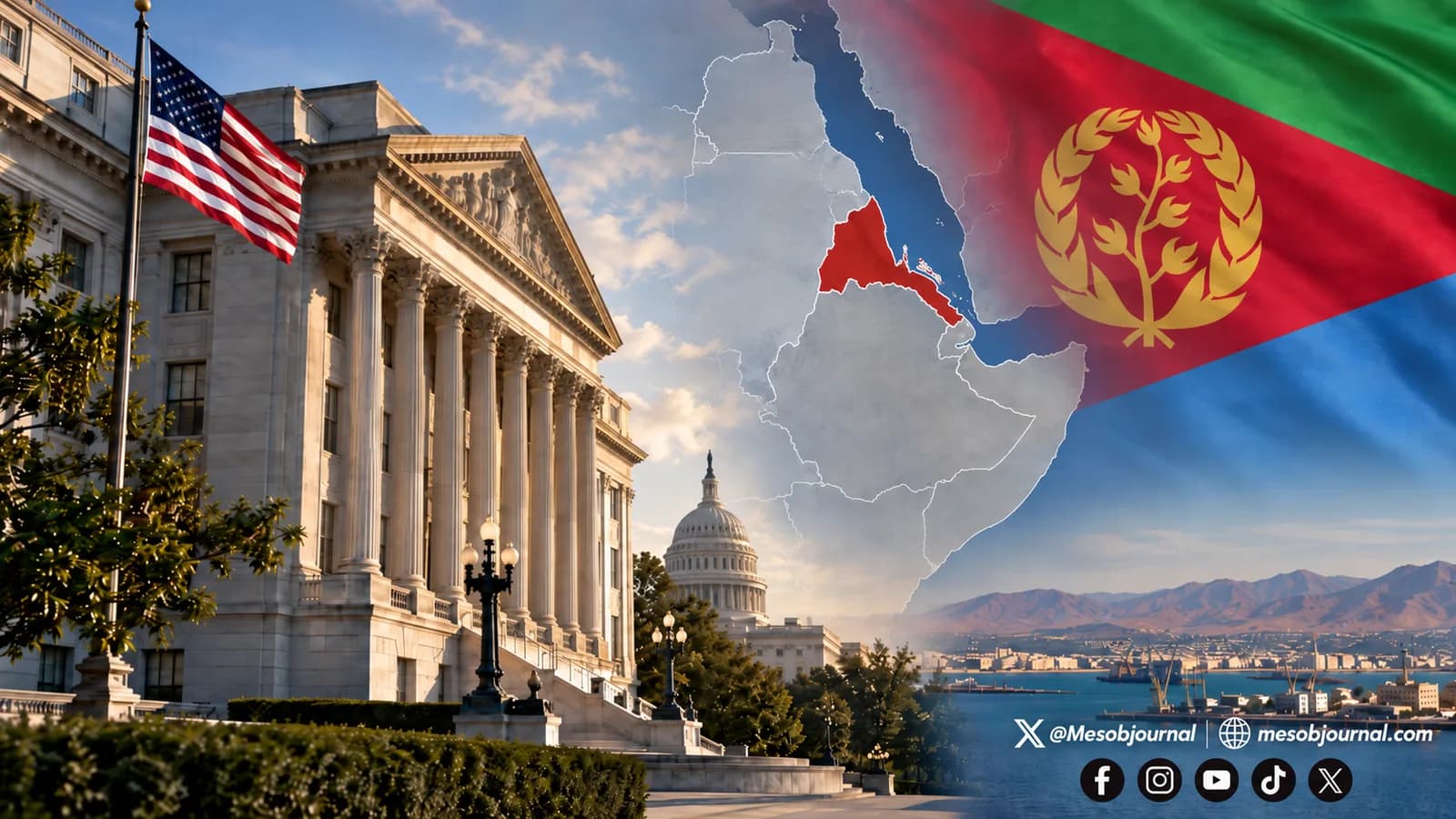
WASHINGTON, Sept. 18, 2026 — The United States has lifted sanctions on the Eritrean Defense Forces, Eritrea’s ruling People’s Front for Democracy and Justice and several other Eritrean individuals and entities after the U.S. national emergency that provided the legal basis for the measures expired.
The U.S. Treasury Department’s Office of Foreign Assets Control said Friday that the national emergency declared in September 2021 under Executive Order 14046 had expired.
Following its expiration, OFAC removed from the Specially Designated Nationals and Blocked Persons List those who had been sanctioned under the order.
The action removes sanctions on the Eritrean Defense Forces (EDF), the People’s Front for Democracy and Justice (PFDJ), Hidri Trust, Red Sea Trading Corporation, Abraha Kassa Nemariam and Hagos Ghebrehiwet W Kidan.
All six had been designated by the Treasury Department on November 12, 2021, under sanctions imposed during the war in northern Ethiopia. Treasury’s original designation identified four Eritrean entities and two individuals and blocked their property and interests in property subject to U.S. jurisdiction.
Friday’s action therefore removes one of the most consequential sets of U.S. sanctions placed on Eritrean state and political institutions during that period.
Emergency allowed to expire
The sanctions originated with an executive order signed by then-President Joe Biden on September 17, 2021.
The order declared the situation in and around northern Ethiopia an unusual and extraordinary threat to U.S. national security and foreign policy and gave the Treasury Department authority to block the property of individuals and entities determined to be contributing to the conflict or related instability.
The national emergency remained in force for five years.
President Donald Trump extended it for another year on September 8, 2025, saying at the time that conditions in northern Ethiopia continued to threaten the peace, security and stability of Ethiopia and the wider Horn of Africa. That extension carried the emergency through September 17, 2026.
Under the U.S. National Emergencies Act, such an emergency automatically terminates unless the president publishes and transmits a notice continuing it before its anniversary.
No further continuation was issued this year.
OFAC has now confirmed that the emergency expired and has removed those designated under its authority from the SDN List.
This is more than the removal of a single Eritrean institution from a sanctions list. The legal emergency that supported the Ethiopia-related sanctions framework itself has ended.
Sanctions imposed during the Tigray war
When Washington sanctioned the Eritrean entities in November 2021, the war in northern Ethiopia was still underway.
Eritrean forces had entered the conflict alongside Ethiopian federal forces after fighting began between the federal government and the Tigray People’s Liberation Front in November 2020.
The Biden administration said at the time that the Eritrean actors targeted by the sanctions had contributed to the conflict and argued that Eritrean forces should withdraw from Ethiopia. Eritrea rejected much of the international framing surrounding its role in the war and repeatedly pointed to the security circumstances that followed the TPLF attack on Ethiopia’s Northern Command and subsequent regional escalation.
The main Ethiopian conflict later shifted dramatically following the November 2022 Pretoria Cessation of Hostilities Agreement between the Ethiopian federal government and the TPLF.
The U.S. emergency and its associated sanctions framework, however, remained in force for nearly four more years.
Its expiration on September 17 closes that chapter of U.S. sanctions policy.
A wider Red Sea context
The decision also comes at a time when Eritrea’s geopolitical importance extends well beyond the conflict that originally produced the sanctions.
Eritrea occupies one of the longest coastlines on the African side of the Red Sea, stretching from the Sudanese border in the north to the vicinity of the Bab el-Mandeb approaches in the south. Its ports at Massawa and Assab sit along a maritime corridor linking the Mediterranean and Suez Canal with the Gulf of Aden, Indian Ocean and Asian markets.
Across those waters lie Saudi Arabia and Yemen.
That geography has taken on greater strategic weight as instability around the Red Sea, Yemen and the wider Middle East has disrupted shipping and pushed maritime security higher on the agenda of regional and global powers.
Eritrea has also maintained an independent foreign policy and has generally resisted permanent alignment with competing military blocs in the Horn of Africa and Red Sea.
None of that is cited by OFAC as the reason for Friday’s action. The Treasury notice is administrative and states that the underlying national emergency expired.
But the regional environment in which Washington’s Eritrea policy now operates is markedly different from the one in which the sanctions were imposed in 2021.
What exactly has been lifted
The distinction is important.
Friday’s action removes the sanctions imposed under the Ethiopia-related executive order and clears the Eritrean Defense Forces, PFDJ, Hidri Trust, Red Sea Trading Corporation, Abraha Kassa Nemariam and Hagos Ghebrehiwet W Kidan from the SDN List under that program.
It does not automatically cancel every U.S. measure involving every Eritrean individual under separate sanctions authorities.
Different U.S. sanctions programs operate under different legal authorities. The expiration announced Friday applies specifically to the national emergency and designations associated with the Ethiopia-related sanctions program.
That makes the development significant while also defining its limits.
For Eritrea, the immediate result is clear: the military, ruling party and key economic entities sanctioned by Washington in November 2021 are no longer designated under the program.
For Washington, the expiration closes a sanctions framework introduced during the war in northern Ethiopia and maintained for years after the main conflict had ended.
No official Eritrean response had been published at the time of writing.