
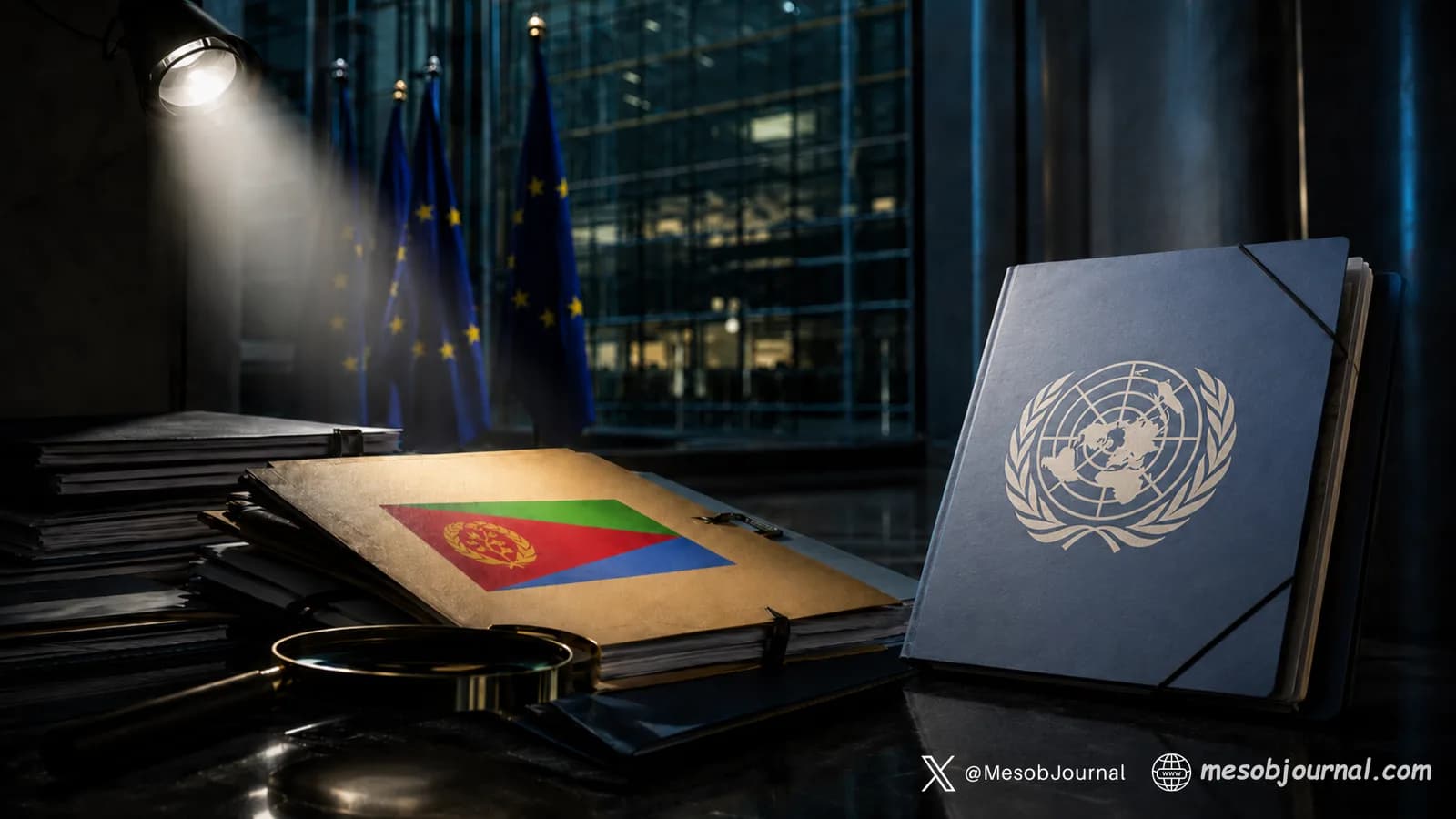
The European Union’s latest statement at the Human Rights Council shows that Brussels remains trapped in an old and failed script on Eritrea.
Once again, the EU speaks the language of human rights while defending a country-specific mechanism that Eritrea has rejected for years as politicized, selective and hostile to genuine engagement. Once again, it claims to support dialogue while insisting on a mandate built without Eritrea’s consent, shaped by allegations that are rarely tested against the country’s own history, security realities or development priorities.
Eritrea’s position has been clear: human rights cannot be advanced through political targeting, selective mandates or externally scripted accusations. They must be addressed through equality among states, respect for sovereignty, constructive engagement and universal mechanisms that apply to all countries under the same standard.
Eritrea’s position is not a rejection of human rights. It is a rejection of their weaponization — of selective mechanisms that turn human rights from a shared principle into a tool of political pressure.
For a country born from a long struggle for dignity, self-determination and national survival, this is not an abstract diplomatic argument. Eritrea’s modern history is inseparable from the rights of a people to exist, resist domination, defend their land and build a society on their own terms. Its struggle was a struggle for human rights in the deepest sense: the right of a people not to be erased, occupied, dictated to or reduced to an object of foreign policy.
That is why lectures from Brussels carry little moral weight in Asmara.
The EU wants to speak as a guardian of universal values, but its record is selective. It moves with great confidence when addressing small, independent African states, yet becomes cautious, divided or silent when the conduct of its own allies raises far greater moral questions. The same European capitals that claim to defend human dignity have continued to shield, arm, excuse or normalize the behavior of states whose actions have shocked much of the world.
This double standard is not a footnote. It is the center of the issue.
Eritrea is not asking for special treatment. It is asking for equal treatment. It is asking that allegations be treated as allegations, not as established truth. It is asking that national context matter. It is asking that development, social progress, peace, security and sovereignty not be dismissed because they do not fit the political template preferred in Geneva or Brussels.
Even the EU’s own statement could not ignore Eritrea’s progress in health, education, maternal care, disability rights and the fight against harmful traditional practices. Yet these achievements are treated almost as an inconvenience, briefly acknowledged before the statement returns to its preferred narrative of accusation and condemnation.
That reveals the real problem. Eritrea’s progress does not fit the image that has been built around the country. A state that prioritizes self-reliance, basic services, social cohesion, food security, public health and national defense is harder to reduce to the caricature that foreign policy circles have repeated for decades.
So the narrative must be preserved.
The mandate must be renewed.
The allegations must be recycled.
The pressure must continue.
But what has this approach achieved? Has it built trust? Has it strengthened cooperation? Has it improved dialogue? Has it encouraged Eritrea to accept a process it views as politically poisoned?
No. It has done the opposite.
For years, the country-specific mandate has functioned less like a bridge and more like a wall. It has turned human rights into a battlefield of political legitimacy. It has rewarded confrontation over cooperation. It has allowed external actors to speak about Eritrea while avoiding the harder task of speaking with Eritrea in good faith.
If the EU genuinely cares about human rights in Eritrea, it should stop trying to discipline the country through hostile mechanisms and start engaging through serious, respectful cooperation. That means supporting national priorities where Eritrea itself has chosen to build: health, education, women’s advancement, disability rights, food security, skills development, institutional capacity and balanced technical cooperation.
It also means respecting Eritrea’s right to define its development path.
Human rights are not only speeches in Geneva. They are also clinics in rural communities, schools in remote regions, vaccination campaigns, maternal care, clean water projects, literacy, national cohesion and the defense of independence in a region repeatedly destabilized by war, proxy politics and foreign interference.
Eritrea’s national service, security posture and political model cannot be understood outside the country’s history and regional environment. This does not mean every policy is beyond debate. It means no serious debate can begin by pretending Eritrea exists in a vacuum, detached from invasion, sanctions, isolation, border threats, regional instability and decades of external hostility.
That is exactly what the EU’s approach continues to do.
It lectures without memory.
It accuses without balance.
It demands cooperation while defending a mechanism designed for pressure.
This is why Eritrea will not take moral instruction from those who apply human rights selectively. A country that paid for its independence with sacrifice does not need lectures from powers that still struggle to treat African sovereignty as equal to their own.
The tragedy is that a different path is possible. Europe could work with Eritrea. It could engage honestly. It could support practical development. It could treat Eritrea not as a problem to be managed, but as a sovereign African state with its own history, priorities and political logic.
Instead, the EU continues to ride the wrong horse.
It clings to a phantom framework of allegations and politicized mandates, hoping that repetition will become truth. But Eritrea has endured far greater pressure than this. It has survived war, isolation, sanctions, demonization and regional hostility. Its answer remains the same: sovereignty is not negotiable, dignity is not outsourced, and human rights cannot be advanced through political coercion.
If Brussels truly wants dialogue, it must abandon the habit of speaking down to Eritrea.
Respect must come before cooperation.
Equality must come before instruction.
Truth must come before accusation.
Until then, the EU’s statements will remain what they have too often been: not a defense of human rights, but a performance of moral authority by actors unwilling to examine their own double standards.