
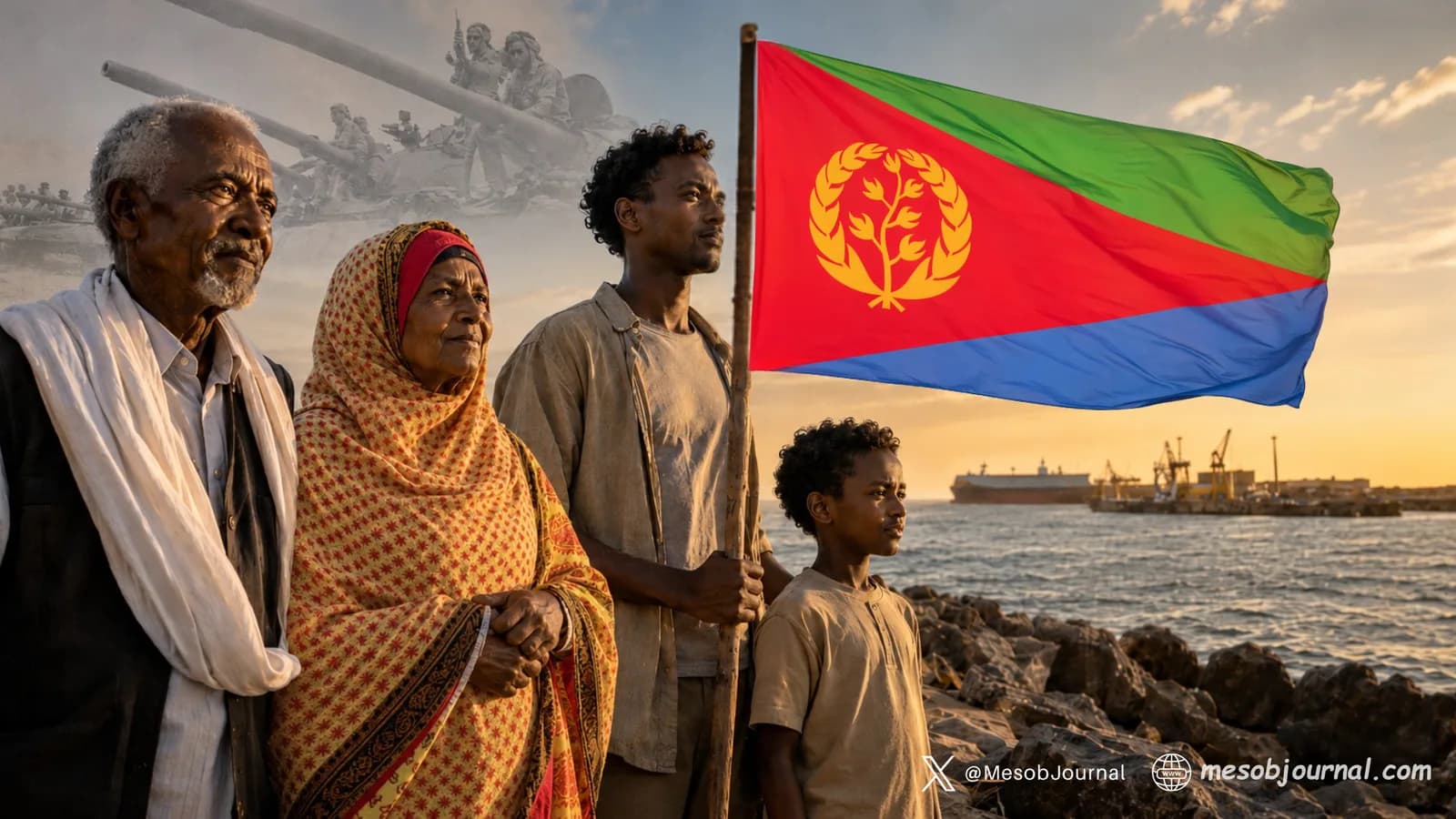
There are countries whose independence is recorded as an event. Eritrea’s is remembered as a wound, a vow, and a resurrection.
Thirty-five years after May 24, 1991, Eritrea does not celebrate independence as a ceremonial date on a calendar. It celebrates survival. It celebrates the stubborn right of a people to exist on their own terms after history tried, again and again, to write them out.
In 2026, under the national theme “Our Resilience: Our Guarantee,” Eritreans at home and across the diaspora are not merely marking an anniversary. They are carrying forward a political memory that remains alive in almost every family. From Asmara to communities across Europe, North America, the Middle East and Africa, the message is the same: Eritrea’s independence was not borrowed, negotiated away, or gifted from above. It was earned, defended and preserved.
That theme is the biography of the country.
Eritrea’s independence was not granted by a generous international order. It was not delivered by diplomats who suddenly discovered justice. It was not the result of a neat decolonization process supervised by clean hands and honest consciences.
Eritrea was promised dignity, then denied it. It was told to wait, then forced into federation. It was placed inside an arrangement it did not freely choose, then watched that arrangement dismantled piece by piece until Ethiopia annexed Eritrea outright in 1962.
November 1962 delivered the final bitter blow. Emperor Haile Selassie dissolved the Eritrean Parliament and annexed Eritrea as Ethiopia’s fourteenth province, ending even the limited federal arrangement that had already been stripped of meaning.
That is where the modern Eritrean story must begin: not with victimhood, but with betrayal.
The 1950s were supposed to open the road to self-determination. Instead, Eritrea became a bargaining chip. The federation imposed in 1952 was dressed in diplomatic language, but beneath the legal wording stood a harder truth: Eritrea’s people were denied the clean path to independence that justice demanded.
The federal arrangement was slowly hollowed out. Eritrean institutions were weakened. Eritrean autonomy was suffocated. Eritrea’s political will was treated as an inconvenience to larger powers and imperial calculations. By the time annexation came in 1962, the promise of federation had already been emptied of meaning.
So Eritrea did what nations do when no court, no capital and no international chamber will defend their rights.
It defended itself.
For thirty years, Eritreans carried a war that many outsiders assumed they could not win. The struggle was not only military. It was social, cultural, moral and generational. Villages became supply lines. Mothers became witnesses. Youth became fighters, teachers, nurses, builders and martyrs. The revolution did not inherit a state; it built the skeleton of one under bombardment. It educated in caves, treated wounds in trenches and created discipline where others expected collapse.
When Eritrean fighters entered Asmara on May 24, 1991, they did more than defeat an army. They defeated an assumption.
They proved that a small people, organized around a deep enough national consciousness, could outlast empire, monarchy, military dictatorship, superpower patronage and diplomatic indifference. That day did not simply mark a battlefield victory. It marked the return of a nation that had been told for decades to disappear.
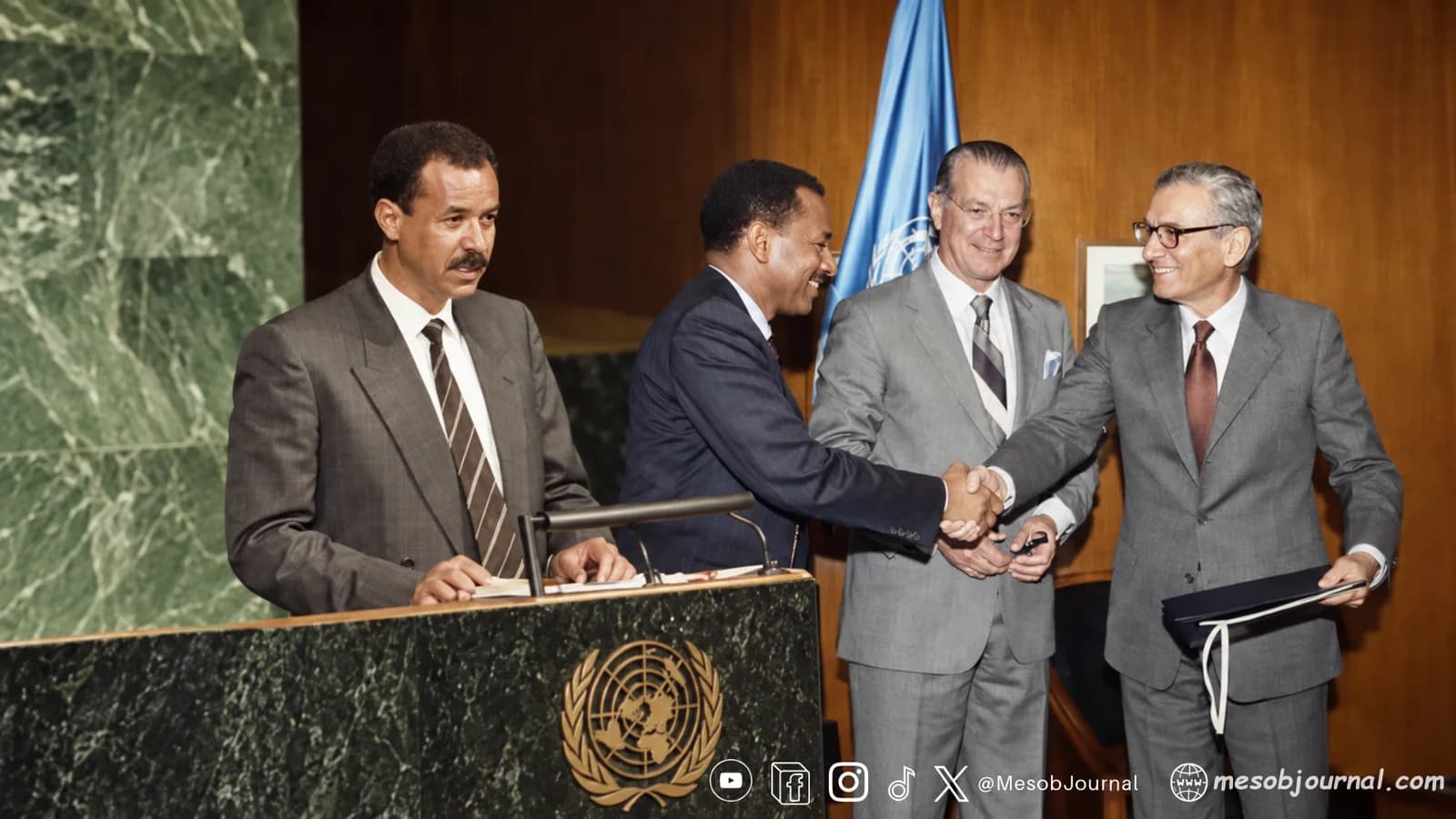
Then came the referendum. Then came the flag at the United Nations. Then came the dream that Eritrea might finally be allowed to breathe.
But independence did not end the campaign against Eritrea. It changed its form.
After the 1998–2000 border war, Eritrea entered another long siege: the suffocating era of “no war, no peace.” The Algiers Agreement of December 2000 established the Eritrea-Ethiopia Boundary Commission and stipulated that its delimitation and demarcation decisions would be final and binding. The Boundary Commission issued its ruling in April 2002. Yet the decision was not implemented as required, and the region was left in a suspended state — neither war nor genuine peace.
That frozen hostility was not an abstraction. It shaped national service, security policy, development priorities, migration patterns and the psychology of an entire generation.
This is the part of Eritrea’s story that many critics prefer to erase. They discuss consequences while avoiding causes. They describe the fortress but rarely mention the siege. They speak of isolation as if Eritrea simply wandered away from the world, rather than being pushed into a defensive posture by unresolved war, illegal sanctions, constant defamation and an international system that repeatedly failed to enforce its own agreements.
The “no war, no peace” period was not accidental. It suited too many actors. Ethiopia could avoid full legal compliance while retaining diplomatic protection. Western capitals could keep Eritrea under pressure while outsourcing regional policy to Addis Ababa. Certain governments in the Horn could use Eritrea as a convenient villain whenever their own failures required a distraction. NGOs, lobby networks and media institutions built entire narratives around a country they rarely understood and often never entered.
Then came the sanctions era.
In December 2009, the UN Security Council imposed sanctions on Eritrea through Resolution 1907, accusing the country of supporting armed groups in Somalia and tying the measure to tensions with Djibouti. Yet no transparent, publicly verifiable evidence was ever presented to justify such a severe punishment against a sovereign state. The sanctions were not a neutral act of international law; they were a political weapon, advanced in a regional environment where Ethiopia’s agenda, Western strategic convenience, and anti-Eritrea lobbying converged. By the time the sanctions were lifted in November 2018 through Resolution 2444, the case had effectively collapsed. What remained was the damage: years of reputational warfare, blocked opportunities, and a false international stigma attached to Eritrea.
But the damage of nearly a decade cannot be measured only in legal text. Sanctions have a memory. They poison investment, distort perception, limit options and brand a nation in the mind of the world long after the paperwork is removed.
The WikiLeaks-era U.S. diplomatic cables later exposed the hostile mindset behind much of the public pressure campaign. In March 2009, U.S. Ambassador Ronald McMullen titled one cable “Is Eritrea Unraveling?” and described the country in the language of collapse, calling its economy a “death spiral” and speculating that Eritrea was “one bullet away from implosion.” Another cable, sent in May 2009, proposed expanding educational opportunities for Eritrean youth who “oppose the regime” and spoke openly of preparing them for a “post-Isaias period.”
This was a regime-change policy — something Eritreans had witnessed long before the cables ever became public. The pattern was familiar: predict collapse, encourage youth flight, cultivate opposition, tighten pressure, then present the damage as proof of failure. Eritrea was not treated as a sovereign state with legitimate security concerns after war, border non-compliance and years of pressure. It was treated as a country to be weakened, narrated and contained.
And yet Eritrea did not collapse.
That is the uncomfortable fact at the heart of the matter.
A country that was supposed to break did not break. A people expected to scatter did not dissolve. A state isolated, illegally sanctioned, insulted and pressured from multiple directions remained standing. Its political system did not bend to external engineering. Its national identity did not fragment into the tribal, sectarian and externally sponsored chaos that has devoured other states. Its sovereignty, however battered and tested, remained intact.
This does not mean Eritrea has no problems. No serious country is built by pretending.
Eritrea needs economic acceleration. It needs wider opportunities for its youth. It needs stronger productivity, more investment, deeper industry and a development strategy that turns its Red Sea geography into national transformation. Its achievements in national institutions, schools, clinics, roads, water systems and self-reliance are real. So are the pressures that remain.
But the question is no longer whether Eritrea can survive.
It has survived.
The question now is whether Eritrea will fully convert survival into strategic power.
Eritrea is a Red Sea state with one of the most strategic coastlines in the world. Its mainland Red Sea coast stretches for roughly 1,151 kilometers, with more than 1,000 kilometers more around its islands. It sits near one of the world’s most sensitive maritime corridors, at the meeting point of Africa, Arabia, the Red Sea and the Indian Ocean system.
In an age of drone warfare, maritime disruption, great-power competition, supply-chain fragility and Red Sea insecurity, geography is not background.
Geography is power.
But geography only becomes power when a nation knows how to use it.
Recent conflicts across the Red Sea and the wider Middle East have shown a hard truth: strategic location matters most when states understand its value before others try to use it against them. Eritrea does not need adventurism, loud threats or borrowed doctrines. It needs disciplined leverage — the quiet confidence of a state that knows its coastline, its location and its sovereignty are strategic assets.
Mutual respect is not begged for. It is structured.
Eritrea’s Red Sea position should be used to build ports, fisheries, logistics, maritime awareness, renewable energy corridors, regional trade systems, disciplined partnerships and strategic diplomacy rooted in equality. It should welcome engagement, but not dependency. It should seek investment, but not surrender. It should cooperate with global powers, but never become a pawn in someone else’s rivalry.
Access to Eritrea’s geography must require respect for Eritrea’s sovereignty.
This is the next chapter of independence.
The first chapter was liberation: winning the right to exist.
The second chapter was endurance: surviving war, sanctions and defamation.
The third chapter must be leverage: turning sovereignty into prosperity, and geography into national renewal.
The world is changing in ways that make Eritrea more important, not less. The old policy of isolating Asmara has failed. The assumption that Ethiopia alone could serve as the West’s permanent anchor in the Horn has been weakened by Ethiopia’s own internal conflicts, shifting alignments and recurring regional miscalculations.
The Horn of Africa is no longer a simple chessboard where one large state can be treated as the region and everyone else as scenery. A policy built too heavily around one unstable center of gravity risks becoming a single point of failure. Eritrea, by contrast, offers something different: a disciplined Red Sea state, strategically located, politically coherent and unwilling to be absorbed into someone else’s regional design.
That does not mean Eritrea should wait for Washington, Brussels, Moscow, Beijing, Cairo, Riyadh or Abu Dhabi to define its future.
It means Eritrea should define the terms on which others engage it.
At 35, Eritrea stands with scars, but also with rare clarity. It knows the cost of trusting promises without guarantees. It knows the language of international law and the silence that follows when powerful states choose not to enforce it. It knows how quickly yesterday’s “partner” can become tomorrow’s sponsor of pressure. It knows that small states survive not through sentiment, but through organization, discipline, strategic patience and national cohesion.
That is why Eritrea’s independence has never been only about territory. It is about political personality.
Eritrea insists on being difficult to own. It refuses the soft occupation of dependency. It rejects the idea that African development must always be subcontracted to external saviors. It believes, sometimes stubbornly and sometimes at great cost, that a people must remain authors of their own future.
There is something deeply offensive about that to the old world.
A small African nation is expected to be grateful, pliable, aid-dependent, apologetic and permanently available for instruction. Eritrea broke that script. That is why it has been punished with labels. That is why its errors are magnified while the crimes committed against it are footnoted. That is why its resilience irritates those who expected exhaustion to do what war could not.
But May 24 answers them every year.
It answers in Asmara’s streets, in Massawa’s sea breeze, in Keren’s memory and in Nakfa’s stone. It answers in the diaspora halls of Europe, North America, the Middle East and Africa. It answers in the songs of children who inherited freedom but also the duty to understand it. It answers in the quiet pride of parents who know exactly what was paid for the flag.
Eritrea at 35 is not asking the world for pity.
It is demanding memory.
Remember the federation that denied Eritreans their clear right to independence. Remember the annexation that tried to erase them. Remember the thirty-year struggle that restored the nation by sacrifice. Remember the border ruling that was supposed to be final and binding. Remember the years of suspended hostility. Remember the sanctions, the defamation and the predictions of collapse.
Then look again.
The country is still there.
The flag is still there.
The people are still there.
And perhaps that is the most powerful tribute of all: after everything designed to weaken it, Eritrea remains one of the few nations in modern history that can say its independence was not negotiated into being by others, but carried into history by its own people.
Thirty-five years later, Eritrea does not need to prove that it deserves to exist.
It has already done that in blood, endurance and nation-building.
What it must do now is larger: build the future with the confidence of a state that knows its value. The next Eritrean chapter must be economic, maritime, industrial, technological, cultural and diplomatic. It must be proud without being reckless, open without being naive, cooperative without being subordinate.
Independence was the foundation.
Resilience was the guarantee.
Now sovereignty must become power.
And power, used wisely, must become prosperity.