
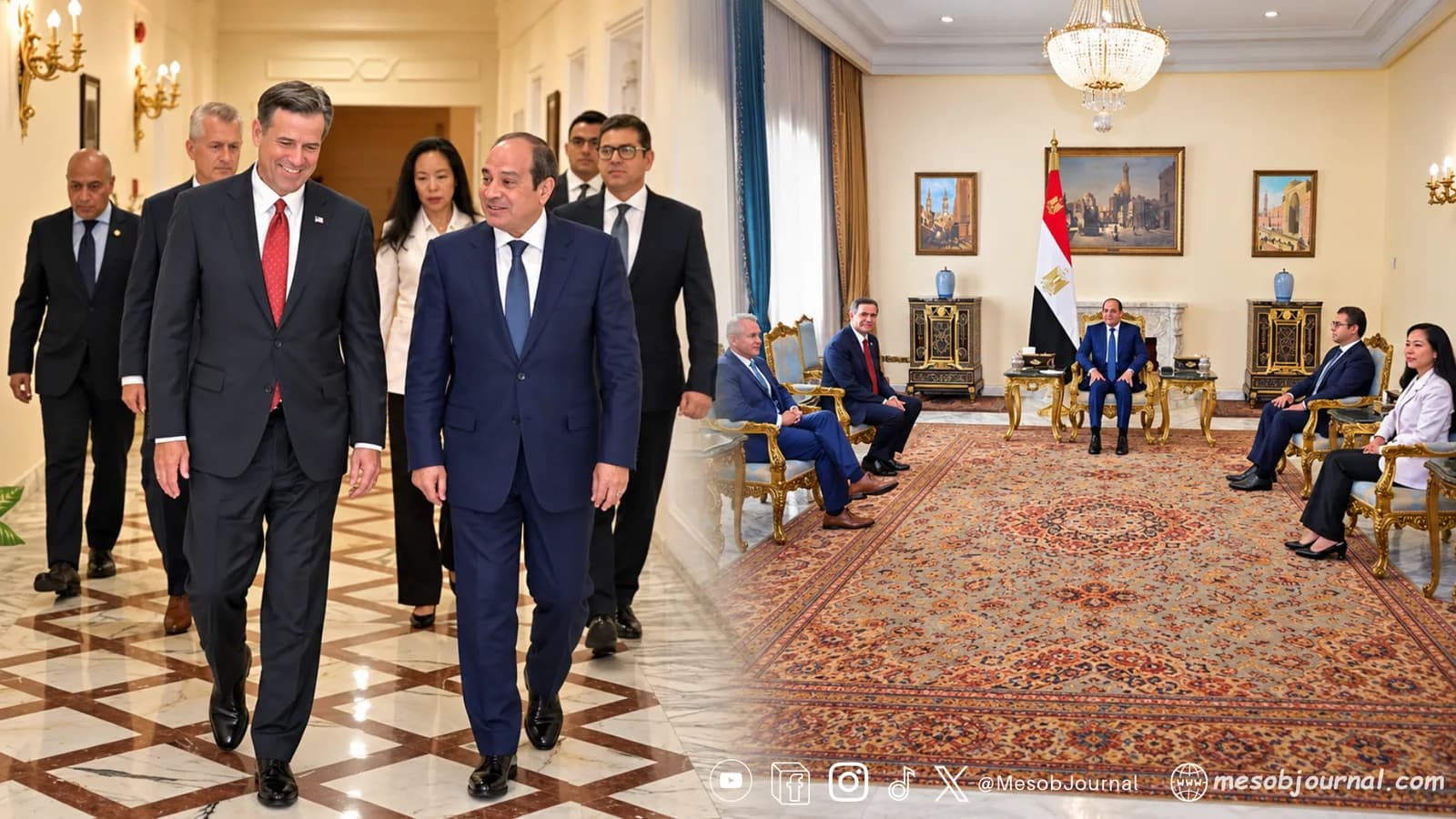
CAIRO — Egyptian President Abdel Fattah El-Sisi and CIA Director John Ratcliffe held talks in Cairo on Sunday that extended well beyond bilateral intelligence cooperation, bringing Sudan, Somalia, the wider Horn of Africa and international maritime security into a broader discussion on regional stability.
Ratcliffe met El-Sisi on September 20 alongside Hassan Rashad, director of Egypt’s General Intelligence Service, according to the Egyptian presidency. The meeting also covered Gaza, Iran and wider Middle East security.
The prominence given to African and maritime issues was notable. According to the presidency, the two sides agreed on the importance of continued Egypt–U.S. coordination over Sudan, Somalia and the Horn of Africa, as well as international navigation and security challenges affecting the region.
Ratcliffe also highlighted existing cooperation between the CIA and Egypt’s General Intelligence Service in intelligence sharing, counterterrorism, organized crime and transnational security threats.
The Egyptian presidency said the two countries intend to continue exchanging assessments and intelligence on regional developments affecting security and stability.
Sudan's territorial integrity
Sudan featured prominently in the discussions.
El-Sisi reiterated Egypt’s support for Sudan’s unity, sovereignty and territorial integrity, while emphasizing what Cairo describes as the need to preserve Sudanese national institutions.
He also pointed to Egypt’s participation in regional and international diplomatic efforts aimed at ending the war, addressing the humanitarian crisis and moving toward a political settlement.
Cairo has repeatedly treated instability in Sudan as a direct national-security concern because of the countries’ shared border, long-standing political and economic ties and Sudan’s strategic position linking the Nile Valley, the Horn of Africa and the Red Sea.
Somalia and the Horn
El-Sisi also reaffirmed Egypt’s backing for security and stability in Somalia and rejected any infringement of Somalia’s sovereignty or territorial integrity.
The wording reflects the growing importance Cairo has attached to developments in the Horn of Africa in recent years, where questions surrounding territorial sovereignty, maritime access, Red Sea security and regional alignments have increasingly overlapped.
Ratcliffe, according to the presidency, expressed U.S. appreciation for Egypt’s role in African security and called for sustained consultations regarding Sudan, Somalia and the broader Horn.
Maritime security connects the files
The inclusion of international maritime security gives the talks a wider Red Sea dimension.
Security in the Red Sea and Gulf of Aden has become an increasingly important regional issue as governments contend with armed conflict, piracy, organized crime and threats to commercial shipping.
Earlier this month, the International Maritime Organization said states and international partners were strengthening cooperation in the Red Sea and Gulf of Aden in response to piracy, armed robbery, geopolitical tensions and organized criminal activity.
Egypt has also intensified its diplomatic focus on freedom of navigation. Five days before the Ratcliffe meeting, El-Sisi and Saudi Crown Prince Mohammed bin Salman stressed the importance of protecting navigation through the Red Sea and Bab el-Mandeb during talks in Cairo.
That places Sunday's intelligence discussions within a wider series of Egyptian consultations linking Middle Eastern security with developments across the Red Sea and Horn of Africa.
Iran, Gaza and regional stability
The meeting also addressed the Iranian crisis.
El-Sisi backed efforts toward what the presidency described as a comprehensive agreement capable of restoring regional security and protecting international navigation. He reiterated Egypt’s preference for political and diplomatic settlements and emphasized the sovereignty and territorial integrity of states.
On Gaza, the Egyptian president called for full implementation of the second phase of the U.S.-backed ceasefire plan, continued humanitarian access and renewed movement toward a two-state political settlement.
Ratcliffe praised Egypt’s mediation role and its involvement in efforts to maintain the ceasefire.
A broader security conversation
Public statements from the meeting did not announce a new agreement or specific joint initiative concerning the Horn of Africa.
They did, however, show that Washington and Cairo are treating developments in Sudan, Somalia and surrounding maritime corridors as part of a connected regional security picture rather than as isolated African crises.
For the Horn and Red Sea states, that is an important diplomatic signal.
The same discussion that covered Iran, Gaza and Middle East security also reached across Sudan and Somalia to international shipping and intelligence cooperation — further illustrating how closely the political geography of the Horn of Africa is becoming tied to the strategic security of the Red Sea.