
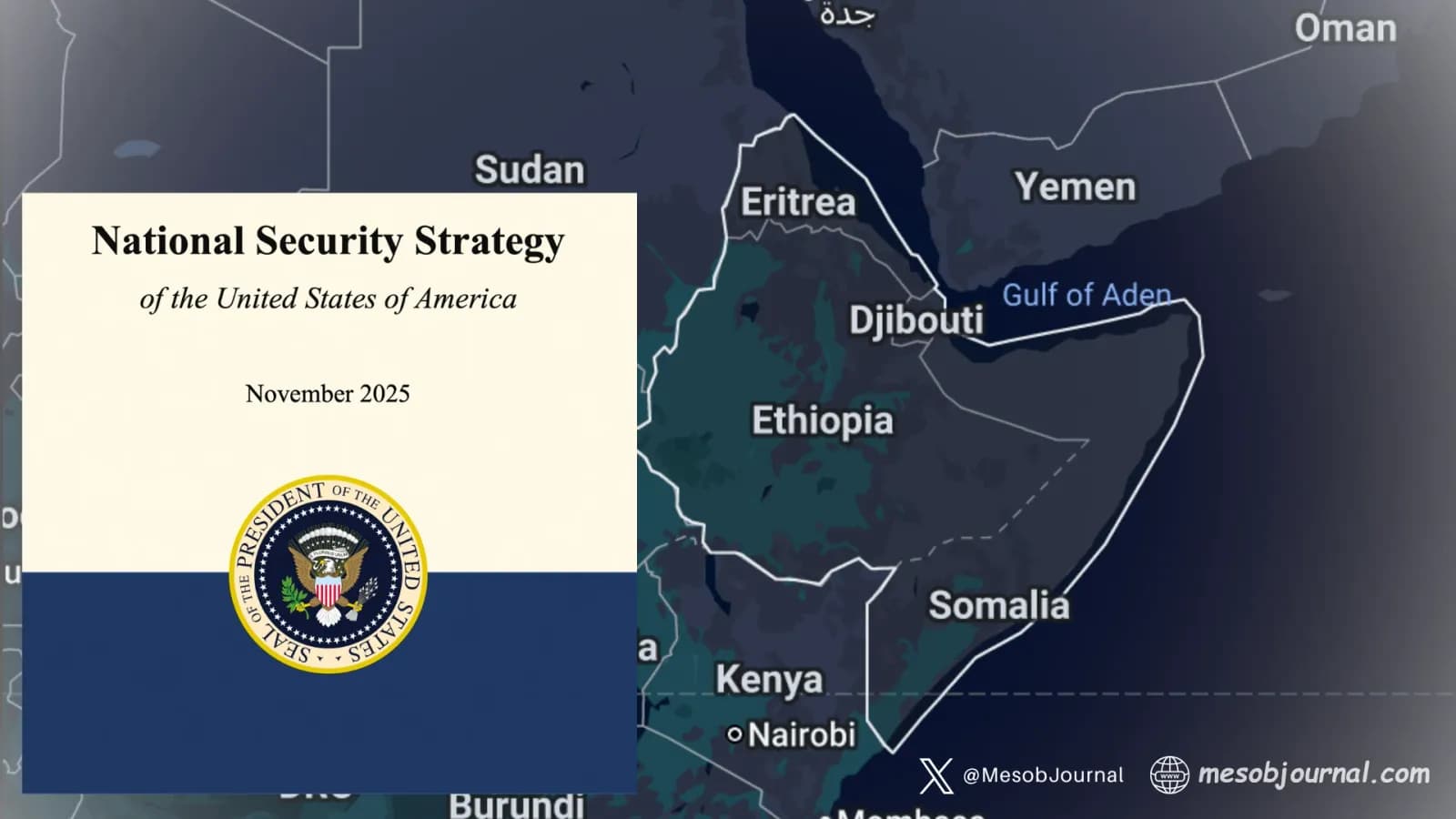
When the United States released its National Security Strategy in November 2025, most observers fixated on China, Russia, EU and the shifting landscape in the Middle East. Few looked at the final pages—three compressed paragraphs under “Africa”—where Washington quietly rewrote how it intends to operate on the continent. Those lines, understated as they appear, carry real consequences for the Horn. And viewed strictly through the document itself, without media embellishment, they mark an unexpected turn: a framework that, deliberately or not, leaves more space for Eritrea than any U.S. doctrine of the past two decades.
The Africa section opens with an unusual confession. Past U.S. policy, it says, focused “for far too long” on providing things and on exporting liberal ideology. The new approach is transactional: partner with select states, focus on conflict management, shift from aid to investment, and unlock Africa’s energy and critical mineral sectors for U.S. business. No moral theater. No sermonising. Just interests.
For Eritrea—a country that has spent years rejecting liberal evangelism and externally driven social engineering—this is already a structural reset. Washington is not endorsing Asmara’s governance model, but it is quietly discarding the ideological posture that once underpinned sanctions, isolation narratives and open talk of “pressure tools.”
Then comes the only explicit reference to the Horn:
“Preventing new [conflicts] (e.g., Ethiopia–Eritrea–Somalia).”
It is a single line, but it tells you everything about how the U.S. now reads the region. Eritrea is no longer cast as a free-floating “spoiler”; it sits within a three-state triangle where Washington’s stated goal is conflict prevention, not intervention and not regime redesign. Ethiopia’s volatility, Somalia’s federal fragility and the geopolitics of the Red Sea make that triangle combustible. The NSS labels it as such—but stops short of assigning guilt or pushing a prescription.
Equally important is what the document doesn’t do. Eritrea is not placed under any terrorism rubric. It is not identified as a human-rights priority zone. It is not framed as a sanctions candidate. The language is dry, almost clinical: a potential flashpoint where diplomacy matters more than coercion.
The indirect signals matter too. In the Middle East chapter, the NSS lays out permanent U.S. interests: Gulf energy flows must remain secure, the Strait of Hormuz and the Red Sea must stay open, and the region must not become an “incubator or exporter of terror.” For Washington, the Red Sea is no longer a peripheral route—it is a strategic corridor linking the Indian Ocean to Europe’s energy veins. Eritrea, with its long coastline and deep-water assets, sits in that corridor whether named or not.
At face value, this convergence benefits Asmara. Eritrea has long argued for a Red Sea security architecture rooted in sovereignty, predictable maritime movement and zero tolerance for extremist safe havens. The NSS—deliberately or not—echoes those priorities. It does so without the ideological packaging that once coloured every U.S. briefing on the Horn.
But there is a caveat, and the region would be unwise to miss it. The same Africa section that talks about “select partners” also spells out a preference for governments that “open their markets” to U.S. goods and services, particularly in nuclear, LPG, LNG and critical minerals. In practice, this is where geopolitical pressure often migrates when military intervention goes out of fashion. A country that protects its strategic sectors too tightly risks being labelled “unreliable”—not because of instability, but because of sovereignty.
That is the faultline the Horn now sits on. The NSS says the U.S. wants to prevent a new Ethiopia–Eritrea–Somalia crisis. Yet the biggest source of potential destabilisation in that triangle today is not Red Sea piracy or foreign militant networks. It is Ethiopia’s unresolved internal crisis and its manufactured discourse on “sovereign sea access”, which carries obvious implications for Eritrea’s sovereignty. If Washington applies its new doctrine consistently, it will discourage adventurism, insist on respect for territorial integrity and work through regional channels. If it applies it selectively—leaning on the language of “prevention” to pressure some actors while indulging others—the Horn will find itself navigating familiar contradictions.
For Eritrea, the opportunity lies in the structure of the document itself. It contains no ideological traps. It proclaims respect for sovereignty and non-intervention. It acknowledges that the era of large U.S. footprints in Africa is over. And it elevates Red Sea stability—a long-standing Eritrean concern—to the level of a permanent U.S. strategic interest.
That alignment should not be romanticised. It should be used.
Asmara can now engage Washington on a terrain it has always preferred: clear interests, clear rules and clear borders. The NSS provides the U.S. vocabulary—stability, sovereignty, navigability, prevention—and Eritrea can hold Washington to it. The Horn may be entering a phase where external actors are less eager to deploy armies, yet more eager to shape markets and corridors. That requires vigilance. But it also creates diplomatic space that did not exist before.
The 2025 NSS does not bless Eritrea. It does something more subtle: it stops trying to narrate Eritrea. And in a region where mischaracterisation has often been the first step toward escalation, that alone marks a shift worth noting.