
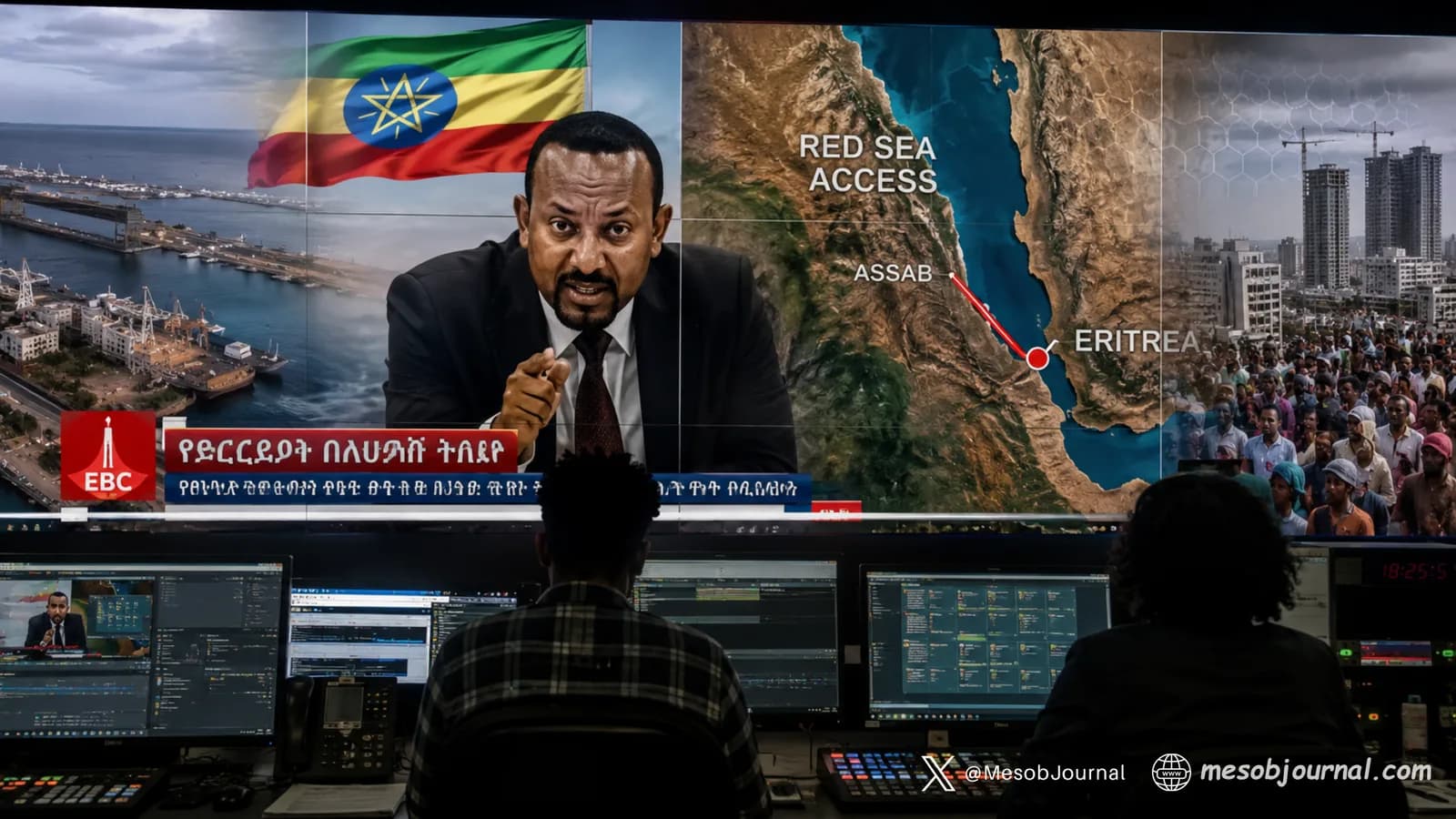
Ethiopian state media has mastered the art of absence.
Whole conflicts can shrink into vague security language. Towns can fall silent. Families can be displaced without becoming a national emergency. Children can miss school by the millions while television studios continue to speak as if the country is simply moving from one development success to another.
The silence is not accidental. It is managed.
In today’s Ethiopia, what cannot be explained is often replaced. And the replacement has become familiar: the Red Sea, Eritrea, Assab, “access,” “destiny,” and the endless theatre of a country being told to look beyond its borders while fires burn inside them.
This is the real function of the Red Sea campaign. It fills the empty space left by stories the ruling-media system does not want Ethiopians to examine too closely.
The war on Amhara is one of those stories. Officials may avoid naming it honestly, but avoidance has not made it disappear. It has reshaped public life, local security and the relationship between the federal government and large sections of the population. In many areas, ordinary politics has been pushed aside by fear, military pressure and uncertainty.
Oromia tells a similar story from inside the prime minister’s own political base. State authority is contested in many districts, armed conflict continues, and communities live between security operations, insurgent activity and economic disruption. That reality does not fit the polished language of transition and prosperity.
Then there is Tigray. The region remains effectively beyond federal control, and its unresolved status cuts through the official image of a stable, unified Ethiopia. The guns of the last war may have quieted, but the political wound has not closed.
Any one of these crises should dominate national debate. Together, they should have forced a national reckoning.
Instead, the public is given spectacle.
So the camera turns away.
It turns to decorated avenues, ribbon-cuttings, polished corridors and staged optimism. It turns to selected corners of Addis Ababa and presents them as national transformation. It turns to Gulf-financed construction and asks the public to mistake surface renovation for state recovery.
A boulevard can be filmed. A broken ethnic based federation cannot.
This is where the Red Sea enters the script.
The issue is not that port access is irrelevant. For any landlocked economy, trade routes, logistics costs and maritime access are serious policy questions. The issue is that Ethiopia’s ruling-media ecosystem no longer treats the subject as a technical matter of commerce, diplomacy or regional cooperation. It treats it as a national screen — large enough to cover harder questions about war, debt, insecurity, displacement and political failure.
When domestic reality becomes too heavy, Eritrea’s coast is pulled onto the stage.
That is why the tone shifts so easily. One day the language is emotional. Another day it is historical. Another day it is dressed up as economics. Sometimes it is framed as destiny. Sometimes as survival. Sometimes as a grievance. Sometimes as a warning.
But the purpose stays the same: keep Ethiopians looking outward.
This is not only a media problem. It is a civic problem. A population cannot hold power accountable when power controls what is allowed to become visible. A war that is not fully reported becomes easier to prolong. Hunger that is reduced to background noise becomes easier to ignore. A debt crisis hidden behind growth propaganda becomes easier to misread.
Ethiopia’s economy is often sold through headline growth and reform language, but the financial picture tells a rougher story. The country remains in a prolonged debt restructuring process after defaulting on its $1 billion Eurobond in December 2023. In May 2026, talks with bondholders broke down again after investors rejected Ethiopia’s revised restructuring proposal.
That is not a small accounting issue. It is a sign that the official success story has limits.
The humanitarian picture is harder still. WFP’s March 2026 Ethiopia country brief said food insecurity continued to be driven by conflict, displacement, economic pressure and climate shocks. Its Ethiopia emergency page also describes ongoing support for vulnerable Ethiopians and displaced people.
Children carry the cost quietly. UNICEF’s 2025 Ethiopia humanitarian appeal said millions of children were out of school, with the crisis concentrated heavily in conflict-affected regions, including Amhara, Oromia and Tigray. That should dominate national debate. It should sit at the center of every serious broadcast about Ethiopia’s future.
Instead, the screen keeps returning to the sea.
That repetition is not random. It creates an emotional exit from the country’s internal crisis. It offers a simple story where the real story is complicated. It gives the public an external grievance when the hardest questions point inward. It turns frustration into nationalism and nationalism into pressure against a neighbour.
For Ethiopians, this should be the alarm bell.
Eritrea is not responsible for Ethiopia’s wars. Eritrea did not close Ethiopia’s classrooms. Eritrea did not create the debt negotiations. Eritrea did not fracture the political settlement in Amhara, Oromia or Tigray. Eritrea did not force Ethiopian state media to avoid its own country’s pain.
Yet Eritrea’s coastline is repeatedly pushed into the Ethiopian public imagination as if the sea could explain everything.
It cannot.
The Red Sea will not explain why a government that promised reform now governs through fear and restriction. It will not explain why "elections" take place under the shadow of insecurity and weakened opposition. It will not explain why a country with enormous human potential keeps cycling through war, propaganda and elite survival politics. It will not explain why citizens are asked to admire construction while avoiding the ruins behind it.
This is why the media campaign is dangerous.
It does not merely misinform. It trains the public to accept substitution. War is replaced by maps. Debt is replaced by growth talk. Hunger is replaced by ceremony. Political failure is replaced by a coastline.
And once a society accepts substitution long enough, it loses the habit of asking direct questions.
That is what Ethiopians must recover now: the right to ask direct questions.
What is happening in Amhara today?
Who is accountable for the violence in Oromia?
What is the real political future of Tigray?
How many families have been displaced?
How many children are still out of school?
What did the debt negotiations reveal about the true state of the economy?
Why does the state media machine speak more freely about Eritrea’s coast than about Ethiopia’s own suffering?
These are not anti-Ethiopian questions. They are the questions of citizens who want their country back from illusion.
No serious Ethiopian should accept being fed a foreign coastline in place of domestic truth. No serious journalist should treat another country’s sovereign territory as a convenient object for national distraction. No serious government should need to manufacture emotional theatre around the Red Sea to avoid explaining why so many of its own citizens live under insecurity.
The tragedy is that Ethiopia has real possibilities. Its people are young, energetic, hardworking and politically alert. Its regions carry enormous economic promise. Its location could make it a bridge between Africa and the wider world.
But none of that potential can be built on denial.
A country cannot heal what its media is forbidden to name. It cannot rebuild trust while turning citizens away from their own wounds. It cannot create unity by pointing frustrated people toward a neighbour’s coastline.
Ethiopia does not need more noise about the sea.
It needs an honest national mirror.
And if the state media refuses to hold it up, Ethiopians will have to do it themselves. A people denied honest information will eventually be asked to pay for decisions they were never allowed to understand.
That is the danger.
Not only for Eritrea.
First for Ethiopians themselves.